Author: empower

  • History, the Confederacy, and Monuments

    Recently here on EDN, Robert Cornwall had an excellent article on the need to study history. On that point I completely agree. That said, I thought the view of history in the article he recommended was a bit binary and one sided. To be sure, there is a lot of truth in the description of Confederate monuments being linked to the “the Lost Cause” and when I was younger (i.e., the 1960s and 70s) it was still not all that uncommon to hear at least some of the older southerners refer to “the war of northern aggression.”
    While there have been some attempts to remove the issue of slavery from the Civil War, instead trying to find some sort of economic justification, ultimately those attempts have failed. Whatever other factors may have been involved, they were clearly secondary. If one could somehow erase the issue of slavery from the early history of the United States, there would have been no Civil War.
    Granted, in the early part of the war, many in the North were focused mainly on preserving the Union. Any such pretext was removed with the Emancipation Proclamation, and in the latter half of the war both sides fought over slavery, the South to preserve it and the North to end it.
    Slavery, the original sin of the country, ran deep, dividing the it from its earliest days. It stained the Constitution, dragging it away of the goals of the Declaration of Independence where “all men are created equal” into a 3/5 compromise. It repeatedly plagued the early years of the country as a cancer eating away at its victim. Periodically, it would bubble to the surface, resulting in yet more compromises.
    While the Democratic Party was mostly pro-slavery, the Whig party was split between those who wanted to restrict or even end slavery, and those who were willing to accommodate it or did not care. As the abolitionist movement grew, this split among the Whigs eventually destroyed the party and out of its destruction emerged the clearly anti-slavery Republican Party. With the election of the first Republican President, Lincoln, the South, fearing what the anti-slavery Republicans would do, started the Civil War.
    The war ended, but the stain remained. While Republicans moved more towards the idea of the Declaration, Democrats continued to view issues through the lens of race. As Republicans began to lose political control of the South, the Democrats began to impose another form of racism: Segregation, which sadly would last until the 100th anniversary of the Civil war. While there are some notable Democratic exceptions, as there were for Republicans as well, for the most part the Democrats were the party of race, first supporting slavery, then of segregation, and the KKK was the base of many Democratic politicians who were often members themselves.
    I was recently asked by a young software developer how is it that this was turned on its head? I answered that in many respects it really hasn’t. Democrats still tend to see everything through the eyes of race while Republicans are still the party where the color of one’s skin just is not that important; what matters is what one does and believes.
    For many Democrats the focus on races and dividing people into groups is so strong that they have a hard time accepting that Republicans really do not care about skin pigmentation. Instead they take the resistance to dividing people into groups as itself a form of racism, and then create myths such as the southern strategy to project their former evils unto their political opponents.
    Yet a Republican can, as many did, oppose Obama and yet enthusiastically support Ben Carson because of their policies and positions not their skin color. For Democrats, Republican opposition to Obama is frequently portrayed as racism, and the explanations for Carson, when offered, range from the incoherent to the disgusting (i.e., portraying Carson as an Uncle Tom).
    So where do I come down on Confederate monuments? While, my mother was from North Carolina, my Dad was from Wyoming and I grew up as an Air Force brat, an Air Force that had been desegregated by Harry Truman, a Democrat, seven years before I was born. Most of my memories as a child come from Pennsylvania and California. I now live in Wisconsin. So I am basically a northern Republican and do not view the Civil War as a lost cause or a war of Northern aggression. After all, the South started it by firing on Fort Sumter. I view the Civil War as two things: A Victory, and Over.
    Something common among the military, but not always understood by civilians, is the way that true warriors can fight so hard during a war, but then see those on “the other side” as fellow warriors after the war is over, even getting together to commemorate those fallen in battle. Thus, I can read a book like Rod Gragg’s “Covered with Glory: the 26th North Carolina Infantry at the Battle of Gettysburg” and not be rooting for my side to win and them to lose, but instead seeking an understanding of what they went through and suffered.
    Towards the end of the first day of fighting, a federal solder, Corporal Charles H McConnell of the 24th Michigan was falling back. He took his last bullet, and aiming at a large man in gray 30 yards away, pulled the trigger. The large man was Colonel John R Lane, of the 26th North Carolina. The bullet hit Lane in the back of the neck exiting out through his teeth. It was a horrendous wound that nearly killed him. Yet 40 years later, at the anniversary of battle, Lane and McConnell met again and became friends. How is this possible?
    Ultimately, it is because warriors realize, better than most, that in war those on both sides are caught up in something larger than themselves. Once the conflict is settled, it is time to move on and turn swords into plowshares. I can admire as tragic figures “those on the other side” like Lee and Stonewall Jackson. I can get a glimpse of the internal struggle that some faced as they came up against good friends in battle like Armistead and Harrison at Gettysburg. In short, I see them as people who suffered, and not part of an issue to be fought over.
    In this light, when it comes to monuments in cemeteries or places like Gettysburg, I would be very strongly opposed to their removal. As for the others, I see them as much more problematic. I do believe that some of these celebrate the military tradition of the South, something that is much stronger than it is in the North, and it is a part of who they are, or at least were. Note that what is often called the Confederate flag was not actually the flag of the confederacy but a battle flag. Like it or not it is their history. But I can also understand the difficulty in separating this from the reason for which the war was fought, the preservation of the evil of slavery.
    The love of history in me would hate to see their blanket removal as something akin to how Islamic radicals seek to purge the areas they conquer of any vestige of the things they oppose. Ultimately, I wish those involved would learn to be more like Lane and McConnell and I wish we could look back on the Civil War as a tragedy which engulfed the nation, caused by our compromise with the evil of slavery.
    Frankly it should be much easier for us than it was for Lane and McConnell, after all no one alive today actually fought in the Civil War. Maybe a solution is that, rather than remove the Civil War monuments, we should focus on the positive endeavor of building more monuments to those who fought so hard to end the legacy of segregation in the Civil Rights movement.
    Elgin Hushbeck, Jr., Engineer, teacher, Christian apologist, and author of Preserving Democracy, What is Wrong with Social Justice?, A Short Critique of Climate Change, Christianity and Secularism, and Evidence for the Bible.
     
    [slideshow_deploy id=’2411′]

  • Myths, metaphors, mysteries and making it up: theology meets fiction

    There is a saying which I’ve seen variously attributed to African, Amerind and Asian wise men, which goes “I don’t know if it happened this way, but I know this story is true”.
    A little while ago, I blogged on the back of a short story by Ursula le Guin called “The Ones Who Walk Away from Omelas”, which is most definitely “made up”. On the other hand, through an entirely fictional place and people, it conveys a really important truth about how I, at least, feel about morality, and in particular the utilitarian concept that the individual should be sacrificed for the greater good. It rests on the concept that the entire happiness of an otherwise idyllic, utopian society is founded on them keeping a vulnerable innocent in appalling conditions, and never even speaking a kind word to the victim – and, on learning of this truth about their society, some elect to walk away, then or later, despite leaving also all the positives of their society. (Read more)
     
    Chris Eyre is an editor for Energion Publications and a retired solicitor.

  • Evil and Human Freedom

    A brief discussion of ANTONY FLEW, JOHN HICK AND FREEDOM1

    John Hick summarized the traditional freewill defense as an argument with three phases. First, God’s omnipotence is defined as excluding the capacity to perform what is logically absurd. Secondly, to claim that man is free to assert that he can choose between right and wrong. The possibility of choosing wrong is necessary for beings to be free. Men in fact realize this possibility in doing evil. Thirdly, Hick takes issue with Flew and Mackie, when they suggest that God could have created human creatures so that they would always choose the good.
    Flew pointed out that one of the ways of escaping from the dilemma concerning the goodness and omnipotence of God was to lay emphasis on human freedom. Since men are free they may do good or evil. Thus evil has its source in human freedom, for when they commit evil, men employ their freedom. That God created men free involves that they perform either good or evil. This possibility is realised in that they choose and perform evil.
    Flew argues that this position can be counter-attacked, since it affirms that ‘there is a contradiction involved in saying that God might have made people so that they always in fact freely chose the right.’ What Flew means by freedom is that if a person had chosen to do otherwise he would have been able to have done what he so chose. To say he is free ‘is not to say that his actions or choices were uncaused or in principle unpredictable: but precisely and only that . . . he did what he did and rejected alternative courses of action without being under any pressure to act in this way.’1 So an action can be both free and predictable in terms of caused causes. A free action is neither uncaused nor unpredictable. The natural order with its laws and causal explanations is such that there were enough known, freely chosen courses of action which could be predicted.
    Flew then argues that if it is logically possible for an action to be both freely chosen and determined by natural causes, there is no contradiction in speaking of God so arranging the laws of nature that all men always as a matter of fact freely choose to do the right.2 Hence the free-will defense cannot accomplish its stated aim: to shift the responsibility for evil from God to man. Moreover, the other lines of defense of theism then become unnecessary. There would be no need for the presence of evil in order to produce virtues, second-order goods. Nor would there be the problem of hell and damnation.3
    In short, the argument against the traditional solution to the problem of evil rests on two assertions about logical possibilities. First, that human behaviour may be determined, that is to say fitted in with and predictable on the basis of the laws of nature. (It would be a different nature from the one which we know, of course.) The notion of caused cause would apply to all human behaviour. Secondly, men always do the right. This does not mean that there would be no temptation. It means that in face of temptation, men will be more successful to resist, indeed that they would always successfully resist.
    God did not realise this possibility. So the original dilemma remains. God is either not all-good or all-powerful, or neither.
    But is it consistent to hold the crucial proposition that men may be free and always freely choose the right because they have be so created by God? Hick takes issue. While it is logically possible that God may have created human creatures so that they would always act rightly to one another, ‘it would not be logically possible for God so to make men that they could be guaranteed freely to respond to himself in genuine trust and love.’4 That would be to make the relationship between God and man analogous to that of a hypnotist and his patient/subject. The relationship would not be one of personal trust and devotion. The concept of God would have been so radically altered as to be no longer Christian. Whatever the appearance may be, the actual relationship would be that of manipulator- manipulated.
    Hick’s second objection is that the conception of freedom is inadequate. The theistic position requires a more thoroughgoing definition of freedom, stronger than that freewill is simply absence of external constraints: ‘. . . the Christian conception of the divine purpose for man requires as its postulate the stronger notion of free will as a capacity for choice whose outcome is in principle unpredictable.’5
    What is at issue in the nature of the relationship of creature-man to Creator-God? An authentic relationship between Creator and creature demands a creativity on the creature’s part, ‘a genuine though limited autonomy,’6 oblique to philosophical analysis (it must be admitted).7


    Footnotes
    1Antony Flew, ‘Divine Omnipotence and Human Freedom,’ New Essays in Philosophical Theology, London: SCM Press,1955. pp. 144-169.
    2Ibid., p. 152.
    3Ibid., p. 155.
    4Hick., Evil and the God of Love. London: Collins, 1975. p. 310.
    5Ibid., p. 304.
    6Ibid., p. 313.
    7The question remains whether in affirming such freedom one must, as Hick argues is the case, assert the inevitability of the Fall. Discussion of the question of the ultimate use or misuse of such freedom will also proceed by introducing further considerations of both a theological and philosophical kind, which will have to be appropriately and critically assessed.
     
     
    [slideshow_deploy id=’2645′]

  • Can Christians Use Reiki?

    Recently, as our congregation’s sexton was changing the sermon title on the congregation’s marquee, a woman drove up and asked him, “Are you the new age church?” He responded, “We’re part of the United Church of Christ and our pastor is a biblical preacher.” She continued, “But, how can you be Christian? You’re celebrating earth day and have reiki group meeting at church on Saturday. This isn’t Christian; it’s pagan.”
    My sexton was surprised at her comments. When he reported them to me, I was equally surprised, although I understood where she was coming from. I realize that many Christians have narrow views of healing and inspiration, and limit God to their own doctrinal or liturgical orthodoxy.
    This woman is not alone. I have heard a similar critique leveled by many other conservative Christians. They assume that because reiki isn’t described in scripture or doesn’t emerge from their brand of “orthodox” Christianity or has Buddhist roots, reiki should be abandoned, if not denounced, by those who uphold what they believe to be authentic Christianity. A number of years ago, even the USA Roman Catholic Bishops deemed reiki incompatible with Catholic beliefs and challenged its use in Catholic hospitals. In all these cases, I believe such judgments come from failures to adequately research reiki and the medical studies indicating its health benefits as well as theological viewpoints that narrow Christian healing to the recitation of certain words or the utilization of certain liturgies.
    Theology matters, and what we believe about God, the scope of Jesus’ ministry, and the nature of truth and healing shapes how we understand medical practice, science, bioethics, and the use of reiki healing touch and other complementary forms of health care.
    In two books, The Energy of Love: Reiki and Christianity (Energion Publications) and Reiki Healing Touch and the Way of Jesus (Northstone Books), I have argued that reiki healing touch is congruent with Christian faith and reflects the spirit of Jesus’ healing ministry. In the spirit of John’s Gospel, I affirm that God’s light shines in all things and that divine wisdom is available to everyone. The true light of God shines on everyone. Grounded in John’s vision, early Christian theologians proclaimed the university of the Divine Logos, or Sophia, and asserted that wherever truth is found, God is its source. To this, I would add, wherever truth and healing are found, God is its source, even if Christ’s name is not spoken. God is present and at work in the operating room, the pharmaceutical laboratory, the chemotherapy clinic, and in the practices of those who give reiki healing touch and other complementary medical treatments. Jesus came that we might have abundant life, and whatever authentically contributes to abundant life participates in Jesus’ healing ministry. Reiki complements Christian faith in the same way as counseling, psychotherapy, and pharmacology share in Jesus’ aim at wholeness, most of which are utilized by more conservative Christians.
    I recognize the need for critical theological thinking. In fact, my two books on reiki healing touch present sustained arguments for the integration of Christianity and reiki healing touch. Jesus himself recognized the efficacy of healers outside his immediate circle of disciples (Mark 9:38-41) and invited his followers to be open to “greater things” in their ministries. (John 14:12) The Reality in whom we live and move and have our being surely embraces a wide variety of healing practices, including liturgical laying on of hands as well as complementary healing practices like reiki.
    As a Christian minister, I join reiki with my faith in Jesus and see reiki as an extension of Jesus’ healing ministry, in the same way as the Healer from Nazareth used a variety of methods himself from touch and exorcism to anointing, forgiving, and welcoming. I use the name of Jesus when I apply reiki healing touch and assume that God’s energy of love flows through me whenever I give a treatment. Just as “energy” or “power” flowed from Jesus to a woman experiencing hemorrhages (Mark 5:30), this same energy flows though us, whether we use reiki, laying on of hands, or anointing. Thus, when someone asks, “Can Christians use reiki?” my response is a resounding “Yes.”
    Dr. Bruce G. Epperly, pastor, professor, retreat leader, and Energion author of Healing Marks: Healing and Spirituality in Mark’s Gospel, Process Theology: Embracing Adventure with God, Galatians: A Participatory Study Guide, Angels, Mysteries, and Miracles, Finding God in Suffering: A Journey with Job and more.


  • Time to Study History

    History is a subject we all take in school. Sometimes it’s taught well. Sometimes it’s not. Either way, the study of history is often viewed as irrelevant to daily life. History is about the past, and while we’re told at times that if we fail to learn the lessons of the past, we’re fated to repeat them, I’m not sure that’s true, but we can learn a lot from history about context and the way things have evolved.
    Many of the issues of our day have roots in the past, none more serious than the legacy of slavery and Jim Crow, two legacies of our past that are enshrined in monuments remembering and even celebrating the Lost Cause of the Confederacy. (Read more.)
     
    This blog was written by Energion Publications’ author, Dr. Robert Cornwall. His published books include Faith in the Public Square, Out of the Office: A Theology of Ministry, Ultimate Allegiance: The Subversive Nature of the Lord’s Prayerand more which can be found at EnergionDirect.com, Amazon and Barnes and Noble, in written and electronic forms.
     
    [slideshow_deploy id=’2343′]  

  • A Different Kind of Liberal

    Allan Bevere posted a link to three posts by Roger Olson, in which Roger successively defined Fundamentalist, Evangelical, and Liberal. Now Energion author, United Church of Christ pastor, and theologian, Dr. Bruce G. Epperly, responds to Roger Olson’s definition of Liberal.
    A growing number of liberal Christians are rethinking what it means to be liberal. Many of us are choosing to call ourselves “progressive” as testimony to our dynamic, energetic theological naturalistic vision of reality. We don’t see ourselves or our theologies as “shallow, insipid, plastic, and fuzzy,” as Olson suggests. In fact, despite the inherent limitations of every theological vision, theology is important to us – a lively, well-articulated theology that privileges the love of God, the partnership of God and humankind in healing the world, original wholeness rather than original sin, the affirmation of science, interdependence, and spiritual practices that are both heavenly minded and earthly good.
    For the most part, we are universalists, but our universalism joins heaven and earth and this world and the next and joins grace and judgment in a realm where “love wins.” What we do matters as we seek God’s vision “on earth as it is in heaven.” God will not rescue us, nor can God violate the laws of nature just to get us out of a jam, personally or institutionally. The world process is such that God cannot stop nuclear warheads originating in either North Korea or the United States.
    God needs us to be companions in healing the earth. We don’t wait passively for a long-expected Second Coming nor do we create universally-mistaken time tables of Jesus’ return. God comes to us – and all creation – in every moment, inviting us to choose life for ourselves and our descendants. We look forward to the afterlife, but affirm the holiness of embodiment, the non-human world, and the creative process. To progressive Christians, these this-worldly affirmations are at the heart of historical dynamism of biblical theology.
    And, we affirm the spiritual, miraculous, and paranormal without reliance of supernatural interruptions of the predicable patterns of nature! While “old school” liberals may have minimized – even denied – anything spiritually-oriented, such as the healings of Jesus, contemplative practices, or accounts of interactions with angels and demons, our naturalistic theism sees divinity embedded in every moment, joins spirit and flesh, and affirms leaps of energy often identified with the miraculous. In contrast to the three-story universe, still affirmed in much popular theology and its historical antecedents, our world is multi-dimensional and spirit-filled. We can affirm the existence of “higher beings,” both positive and negative in spirit, just as we recognize in everyday life beings less complicated than ourselves. Our faith tells us that although we are created in God’s image, we are not the crown of creation.
    Old school liberalism is often accused of being purely horizonal, with no room for dramatic acts of God. While both liberals and progressives see God’s presence as primarily contextual, immanent, and relational, many of us believe that there are also decisive moments – often identified with spiritual and physical healings and mystical experiences. These moments are not “supernatural,” that is, disruptive of the trustworthy patterns of nature, but reflective of the gentle, and sometimes lively providence of an ever-present, always active God, whose power is relational rather than coercive. In certain moments, there is a congruence between God’s graceful aim at wholeness and our openness to divine healing and inspiration. While answers to prayer may be unexpected and surprising, our prayers, or better yet, God’s prayers within us in terms of “sighs too deep for words,” create a field of force in which God’s “working for good” can be fully realized. The healings of Jesus involve life-transforming manifestations of what is present at the depths of creation.
    I have tried to articulate a robust, open, well-grounded, and clear theological vision throughout my teaching and writing career. I believe that progressive Christianity, with its vision of naturalistic theism, divine-human partnership, and global interdependence can be a catalyst for personal and social transformation, inviting us to expect great things from God and great things from ourselves as God’s companions in healing and wholeness.
    (For more on this progressive vision, I recommend a number of my books – Angels, Mysteries, and Miracles: A Progressive Vision; Healing Marks: Spirituality and Healing in Mark’s Gospel; From Here to Eternity: Preparing for the Next Adventure; Reiki Healing Touch and the Way of Jesus; The Energy of Love: Reiki and Christian Healing; God’s Touch: Faith, Wholeness, and the Healing Miracles of Jesus; Process Theology: Embracing Adventure with God; Process Theology: A Guide for the Perplexed.)
     
    [slideshow_deploy id=’2461′]  

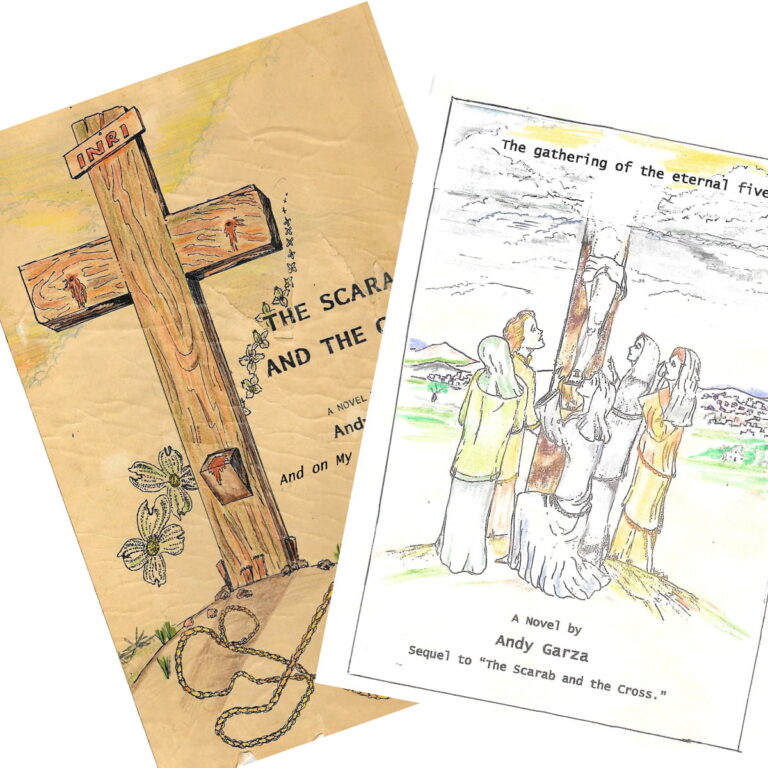
  • The Gathering of the Eternal Five: Yerushalayim

    The Gathering of the Eternal Five: Yerushalayim

    Chapter 12

    YERUSHALAYIM, The cradle of miracles

    Onofrio and Samuel would never find two better mentors than Serou and Tremiyo. Serou, grand gallant Serou even won the attention and admiration of his lovely wife of almost twenty years. Glistening eyes admired the eloquence of his speech, demeanor and gesturing habits. He was the only man she admired and loved for so many years.

    “I remember you talking about that miracle. It must have impressed you deeply to remember it in such great detail.”

    Serou simply smiled at his wife. “I came home late that night and you fussed at me.” Even Serou had a wife he must answer to as he continued.

    “The greatest miracle of all is the resurrection from his death.”

    Onofrio was urged to speak, he could not help it. He looked at Samuel as if to apologize, for he had refused to speak of his ordeal. In obvious reluctance Onofrio began to relate his story.

    “I had been to Pontius Pilate on business that morning and missed the trial. I noticed Pilate was visibly disturbed by the previous case. He was short tempered and I was quickly dismissed without ceremony when our business was concluded. He was drying his hands as if he just washed them and there was a dripping basin nearby.

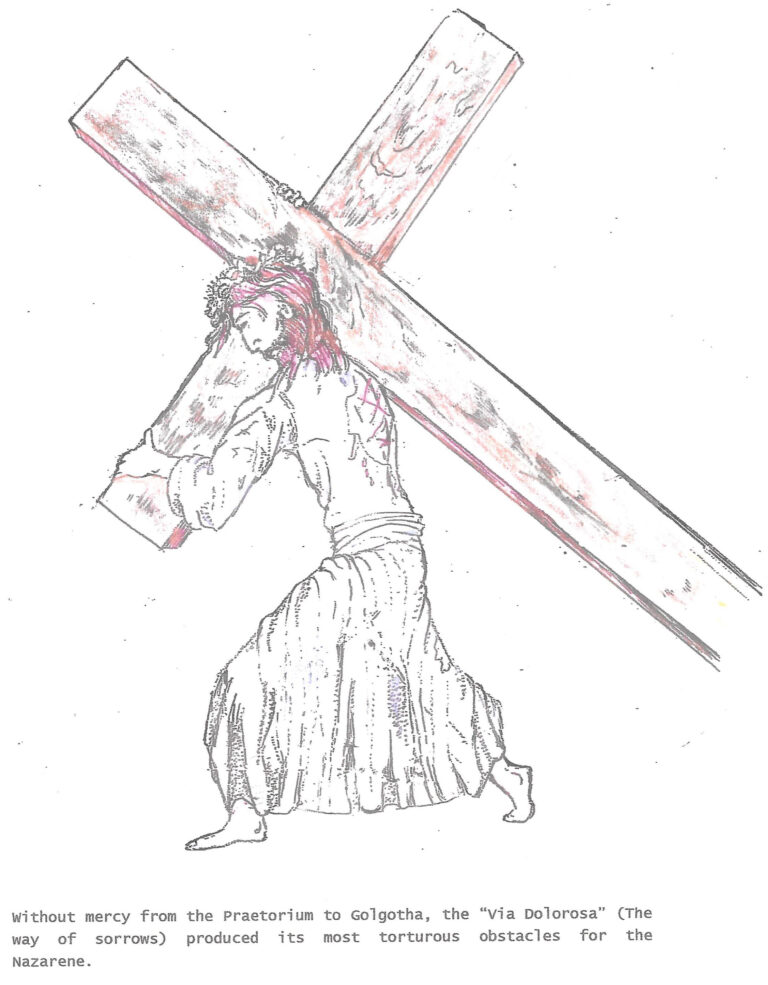
    I left the Praetorian in no particular haste as I had ample time to see about my other duties. It surprised me to almost immediately be swept into a mob of people going to see Jesus struggling with a ponderous cross on his shoulder.  I managed to see through the crowd that he had been brutally lashed. His back was a deep and ugly criss-cross pattern of bright red lacerations. Little strips of flesh hung from the injuries adding pain where the cross rubbed on the open wounds. The people were pushing, shoving, crying, yelling and some even cursing the rude mob. I tried several times to get to my chariot and horses. I had business elsewhere and no time to witness another crucifixion. Forced in the opposite direction I struggled uselessly against the mob. An old woman we helped a few days prior approached me out that mad herd of distorted faces. Her once black and blue swollen ankle was healed. The old woman was crying painfully bewailing in a highly animated state. She screamed at me and her scream became a command. “Do something. They are going to kill him. Oh, by all the gods in heaven, why him? He does not deserve this death. He is my savior. You can do something to save his life.” The old woman was consumed with uncontrolled hysteria and with borrowed strength forced me into the brainless herd. They had ceased to be human. They were beasts driven by an unknown power. Swept away from the old lady I heard her screams die out in the roar of the pack. I was captured by the mood of the multitude. Unconsciously I fought everybody for an inch forward and a single view of what was happening. When I finally had a clear view of his whip lashes, I felt his pain on my own back. I tried to reason with it, but the hurt was real. My hands were trembling out of control from the pain and agony Jesus was suffering. It was unreasonable and I knew it, but the biting stings on my back were real. My back was in utter torment from the lashes I never received. Through what seemed a foggy mind I heard two men talking alongside me, “They gave him thirty-nine lashes” One said in a tone of no concern. “It was forty-two according to someone nearby,” the second man stated. “The Raven miscounted, again.”

    “Who in the hell is the Raven? Asked the first individual.”

    “He’s the official scourger that delivers legal punishment in most cases.”

    I was too engrossed with the torment of Jesus to join their conversation. Then through my pain, the third man lent his voice to the proceedings.

    “Look! Some thoughtful individual braided a wreath of thorns with which to crown the king of the Jews.”

    “I strained my neck to get a view and suffered added shock to see the fierce thorns from the wreath piercing the skin around his head. How could I have missed it? Adding to his agony was the hideous crown of thorns. My mind rang with the question, what kind of senseless brutality is this? And what does it prove? Nothing! It proves nothing but a sheer undiluted demonstration of senseless brutality. I felt a sense of anger rising within me and realized the helplessness of my efforts. Kneaded into a perplexing and chocking sensation, I was in pain from multiple sources. Added to my torment came a yell from an upper balcony, “If you’re really the son of God why then do you not save yourself.” From another unseen voice was heard, “You ran out of miracles too soon. You need one for yourself.” “I looked to the flawless sky and remember seeing a single black vulture with wings spread wide slowly circling the rising smell of the blood of Jesus. I took it to be an evil omen and lost hope that a miracle would save the street healer from Nazareth.” He took Senobia’s hand held it close then continued, “Our jeweler friend from Mecca accosted me in a frightful state. He was grief torn beyond recognition and almost yelled at me, “Onofrio, these idiots are going to kill the son of God. There will be such wrath come down from heaven that the world will never be the same again. Make peace with all your Gods. For, the end of the world will soon be upon us all. For all of those that condemned him and equally so for those of us without the courage to prevent it.” The jeweler looked to the infinite sky as if expecting bolts of lightning to come down and burn the earth to a cinder. Maniacally he pleaded with Allah to intervene in this mad injustice and save the Nazarene. I have never seen a man so torn with emotion as our jeweler friend was that day. He promised to atone for all his sins and dedicate his life to the service of Allah if only he saved Jesus from this terrible wrong. In painful tears he told me how he had started searching for Jesus ten years prior and knew Jesus to be the rightful son of god. He praised the pureness of the Nazarene’s spirit, his mind and body. He claimed to have known what Jesus taught before finding him. The jeweler even stated that such pureness of spirit crowned the Nazarene as the sacrificial lamb. Although he wished it not be so. And our ragged jeweler friend disappeared into the frenzied mob still bewailing insanely.” Onofrio looked at Serou to confess, “What I say next will sound  childish, but it’s what I thought at the time. I seriously fought my way forward to rescue Jesus and bring him home to us. Here we have an army to protect him and you could hire a clever attorney to dismiss the false charges against him. I was convinced that a second trial would bear more favorable results. I have much faith in you and even thought at the time that you, Serou the Egyptian master of public works could even heal a scar on the ocean.”

    Serou could do nothing but bow his head, touched by such enormous praise he never expected. He took a swallow of wine and saluted his foster son with a simple “thank you,” and recorded the thought.

    “Based on that conviction, I charged myself forward. I pushed and shoved and even kicked my way to the forefront where I could reach Jesus and pull him away from his destiny. I knew we could fight for a better outcome for him. I confronted a low class Roman soldier and made an effort to pass beyond him to my objective. He stood solid at his post and I made a second effort. This time he proved that a shielded elbow was mightier than my ambition. He slammed me hard between jaw and chin and I went flying backwards to become carpet for ruthless feet all using me to push forward. I grabbed someone’s robe and pulled myself up to meet with an angry face that shoved me back to the ground. When I finally stood up, I felt a warm trickle running down my face. My clothes were a collection of street dirt and my blood. No low class Roman was going to do that to me and simply walk away. Anger boiled within me. I started grabbing people by their clothes and shoulders projecting myself through walls of living flesh that gave no leeway. With all my strength I fought the mob for an inch of progress to get nowhere. My head was reeling and I shook it to clear my swirling vision. My mouth was bleeding and I spit it out several times. From somewhere in the noisy confusion a hand grabbed me and pulled me to the relative safety of somebody’s front entrance. It was the Syrian overseer from the manufacturing plant where we worked together. He ripped my ruined turban and poured wine on the cloth then pressed it against my wound to stop the bleeding. When I made an effort to pursue my quest, the Syrian kept me from going, advising to remain safe behind the angry maniacal herd. Reluctantly I accepted the wisdom of his advice. He soon spotted a small wiry man and hoisted him up on his shoulders and urged the man to tell us what was happening up front. Painfully reeling I progressed with the Syrian and his shoulder high reporter. We shared a wineskin and I thought I felt better but, perhaps it was the excitement of hearing the progress reports.

    “Jesus has fallen. Wait! There’s a woman coming to his aid. No. She’s not helping. She is. She is his mother. Yes. That is Mary, the widow of Joseph the carpenter of Nazareth. Yes, that’s his mother. They’re talking. I’m too far away to hear what they’re saying. Mary of Magdala is there also. They are talking to Jesus. He is still fallen. But wait, he is getting up. Yes, he’s gotten up. He’s taking the cross again.”

    Just then the Syrian planted a big foot in the middle of the person in front of him and gave a mighty shove. More than a dozen people started falling in all directions taking many others down with them. He looked at me and I needed no urging to follow. We worked our way forward over fallen bodies and vile insults. Soon the wiry man started reporting again. I was helplessly galvanized to his voice. “Jesus has fallen again. A soldier grabbed a black man and forced him to carry the cross for Jesus. They just made Jesus lead the black man.

    And as they led him away, they seized one

    Simon of Cyrene, who was coming in from

    The country, and laid on him the

    Cross, to carry it behind Jesus. And there

    Followed him a great multitude of the people

    And of women who bewailed and lamented him.

    Luke 23: 26-27     NIV

    The black man has the cross over his shoulder. Another woman is coming to help Jesus. I know who that is, that is a woman named Bernice.  She is cleaning the face of the Nazarene with her head scarf or maybe a damp rag. I can’t tell for sure. She sneaked behind the soldiers to help Jesus. She’s wiped his face now. It looks a little cleaner of dirt and blood. Awh Awh. A soldier just caught her and shoved her back into the crowd. Poor Bernice, she a good woman and she’s not hurt. Jesus is up and limping. He is weak. He has lost a lot of blood and he looks drained. He is reeling. He will never make it to the top of skull hill. That hill is also known as Golgotha in Hebrew, you know. Loose stones make it very treacherous for an able bodied man, let alone for Jesus who is apparently very weak. The black man has stopped. He’s waiting for Jesus to recover and lead.”

    When a group of soldiers came by I urged the Syrian to fall in behind them. The wiry little man never stopped reporting, “Some women have come to his side. They are talking to him and trying to give him some help and perhaps, courage. The women look Jewish. But, I’m not sure. Mary of Magdala is there. Whoa, a soldier just tried to push her away and she stood up to him and refused to move. That takes a lot of courage. Romans are trained to hurt people, you know. This man, Jesus has every woman in Jerusalem crying for him. If I had that many women aching for me, they would not ache for long. Jesus is leaving the women now. He’s shaky. He’s fallen again. This is his third fall. He could never carry that cross up the hill without the black man.“ From an upper balcony I heard a woman yelling out, “Hang the blasphemer. Who needs more Gods? Sons of Gods or sons of bitches, they all end up here.” The crude sign over the scarlet door read “Food, wine and women” in Greek. The wiry little man tapped my shoulder with his toe and pointed to a muscular unshaven man standing at ease by the scarlet door with a goblet in hand. In a near whisper he announced, “That’s Barabbas. Apparently he came to see his cross being used by somebody else.” The Syrian spotted the man and confirmed the report. “Yah! That’s him. He’s got a right to celebrate. But he don’t got the right to show it off.

    I saw an elderly man richly dressed like a statesman and his family  behind an iron fence, each one in solemn prayer. They were in obvious trauma over the mad parade passing before their eyes. I could not read the plaque over his door but symbols indicated he was a Roman official. They were all safely away from the tangled menagerie of near human beasts. I heard the cry to spare Jesus his ordeal but it was only a whisper in a raging storm. Momentarily, I leaned on the elderly man’s fence and through the rails he reached to lay his hand on my shoulder. His swollen but kind and gentle face was washed in silver tears running down his beard. In a tormented voice the old man stated, “It’s a terrible day in Judea. But it’s a fine day in heaven. The son of God is coming home.” Mysteriously mechanized I fell in behind a separate set of soldiers along with the Syrian and our happy reporter. He was up high, with a clear view ahead, a free ride and wine.

    I looked back just in time to see the elderly gentlemen cleave the sign of the cross in mid-air like a blessing or a farewell.

    The crowd was dwindling as we were well out of the city walls now. I was no longer plotting to rescue Jesus but drawn to the finish of this maniacal drama without a will of my own.

    “We’re going up the hill to Calvary,” the wiry man reported. “Some call it Golgotha. Oh, I told you that already.”

    At the summit, the black man was ordered to drop the cross from his shoulder. Relieved the black man eased the cross off his shoulder to land with a resounding wallop atop Golgotha. The Syrian put the small wiry man down and frantically started pointing at the cross. “Look, Onofrio. Look! That’s the cross you built. They’re gonna crucify Jesus of Nazareth on the cross you made. Look at the bottom of it. It’s got your burned “O” on the upright beam.

    It took me moments to break down what he said and understand his excitement. When the Syrian’s yammering finally came clear and I understood what he said. My eyes focused on the bottom of the cross and I was horrified to see my burned “O” on the bottom of the upright beam. Sheer terror swept through me in a flash. I shook violently and could not stop. I looked again and there was no mistaking my burned circle shone brightly in the noon day sun. Memories of that day flashed through my mind. I even remembered an insistent little four petal flower that made such a valiant effort to survive. I scanned the rough hewn beam carefully and was sure I spotted the exact location where that insistent little blossom existed. I could not be wrong. It was my cross. When I made a move forward to confirm it, I was stopped again. I could not take my eyes away from the fearsome instrument of death. I saw Jesus speaking painfully to the black man. The bearer of his cross was crying profusely. Streams of silver tears ran down his black, shiny face, now a contorted map of pain. The Syrian tapped my shoulder to cheerfully claim, “One thing for sure, this fellow Jesus got the best we had to offer. Some people have all the luck. My two crosses got used by a pair of common thieves. Your cross was used for the son of God. Some people are just born lucky.” I was disturbed by the Syrian’s cryptic statement but was forced to the unfolding scene. I could not discharge the thought that Jesus would die today on a cross I built.

    Slowly the crowd began to disperse all around us. Small hazy clouds were forming in the distant horizon. People were receding down Golgotha since a storm brewing in the far away hills was creeping our way. People had seen crucifixions before and some had lost interest. Crucifixions were a common occurrence to most sightseers. The name “Jesus” was simply one more name soon to be forgotten, like so many others. The festering storm in the distance was slowing advancing forward. No sensible reason to get soaked over some criminals getting their just reward. Disgruntled, disappointed or just bored, thrill seekers found reason to leave the scene. The oncoming tempest slowly dimmed the day like an evening out of time. Brave hearts surrendered to suspenseful apprehension by the eerie silence of the birds and whispering voices riding on the wind.

    Two men, both thieves were already secured to their penitent crosses. Jesus stood facing Calvary, examining the cross at his feet. I was unable to move. I was galvanized to the man named Jesus of Nazareth. I was unflinching and immobile before the horrifying spectacle of death so nearby. I could not grasp a single reason why this man should be here to suffer the agony ahead. A trooper came forward and ripped off the clothes draped on Jesus’ shoulders, leaving him naked to the world with only a cloth to cover his genitals. I froze in horror when someone produced a handful of sharp spikes with  a large hammer then tossed them to the ground near the cross. I wanted to lunge forward and stop this raging lunacy but I was immobilized not able to move. Frozen in place staring at the unbelievable proceedings. I felt paralyzed and only my mind and eyes seemed to work. I saw the lacerations on his back still bleeding in tiny trickles. Unceremoniously Jesus was positioned on the cross without a trace of concern.  Not a sign of pity showed in the cold eyes of the trooper well accustomed to the sight of someone else’s blood. Jesus saw the spikes. His face projected a portrait of resignation. A soldier stretched an arm on the patibulum (crossbar) and with only two quick blows drove the spike through the wrist very close to the palm of Jesus’ hand. A task performed with the efficiency of experience. In rapid motion he stepped over Jesus and repeated his performance on his other arm. With the help of added troopers they positioned a foot atop another on the wooden block. The trooper looked carefully at his work. Notably calculating the trajectory of his hammer and with two skillfully delivered blows drove the spike through both feet. I heard the ringing sound of steel hammer striking steel spike and pass through living flesh. My breath failed me and I was unable to scream.

    A deathly grip choked me as I literally felt the pain Jesus was suffering. I was crying profusely and found myself completely alone. The Syrian and the small wiry man were gone and I never saw them leave. Thunder was booming and clattering closer in the dimming horizon. I saw Jesus being abnormally quiet. He had not let out a whimper or a scream. He suffered his agony in silence. Not giving his enemies reason to gloat. Such strength could only be God-sent as he intently looked unto heaven armed only with his full hearted devotion.

    Down in the heart of the outrageous mob was the mother of Jesus. She and her companions were shoved and pushed aside as they struggled to be close to Jesus. It took their breath away to see him spiked to hardwood timbers. There to suffer painfully until the last breath is forced slowly from his body by his own weight. The rude crowd all too engrossed on achieving the best view showed no concern or mercy for His grieving mother. Finally a strong armed man shoved people aside to allow Mary and her companions safe passage to the front. Having been forced aside an angry voice asked, “Who the hell are those women and what are they doing in this madness?” “Shut up, idiot. That’s the mother of the one on the center cross,”came the stern reply.

    Imagine then the agonizing torment of Mary struggling painfully through that unruly mob to witness her son’s death. Grief beyond measure dwelled in her heart. The child she carried in her womb was now the subject of scorn and obnoxious ridicule. She was subject to obey the law and the law forbade her to help her child. At the summit she waited with painfully beating heart for the end to come and prayed in earnest for the moment not to arrive. But Mary had been recipient and first hand witness to many miracles her son delivered. Can we not speculate that on this fateful day she would pray deeply for Godly intervention and save her son? Of course, we can. Imagine then, the super human strength of his little woman to forge ahead half in prayer and half in acceptance of his pre-ordained fate. Through this terrible ordeal she suffered a thousand deaths and held together by a power she herself did not know. Let alone understand.  In humble solace she had long ago accepted this cruel and unwelcome destiny. Not until the third torturous day would she know peace. When news would come that her son rose from the dead and was seen ascending to heaven. But, that as three long painful days away.


    When Jesus saw his mother,

    and the disciple whom he loved

    standing near, he said to his mother,

    “woman behold your son!” Then he said

    to the disciple, “Behold your mother!”

    And from that hour the disciple took

    Her to his own home.

    John 19: 26-27     NIV


    Workmen materialized and with considerable effort lifted the cross and edged it to the mouth of the pre-dug pit. With a resounding wallop the cross landed at the bottom of the hole. A loud thud echoed from the bowels of Golgotha joined by a resounding clap of approaching thunder. The living body of Jesus shook from the torment. Blood flowed freely from his hands and feet and still not a moan was heard from him. The crown of thorns dug deeper into his flesh with the slightest move. He hung limp on the rude timber, breathing with painful effort. Some stout hearted sightseers still lingered along with a company of soldiers. The work crew used stones, dirt and wooden wedges to position the cross perfectly upright. A rude plaque was secured before the cross went in the hole. It read “INRI” in three languages, meaning “Jesus, of Nazareth king of the Jews.” Jeers, shouts and foul insults all fell from his ear without meaning. Instead he made an effort to give comfort to the pair of thieves on the adjoining crosses. He told them that before this day passed, they would join him in heaven. After an unmeasured length of time, he looked to heaven and clearly stated, “Forgive them father, For they know not what they do.” The words rang in my ear and they seemed senseless considering the reality of the moment. The crown of thorns shifted when the cross landed at the bottom of the pit. New trickles of blood eased their way down his face and chest. The sight seemed to add joy to the callous troopers as they doubled their foul cheers and insults. “Hail, King of the Jews” rang unanimously through their ranks and stout hearted sightseers. “If you be the son of God, your father has forsaken you,” jeered a young soldier. I looked to the sun as my usual time keeper. It was shortly past noon. I noticed a grayish veil began to fill the sky stretching from horizon to horizon. Not like the coming of sunset but like an encircling gloom, coming from all directions. Hardly noticeable at first, but the bright day was slowly dimming like an evening before its time. Again I heard the distinct silence of the birds and whispers in the twirling wind. Could they be conversations between the Gods? My face was stung by the sand blown up in the coming storm. The caustic merriment of moments ago transferred to apprehensive awe and disquieted whispers. Still I could not remove myself from this man now nailed to the center cross. For a brief moment I imagined smelling sulfur, perhaps from the mines in the distant hills. More obvious was the smell of fear coming from the remaining soldiers. I saw tempered warriors gazing at each other in shaded trepidation, while others seemed to grow pale. And the light of day continued to fade into the gloomy veil of an unexpected evening. Two thieves and a Jewish rabble rouser were secure on their crosses. A weird storm was closing in. Their orders had been carried out and some soldiers began to withdraw from the stony hill. A voice perhaps inspired by Jewish dictate called out, “He that cannot save himself, would destroy the temple and rebuild it in three days, ha, ha, ha.” His voice was followed by mocking laughter. It gave leave for others to launch their insults like stones at the impaled Nazarene. Suffering tremendously and totally helpless he endured their foul mockery. I stood helplessly gazing at the devotion and strength of this slender man. A man of greater physical strength would have long ago cried out in shameless pain. Yet, Jesus with absolute resolve languished on my cross. Bearing Jeer, insult and agony with equal silence. Another unseen voice urged the Nazarene to come down to them and prove he was truly the son of God. I calculated he had been on the cross no less than two hours. I heard him cry for water and someone came with a sponge at the end of a long stick. The individual poured sour wine on the sponge and raised the stick to the face and mouth of Jesus.

    Jesus knowing that all was now finished,

    Said (to fulfill the scripture),”I thirst.”

    A bowl of vinegar stood there; so they put

    a sponge full of vinegar on hyssop and

    held it to his mouth.

    John 19: 28-29    NKJV

    Still not a single word of anger or retaliation came from Jesus.

    When Jesus had received the vinegar,

    He said, “It is finished”; and he bowed

    His head and gave up his spirit.

    John 19: 30

    NKJV


    It was while I stood gazing at the unfathomed devotion of this man that I realized my memory had returned. I saw images of my childhood happiness as clear as if they happened this morning. Years of mystery dissolved into absolute clarity. As graphic as the reality of this man that hung painfully by his bleeding hands, feet and head on a cross I built for pay. This man of healing miracles, a teacher of God’s laws was as innocent of criminal activity as a new born lamb. This was a man devoted to the path of righteousness. A man of such spiritual strength as no ordinary person could ever hope to match. Only the most wanton, depraved and ignorant person could not see that.

    It came to be the third hour of his ordeal when he surrendered his spirit. Although many people lingered nearby obsessed by what they saw. Others came to see and weep anew. Some misaligned individuals simply came to enjoy the view. A separate group in black hooded robes was solemnly on their knees, praying in earnest before the son of God. I remained honed into the pain and agony this man suffered. An innocent man condemned to this torturous death by the masters of plot, ploy and scheme.

    There was darkness over the whole land until the ninth

    Hour, while the sun’s light failed; and the curtain of

    The temple was torn in two. Then Jesus, crying in a loud

    Voice said, “father, into thy hands I commit my

    spirit!” And having said this he breathed his last.

    Luke 23: 44-46  ESV


    CRUCIFIXION TO THE WORLD BY

    THE CROSS OF CHRIST.

    When I survey the wondrous Cross

    Where the young prince of Glory died,

    My richest gain I count but loss,

    And pour contempt on all my pride.

    Forbid it. Lord, that I should boast

    Save in the death of Christ, my Lord;

    All the vain things that charm me most,

    I sacrifice them to his blood.

    See from his head, his hands, his feet,

    Sorrow and love flow mingled down;

    Did e’er such love and sorrow meet?

    Or thorns compose so rich a crown?

    His dying crimson like a robe

    Spreads o’er his body on the tree,

    Then am I dead to all the globe,

    And all the globe is dead to me.

    Were the whole realm of nature be mine,

    That were a present far too small;

    Love so amazing, so devine,

    Demands my soul, my life, my all.


    ISAAC WATTS, 1674-1748


    When the soldiers had crucified Jesus they took his garments and made four parts, one for each soldier; also his tunic. But the tunic was without seam, woven from top to bottom; so they said to one another, let us not tear it, but cast lots for it to see to whose it shall be.”

    John 19: 23-24   ESV

    And when evening had come, since it was the day of preparation, that is, the day before the Sabbath, Joseph of Arimathea, a respectable member of the council, who was himself looking for the kingdom of God, took courage and went to Pilate, and asked for the body of Jesus.

    Mark 15: 42-43  NWT

    And Joseph took the body and wrapped it in a clean linen shroud and laid it in his own tomb, which he had hewn in the rock; and he rolled a great stone to the door of the tomb, and departed. Mary Magdalene and the other Mary were there, sitting opposite the sepulcher.

    Matthew 27: 59-61    NIV


    As if performing nothing more than a menial task, a soldier drove a spear into the ribcage of the lifeless body of the Nazarene. It proved Jesus was truly dead. Blood eased out of the wound followed by a surprising amount of water. Joseph of Arimathea along with a collection of stout men came to the scene. Joseph showed the Roman guardsman a document signed by Pilate granting him permission to dislodge the corpse and carry it off to a proper burial place. With great effort the cross was carefully dislodged from the pit by strong arms paid to do the work. Gently the cross was brought to the ground atop Golgotha. Joseph insisted with strong demand that no added harm be done to the lifeless body. With the help of an added timber and a metal tool the spikes were carefully extracted and the corpse then smoothly transferred to a makeshift liter. The tempest was drawing ever closer. Black roiling clouds advanced without hesitation. It was raining in the hills nearby. I saw Mary in the company of her other sons and some women. Our eyes met but neither one of us knew each other, so Mary only nodded gently in acceptance of my obvious grief. I bowed my head to her acknowledging her sorrow. My mind raced to the fact that she, the mother of Jesus was another victim of the cross I built. Her unfathomed anguish and pain clearly visible on her face and limp movements. My sense of guilt amplified tenfold at the sight of her despair. The grief and pain of her ordeal became my own. In that fleeting moment and in painful bond Mary and I became as one in shared agony. The cross broadcast pain in wholesale fashion and I was the architect of grief.

    Jesus died in thirst and excruciating pain. I experienced physical agony and intense torment such as I have never known. Then without warning an enormous sense of guilt filled me. I was responsible for building the instrument of his death. The Nazarene never did anything to harm me and it was my work that ended his life. I was instrumental in his murder. False accusations condemned him to the cross but I was the executioner. I tried to reason with my guilt and could not free myself of the enormous self reproach that gripped me. I then saw soldiers tossing a leather dice cup for the robe of Jesus. It was a hand-woven seamless garment, colored with walnut stain. I could not fathom how men could be so callous. Jesus was barely dead and these men already contested for the spoils. It was a way of life for these men and I realized that once upon a foggy dream, I had seriously considered becoming one of them.

    Suddenly the earth heaved in fierce convulsion, forcing the world to shudder in unmeasured violence. Tongues of angry fire raced across the purple sky in repeated shows of Godly force. Horrendous thunder clapped and roared with savage fury. Each crashing boom louder that the last and close enough to strike fear in the bravest heart. I knew it was mid-afternoon, yet this storm discharged the sun of day into the blackest void. As if the Gods willed this day to cease as my friend, the ragged jeweler had earlier predicted. There was ample reason to believe the Gods were furious because one of their own had been murdered. And I was among those that helped commit that felony. Brave men ran like frightened children seeking shelter. The mob dispersed as fast as scared legs could carry them. Only a few of the more seasoned warriors stood their post. They were captured by the awesome display of godly fury upon the land and sky. I somehow felt that fury directed at me. A soldier standing close by visibly scared and deathly pale looked at Jesus had said, “This man was truly the son of God.”  I fell to my knees expecting the next bolt of lightning to strike me dead as I felt I justly deserved. I had seriously offended the Gods and my penalty was death. Rain fell from the darkened skies in furious gushers. The hill became awash with mad, dashing streams hauling debris, twigs and small stones down the incline. I found it difficult to make my way down the rocky knoll. Lightning struck close by and a small bush ignited in hellish white and blue fire. Only to be quickly extinguished by the heavy downpour. I knew the angry Gods were aiming their vengeful bolts at me and I did not expect to survive the noon day night. From a distant corner in my mind I remembered the words of my father, Horacio Vega de Iberia. “When a man has done wrong, he should be man enough to accept the result of his actions.” My actions were undeniable and my guilt unquestioned. In that light, I resolved to meet my doom when it arrived. I labored for every step down Golgotha. I could not stop trembling violently. I surmised that it was partly in fear and partly in knowing my death was on the way. I imagined a bolt of lightning coming at me and then I saw total darkness. I would be condemned to utter silence and total darkness for eternity. God would not glorify my part in his son’s murder. Emblazoned in my mind was the suffering of Jesus in precise detail. Into myself I asked Jesus to forgive me and gave him logical reason to deny my request. The tempest raged upon me and all around me as far as I could see. I wanted to run but then, to where does one run from an angry God?  Another bolt of lightning struck a water puddle ahead of my next step. Gaseous blue flame raced across the drenched earth as if looking for a victim to strike dead. It was intended for me. I resolved to walk upright and meet my destiny as a man deserving what the Gods dole out. Finally the incline gave way to level ground and I could not hasten my pace. I was drenched to the skin and my clothes were heavy with water. I collected the dragging hems to lessen the burden on my stride. I walked upright although I knew it was with false courage. My very soul was shaking painfully.  I feared to take the next step, thinking it may be my last. There could be no shame in being struck dead by Godly fury. Even the Gods have a right to justice. Hiding my face behind my hands would do no good. The father of Jesus knew who I was and picked me out from the lessening crowd to deliver punishment on me. I knew that if someone murdered a child of my own, I would seek that individual out and destroy him. A life for a life is rightful justice.”

    Onofrio stood up and took Senobia in his arm while he caressed her face with his free hand. Eyes the color of the Mediterranean looked back into his in wonder as he softly spoke to her before the gathered families. “Like a soothing breeze that comes when a storm is over, you eased into my troubled mind. If God struck me dead as I struggled away from the murder scene, you would in due course marry someone else. To add injury to my penalty, I would see you in the arms of another man from wherever dead people go. I truly felt pain invade my heart at that realization. Yet, I knew somehow that God, your God would have mercy on my soul and not deny me this very moment with you in my arms. I could not fully believe that, but it was vibrating hope that kept me walking away from the murder at Golgotha. It was the image of you, my love. The image of you and I in this embrace that kept me walking away from that hill and not expecting to make it home to you. I trembled in fear and could not stop. Only the image of you kept me going.” He kissed her forehead and simply held her gently within his arms. And she felt him crying and clearly heard him say in her ear,” Thank you God. Thank you.” She wiped his tears with her sleeve and went to refresh his wine. Never had he said “I love you”, with so much proof in hand.

    [Previous Episode] [Next Episode]
  • Addendum self deception

    The term self deception is sometimes used in a very loose way. It is easy to put ‘self’ in front of ‘deception’ when the self has been passive in accepting a falsehood. When someone believes something false, and we consider that false belief unreasonable we may say, but say wrongly, that the person is self deceived, when we mean only that we believe what is false and could believe what is true instead. He is simply deceived. That deception may be the result of someone deliberately telling him a falsehood, or it may be the result of not his not having looked into the evidence adequately. In any case he is simply deceived. But he has not, even if it is possible, deliberately deceived himself.

    If we are going to speak carefully we will distinguish believing something false, from self deception even if self deception entails believing something false. Something more has to be said.

    So we shall distinguish two kinds of false believing: (1) believing falsehood, not knowing it is false. (2) believing falsehood, knowing it is false. Let’s take these in turn.

    (1) is a common enough occurrence. There are enough agents who will benefit from our believing falsehoods, or not believing a truth: salesmen, politicians, come immediately to mind. There are other motivations than gaining profit or power for an agent to tell you and hope you will believe a lie. Why do parents tell children lies about Father Christmas, the Easter bunny, etc.? Motivations differ but the different instances have something in common. I am led to believe a falsehood because of the initiative of another person, or of a community,.

    When I am unaware that the falsehood I believe is false, I may be content with it. On the one hand I may not have an awareness that there are alternatives. What chance does a young child stand when the adult world conspires to have it believe the fabrications about Santa Claus? In due course the once deceived person may learn that what he has believed is false and then will abandon the belief. He may or he may not find an alternative that is reasonable and true. The rational thing to do at any rate is to abandon the belief I know to be false.

    (2) The second case is that I may know that what I believe is false and still retain the false belief. This differs from (1) in my being aware of the status of my belief. I know it its false, and so irrational to believe it. I believe it nevertheless. So some response, activity, failure to arc on the part of the self is required for self deception to occur. The self is here involved as it is not in the case of being deceived by a third party. Since such self deception is irrational we can ask whether it is really possible. If we answer that it is, we must then conclude that human existence is often irrational, that there is an endemic irrationality to our human condition, and that (as Paul has said) would be wretched indeed.

    by Dr. Edward W.H. Vick, retired professor and author of Death, Immortality and Resurrection, From Inspiration to Understanding: Reading the Bible Seriously and Faithfully, Philosophy for Believers, Creation: The Christian Doctrine, History and Christian Faith and more!

    [slideshow_deploy id=’2645′]

  • The Gathering of the Eternal Five: Golgotha, Revisited

    The Gathering of the Eternal Five: Golgotha, Revisited

    The Messiah

    had been to earth on his mission. Men chose to ignore the signs and tormented, mutilated and crucified their own savior. They cast aside that the name Jesus in their own language meant “save” and he that saves is therefore a savior. They chose to forget that the angel Gabriel commanded his mother, the Virgin Mary to name her son “Jesus.”


    Chapter 11


    Then he led them out as far as Bethany,

    and lifting up his hands he blessed

    them. While he blessed them, he parted

    from them and was carried up into

    heaven. And they returned to Jerusalem

    with great joy.

    Luke 24: 50-52 (New Revised Version)


    When Samuel came home to the house of his father, he was greeted with great joy. Even Senobia’s children were all anxious to spend time with their uncle Samuel. Neither Samuel nor his father could get enough of stealing looks at each other. They exchanged many stories of joy and sorrow while Senobia and Onofrio simply watched the display of love reunited. His most recent exploit with the wife of Pontius Pilate and Mary of Magdala governed his conversation. Extracting a solemn promise to keep what he said about the two ladies within the family. Furthermore he admonished his sister Senobia, for keeping an unfounded opinion of Mary of Magdala in her mind. He supplicated Senobia to cleanse her mind and heart of rumors she did not know as fact. Only once did Senobia rebuke her brother’s appeal with a stinging barb.

    “As a man you would be one to enjoy her demeanor and shows of open flesh. I am not surprised that you would defend her so.”

    Brother and sister have quarreled since the dawn of time. Today would not be one of those days. Samuel with easy calm quietly asked,

    “Have you ever been in the presence of Mary of Magdala?”

    “Of course not,” why do you even ask?” She pouted in near anger.

    “I have. And I saw a dedication rare among people. A dedication to He that cleansed her soul of human faults. She said it herself when she said that her savior, Jesus had shown her the way to walk on rainbows.

    Remember this; she will pay for her brother’s resurrection with devotion to Jesus of Nazareth for the rest of her life. Also learn from this, the first casualty of truth is always gossip. Don’t fall victim to those that embellish stories for gain of their own.”

    With due respect Samuel asked Tremiyo if he could proceed and was granted approval with a degree of admiration.

    “Baby sister, I love you so. It delights me to see you so happy. But you are suffering from one of the sins that Mary of Magdala is accused of. I believe you are suffering from a case of groundless jealousy. Fear not baby sister. Your husband would never seek Mary of Magdala out for sinful pleasure. You may rest assured of that. That leaves you with a blemish on your soul. Pray to your Jesus that he forgive you or condemn your soul to hell for raising falsehoods against one that has done you no harm. You betray father’s teachings by harboring such thoughts.” Tremiyo sat in awe at his son’s hard gained maturity.

    Tremiyo literally roasted the fatted calf for his son’s weeklong visit. The invitation went out to all four corners of Judea, “come feast with the son of Tremiyo, Stewart of the house of Serou”. Unexpected Serou, the lady Clavenia (his wife) and their two daughters Banafrit and Irisi now near teen agers attended the day long festival. An event carefully planned by he that had planned so many others. Barrels of wine, tubs of vegetables, stacks of condiments and wagon loads of bread made for an awesome feast for so many guests. There were tables stacked with tid-bits to eat of unimaginable variety. And nobody was shy to try them all. Senobia and Onofrio dressed in all white. They were specially groomed and transmitted a near regal appearance. Onofrio’s once tinge of premature gray had progressed and he was now crowned with a collage of gray and dark brownish copper hair, adding dignity to his character. He remained clean shaven and although tempted refused to grow a beard. Senobia held her chin high filled with pride at the side of her husband always clinging to his forearm. She never let a moment pass without showing her love for him. In spite of delivering three children her figure had expanded very little and granted her a more appealing figure. The children behaved well, except Horacio who preferred to be close To Banafrit and Irisi.

    Since their relationship had developed into a closer bond, Serou came to Onofrio and borrowed a bit of his foster son’s humor. “I’m here to tell you to keep your son away from my daughters, as I fear the wolf has come to call.” Serou had reason to experience premature concern as Horacio was keenly interested in the younger sister, Irisi. They were close to the same age and appeared to prefer each other’s company. Both men enjoyed a laugh watching their pre-teen children and lodged their thoughts for a later time.

    Samuel spent the best part of the afternoon greeting guests and shaking hands. Conversations bloomed in all directions on multiple subjects by different languages. While the story of the father and son’s reunion was repeated many times. Two sets of musicians entertained the crowd, while jugglers and acrobats added zest to the festivity. When the sun started painting the western sky with Nature’s majestic artistry the crowd began to wane. As the purple veil of early evening settled upon them the last few guests paid their respects and departed. Young Samuel would never be a stranger in Judea. His father had seen to that.

    Appointed personnel were assigned to clean up and set all things right after such a celebration. Under candle light and pest repelling torches members of two families sat to enjoy the evening and mull over passing events. A delightful sense of ease blessed the guests as bits of conversation floated free among them. Clavenia, Serou’s wife spoke directly to her foster son, “Onofrio, not long ago we spoke of Judea being the cradle of miracles. I would like to know which the greatest miracles of Jesus were.”

    Serou’s attention went on call. He was surrounded by the ladies in his life. The two girls leaned their heads against their father in sleepy nods seemingly happy to be there. In noted admiration Clavenia turned her attention to her husband, knowing he was always well informed. Patiently she waited as he gathered his thoughts. An easy task for the master of public works.

    “Two or perhaps even three of the miracles he performed deserve volumes of historical attention. Let there be no doubt that all his cures and miracles deserve being noted. I am addressing his greatest Godly acts. I was in transit along the shores of the Sea of Galilee when I was literally mobbed by an immense crowd. I had grown accustomed to running into mobs anxious to hear Him speak. I even knew the scribes by name that hounded him for the latest word to drop from his lips. The landscape was infested in all directions with people. Mothers, fathers and their children all drawn to the same location. It was late afternoon, close to evening when I discovered the cause of such attention. I stopped a man and woman in possession of fish and barley bread, each with a respectable portion. I found it difficult to accept their gladdened revelation. Jesus and his disciples were passing out fish and loaves of barley bread to all that came to them. Jesus instructed his disciples to have those that were served to sit on the grass. Seated indicated they were fed. I lost count of the people I saw. I stopped my chariot and surveyed the area in all directions. People looked like ants whose nest has been disturbed. All coming to attend the feast of Jesus. My estimated guess arrived at upwards of three thousand people. I had no choice but to stop with so many people blocking my way and gauge for myself the end result of such abundance. Barley loaves and fish came from an endless source. There was no stopping the eternal flow. I was sorely tempted to avail myself of such abundance but my pride kept me from it. It amazed me that I actually felt a calling to come to his presence and receive what he had to give. I later remembered that bread is considered the staff of life and fish is the symbol of his mission. He was in effect inviting the endless mob to dwell in his words. I shamed a man that came to his donkey and filled a bag on the animals back with what he received. After he made the second trip, I stopped him to say, “What you do is stealing. Plain and simple theft.” Without shame he quickly answered, “You’re the rich Egyptian Master of public works. You don’t Know what it’s like to be hungry. I’ve got a family to feed,” and never stopped his endeavor. Not everybody ate bread on the spot. I saw many carrying away the benefit of their efforts. I even suspected in silence that some would sell what they gathered in the city. As the crowd subsided; I reined my animals close to the source of such generosity. I saw this man named Jesus and four others passing out the vestiges from their boundless cornucopia. They were five tired men with just enough left to feed themselves. But they had miraculously fed a crowd of uncounted people. My guess was only an estimate. I’m sure many people escaped my count. Nowhere in my knowledge of godly deeds have I known of such unrequited bounty. I had no cause to investigate how this was done. I simply added this to the list of his accomplishments. I recognized the men with Jesus but I am not sure of all their names. One was a fellow named Matthew, another was named Luke. I recognized a third individual as Mark and the last, I think was John. I had seen these men before but since they did not affect my concern, I always discharged their identity. They were among the followers of the Nazarene and so be it.”

    Lifting up his eyes, then, and seeing that a

    multitude was coming to him, Jesus said to

    Phillip, “How are we to buy bread so that these            

    People may eat?” This he said to test him, for

    He himself knew what he would do. Andrew, Simon

    Peter’s brother, said to him, “There is a lad

    here who has five barley loaves and two fish;

    But what are they among so many?”

    John 6: 5-9 (NIV)


    [Previous Episode] [Next Episode]

  • Balance

    If the history of Christianity teaches us anything, with all the divisions, doctrinal disputes, conflicts and even a few wars, it is that a correct understanding of God’s Word is not easily achieved. Of course, one could just take the position, as some Christians do, that it really is easy for them to read and understand God’s word, and as for those who do not accept their interpretation, well, they are just letting the things of the world cloud their understanding.
    One problem is that while it is easy to see how others are letting things interfere with their understanding God’s word, it is usually correspondingly difficult to see how such things are getting in our way. This is why I believe that humility, dialogue, and a tolerance for those who disagree, working in a framework that stresses unity rather than division, are so important.
    There is another problem as well. Even when there is an agreement on a biblical teaching there can still be disagreement on how this applies to real life situations. Thus, while I think I can confidently say that all of the authors posting on this board believe that based on God’s word, we have an obligation to the poor, there is considerable disagreement on the exact nature of this obligation and how it should be worked out.
    Probably the most difficult problem is the question of balance. While many of the statements of Scripture are pretty clear, how they all fit together often is not. This is probably to be expected when dealing with nature of God. We do not really know how the statements that the Father, the Son, and the Holy Spirit are God fit together with the statements that there is only one God. But this problem goes beyond God’s nature. We do not really know how the statements that salvation is a choice we should accept fit in with the statements of God’s predestination of the elect.
    As a result, as we seek to merge all these biblical statements into a unified whole, if we are not extremely careful, and historically it is clear the Church has not been careful, we create divisions in the body of Christ. For example, as some gave more weight to the verses that speak of our choice, others gave more weight to the verses that speak of our election. To disagree on this is one thing. To divide on it is another.
    This is further exacerbated by our ability to reason, or perhaps rationalize. We reason what a biblical concept must mean, Sovereignty, Love, Grace, Righteousness, etc., and then interpret seemingly contrary passages to fit the our reasoning.
    When you look at what are considered heretical views of the nature of God, they all try to rationalize God’s nature into something we can understand. Passages that teach contrary to the rationalization are then effectively ignored.
    Again, while it is easy to see this process at work in the views of others, we all do this to some extent and in some places. God is a god of mercy. God is a god of justice. Those teachings are easy, but how we combined them is tough and thus we will tend to err to one side or the other, and examples of both errors are to be found in church history.
    This is one place where discussion towards unity becomes so important. I have heard that when trying to guess the number of jelly beans in a jar, the best way is to have a large number of people guess and then take the average of their guesses. As we wrestle with these issues as a community, we will as a community reach better answers than we could individually.
    Of course, one problem with this approach is when there are influences that effect everyone and the biggest of these is culture. How can these be counteracted? First, you must realize they are there. It is much easier to tell if you are being swept along by a current if you are on a river, than in the middle ocean. This is because the river bank is a fix point of reference.
    The Bible is, or can be, such a fixed point of reference. If your understanding of the Bible is being updated to keep up with cultural changes, that should at least set off alarm bells. We are in this world, but our citizenship is not of this world. This is a world of sin that Jesus came to redeem, not imitate.
    But again, it is always easier to pick out the flaws in others which is why, contrary to my normal pattern, I am not giving much in the way of examples. One hopefully safe example, is that it is much easier for us to see how our brothers and sisters, who lived during the Middle Ages, got some things wrong than it would be for us to see this in our brothers and sisters today, particularly those brothers and sisters who tend to agree with us. The sobering thing to realize is that our brothers and sisters from the Middle Ages would probably be equally adept at seeing how we are getting some things wrong.
    Still, overall, I think the Church has learned from at least some of its mistakes and there has been some improvement over the last 2000 years. But I do not think the progression has been uniform or constant. As we have improved in one area, it has often come at the expense of others. Nor is this to be a surprise. To “get it right” we would essentially have to be God. Thus, I believe our efforts to balance out the seemingly conflicting aspects of God’s nature, to come to a better understanding of God’s will, and thereby God, will be a process that will last at least until Christ returns, and probably into eternity.
    Elgin Hushbeck, Jr., Engineer, teacher, Christian apologist, and author of Preserving DemocracyWhat is Wrong with Social Justice?, A Short Critique of Climate ChangeChristianity and Secularism, and Evidence for the Bible.
     
    [slideshow_deploy id=’2411′]

Energion Direct
Privacy Overview

This website uses cookies so that we can provide you with the best user experience possible. Cookie information is stored in your browser and performs functions such as recognising you when you return to our website and helping our team to understand which sections of the website you find most interesting and useful.