by Chris Eyres, an Energion Publications editor and former English solicitor.
I’ve just listened to an interview with Walter Brueggemann on the topic of money, and as a result have his book on the subject on my wish list. I wrote a fair amount about property a little while ago (this is a link to the earlier post in that series), and it is very good to hear Brueggemann endorsing my view that possessions and money are not to be regarded, if you wish to follow the Biblical witness, as being “yours”; I like the concept of “holding on trust” which he talks of.
Of course, I anticipate the argument that we can’t actually run a society based on these Biblical principles. G.K. Chesterton wrote “The Christian ideal has not been tried and found wanting. It has been found difficult; and left untried”, and I am very tempted to agree. As I’ve written before, there seems evidence in Acts 2-5 that the very early church was trying to take a view of economics which was essentially communitarian (particularly Acts 4:32), but the experiment does not seem to have persisted all that long, and the injunction in Leviticus to hold a regular “year of Jubilee” when all debts were cancelled and all land returned to its original owners does not seem to have been followed for very long, if at all – certainly there is no trace of it in the historical record; I ask myself whether the Pauline efforts to support the Jerusalem Church were in fact famine relief, or whether trying to follow Jesus’ and the Hebrew Scriptures’ injunctions regarding property might have had significant negative effect, in which case there would be some justification in saying that Chesterton was wrong in saying the ideal had not been tried.
(Read more …)
Author: empower
-
Chris Eyres: Thanks for the trust …
-
Thomas W. Hudgins: The First “Servant Song” in Isaiah
by Dr. Thomas W. Hudgins, professor, author and translator of Dr. David Alan Black’s book, Aprenda a Leer el Griego del Nuevo Testamento.
Isaiah 42:1-9
You might never have heard the expression “Servant Songs” before. But I’m sure you have heard of Isaiah the prophet and the book in the Old Testament that was written by him. And I’m also sure that you have read Isaiah 53 before. You know, that’s the place in the Old Testament with verses like “But he was pierced for our transgressions, he was crushed for our iniquities; the chastening for our well-being fell upon him, and by his scourging we are healed” (Isaiah 53:5). This is no doubt the portion of Isaiah that Peter is pointing his audience to when he writes that Jesus “bore our sins in his body on the cross . . . for by his wounds you were healed” (1 Peter 2:24). But one thing you might not know is there are four “Servant Songs” in Isaiah, and the one we are most familiar with is actually the fourth—and longest. What are the “Servant Songs,” where are they, and what do they tell us about the identity of the Messiah? That’s our focus here, though we’re only going to focus on the first one.
There are four “Servant Songs” in Isaiah: (1) 42:1–9 (though some restrict it to vv. 1–4), (2) 49:1–6, (3) 50:4–9, and (4) 52:13–53:12. Each refers to an individual by the expression “my Servant.” These passages are unique in Isaiah, who uses the word “servant” elsewhere in reference to Israel, in that they discuss specific activities that are attributed to the Messiah. John Oswalt writes this:
“In all the other occurrences of ‘servant’ in chapters 40–48 a fearful servant, clearly identified as the nation, is assured of God’s continuing love and care . . . . No function other than ‘witness’ is mentioned. But in these ‘Servant Song’ references, while there are assurances of help, the emphasis is on the Servant’s activities for the world” (The Book of Isaiah: Chapters 40–66, NICOT [Grand Rapids: William B. Eerdmans, 1998], 109).
Calling them “songs” comes from form critical studies in the previous century. Were they actually songs? –No, at least they weren’t originally intended to be sung like the psalms per se. With that said, though, scholars began referring to them as songs because they saw in them parallels with Ancient Near Eastern liturgy. Has someone ever put these words to music? Sure. But I’m not inclined to think they were written after any Ancient Near Eastern pattern. These are the words given to Isaiah for him to proclaim to the generation who has stiffened their necks to their Master and become more disobedient than Israel’s livestock to their masters. In any event, the name “Servant Songs” stuck and it’s the default way people refer to these four discourse units in Isaiah.
The first Servant Song is found in Isaiah 42:1–9. Let’s take a look at some of the highlights of this passage. There’s lots here, so we can’t park and take the tour. Verse 1b reads, “I have put my Spirit upon him; he will bring forth justice to the nations.” Notice that Isaiah uses the word “nations,” not Israel. That’s very, very, very interesting. I’m a Gentile. And unless you are Jewish, you are too. And I sure love seeing how the Gentiles were on God’s radar from the very beginning, even after he formed a special covenant relationship with Israel. The Gentiles play a huge role in Isaiah’s prophecy. One of the most familiar verses is found in Isaiah 9: “But there will be no more gloom for her who was in anguish; in earlier times he treated the land of Zebulon and the land of Naphtali with contempt, but later on he shall make it glorious, by the way of the sea, on the other side of Jordan, Galilee of the Gentiles: The people who walk in darkness will see a great light; those who live in a dark land, the light will shine on them” (vv. 1–2). And just a little further into Isaiah we find, “Then in that day, the nations will resort to the root of Jesse, who will stand as a signal for the peoples; and his resting place will be glory” (Isaiah 11:10). The Gentiles are on God’s mind and of significant importance in his redemptive plan. Jesus spent time with Gentiles. Remember the woman at the well in John 4; John made a point to say Jesus absolutely had to travel through Samaria. Why? There was one person he had to talk to, and he waited for her by Jacob’s well. And don’t forget the demoniac on the eastern shore of the Sea of Galilee (Mark 5). That individual ended up being the only person impacted by Jesus and his message during that trip. Jesus definitely focused on the Jewish people during his ministry. After all, to them belonged the covenants and they were his people, both as their God and as a descendant, having taken on human flesh. But his mission was a mission to the world, and he modeled for his own disciples how globally focused they had to be if they were going to represent him well later in their endeavors to the ends of the world.
The first Servant Song has a lot in it. One of my favorite verses about Jesus is also found in this first one, though most people might not be as familiar with it. Here’s what Isaiah tells us: “He will not cry out or raise his voice, nor make his voice heard in the street. A bruised reed he will not break and a dimly burning wick he will not extinguish. He will faithfully bring forth justice” (Isaiah 42:2–3). It’s verse three that I really love so much. But there’s an issue in verse two that we need to deal with: What does it mean that “he will not cry out or raise his voice, nor make his voice heard in the street”? Didn’t Jesus teach? Didn’t people hear him? And didn’t he cry out, such as the “Woes” found in Matthew 23? Of course. Verse two doesn’t say that Jesus will be utterly silent. It’s not even a reference to what we find later in 1 Peter: “and while being reviled, he did not revile in return; while suffering he uttered no threats . . .” (1 Peter 2:23). Isaiah is pointing out just how gentle the Messiah is overall and how gentle he would be when he took on human flesh and ministered in Galilee, its environs, and ultimately Jerusalem, where he offered his life as a guilt offering. Isaiah is pointing to how the Messiah would understand the importance of biding his time, withdrawing when need be, so that he could offer hope to those who otherwise had no hope and for whom leaders were confident no hope would come.
And that’s the verse that really jumps out at me—verse 3—which explicitly refers to this gentleness, offering two beautiful descriptions of just how gentle he will be. First, he says the Messiah will not break a bruised reed. A bruised reed was useless. You could do anything really with a reed. It was like an all-purpose ingredient. But if it was bruised, a person would break it and discard it. Why break it? So you wouldn’t pick it up again and think you could do something with it. What’s Isaiah say? The Messiah won’t break it. He won’t discard it. Second, Isaiah says the Messiah is so gentle that he could walk by a candle that was just about to go out, and sure enough, it wouldn’t extinguish. Now for us, this imagery is probably closer to our world. You’ve used a candle haven’t you? Seen one that was just at the wick’s end? When a candle burns way down to the end of a wick, it doesn’t have much life left. In fact, you can put it out pretty easy. Just the slightest movement of air can strangle the life out of a dimly burning wick. But the Messiah would be so gentle that he could walk past the most faint of dim flames and somehow it wouldn’t go out. He’s that gentle.
You’ll find the first half of the first Servant Song quoted in Matthew’s Gospel. Matthew records it in his account right before the religious leaders of Jesus’ day reject him as the Messiah and heir to David’s throne. When we think about the Messiah, specifically when we think about the Messiah in Isaiah, our minds immediately turn to Isaiah 7:14, 9:1–6, and, most definitely, the fourth and final Servant Song, Isaiah 52:13–53:12. We need to know those passages, and know them well. But if you’ve never turned your attention to the first three Servant Songs, take my advice and dig in today. We sometimes think the Gospels are the only place to go if we want to see Jesus. My friends, the whole of the Old Testament tells his story. It is the story of Jesus. And Isaiah contains four specific prophecies concerning the Messiah that share the phrase “my Servant.” It’s remarkable what Isaiah tells us about the one who would come and give his life on that cross. Amazing. -
Henry & Elgin: Looking Back & Looking Forward
Elgin Hushbeck, Jr was the second author to join Energion Publications in 2004. He and publisher, Henry Neufeld, sat down last night and discussed the past and future of EP during the Tuesday Hangout.
In this hangout we discuss Elgin’s work on apologetics and the importance of being open to and introducing these questions in the church. We may differ about the answers, but when we try to ignore or shut own the questions, we just open up the opportunity for people to needlessly lose their faith.
Bonus Free Book! The first person to email Henry [pubs@energion.com] by Saturday morning, January 7, at 6 a.m. Central Time, will receive a First Edition hardback of Elgin’s book, Preserving Democracy: What the Founding Fathers Knew, What We Have Forgotten, and How It Threatens Democracy. -

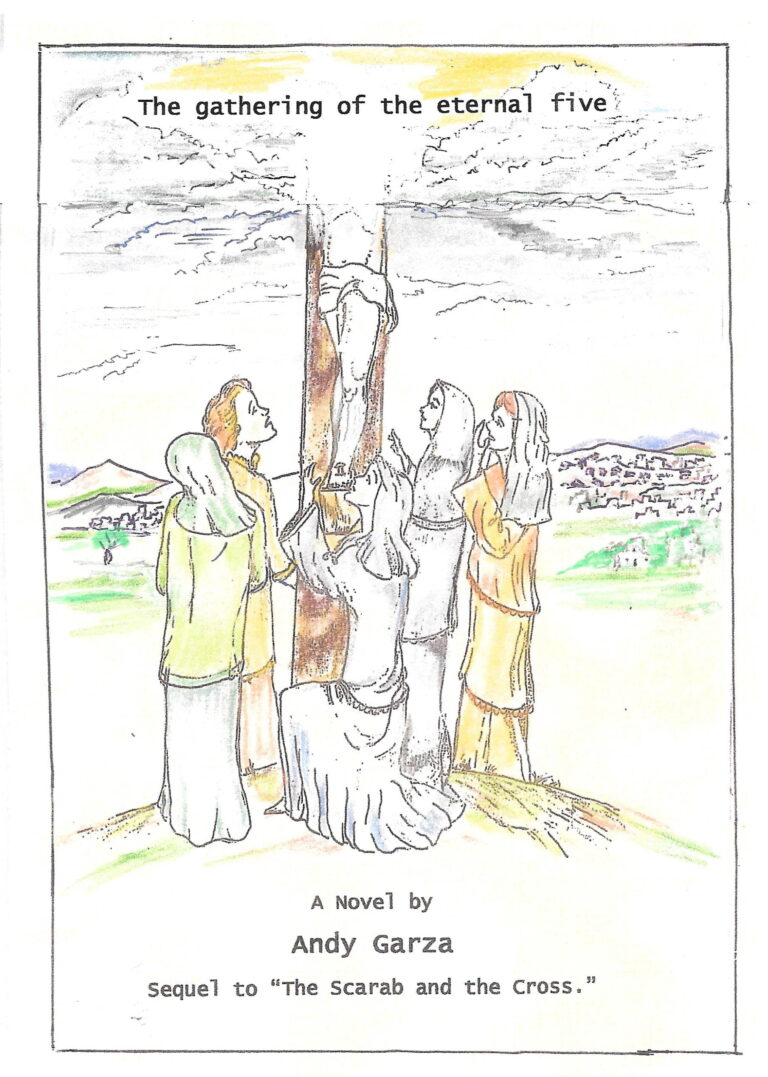
Gathering of the Eternal Five (3rd Installment)
When God spoke with actions
Chapter 2.Tremiyo agreed, “We’re living in a cradle of miracles. Mary Magdalene was the first to see Jesus the morning of his resurrection. God granted a life to Joachim and Anna in their child Mary and has returned Jesus to finish his earthly assignments before residing in the house of his heavenly father.”Tremiyo seemed to be addressing Onofrio directly like a professor at a college lecture. “Nature as you are so fond of saying is an enormous force that governs all living things. But, look at how your favorite item of worship was coerced by an even greater power. As Jesus suffered his final moments a storm was made to develop and progress to Golgotha. The storm was unexpected. It was produced to wash away the torment the son of God endured. Cleanse the soil of his agony. Wash the air of hateful malice. The tempest was timed and guided to the precise location of the cross. Son, that was not a normal rain storm. It was not a little spring shower. Within the bowels of that tempest was the anger of God that Hebrew leaders have grown so blind to the words and prophesies of their fathers. The rain that carried strains of the blood of Jesus healed some of the runaway spectators. People reported hearing sinister laughter in the wind. That could only be Satan himself laughing and rejoicing in his work to turn the heads of the Hebrew council. Those hardheads appear to be following the words of Satan rather than the teachings of their God. The storm hurled violent arcs of fire unto the earth. Lightening splintered boulders into dust. Thunder echoed from the intestines of the earth to resonate in the hearts of frightened men. Your item of worship, Mother Nature has never been given cause to display such violence. And that was only the rain storm. The earth shook brutally. An earthquake tore down hillsides, destroyed trees, shattered homes and strong buildings and put awesome fear in the hearts of those that plotted against Jesus. People died and some suffered injuries from the shifting of the earth. The earthquake announced the beginning of a new era. A spring time for mankind. A time of rebirth. Only the most perverted mind cannot see or understand that God has spoken. The gloom of darkest night invaded the bright noon day with a blanket of solid black. A cape of ebony to touch even the stoutest heart lay upon the land. But God was not finished delivering a message to his delinquent people. The Hebrew council had been misled by greedy minds and for their misguided obedience God struck the veil at the temple in two. The veil was a sacred shield to protect the Ark of the Covenant in a room called the Holy of Holies inside the Tabernacle. The veil, as it is called is a hand woven tapestry 45 to 60 feet high and four inches thick. It is a protective shield without the need of stone and mortar. The strongest timbers were chosen to support the woven wall suspended as if floating free. It was ripped by a Godly force from top to bottom, indicating the power that struck it came from above. That you may better understand, it was God sent. The council members trembled in fear that the splitting of the awesome veil is God condemning their lack of faith. God has cast aside his commitment to his chosen children until they mend their misguided ways. As unable to agree as they are, it may take forever. God’s penalty could last for Jewish eternity. It was said the temple would fall and be rebuilt in three days. They believed the strength and soul of the temple was the veil. It represents God’s commitment to his chosen people. But even a blind man can see that the chosen children have turned their backs on Him. In effect the temple was destroyed as foretold. Three days in God’s time in not equal to three days in man’s time. The temple still lies in shambles, left alone by those that greed for the price of rebuilding it.” Tremiyo was like an energetic college professor delivering his favorite lecture. “Now son, listen to this carefully. It has been clearly shown throughout history that God speaks to us in ways we do not clearly understand. People were expecting the temple to fall to pieces and be reconstructed stone by stone in three days. As Jesus said it would. Not so be the case, son. Jesus was the keeper of God’s words. The temple veil was simply a road sign. A list of directions, so to speak. Jesus was the temple of God’s soul, His only begotten son. A temple is also a place deemed sacred by virtue of God’s presence. God resided in the heart of his only begotten son, Jesus. That is the temple of God. Not a stone building. When Jesus died God went into a rage. Three days later the temple of God’s very soul was seen rising to heaven, escorted by angels. The stone temple was still intact. Fools made mockery of it and did not grasp the full message.” Tremiyo, the unassuming Stewart of the house of Serou was momentarily a giant of faith pointing a rigid finger at his son-in-law and Serou as well. With head bowed sideways, Serou hawkeyed his long time friend and companion. “Tremiyo, I’ve known you for close to twenty years and to this day, you never cease to amaze me. One of the Hebrew councilmen with whom I often speak stated with a wise look on his face, how glad he was that the demented carpenter from Nazareth was stolen from his charity grave and secretly buried elsewhere. God does not fool around with the unworthy,” were his exact words. I am prone to believe that Jehovah is the best judge of who is worthy and who is not. My Gods have all faded into a realm beyond my comprehension. I am seeing miracles happen and began to believe that faith and religion are on a new path to greater glory. Based on what I’ve seen, I feel I am not too far wrong. The Hebrew council is searching for willing skills to mend the road sign in their temple and have yet to read the full meanings. Pity they cannot change their ways. They’re good people going down the wrong road.”
The Romans are in dire need of building material, I predict they will find just cause to bring down the temple and use the stones to build something that will benefit their cause.”Tremiyo had captured the attention of the knowledgeable Egyptian, Serou. The Egyptian held his chin in his hand and soaked up every word like a thirsty sponge. While Onofrio was like a child intently listening to his father relate a story. He finally brought himself to ask, “What is the ark of the covenant?” Tremiyo was again called to answer the inquisitive young man from Iberia. Onofrio had made much progress in accepting the miracles of Jesus and the words of his heavenly father. So as an advance course in his beliefs Tremiyo would transfer his thoughts to his son-in-law. But Serou intervened with his knowledge of Hebrew and Egyptian history.
”Moses suffered much with some of his rogue followers feeling the sudden power of freedom and wanting to break away on their own. They were like senseless children never having had a thought of their own. They were unable to fully grasp the miracles their God was delivering to them. They lived by lessons learned in bondage. They took what was given with no intent to repay with allegiance. Moses was hounded by his own people that wished to return to Egypt. There was food, shelter and a semblance of security in Egypt. There was nothing in the desert except scorpions, thirst, heat and hunger. The smell of death rose from the suffering people and became a call to the circling buzzards anxious to cop a meal. Close to death without water and near revolt, Moses tapped on a hillside rock, broke the surface and water flowed freely from the stone to quench their thirst. When they hungered severely, they woke up to a field of bread before them and they called it manna from heaven, because it saved their lives. They saw the red (reed?) sea part in two and gave them safe passage and to this day many remain unable to believe in their own God. Moses was summoned by his God to a mountaintop in the desert. He obeyed all the Godly mandates and answered His call to this one as well. On that lofty mountain top that no man can rightly say, this is the right mountain Moses received the rules by which man should live.
Alongside a wild bush on fire that would not burn. God represented himself as being the fire within the bush. Not in the form of a man but in the form of an eternal flame. At that location Commandments cut in stone were delivered by an awesome power that intimidated the faithful Moses to the ground. Prostrate on the soil of God, Moses trembled in fear of the awesome power that burned words into stone. He was commanded not to raise his eyes to God and he submitted to that demand. With borrowed courage Moses meekly asked for God’s name that he may share it with his people and that they would have a name to revere. And God answered, “I am that I am.” Then having delivered his message to Moses God went silent leaving Moses to accept or reject what transpired on the holy mountain of “I am that I am.” Some people believe that mountain is Sinai. But it’s never been proven.
Full of Divine guidance he returned to his people. In shock he found mislead Hebrews had created their own version of God and were wanton with sin of all manner. In anger he dashed the tablets onto the rocky ground. The commandments written by the hand of God on a stone tablet were damaged beyond repair. Like an angry mouth the earth split open where the tablets struck and wanton sinners were swept and blown into the burning bowels of hell. They were trash God had no use for. They were beyond forgiving, they belonged to Satan. And God send them there. When the faithful gathered before Moses in tearful lament for they had lost loved ones to the wages of sin they presented him with the remnants of the tablets where God had written their program for life.
In painful labor they built a chest, box or container in which to preserve the words of God. Not to be touched my mortal men, the container became known as the Ark of the Covenant. It harbors God’s laws for mankind. Covered in sacred gold it was carried on a litter to the Tabernacle where God took residence on earth.” Serou also directed his oratory to his adopted son. “You can see that the council has violated their devotion to God. The rupture of the veil verifies what your father-in-law said that God like Pontius Pilate is washing his hands of such delinquents. I have no way to prove it, but I feel safe to say that God has moved his headquarters to a more devoted place.” Serou with his usual eloquence created an impressionable image in Onofrio’s mind. Thoughts and visions Onofrio would carry and share with his children and whoever else would listen.Rightfully impressed Tremiyo looked to Serou and had to jest fully enter, “I am so happy you gained such deep knowledge by associating with me.” To which three men found reason to laugh. The time together was irreplaceable as each man wanted to preserve the moments so rarely enjoyed in such a pleasant ambience. It was Senobia that broke into the globe of peaceful exchange. “Papa, baby Sintia has grown cross. She wants to be in papa’s arm so she can sleep. You started that. Now she thinks that afternoon naps are only good when she has them in your arms.”Gently Senobia delivered the child to her grandfather’s cradle of love. Baby Sintia cooed with pleasure and snuggled into the receiving arms with obvious joy and almost immediately closed her eyes. Tremiyo’s heart opened to endless joy at the sight of his loving Sintia in his arms once more. The child was a reflection of Grecian beauty taken from her mother Senobia and the handsome young man de Iberia. Senobia on her way to round up Horacio and pick up Angelica tweaked Onofrio’s ear and gently pulled a lock of his hair. With loving eyes she pursued her lips and cast a silent kiss to her husband. A kiss gratefully accepted and tucked into a secret pocket in his heart, there to dwell forever. Having been raised never to interfere in the talks of men she reluctantly left her husband in his conference with her father and Serou. Senobia’s loving step mother Camia, showed up to more or less check on her husband Tremiyo and help carry baby Angelica to her bed for an afternoon nap. The women in their circle of friends within the Serou’s compound of slaves would chat and plan their evening meals as a feminine ritual so long in practice.
Now a certain man was ill, Lazarus of Bethany,
of the village of Mary and her sister Martha. It
was Mary who anointed the Lord and wiped his
feet with her hair, whose brother Lazarus was
ill. So the sisters went to him, saying,
“Lord, he whom you love is ill.”
John 11: 1-3 NIVTremiyo continued in his usual casual but serious tone. “We should not disregard a miracle close to home. Word reached the Nazarene that Lazarus was very ill. It is said Jesus postponed his arrival to further convince the people that he was truly the son of God come to earth on a mission of his father’s design. The sister of Lazarus, Martha met Jesus at the village edge and bewailed her brother’s demise. “Oh, Lord. Dearest Rabbi, had you been here a few days earlier our brother would live.”
To which Jesus replied, “Fear not, Martha. Your brother shall walk again. Lead me to where he is laid.”
Followed by a flock of curious people Jesus went with Martha and Mary of Magdala, (her sister). On the way so all could hear he told them, “I am the resurrection and the life. He who believes in me will live even though he dies; and whoever lives and believes in me will never die. Do you believe this?”Rightly intimidated the sisters had to agree. “Yes Lord. We believe that you are the Messiah, the son of God, who is to come into the world. Mary of Magdala had already experienced a strong attraction to the Nazarene. It was said that she was a student of the Goddess Isis and seemed to follow in that teaching. The stone that sealed the sepulchre was enormous and it took some strong convincing to have some men in the crowd put their shoulder to the task. A hush took over the anxious crowd. The fear of rotting flesh ran though the mob in whispered tones. “It’s one thing to heal the sick. It is quite another to make the dead walk again.” “Even making the blind see is easier than reviving a man four days dead.” The fear of the stench kept people away from the darkened entrance. Decay would have set in and the flesh would be like shreds falling off his bones. His eyes would be decomposed and falling out of their sockets on strings of moldy flesh. Even the stoutest heart took a few steps back. People were equally divided, by the brave that stood by knowing nothing but stink would come from within the burial vault. Lazarus lay still forever. Nothing could change that. Then there were the frightened children wanting to believe in the power of the Nazarene, supposedly son of God and master of miracles. Yet they were held in place by undeniable logic. The dead do not get up to walk again.
Only Mary Magdalene in that immense gathering held firm to the belief that the Goddess Isis had resurrected her lover Osiris from the dead and Jesus loved mankind enough to give his life for their salvation. The love Jesus held in his heart and the faith he had in his heavenly father would raise her brother. She alone waited for her brother to rise from his eternal slumber and walk again. And so he did.
Jesus stood firm on the ground like a commanding general and called out, “Lazarus, come forth.” Anxious moments passed and nothing happened. The crowd stepped back while stone hearted critics smiled in mockery. As if his voice had not carried into the depths of the tomb Jesus called again, “Lazarus, it is I, come forth.” Before a bewildered crowd Lazarus slowly struggled within his funeral wraps into the faint light at the entrance. Blind and bound in awkward steps he shuffled painfully into the light of life. Jesus was first to attend him and Lazarus recognized his savior and smiled weakly like a frightened child. The awesome realization of coming back to life would intimidate even the strongest man.
People fell to the ground in fear as well as prayer. Some simply fainted and others ran away to regroup their senses and spread the news. Lazarus, four days dead was raised by Jesus of Nazareth and the conviction that he was truly the son of God multiplied.”
Lazarus and Mary
“Take ye away the stone!” Then lifted He
His moisten’d eyes to heaven, and while the Jews
And the disciples bent their heads in awe,
And, trembling, Mary sank to her knees.
The son of God prayed audibly. He ceased.
And for a minute’s space there was a hush,
as if the angelic watchers of the world
had stayed the pulse of all living things,
to listen to that prayer. The face of Christ
shone as he stood, and over Him there came
Command, as ‘twere the living face of God,
And with a loud voice, he cried, “Lazarus!
Come forth!” And instantly, bound hand and foot,
And borne by unseen angels from the cave,
he that was dead stood before them. At the word
of Jesus, the fear stricken Jews unloosed
the bands from off the foldings of his shroud;
And Mary, with her dark veil thrown aside
Ran to him swiftly, and cried, “Lazarus!
My brother Lazarus!” and tore away
The napkin she had bound about his head-
And touched the warm lips with her fearful hand-
And on his neck fell weeping.
Nathaniel Parker Willis 1806-1867Tremiyo’s summary on the subject of resurrection had touched on Onofrio’s heart. His chest felt constricted, his eyes went glassy and he knew not why. He went to pick up Horacio’s toys but more so to take some time alone. He excused himself from his companions by saying, “I need to pray and pick up my son’s treasures.” Some of those treasures were toys Onofrio made for his son with loving hands. They were reminders of toys his own father made for him when he was a little boy in a faraway place. A place where love resided. A place he would never forget. A modest cottage in farmland Iberia.
-
Gathering of the Eternal Five (2nd Installment)
Serou found reason to clarify a point. “He was Jewish as his mother and father were since the birth of time. The Hebrew council was actually guilty of conspiring against one of their kind. Simply because they could not accept His birth place as being a kingly location. And because Jesus’ oratory stung them where it hurt the most, their departure from the laws of Moses and Abraham.
Jesus of Nazareth, was a slender man of firm muscle and graceful stride. Labor hardened hands gone tender from the lack of exercise. And so became a Devine healer’s tender touch that delivered mercy from pain. His hair was brown to his shoulders with eyes to match. There was power in those eyes clearly proven since he moved twelve men to abandon their ways and become the echoes of his lessons. That was only a few year ago.Today in hastened pace the miracles of the Nazarene travel to the outermost reaches of our world. Faster still went the news of his resurrection. Anxious hearts traveled many miles to confirm the report and some come in quest of still another miracle from the risen “Messiah”. The expectations of millennia are unfolding before the eyes of firm believers and converts alike. The words “He is risen” echoed unanimously throughout the land. Jesus was the cure and the hope of countless individuals as history will record.
A welcome reprieve from torturous anxiety finally gave his mother a soul relieving hope that her son was truly alive and fulfilling his destiny. The Prophesies were coming into focus after endless time and three days of unfathomed anguish. The son of humble Mary of Nazareth was seen by countless people alive. Exhausted from her ordeal Mary
retreated into quiet solitude. There to mourn and regroup her life as she knew that his destiny was not yet fulfilled. Women were prohibited from entering the court room while his trial went on, but she was listening close by. History records her faithful journey with Jesus to Golgotha and his final moments on earth.It was Friday and during that time of celebration the work of removing corpses from their place of penance was forbidden. Jesus was at serious risk of being ripped off the cross and thrown into a pauper’s grave without ceremony. Criminals were known to be dumped in ditches away from town as meals for scavengers. In this ambience of cold hearted cruelty Joseph of Arimathea and Nicodemus geared up their courage to go before Pontius Pilate, governor of Judea and the awesome power of Rome to literally beg for the corpse of a dead Jesus.
He would be forever grateful to Claudia Procula, Pilate’s wife who by his side gently convinced her husband to grant Joseph and Nicodemus their request. Jesus was dead. What was the harm? What would it matter? An obvious act of kindness would serve Pontius Pilate well. Pilate had washed his hands of the regretful decision to crucify Jesus. This gesture could ease his soulful penance. Pontius Pilate could be as hard and brutal as the occasion required. He could also be thoughtful and considerate in his kinder moments. This act would at least give the Nazarene a decent burial and ease the torment of his family. To deny such a request was known in Rome to be unwarranted cruelty to the criminal’s relatives.
Mary with her uncle, Joseph of Arimathea, Mary Magdalene and Mary the wife of (Cleophas) Clopas helped to remove the corpse of Jesus from the villainous cross. Salome was there also Jesus suffered his ordeal for six hours before he gave up his spirit and asked to be called home. The sky was still a forest of black and threatening clouds like angry watchmen from the heavens. It was shortly passed mid-day and the world suffered to see their way in the fearsome noon day night that lasted throughout the afternoon.
Now, hear this from Luke 23: 44-46 NRSV
There was darkness over the whole land
Until the ninth hour, while the sun’s
light failed; and the curtain of the
temple was torn in two. Then Jesus
crying with a loud voice, said, “Father
into thy hands I commit my spirit.” And
having said this he breathed his last.It is safe to say that after the unexpected storm, Golgotha was a treacherous location for the work of bringing down the cross. Then remove the horrible spikes from his flesh without inflicting further damage. Blood and water still trickled from a deep wound on his right side. His back was a roadmap of lashes and shreds of flesh still hung from his wounds. It was a heart ripping task for all involved. Suffer then the horror of seeing the ugly spike holes left on the corpse of a street healer and messenger of God. There was still the matter of transporting the body to the tomb donated by Joseph of Arimathea in that awful storm. The way was made dangerous by wash away stones and swift muddy rivulets. An earthquake disrupted numerous hillsides breaking boulders into pebbles and adding hardship to the task at hand. Within the violent winds that followed, satanic laughter was heard while some people reported smelling sulfur in the air. There would be people to accept the darkened skies as nothing more than a simple eclipse. The temple veil providing a secure place for the Ark of the Covenant was ripped in half from top to bottom. Indicating the power that struck it came from above. As a sign that God was also washing his hands of the Jewish council’s decision. A hand woven tapestry forty-five to sixty feet high and four inches thick ripped like thin silk in a single stroke. An awesome feat demonstrating the power of an angry God and deleting previous commitments. But, the earthquake could have caused the momentous rupture of the barrier veil. Could’nt it? Or could it?
And Joseph took the body, and wrapped
it in a clean linen shroud and laid it
in his own new tomb, which he had hewn
in the rock; and he rolled a great stone
to the door of the tomb, and departed.
Mary Magdalene and the other Mary were
There, sitting opposite the sepulcher
Matthew 27: 59-61 NIVThe world was sorely shaken by so many miracles and frightful things happening all at once. Jerusalem was a conglomerate of many races and convictions. Various gods were still routinely worshipped. To some of these people business continued as usual. The rain passed, the skies cleared, the earthly rumbles ceased and it was dinner time. It was just another day.
Through all the momentous excitement, fears and relief nobody could experience greater emotions than his mother. Her aching heart was experiencing new hopes and joy in her life programmed by a higher order. Four other women interlaced their lives with the Nazarene and each came to his side to leave their mark on his existence.First and foremost was Mary, his mother. All indications point to her being a god-sent miracle to her ageing mother and father. Joachim and Anna. Mary of Magdala, (Magdalene) Jesus’ faithful disciple and travel companion. It’s been said she worshipped the goddess, Isis.
Bernice who came to the side of Jesus and wiped his face of sweat and tears. A clear to life image of his face appeared on her head scarf and became a healing instrument even for the Emperor Tiberius.Claudia Procula, wife of Pontius Pilate, friend of Mary Magdala that made an effort to cease the trial and set Jesus free. Primarily because Jesus is reputed to have cured her son “Pilo” of a club Left foot. She suffered rejection and abuse from the maddened crowd that sought to touch Jesus for their own sake. Her joy was unmeasured to see her only son emerge from the mob free of his affliction. He had been close enough to Jesus to benefit by it. That act anchored Claudia’s faith to the Nazarene for life.
[Previous episode] [Next episode] -
Allan R. Bevere: Politics of Witness: Introduction
by Dr. Allan R. Bevere, pastor, professor and author of The Politics of Witness: The Character of the Church in the World, Colossians and Philemon: A Participatory Study Guide, and The Character of our Discontent.
For the next few Thursdays I will be publishing a series of posts on a subject that is very important to me– so important in fact that I wrote a small book on the subject — The Politics of Witness. The reasons for this series is the continued misunderstanding of my position and those of us who embrace what I also refer to as a robust political ecclesiology. My position does not promote withdrawal from the culture or nation state politics, nor does it embrace a very untenable personal/public dichotomy. The reasons for this continued misunderstanding are found in the very context I desire to critique. I will post more on this over the next few weeks.
While the subject of the church’s witness has hardly been ignored, I overtly tie the church’s witness to politics and politics to ecclesiology. I ask the church to consider the recovery of a robust political ecclesiology that sees the very life and witness of the ecclesia as its politics, and that the primary and central political posture of the church toward the nations is not one of influence in the political chambers of Washington D.C., but by embodying in its collective life what God expects of the nations. The church can only reclaim its mission and prophetic witness in the world by embracing the politics of witness. I seek a way out of a status quo ecclesiology and a completely uninteresting understanding of nation state politics. I believe that God is looking for a remnant to faithfully embody the politics of witness to the nations. (Read more …)
[slideshow_deploy id=’2564′] -
Edward W.H. Vick: Reading Scripture
by Dr. Edward W.H. Vick, retired professor and author of From Inspiration to Understanding: Reading the Bible Seriously and Faithfully, Philosophy for Believers, and more!
We have different purposes when we come to read Scripture. We may distinguish two approaches, by the individual and by the established community.
The Community
For many centuries the Bible was in languages the individual Christian could not understand. So what the Bible said was locked away from the majority. Greek, the language of the New Testament, Latin the language of the dominant church, and Hebrew the language of the Old Testament was available only for the few. So the church’s representatives who were able to communicate to the masses provided them with their favoured interpretations for acceptance buys those who had no reference to the text of Scripture.
The individual
There were champions for the individual however. But not till very late in the Christian story. Tyndale and Luther were passionate in believing that given opportunity the individual, humble however he might be, could readily read and understand the Christian teachings if they had access to the text of Scripture. They struggled to provide translations that the ploughboy could read and understand. Two names, among others stand out: William Tyndale and Martin Luther.
It is no longer the case that the text of Scripture is inaccessible to the majority of Christians. We may and must distinguish between two approaches to Scripture.
The individual reads Scripture for the spiritual and moral uplift and understanding it provides. The church community seeks confirmation of its doctrine by reference to Scripture. Indeed some churches claim that their whole teaching is based on Scripture. The serious question then is this: How does one approach Scripture so as to arrive at doctrines that the church teaches as essential? That is the problem that is addressed by the question: Which is a correct and valid way of so interpreting Scripture that what results is faithful to Scripture. This is the activity we call hermeneutic.
We can therefore examine not only the actual teachings, the doctrines of a community, but make clear the method of interpreting Scripture that has led to the production of such doctrines. Such methods of interpreting Scripture are often reflections of particular situations, as indeed the coming into being of the diverse ‘writings’ of Scripture was. To understand in asking the question about hermeneutic, we must examine the historical context in which the hermeneutic emerged. This we must of course do also with reference to the emergence of the many various ‘writings’ included in the biblical canon that we are interpreting.
Divergence
An interesting question arises. How might the devotional, individual reading of Scripture influence the development or acceptance of doctrinal positions? Individual believers as they give careful attention to what they are reading will relate what they understand Scripture to teach to the teachings of the church community of which they are members. Then they may make a decision. Do they correspond? If the reader discerns that they do not, he may resolve the conflict by rejecting the teachings of the church or by asking for consideration of alternatives. In this way the opportunity for the personal reading of Scripture poses a threat to a traditional church. Sometimes that produced determined opposition by the establishment to the translation of Scripture. The cruelty with which such opposition was exposed is well attested. Tyndale and his supporters provide an all too typical example. That is now in the past.
However, some churches have an orthodoxy they seek to maintain rigidly. The sad fact of the rejection of those who doubt and suggest alternatives is well attested. Sanctions of various kinds are applied to such people. A closed community then remains closed, enclosed by the insistence of holding rigidly to its traditions, sometimes defending its insistence by claiming that its doctrine is a direct and valid interpretation, i. rendering, of Scripture. Here there is conflict with the conviction of the individual reader. Sometimes it leads to reformation. Sometimes to emphatic insistence on maintaining the established teaching, to revival rather than to reformation.
Sam (short for Samson, not Samuel), picked up the stein of beer he had just paid for, gave it an initial taste to savor the taste, and then followed with a gulp. He enjoyed his beer in the evening after a hard day of work.