Question 3 Joel Watts – Question 3 Response 1 Elgin Hushbeck – Question 3 Response 1 Joel Watts – Question 3 Response 2
1) I would agree with your statement that, “liberty is not absolute freedom as that would lead to anarchy.” I found your statement, “we are truly never free given that even free will is a myth” puzzling, but I fear pursuing it as that would take us wildly off track. Still at the end I was left uncertain about the answer to my question “Where does liberty fit into your view of Government? “
For example you wrote, “Economic Liberty is a wild animal to tame, but it must include the notion not of unlimited enterprise or unlimited gain, else by such measures we limit others, but the liberty to pursue or not pursue individual wealth so as to not harm the social compact.” This is a statement that I could agree with, but a lot is buried in the definitions of “unlimited” and “pursue” and I suspect that while we both might agree with the statement, we would then disagree about what it actually means.
I believe, for example that the free enterprise system is not an unlimited or anything goes system, but one that is constructed to ensure competition among suppliers and thus choice for consumers. Only in such a system do people have both the most opportunity and liberty. I believe that government, at least as it is currently constructed, is a barrier to this, limiting competition and thus choice. The larger the government is, the greater will be the burden on society and the limits on individuals. Thus both choices and opportunity will be restricted.
In addition, it also distorts the market in a way that leads to problems. For example, as I detail in my book, the cause of the financial problems of 2008 and early 2009 were a combination of bad government policies and regulations. But since it is government that holds the hearings and writes the laws, they rarely focus on themselves, and thus most of this was just ignored.
A key problem is that, even when not flawed, government regulation comes at a cost. As government regulation increases, the burden of simply keeping up becomes a barrier to entry for smaller businesses wishing to enter a market. Thus it is not uncommon to find large organizations pushing to be regulated, as they know that it is a cost they can afford, but their smaller completion cannot. Often the end result is that regulations have little if any actual benefit to the consumer, but instead have the negative effect of limiting competition and choice.
To be clear this is not an argument against all regulation, but rather that the cost of regulation and their impact on competition must be carefully considered, something that is clearly not happening at the moment.
2) While I generally agree with your second answer, I do not think that the division is quite so clear cut. The realms of the moral and the realms of the natural overlap to a considerable degree. While you claim that “Government cannot replace God, nor the individual conscience,” It certainly seems at times to be trying, such as in the recent HHS mandates that would require individuals to violate their conscience and what they perceive to be their duty to God. If Government and God are to be kept separate, the larger and more encompassing the role of Government the less room there will be for God. Sure if one’s views of God are in sync with the views of the Government, then one may not perceive any problem, but that would hardly be religious liberty.
3) What distance is the Federal Government away from us?
Perhaps the distance metaphor did not work for you, but it does for a vast majority of Americans. In fact, many in the Western states often speak of a War on the West. It is so well established that we speak of Washington D.C. as inside the beltway, in the sense that the beltway is a barrier to the rest of America.
When you said that “In our system, we are intertwined” I think you are confusing the effects of the federal government which people do encounter every day, with the rule of the federal government, over which they have little say.
There are many factors in this. One is just simple population/mathematics. Your input at the community level is larger than your input at the state, which is larger than you input at the federal. I discuss this and some of the other factor such as the concepts of safe seats, and the problems with elections in my book, but the bottom line, is that we simply have very little say in what actually happens at the federal level.
For example, polls consistently showed that ObamaCare was opposed by significant majorities of the American public. Scott Brown even won an election in the Democratic bastion of Massachusetts in an attempt to stop it. But it was passed anyway, and while it remains unpopular is unlikely to be repealed any time soon. Then there is the fact that the bill itself was only an outline compared the tens of thousands of regulations that will affect our daily life, but over which we have no effective say.
The point here is not ObamaCare one way or the other and I have no doubt that you can come up with some examples of your own from the liberal perspective. But it is an example that politicians in Washington are cut off from the people. And this is the political branch, the courts are even worse.
It is just a fact that in almost every election people have supported keeping the traditional definition of marriage. The people of California voted twice. But come June the Supreme Court may overrule the people yet again and impose a new definition of marriage on the entire nation.
Again the point here is not really marriage per se. New York passed same-sex marriage and I would be opposed if the court ruled that unconstitutional as well. The point here is that the federal government would impose this view, not based on the will of the people (who have repeatedly voted against it), or on the Constitution (which does not mention it), but because that is what a majority of the justices think it should be.
This is what I was referring to, that the level of government we have the least influence over is controlling more and more of our lives. The mayor of New York can ban 32 ounce drinks, and while I laugh at him and think it silly, if that is what New York city wants, who am I to say otherwise. I don’t have to go to New York. But if this was done at the federal level how could I avoid it?
Question 3 Joel Watts – Question 3 Response 1 Elgin Hushbeck – Question 3 Response 1 Elgin Hushbeck – Question 3 Response 2
First, I want to answer the questions posed: So how do you view the Constitution?
The Constitution is a man-made document filled with flaws and temporal based ideals and errors; however, it has provided for its only continuation through the amendment process. The Constitution is not ignoble, but an economic charter meant first to protect the rights of the landed gentry, give some reasonable image of participation on Government to those who could own property but was not so wealthy as to afford to leave large estates. But, it has evolved somewhat into a more humane and modern document allowing for more participation in Government.
On a more legal side, it is the Law by which the Republic must be guided by. This Republic is not based on the Declaration of Independence, but the Constitution, although we seem to be moving in the direction of Jefferson’s ideal, utopian commune of life, liberty, and the pursuit of social happiness. What role does Freedom play in your view of Government?
Freedom is just another word for nothing left to lose. It is a false idea, as often times we enjoy only what freedoms someone else allows. Freedom is a propagandist tool. So how would you define Individualism?
Individualism is the suggestion best summed up in the expression “pulled himself up by his own bootstraps.” This has never occurred in all of human history. Individualism is the antithesis of human civilization. Individualism, then, suggests that one man is indeed an island. The moral worth of an individual is only found in the community’s actions, so that an individual is only worth something if he or she is a part of a community. This is antithetical to individualism.
Now, I want to turn some of the issues Elgin believes he has raised or laid to rest in his answer to my questions.
1.) Judeo-Christianity is a new term and concept. The Founding Fathers referred to the Jews, but so too to Islamic notions. Western Civilization has even found influence in Islam. Further, Christianity was shaped first by the discovery of pagan philosophers, such as Plato and Aristotle — likewise influences on the Founding Fathers. It is more appropriate to say that the West is still shaped by ideals of these philosophers but that these philosophers have been shaped by Jewish, Islamic, and Christian appropriation of their statements.
Q: What Judeo-Christianity values have defined the country from the very beginning?
2.) The Declaration of Independence is not our founding document. It is the founding document of the united States, governed under the Articles of Confederation. We no longer have that country, but one founded under the Constitution which is not concerned with the communal pursuit of life, liberty, or the pursuit of social happiness. I find it odd that you write, “(freedom) remained a central value up through the 1960’s,” given the reason MLK marched is because the central value of the country was equality only for white people. What did equality mean? It was transformed and muted and moderated, and unleashed in various ways throughout the preceding decades, but it was never about true equality.
This is where (your) poor theology of free moral agents comes into play, something the great thinkers of Christianity would have disagreed with. This is counter to both sound Government and sound Christian theology. While, as a Wesleyan, I find some sense of freewill, not even Jacobus Arminius argued for a complete free agency. Our choices are, as the Greek thinkers who gave way to the Latin from North Africa who gave way to Thomas Aquinas and so on said, not our own, but there by God.
Q: Can you define liberty and freedom only from the Constitution, of which Jefferson had no part? How might this shape your view of Government?
Q: Now that I’ve explained my stances on individualism, I will repeat the question:
Individualism is in direct opposition to Jewish Tradition, Christian Tradition, and the Declaration of Independence. Why is it, then, your bedrock ideal?
Question 1: While there is considerable agreement between our views a major difference between us, and I believe between liberals can conservatives in general, is over the competing goals of liberty and equality. You see equality or as you put it, “leveling the playing field” as one of the driving principles of government. Where does liberty fit into your view of Government?
Liberty is a manifold thing. We may find that liberty is that which allows us to govern ourselves, with the idea that if we are subject to someone or something else, we are not free. Yet, we are always subject to one thing or another. No, this is not liberty.
I would propose first a definition of liberty. True liberty is that which prevents another from controlling us. Therefore, we are truly never free given that even free will is a myth. Instead, liberty under a government must be achieved as an ideal. What is this governed liberty? Governed liberty is the ability to flourish dually as a citizen and an individual. To that end, we must respect the notion that liberty means different things in different situations.
For instance, political liberty is not anarchy, an enslaving process if there was ever one, but that which allows an individual who has achieved some form of citizenship to actively participate or not participate in the political life of the country. A Government, properly, must not interfere in the political liberty of the governed, else it separates itself from the governed.
Economic Liberty is a wild animal to tame, but it must include the notion not of unlimited enterprise or unlimited gain, else by such measures we limit others, but the liberty to pursue or not pursue individual wealth so as to not harm the social compact.
Briefly, liberty is not absolute freedom, but a part of the social compact allowing the governed to both control the government and to limit untamed power absorption — to limit the ability of the governed to divest themselves of the government. Question 2: You say that “Government has no unnatural proper bounds. It has no unnatural limitations” but then in the next paragraph write how “role of Government is not theocratic, nor moral” Is not the latter a bound or limitation? If not what did you mean by the first statement?
Government cannot replace God, nor the individual conscience. Whereas the economic, civil, and political realms are the Government’s role, the unnatural, that which is above natural control, does not have a place in the control of government. If something deemed moral is better contrived as under natural control, or indeed of control, it must be decided if this is truly a moral issue or a natural issue. Question 3: You say that “a Government apart from the Governed is unnatural and must be restrained as a rabid dog” but would this not argue for a focus more on local government, than on a large federal government separated from the people in both distance and influence?
What distance is the Federal Government away from us? In our system, we are intertwined. We have Federal highways and Federal laws alongside county, local, and such laws. There really is no distance between the Federal Government and the local person. Further, we vote for Federal office holders, even the Senators.
Links: Question 3 Watts – Question 3 Reply Hushbeck – Question 3 Reply Hushbeck – Question 3 Response 1
1. Elgin, I contend that the idea of a Judeo-Christian anything is a myth beginning in the last century with Darby (England) and expanded by Scofield in the United States. It is a myth, and not the good kind like Genesis 1. In my opinion, this idea of a Judeo-Christian foundation presents an unreal expectation and authority for the Constitution and the Government. I will allow, for the moment, “Christian” entails Christian Tradition rather than the New Testament (so that we have Thomas Aquinas rather than, say, Paul). Here is the question. Given the mythical foundations promoted in the last century, such as Judeo-Christian, how do we might place the philosophy of Government back into Enlightenment-era deism from which it sprang and forgo the revisionist history, such as the values you list on the currency?
There are so many false assumptions in your question it is hard to know where to begin. First, I am not sure what you think the Judeo-Christian heritage is, but for me it is simply an easy way to reference how Western Civilization was shaped and influenced by Christianity and Judaism. That it was shaped is simply a fact. Medieval Europe was an amalgamation of three main influences: The declining Roman Empire, the invading barbarians, and Christianity. Even today, though its influence has waned some, Christianity remains a considerable influence shaping how Western Civilization viewed the world.
Even given that, I do not see any authority in the Constitution stemming from the Judeo-Christian heritage. As for the values on the currency, these do not provide any authority. As I layout in my book Preserving Democracy, they simply are the values that have defined the country from its founding until fairly recently. Though as I lay out in the book, I think these are good values to build a country on and much better than the alternative values seeking to replace them.
Thus since your question is based on a false premise, there really is no answer to it.
As for the authority of the Constitution, itrests on the value of its answers to the problems of a democratic government. It provides for a limited government of enumerated powers.
So how do you view the Constitution? 2. You say the people “should be free.” Where is the argument for this and further, what is “free?”
There are several ways I could answer this. In terms of this country it was one of the driving principles behind the revolution and a founding principle of the country set forth in the Declaration of Independence when it says “that all men are created equal, that they are endowed by their Creator with certain unalienable Rights, that among these are Life, Liberty and the pursuit of Happiness.”
It remained a central value up through the 1960’s when Martin Luther King so movingly proclaimed in his speech on the mall, So let freedom ring from the prodigious hilltops of New Hampshire. Let freedom ring from the mighty mountains of New York. Let freedom ring from the heightening Alleghenies of Pennsylvania! Let freedom ring from the snowcapped Rockies of Colorado! Let freedom ring from the curvaceous slopes of California! But not only that; let freedom ring from Stone Mountain of Georgia! Let freedom ring from Lookout Mountain of Tennessee! Let freedom ring from every hill and molehill of Mississippi. From every mountainside, let freedom ring. And when this happens, when we allow freedom to ring, when we let it ring from every village and every hamlet, from every state and every city, we will be able to speed up that day when all of God’s children, black men and white men, Jews and Gentiles, Protestants and Catholics, will be able to join hands and sing in the words of the old Negro spiritual, “Free at last! free at last! thank God Almighty, we are free at last!” Ultimately I believe we should be free because God created us as moral agents with the ability to choose. My argument is the fundamental argument for human rights, what God has given, no one, not even the king, should take away. As for what is free, while I believe that freedom is important, I do not believe that it is absolute. I believe that individuals should be free to act, but as I wrote in my answer that this includes a say in the community in which they live. I do not believe that the freedom of the one automatically trumps the freedom of the community. To use an analogy from the movie Back to the Future, Biff’s ability to set up a casino in the second movie should not automatically override the citizens of Hillsdale’s say in the type of community in which they wish to live. This is why I believe that levels of government are so important, and why I would give local governments much more latitude to act then the Federal Government, for such a system strikes a balance between the rights of the individual and the rights of the community.
What role does Freedom play in your view of Government? 3. Individualism is in direct opposition to Jewish Tradition, Christian Tradition, and the Declaration of Independence. Why is it, then, your bedrock ideal?
Individualism is a very broad term encompassing a lot of views some of which I agree with while others I would soundly reject. After all I am a conservative, and not a libertarian who have a much stronger view of the individual’s freedom. Thus, before I could answer this question, I would have to know how you understand Individualism. Somehow I suspect that your view of Individualism does not conform very well to what I actually believe.
So how would you define Individualism?
Links: Question 3 Watts – Question 3 Reply Hushbeck – Question 3 Reply Watts – Question 3 Response 1
Link to the Question.
The role of Government is one that must be defined generation to generation, people to people. At one time, tribal chiefs reigned but gave way to monarchies. These sovereigns have given way to a people convinced they are little lower than the angels, democrats. Each form of government has its certain good points and its disastrous pitfalls, but what we must discover first is the proper role of Government.
Humans in their natural form are little more than murderous beasts who are active in their rebellion against nature and nature’s God. To curb this plague, we must establish governments so as to preserve society. The role here is not one of force, although force is certainly a part of government. It is to act as a barrier between the powerful and the weak, and in many cases, act to equalize the genesis of each group. We might call his ineloquently “leveling the playing field.” The role of Government is not to take from one and give to the other, unless justice is served, but to prevent oligarchy.
To that end, the Government has no unnatural proper bounds. It has no unnatural limitations. Where it has natural limitations is not in code, written upon some mythical rock, but in the extent that the Government is the Governed. If a Government is separated from the Governed, then this is a natural limitation. It must be restrained then, back to the governed.
The role of Government is not theocratic, nor moral. It has no real cause to govern individual morality nor to validate religious institutions. The best example of this is the role of Government in marriage. Marriage is a Christian sacrament. To say otherwise is to be ignorant of the history of marriage. But we have allowed the Government to step away from the governed and instead absorb instead a power that is foreign to it, that of God. We would not ask the Government to validate Christian baptism or to control who receives the Eucharist; yet we are able to surrender to the Government the control of who enjoys another Christian sacrament. This is not the role of Government.
However, it is the role of the Government to enforce proper honoring of contracts, either individual or corporate. Because contracts necessitate a community cohesion, Governments must oversee certain aspects of them, including the fairness to each party as well as to ensure what the appropriate response to a failed contract. The dissolution of marriage is one such instance — as is the contract between an employee and the employer. Governments must insure that fairness, justice, and rights are honored.
In the cases of individual morality, the Government has no role. If a person wishes to remain home and invest his body with large amounts of legal or illegal drugs, the Government should not stop it. However, if the same person who uses his natural rights to do bodily harm to himself presents himself in a situation that possible harm may be caused to another, then the role of the Government is to stop this person, with whatever force may be necessary. It is unnatural to limit a Government’s response to secure the rights of the Governed, including life. Or death, as the case may be.
The role of the Government is likewise economic. It must insure that an equitable starting point is provided. It must also suppress extreme wealth and extreme poverty, using one to equalize out the other. There is equal danger in the Government separating from the Governed and the Governed separating from the Government. Here, it is best to surrender almost completely to Thomas Aquinas who has written on the subject of private property and excess wealth. Where teaching of the rich does not lend them to “distribute and share readily” (1 Tim 6.17-8), the Government must ensure that such a distribution is not onerous. After all, as Thomas writes, “And so the natural law requires that superfluous things in one’s possession be used for the substance of the poor.” This is not theft, he assures us, if it is done lawfully and with necessity. The Government’s role here is to foster neither poverty nor excess wealth.
Finally, the role of the Government is to be the Governed. This is a rather simple concept. As I have stated before, a Government apart from the Governed is unnatural and must be restrained as a rabid dog. Instead, the Government must derive from the Governed and the Governed from the Government to affect a better perichoresis. A Government separating itself from the Governed becomes an occupying force; the Governed separating itself from the Government is soon given to anarchy. Neither leads to any kind of wholeness, but only to more rebellion.
What is the proper role of Government – limitations, boundaries? Where do you draw this philosophy from? (link)
My philosophy of government is drawn basically from the founding fathers, and thus by extensions philosopher such as Locke and Montesquieu and the Judeo-Christian world view in which developed the ideas behind the founding of the United States. I do believe that the country they founded is not only the greatest the world has seen, and but is in many ways unique.
No other country has the unique combination of core values that are so key to this country that they appear on our currency: Liberty, In God we Trust, and E Pluribus Unum. Sadly, as I describe in Preserving Democracy, all three are now under assault and are in danger of being replaced by a different set of values.
While all of these values are important, perhaps for this particular discussion, the most important is liberty. The desire for liberty drove both the revolution and the formation of the county. Having broken free of an oppressive government the founding fathers were so loathed to set up another one, that their first attempted failed. The government created with the Articles of Confederation was simply too weak to be effective. But their second attempt with the Constitution was a success.
With the Constitution they set up a more powerful Federal Government, but one that was still limited, for it powers were strictly enumerated. But even with this many, such as Patrick Henry, were concerned, and the new Constitution was only passed with the promise that it would be amended to safeguard the liberty of the people, which it was with what we now know as the Bill of Rights.
From this it is clear that the founders saw government as a threat to liberty and something to be limited. Power was a corrupting influence and safeguards were put in place with a series of checks and balances.
Power rested with the people, and people should be free. When the power of the government is needed, the first recourse should be to the local government, where people can have the largest say. Only when local government cannot handle an issue, should higher levels of government be called upon, first the county, then the State, and only as a last resort the Federal Government. Thus when I was younger it was not uncommon to hear some say “Don’t make a federal issue out of it.” Now it seems everything is a federal issue.
Because of this separation of powers, and the multiple layers of government, there is no single clear cut answer to the question of the “the proper role of Government.” To maintain liberty, the first choice for governance is the individual. A free people making choices for themselves. But not all choices effect just the individual and people should also have some say about the community in which they live, and this is where government comes in. Still it is important to remember that these two aims are in conflict, for virtually every act of government is a limitation on freedom in one fashion or another.
To some extent this conflict can be limited by relying on local government, which should have greater latitude, than the state, which should have greater latitude than federal. If someone does not like the laws of their community they at least have the possibility of moving to location that has laws more to their liking, and thus some liberty is maintained as people are free to choose what community they live in. For state laws, the ability to move becomes much more difficult. For federal laws, it becomes very difficult indeed.
Thus for example, prostitution is illegal in most of the country. However it is legal in a few communities in Nevada. If there was a bill to legalize prostitution in my city or state, I would oppose it. However, I do not believe there should be a federal law on prostitution one way or the other. If Carson City, NV wants legal prostitution, that should be up to the citizens of Carson City.
At all levels the primary role of Government is to protect public safety, be that from crime at the local level to international threats at the federal. The other major function is to provide the infrastructure and framework in which people can live from roads to sewers. Finally there is a need to provide the framework in which commerce can take place.
As I describe in detail in Preserving Democracy there are two main approaches to the latter one based on central planning and control, the other based on choice and competition. I believe the former is not only doomed to fail but threatens liberty. The bigger the plan, and the more centralized the planning, the less choice and freedom people will have. As a result the approach taken by government should be one that tries where possible, to encourage choice and competition, one that leaves people free to make the choices they think are best for them.
Such a view does not eliminate the need for government. For example, one way to expand the choices people have is to see that they get a good education and thus there is a role for government in education. The planning and control approach wants to centralize education decisions to the state and even federal level whereas the choice and competition approach want do decentralize educations decisions down to the parents. The former wants to assign your child to a school, the latter lets you choose which schools is best for your child either though charter schools, or though vouchers.
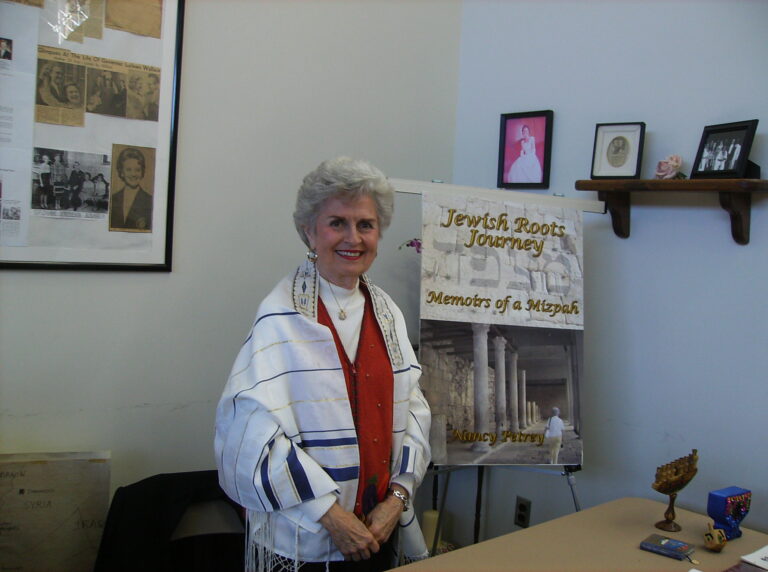
Nancy Petrey
Nancy Petrey is the author of Energion title Jewish Roots Journey. You can learn more about her via her author page. Her book is on sale via Energion Direct for just $15.00 (free shipping in the U. S.), or $2.99 off the regular price. God loves unity! “And the two shall become one flesh” (Gen. 2:24). God modeled unity in the Garden of Eden with the marriage of the first man and woman. The Apostle Paul quoted this verse to teach that Jesus and the Church were like husband and wife, united in one flesh (Eph. 5:22-32). The greatest demonstration of love the world has ever known was when the Bridegroom laid down His life for the Bride. And the greatest love the Bride can show for the Bridegroom is to submit her life totally to Him. Unity is all about love. Unity is the essence of the God we believe in. “Hear O Israel: The Lord our God, the Lord is one” (Deut. 6:4)! God proclaims the unity of the Godhead, so, of course, He expects unity in His covenant people. That word, “one,” is echad in Hebrew. It is a compound word. Christians can see the Trinity in that word. Jesus made the bold claim, “I and My Father are one” (John 10:30). Paul ends his second letter to the Corinthians with this benediction, affirming the Trinity, “The grace of the Lord Jesus Christ, and the love of God, and the communion of the Holy Spirit be with you all. Amen” (II Cor. 13:14). Yes, amen! Jesus wants His followers to be in unity. He prayed to the Father right before His arrest and crucifixion that those who believe in Him would be one just as He and His Father are one. He prayed that His followers would be included in the divine oneness. That marvelous witness of unity would be what the world longs to see!(John 17: 20-23). Who could resist the allure of a Church who truly loves its own enough to die for them? That is the divine strategy for winning the lost – unity! The Church today needs to understand just who Jesus was referring to in His high priestly prayer for unity. The average Christian who reads John 17 most likely thinks of divisions he is familiar with, such as racial, ethnic, parent-child, husband-wife, employer-employee, political, religious, educational, or economic divisions. Those types of division are real and touch everyone on the planet. No doubt Jesus grieves over these divisions, but the division he most longs to see healed is that of Jew and Gentile. The original Church was totally Jewish for ten years, with Jewish bishops in Jerusalem. The first church split happened in the second century between Jewish and Gentile believers, and it resulted in a paganized kind of Christianity that forgot its Jewish origins. This led to anti-Semitism and persecution of Jews during the Inquisition, the pogroms, the Crusades, and right up to the Holocaust, all at the hands of the Church! This is documented history and very tragic. Most Christians don’t know a thing about it! And many in the Church do not even realize the Jewishness of the Head of the Church, Yeshua HaMashiach (Jesus Christ). Jesus made it clear at His first coming that His mission was primarily to His own people, the Jews, not the Gentiles. Jesus sent out His twelve disciples, saying: “Do not go into the way of the Gentiles, and do not enter a city of the Samaritans. But go rather to the lost sheep of the house of Israel.” After His death and resurrection that line of division was eliminated when He gave the “Great Commission” to His Jewish disciples – “Go, therefore, and make disciples of all the nations, baptizing them in the name of the Father and of the Son and of the Holy Spirit” (Matt. 28:19). It is significant that He named the Trinity in His command to bring all nations into His kingdom. The big heart of God is longing to bring everyone into His kingdom. He is not willing that anyone should perish! He invites all to be one with the Godhead! Incredible!
God does not show partiality, but He does have order in the way He operates, and the Jews come first. On the Day of Pentecost the Holy Spirit first came to 120 Jews and baptized them with “tongues of fire” on their heads and in their mouths! In Jerusalem the visiting Jews “from every nation under heaven” heard the gospel in their own language, and 3,000 believed! (Acts 2). No doubt they went back home and began discipling others, just as Jesus had commanded.
Paul kept the order Jesus initiated, saying that the gospel was for the Jew first, then the Greek or Gentile (Rom. 1:16). He always first visited the synagogue in every place he went, even after he said on two occasions that he was finished with the Jews and would go to the Gentiles (Acts 13:46; 18:6).
The Church gained more and more Gentiles as Paul went on his missionary journeys. He taught them their Jewish roots, saying to the Ephesians that as Gentiles they “were without Christ, being aliens from the commonwealth of Israel and strangers from the covenants of promise, having no hope and without God in the world. But now in Christ Jesus you who once were far off have been brought near by the blood of Christ. For He Himself is our peace, who has made bothone and has broken down the middle wall of separation, … so as to create in Himself one new man from the two, thus making peace, and that He might reconcile them both to God in one body through the cross, thereby putting to death the enmity” (Eph. 2: 11-16).
In those days it was a curious thing that Gentiles could join the Jews as part of God’s covenant people. The Jews were in. The Gentiles were out. Paul called it a “mystery” that God had revealed to him, previously hidden in other ages, “that the Gentiles should be fellow heirs, of the same body, and partakers of His promise in Christ through the gospel” (Eph. 3:3-6).
May Gentile Christians rejoice that we, as “wild branches,” have been “grafted into” the Jewish “olive tree.” We should not be conceited and “boast against the natural branches.” We, like the Ephesians, must respect the Jewish roots of the Church and remember “we do not support the root, but the root supports us” (Rom. 11:17-18).
Having this understanding of our Jewish roots, Christians should prayerfully and practically support the nation of Israel, love the Jewish people, and seek to bring them to a knowledge of their own Jewish Messiah. Jesus is longing to see One New Man in His Church!!
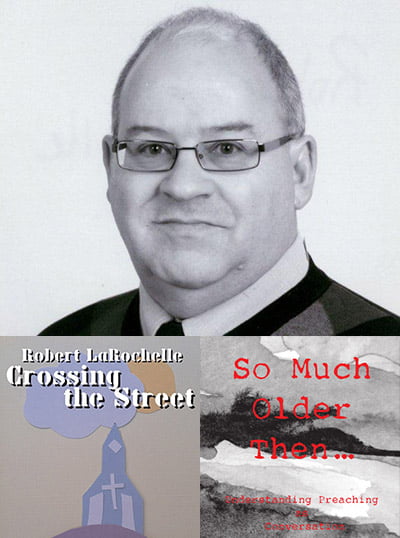
Bob LaRochelle is the pastor of 2nd Congregational Church (UCC) in Manchester, CT and is author of Part-Time Pastor, Full-Time Church (Pilgrim Press, 2010), Crossing the Street (Energion Publications, 2012) and So Much Older Then … (Energion Publications, 2013). He was an ordained deacon in the Catholic Church before becoming a United Church of Christ pastor. He is passionate about ecumenical dialogue.
The recent election of Francis I as the Roman Catholic Church’s new Pope has attracted great worldwide interest and justifiably so. First and most obvious is the fact that the election of a new Pope is a significant time of transition for Catholics. In light of many unfortunate occurrences, including well known scandals, within the Catholic community, this particular election carries with it a hope for a new beginning and some substantial changes.
Of course, depending upon where individual Catholics might rest on the theological spectrum, there are significant differences over precisely which specific changes should occur. There is diversity of thought within Catholicism regarding such policy changes as allowing priests to marry and ordaining women priests, just to name but two examples among many. One’s position on policy changes is connected to something far deeper. Policy flows from theology and theological differences have and continue to exist within the Catholic Church. They flare up in discussions on the topics mentioned above, as well as homosexuality, contraception, the relationship of church doctrine and public law, and many others.
Any Papal election is significant because the Pope is a world leader and has the potential to serve as a bridge builder between and among cultures, religious perspectives and nations.
Any Papal election is significant because the Pope is a world leader and has the potential to serve as a bridge builder between and among cultures, religious perspectives and nations. What is quite interesting is that etymologically the term Pontifex associated with the ministry of the Pope literally means ‘bridge builder’. In addition to the capacity a Pope has to influence world events, he can be a great source for the unification of all Christians, be they Catholic, Protestant or Orthodox. In my view John XXIII and his successor Paul VI were significant catalysts in the way Vatican II expressed the Church’s understanding of ecumenical relationships.
In my book Crossing the Street(Energion Publications, 2012), I contend that Catholics and Protestants, two Christian groupings that have had a checkered relational history, have much to gain in learning from and engaging in dialogue with one another. Despite some different interpretations, oftentimes flowing from different understandings of church authority, there is a true ecumenical center binding Roman Catholics and Protestants together. In his role as the most recognized Christian religious leader in the world, the Pope can do what others have done before him. He can be an influential leader in the necessary cause of Christian unity.
All of which brings us to the election of this man who will go by the title Pope Francis I. As I note in my book, Roman Catholicism is not monolithic. It is comprised of a pluralism and diversity of spiritualities, theological perspectives, starting points and devotional practices. With this in mind, it is thus important to look at the shape of this new Pope’s particular practice of Catholicism with an eye as to how that might influence his leadership. In this vein, I find the following facts about his life to be quite telling and illuminative:
Pope Francis I is a Jesuit. As a member of the Society of Jesus, founded by Ignatius of Loyola, he is part of a religious community that takes the notion of religious community itself most seriously. The Jesuit tradition has made major contributions to the Catholic Church and the Christian world in these significant ways:
The church’s intellectual tradition. No community of priests as a whole receives a broader and deeper education than those who belong to the Jesuit community. This integration of faith and reason has had a profound impact on the world. We Americans can readily identify many truly outstanding universities (Georgetown, Holy Cross, Boston College, to name but a few) that are run to this day by the Society of Jesus. On a personal note, I am so grateful that I have received degrees from two of these simply wonderful educational institutions.
The church’s spiritual tradition. Pope Francis is grounded in the Spiritual Exercises of Ignatius of Loyola, one of the most profound prayer experiences constructed by a mere mortal! Those who enter the Jesuit priesthood have undergone a period of training in which a 230 day retreat centered on these exercises is a necessary component.
Jesuit spirituality is intrinsically linked to its relationship to social justice. The Jesuit community has a global vision, rooted in the church’s stated preferential option for the poor. It is clear that Pope Francis’ compassion for the poor is a hallmark of his approach to pastoral leadership. Some would sound a cautionary note here, one that is worth watching as his Papacy unfolds: There is a chasm between those who embrace ‘liberation theology’[1] and others who express concerns about it. It appears that the new Pope has been among those in the latter category, especially in events that took place in Argentina over thirty years ago. It remains to be seen what this bodes for the future.
He chose the name Francis, in deference and respect to Francis of Assisi. It seems clear from all indications that this Pope eschews a pompous lifestyle and favors simplicity and access to the people whom he pastors. There are those, including myself, who would contend that, regardless of specific policy changes or lack thereof, a Pope could make an incredible impact by changing the image of the Vatican. My early sense is that there is something of Pope John XXIII’s warmth and informality in Pope Francis, somewhat akin to that fictional Pope depicted in Morris West’s classic The Shoes of the Fisherman. The power of that witness could truly make for an incredible effect.
Finally, there was a less than subtle theological/ecclesiological emphasis in the Pope’s opening remarks from the balcony of St. Peter’s. In referring to himself as Bishop of Rome, he issued a reminder that is often lost on many in the Christian world, including a good number of Catholics. Historically, the Petrine ministry, that which Catholics situate in the Pope, rested in the unique role Rome’s bishop played among those other bishops with whom he governed the church. It could be stated that Rome’s bishop is a ‘first among equals.’
There are those, including myself, who would contend that, regardless of specific policy changes or lack thereof, a Pope could make an incredible impact by changing the image of the Vatican.
I would contend that in referring himself in this way, we learn something about an approach to church governance that is most conversant with the historical growth of the Catholic Church and takes its first few centuries as highly informative, not limited its perspective to the medieval model that has wielded great influence in the church for so long. Where this Pope stands in relation to the kinds of questions that dominated Vatican I and other periods of debate over church authority cannot be easily gleaned from these remarks, but the remarks themselves might just scratch the surface of something the implications of which are most profound.
With all of this being said, I believe that this Papacy will be a significant period in the life of the universal church, a church that thrives as the gifts of varied traditions within it are cherished and become resources for our deepened relationship with God.
May all of God’s children thus turn to our God as we pray for Pope Francis’ health, well being and a deeply prophetic ministry to us and with us, in this, God’s most needy world!
AD MAJOREM DEI GLORIAM![2]
[1] This emerged in many nations in Central and South America and was a powerful force in the tensions between governments and religious leaders within the Roman Catholic Church. If ever possible, see the film Romero as a powerful expression of this.
[2] ‘To the greater glory of God’. This is the motto of the Society of Jesus (The Jesuits). It is typical to find the letters A.M.D.G in the cornerstone of buildings at Jesuit colleges, retreat centers and other settings.
We had three wonderful sets of answers to the questions posed in our interview about transforming mainline congregations. The entries were:
Bruce Epperly – If the message isn’t relevant, it isn’t the gospel!
Bob LaRochelle – Renewal should be rooted in good theology.
Bob Cornwall – Taking up a missional identity places the focus on what God is doing in the world and joining with God in that work.
There is still much that could be said about this topic. I invite you to comment on this post or blog about this on your own blog and then add the link. We’ll be happy to provide a central point to list all the responses to this topic.
I’d also like to make a couple of notes about the our three interviewees.
Bob LaRochelle just released his latest book from Energion Publications, So Much Older Then … In this book he models an interactive form of preaching with congregational dialog. In doing so, he addresses some of the most difficult questions a pastor will hear in ministry.