
Category: Ministry

  • Idea Summary: Empathy

    Idea Summary: Empathy

    From the book The God of the Growing Edge

    Empathy plays a crucial role in social change by fostering understanding, compassion, and connection among individuals and communities. Here are some key points on the role of empathy in social change:

    1. Understanding Others’ Experiences: Empathy allows individuals to understand and share the feelings of others, particularly those who are marginalized or oppressed. This understanding is essential for recognizing the injustices and challenges faced by different groups.
    2. Building Compassion: Empathy cultivates compassion, motivating people to take action to alleviate the suffering of others. Compassionate individuals are more likely to engage in social activism and support policies that promote equality and justice.
    3. Creating Connection: Empathy helps build connections between diverse groups by highlighting common human experiences and emotions. These connections can bridge divides and foster solidarity, which is vital for collective action and social movements.
    4. Inspiring Advocacy: When people empathize with the struggles of others, they are more likely to advocate for change. Empathy-driven advocacy can lead to the development of inclusive policies and practices that address the needs of all community members.
    5. Promoting Non-Violence: Empathy encourages non-violent approaches to social change by emphasizing understanding and dialogue over conflict and aggression. Empathetic individuals are more likely to seek peaceful solutions to social issues.
    6. Enhancing Leadership: Empathetic leaders are better equipped to understand the needs and concerns of their constituents. This understanding enables them to make informed decisions that benefit the broader community and drive positive social change.
    7. Encouraging Inclusivity: Empathy promotes inclusivity by recognizing and valuing the diverse experiences and perspectives of all individuals. Inclusive practices are essential for creating equitable and just societies.

    In summary, empathy is a foundational element of social change, as it drives individuals to understand, connect with, and advocate for others. By fostering empathy, we can create a more compassionate and just world.

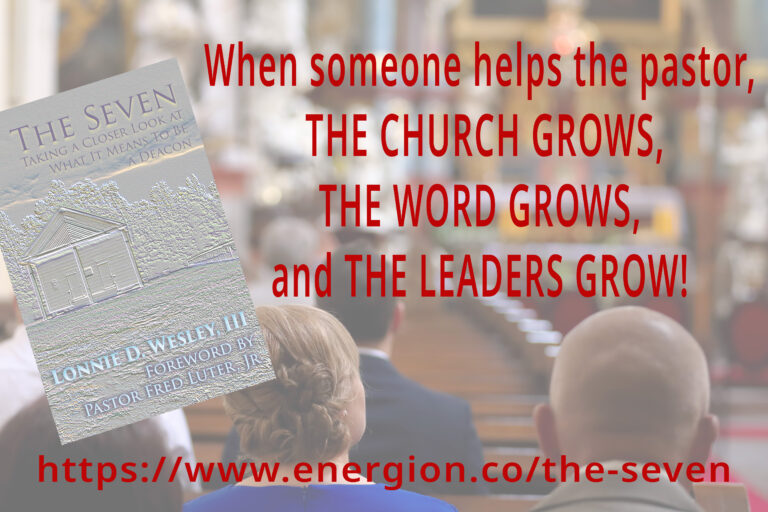
  • When Someone Helps the Pastor

    When Someone Helps the Pastor

    When someone helps the pastor,
    THE CHURCH GROWS,
    THE WORD GROWS,
    and THE LEADERS GROW!

    Lonnie Davis Wesley, III, The Seven: Taking a Closer Look at What It Means to Be a Deacon, p. 81
    People are sitting in the church during mass and empty space for text
  • Press Release: Love Me to Life

    Press Release: Love Me to Life

    https://energiondirect.info/wp-content/uploads/2021/01/press-release-love-me-to-life.pdf
  • Can Christians Use Reiki?

    Recently, as our congregation’s sexton was changing the sermon title on the congregation’s marquee, a woman drove up and asked him, “Are you the new age church?” He responded, “We’re part of the United Church of Christ and our pastor is a biblical preacher.” She continued, “But, how can you be Christian? You’re celebrating earth day and have reiki group meeting at church on Saturday. This isn’t Christian; it’s pagan.”
    My sexton was surprised at her comments. When he reported them to me, I was equally surprised, although I understood where she was coming from. I realize that many Christians have narrow views of healing and inspiration, and limit God to their own doctrinal or liturgical orthodoxy.
    This woman is not alone. I have heard a similar critique leveled by many other conservative Christians. They assume that because reiki isn’t described in scripture or doesn’t emerge from their brand of “orthodox” Christianity or has Buddhist roots, reiki should be abandoned, if not denounced, by those who uphold what they believe to be authentic Christianity. A number of years ago, even the USA Roman Catholic Bishops deemed reiki incompatible with Catholic beliefs and challenged its use in Catholic hospitals. In all these cases, I believe such judgments come from failures to adequately research reiki and the medical studies indicating its health benefits as well as theological viewpoints that narrow Christian healing to the recitation of certain words or the utilization of certain liturgies.
    Theology matters, and what we believe about God, the scope of Jesus’ ministry, and the nature of truth and healing shapes how we understand medical practice, science, bioethics, and the use of reiki healing touch and other complementary forms of health care.
    In two books, The Energy of Love: Reiki and Christianity (Energion Publications) and Reiki Healing Touch and the Way of Jesus (Northstone Books), I have argued that reiki healing touch is congruent with Christian faith and reflects the spirit of Jesus’ healing ministry. In the spirit of John’s Gospel, I affirm that God’s light shines in all things and that divine wisdom is available to everyone. The true light of God shines on everyone. Grounded in John’s vision, early Christian theologians proclaimed the university of the Divine Logos, or Sophia, and asserted that wherever truth is found, God is its source. To this, I would add, wherever truth and healing are found, God is its source, even if Christ’s name is not spoken. God is present and at work in the operating room, the pharmaceutical laboratory, the chemotherapy clinic, and in the practices of those who give reiki healing touch and other complementary medical treatments. Jesus came that we might have abundant life, and whatever authentically contributes to abundant life participates in Jesus’ healing ministry. Reiki complements Christian faith in the same way as counseling, psychotherapy, and pharmacology share in Jesus’ aim at wholeness, most of which are utilized by more conservative Christians.
    I recognize the need for critical theological thinking. In fact, my two books on reiki healing touch present sustained arguments for the integration of Christianity and reiki healing touch. Jesus himself recognized the efficacy of healers outside his immediate circle of disciples (Mark 9:38-41) and invited his followers to be open to “greater things” in their ministries. (John 14:12) The Reality in whom we live and move and have our being surely embraces a wide variety of healing practices, including liturgical laying on of hands as well as complementary healing practices like reiki.
    As a Christian minister, I join reiki with my faith in Jesus and see reiki as an extension of Jesus’ healing ministry, in the same way as the Healer from Nazareth used a variety of methods himself from touch and exorcism to anointing, forgiving, and welcoming. I use the name of Jesus when I apply reiki healing touch and assume that God’s energy of love flows through me whenever I give a treatment. Just as “energy” or “power” flowed from Jesus to a woman experiencing hemorrhages (Mark 5:30), this same energy flows though us, whether we use reiki, laying on of hands, or anointing. Thus, when someone asks, “Can Christians use reiki?” my response is a resounding “Yes.”
    Dr. Bruce G. Epperly, pastor, professor, retreat leader, and Energion author of Healing Marks: Healing and Spirituality in Mark’s Gospel, Process Theology: Embracing Adventure with God, Galatians: A Participatory Study Guide, Angels, Mysteries, and Miracles, Finding God in Suffering: A Journey with Job and more.


  • William Powell Tuck: The Art of Preaching (Video Interview)

    You’ll get some good ideas about preaching from Dr. William Powell Tuck, author of Energion titles Overcoming Sermon Block, The Forgotten Beatitude, and A Positive Word for Christian Lamenting. Also check out the Energion Direct category Preaching.

    [slideshow_deploy id=’2745′]

  • William P. Tuck: Defining Our Neighbor in Today's World

    William P. Tuck: Defining Our Neighbor in Today's World

    by Dr. William Powell Tuck, friarsfragment.com, retired pastor, professor and author of The Forgotten Beatitude: Worshiping Through Stewardship, A Positive Word for Christian Lamenting: Funeral Homilies, The Church Under the Cross, and more!
    Jesus told his followers to love one’s neighbor as one’s self. (Mark 12: 28-34). Who is your neighbor? Jesus defined neighbor in his parable about the good Samaritan. Can you imagine Jesus telling a Pharisee, who even thought fellow Jews were unclean, that a Samaritan was his neighbor? Who did Jesus make a hero? A half-breed Samaritan! No, the Pharisees and other Jews would not have been too thrilled with that hero. In fact, when Jesus asked the Pharisee which of the three he thought had been neighbor to the man who fell among the thieves, he would not even say “Samaritan.” He replied simply: “The one who showed him kindness” (Luke 10:37). This parable focuses on those who talk a lot about religion but in time of need only walked by. The priest and the Levite walked by on the other side of the road and left the man in his pain after he had been robbed. The good Samaritan saw the need of his neighbor and came to his aid.

    Who then is a neighbor? My neighbor is anybody who needs help. A real neighbor reaches out with spontaneous love and extravagant graciousness to help someone in need. There is a need, and we reach out to meet it. Can we turn our back on the refuges in the world or shut our borders to them and still claim we are following the teachings of Jesus?

    The original meaning of our English word neighbor comes from an Anglo-Saxon word which meant “nigh boor” the person who lived “nigh”–near you. The person nigh you might live in the next hollow, on the hill nearby, in the valley below you–anyone nearby. But Jesus doesn’t want us to see our neighbor simply as somebody who happens to live next door, or on the next hill, or over in the next hollow, or in the valley, or on the next mountain peak. Any person who has a need is your neighbor and mine. Persons fleeing persecution around the world are indeed our neighbors.

    The test of real love is not in talk but in action. Love is not limited to feelings but is most visibly realized in service. The real neighbor in the parable of the good Samaritan was the one who reached out and ministered to another person in need. It is one thing to talk about love and another thing to practice it. Who is your neighbor? Any person who has any kind of need at all is your neighbor and mine. When you and I listen to the television news or read the paper and learn about hurting persons around the world, these persons are neighbors too. If we shut our eyes to the immediate needs at hand or around the world, we refuse to be neighbors as God wants us to be. Wherever there is hurt, pain, sorrow, hunger, prejudice, or disease, there is an opportunity to be a neighbor.

    But the tough question then arises: How can I really be a neighbor to others, even if I know there is a need? How can we love our neighbor as we do ourselves? That seems a tall command. Let me make several suggestions on how we can love our neighbor. First, to love my neighbor does not mean that I have to like him or her. If you and I are honest, there are a lot of folks who are hard to like! When we see some of the ugly things they do or say, they are not easy to like. But Jesus didn’t say that we had to like our neighbors, but we were to love them. This might sound like we are playing with words, but, I believe, there is a real difference.

    Now let’s be honest! We all do a whole lot of things from time to time that we don’t like about ourselves, but we keep on loving ourselves. And that is the same way we need to act toward our neighbors. The reason we can do this is because the love which Jesus is talking about here is not an emotion. This love is not based on goose bumps or our feelings. Agape is love that directs the will to actions. Agape is an effort of the will. This is the kind of love that Jesus is calling us to have here. You may not like what somebody does, but you can love them and try to overcome the bad behavior and respond to a higher way.

    Secondly, we can love another person as our neighbor if we treat him or her like we want to be treated ourselves. This teaching is summarized in the golden rule where Jesus taught: “Do unto others as you would have them do even also unto you.” If you and I would act toward other people as we want them to act toward us, then we could love them. This attitude means that you will not do anything to belittle another person, hurt them, or harass them. Your goal is to help them. You act kindly toward them because you know that is the kind of response you would like in return from them. When you and I treat other people as we want them to treat us, it gives us a different perspective toward them. If we see another person merely as someone we can manipulate, abuse, hurt, or criticize, then we do not see them as we want to be seen ourselves. We know that is not the way we act toward ourselves or want others to respond to us. We want to act toward them as we would want them to act toward us.

    Thirdly, you can love your neighbor when you recognize that you cannot be indifferent to another person’s needs since you are not indifferent to your own. You cannot ignore needs in your own self. If you never responded to any of your own needs, you could not really exist. You have to meet those needs in your own life, whether they be food, water, sleep, or friendship. Our awareness of our own needs should make us more sensitive to our neighbor’s needs. This awareness should keep us from shutting our eyes and folding our hands and ignoring our neighbor. He or she is a person who wants love and care.

    Fourthly, we can love our neighbors if we recognize that they are persons of worth and are loved by God, just as we ourselves have sensed that we are persons of worth and we too are loved by God. Even at times when we may feel the most unworthy and unacceptable to God, the good news is that God still loves us. Jesus expressed this in the way he reached out to persons in every walk of life. Tax collectors were among those who were often rejected by their fellow Jews in the time of Jesus. Nevertheless, Jesus reached out to Zacchaeus and called Matthew to be one of his disciples. Mary Magdalene, who was most likely a prostitute, was also forgiven of her sins by Jesus. Jesus called his disciples from every walk of life to follow him. He communicated to all of them that they were persons of worth and were loved by him. He reached out to the hurting people of humanity–the blind, the lame, and the deaf. He reached out to people who were rejected and told them that God loved them.

    Jesus didn’t say that this commandment was going to be easy. Loving God with your total being is certainly not easy. Loving your neighbor as yourself is likewise not easy. But think of the radical difference there would be in our world if we could really love God with all our personality and love our neighbors as we love ourselves. In the early church what often made the real difference in how society responded to the first Christians was not their theology but their love for each other. Others observing the early Christians would often remark: “Behold, how they loved one another.” Do they say that today? How can the world see that kind of love in the constant fights in our denominations, the quarrels in our churches, and especially in how we treat our needy neighbors around the world in their time of need. I for one want to welcome the stranger, the refugee, and the immigrant as my neighbor. “Behold how they loved one another” needs to be a refrain in the life of the church once again.

    We cannot build real communities on hate. They must be built on love. Helmut Thielicke has suggested that we need to turn the lawyer’s question around. We do not need to ask, “Who is my neighbor,” as the Pharisee asked. Our question should be, “To whom am I a neighbor?”i Needs are all around us in our world today. Jesus has told us that the commandment to love our neighbor as ourselves is like the one about loving God. “Love your neighbor as yourself,” Jesus has instructed us. Let us as Christians get up and be about our Lord’s business as we confront the needs near us and around the world.

    i Helmut Thielicke, The Waiting Father (New York: Harper & Row, 1959), p. 168.


    [slideshow_deploy id=’2745′]

  • David Alan Black: A Marathon Plan

    by Dr. David Alan Black, professor, marathon runner, mountain climber and author of Seven Marks of a New Testament Church, Running My Race: Reflections on Life, Loss, Aging, and Forty Years of TeachingThe Jesus Paradigm, and more!
     
    Dave facing the MatterhornIs your church up to doing a marathon? A marathon is 26.2 miles. It’s a slugfest. But you finish by taking one step at a time. So here are 26.2 ideas to get you started and maybe even keep you going to the end.
    1) If you are a pastor, I might suggest that you stop training for “chief ministry provider” and start training for “chief ministry developer.”
    2) Let us rid ourselves of the “consumerism” mentality once and for all. It stands opposite to the “body ministry” as described in the New Testament.
    3) As leaders, let’s commit ourselves to discovering and employing the untapped potential that exists in our churches.
    4) The shift from the “ministry of the clergy” to the “ministry of the laity” is one of the most important decisions facing the church today. Let’s make it.
    5) Let’s self-identify first and foremost as a servant. Only one class of people exists within the church, servants of the Lord Jesus Christ. Within that class there will always be different functions, but servanthood is incumbent upon all of us.
    6) (Read More)


    [slideshow_deploy id=’2299′]
     

  • Ron Higdon: The Challenge of Change

    by Ronald Higdon, retired pastor (including intentional interim ministry), adjunct professor, and author of In Changing Times: A Guide for Reflection and Conversation and Surviving a Son’s Suicide
    in-changing-times-coverA reporter was interviewing an elderly Kentucky farmer and posed an obvious-answer question: “You’ve been farming for over sixty-five years; I bet you’ve seen a lot of changes in that period of time, haven’t you?” The farmer replied, “I certainly have. And I’ve been against every one of them.”
    This is not unlike the song sung by Groucho in an old Marx Brothers movie that has this recurring line: “I’m against it!” This is the theme song of many who see change as only danger and threat. I often quip that I have pastored some churches with the unstated but obvious philosophy: “Come weal or come woe, our status is quo.”
    The above examples keep one in the negative and “kickative” mode because change is the one constant in life that can always be counted on. It is one of the great inevitables written large in the universe. Only of God’s consistency in his grace, mercy, and love can it be said: “As it was in the beginning, so it is now, and so shall it ever be, world without end.”
    A friend was recently talking about some changes that are about to be made in the church of which we are members. Her comment was: “Nothing in my world has remained the same. It seems that everything I have loved and cherished is no more. I guess I had always assumed that at least I could count on my church remaining the same.”
    Books have been written on the impact of the not only increasing amount of change in our world but of the rapidity with which it has come. I told my friend who was lamenting the changes in her life, even in the church, that each day when I get up I look out the window to make certain I’m not living on another planet. Many have brought to our attention our basic dilemma: those of my generation were educated to live in another time and now we find ourselves living in this time. My seminary education was excellent but it certainly did not prepare me for ministry in the church-world of today.
    The reference has been lost but not the story of the Bishop who was meeting with a group of pastors and began his session with the announcement that he had good news and bad news for them. He asked them which they wanted first. After a brief pause, one of the pastors spoke up: “Give us the bad news first.” “It is more difficult to be in pastoral ministry today than in any other time I have known.” After a brief period of silence and heads nodding in approval, the request came: “What is the good news?” The Bishop smiled and confidently announced, “If the fifties ever come back, we’re ready!”
    The impossibility of this kind of “back to the future” does not have to be spelled out even though the attempt to live it out remains in evidence. We shouldn’t have to be told, “There are no trains to yesterday.” We know the intellectual truth of this, even though some continue to wait at the Nostalgia Station for the Express to the past. It’s not coming.
    The time is now. It is not the same as it was in the past and, when the future arrives it will be different than what we are experiencing but, of course, will not be called the future but the present, the now. This is the only time zone in which we can live and in this “new time” in order to live with purpose and hope I believe, that basically, we have to see the changes in our lives as challenges and opportunities.
    In 1980, William Bridges wrote a book titled Transitions: Making Sense of Life’s Changes. He offered what I believe continues to be solid advice: “Whether your chose your change or not, there are unlived potentialities within you, interests and talents that you have not yet explored. Transitions clear the ground for new growth. They drop the curtain so the stage can be set for a new scene. What is it, at this point in your life, that is waiting quietly backstage for an entrance cue?” The challenge in this he spells out in one sentence: “To have a new beginning you need to acknowledge an ending.”
    Why is it so difficult for us to acknowledge that some things are simply over? Endings are usually never swift or easy and are hardly ever complete. I maintain that successful beginnings always depend on reasonably successful endings. The grief process in mourning our losses plays a large part in successful endings and varies greatly with the nature of the loss (ending) and the way we have dealt with previous losses.
    It is not always easy to view change as a time of transition and the opportunity for a new beginning. But that is what it is – if we are determined to be truly alive in the moment in which we are living. Just because something is difficult (and what worthwhile thing isn’t?) doesn’t mean it is not meant to be a part of our learning and growing in God’s world for this time. Who knows what fresh beginnings await us? A lot depends on how we handle the changes that will only keep coming.
     
    [slideshow_deploy id=’3528′]

  • Ruth & Esther: What Can We Learn from Immigrant Women in an Patriarchal Society?

    Dateline: July 5, 2016, Energion Pulications’ Tuesday Night Google Hangout with host, Henry Neufeld, and Dr. Bruce Epperly, author of Ruth and Esther: Women of Agency and Adventure.

Energion Direct
Privacy Overview

This website uses cookies so that we can provide you with the best user experience possible. Cookie information is stored in your browser and performs functions such as recognising you when you return to our website and helping our team to understand which sections of the website you find most interesting and useful.