
Category: Process Theology

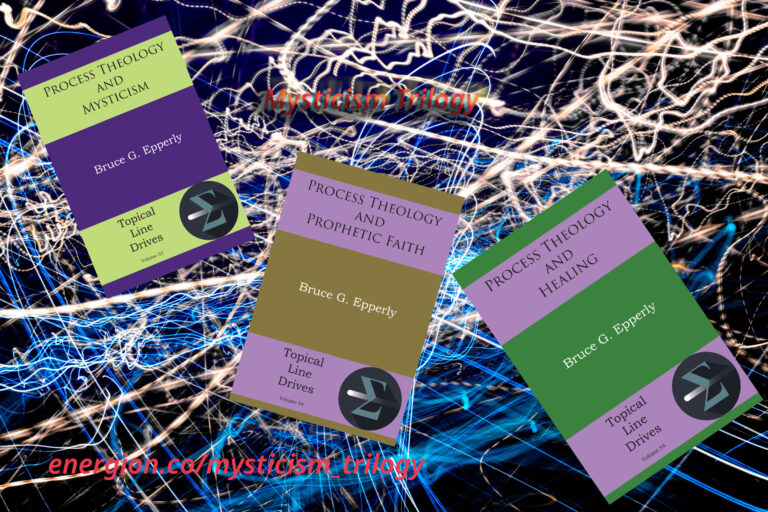
  • Mysticism Trilogy Shipping Soon

    Mysticism Trilogy Shipping Soon

    The ebook editions of these three books, Process Theology and Mysticism, Process Theology and Prophetic Faith, and Process Theology and Healing, have been available since December 5, but there was a delay in the print editions. We will be honoring pre-order pricing of $6.99$4.99 through January 31. Shipping will begin early next week.

    See An Adventure in Mysticism for more information.

  • Making Process Theology Make Sense

    George Bernard Shaw once noted that the professions are conspiracies against the laity. We see this dynamic often when we visit our physician or attempt to have a conversation with an attorney. Many of us are baffled by the vocabularies of our automobile mechanics and computer technicians as well. That certainly is the case for the relationship of theologians to laity. Complicated and often undefined words, and complex doctrinal formulae, baffle laypeople, leading to the assumption that theology is utterly irrelevant to their lives and that theologians have little or no concern, or worse yet, value to issues in the “real” world.
    Sadly, the gap between theologians and laypersons is also evident the work of many process theologians. While there is a place for academic theology and the linguistic richness of Whitehead’s thought, many process theologians’ desire to be true to the insights and language of Alfred North Whitehead often renders process theology incomprehensible, even to congregants who hold advanced degrees. A friend of mine tells the story of her pastor, who preaches an explicit sermon on a theme in process theology once a year. His congregants greet him in the receiving line after worship with the words, “interesting sermon” or “that was profound” and then remark to one another in the parking lot, “Did you understand anything he said? It was way over my head!”
    When I tell my congregants, as I regularly do, “You’re a theologian,” they shake their heads and respond, “Not me. I’m no theologian.” To which I reply, “Anyone who thinks about matters of life and death, about the meaning of life, and their personal calling is a theologian.” Accordingly, good theology must address people where they live and work, responding to their hopes and dreams, their individual aspirations and political ideas. While often the term “practical theology” is used, like most adjectival terms, as a diminutive compared to the “real” theologians, that is, systematic theologians, the most meaningful theological reflection is profoundly practical. Theology, at its best and most profound, should emerge from and then illuminate our everyday experiences of hope and fear, meaning and doubt, aging and adventure, living and dying.
    I have been fortunate to be bi-vocational most of my professional life. For nearly forty years, I have walked the halls of ivy as a seminary, medical school, graduate school, and undergraduate professor. I have spent virtually all those years as a pastor at the congregational and university levels. I have gone straight from the classroom and my keyboard to the hospital, a funeral, or a counseling session. I have taught theology in every congregational venue, and my pastoral experiences have shaped my theological reflections. I have lived my theology – especially process theology – in dealing with issues of life and death of body, mind, and spirit; community involvement; congregational and institutional budget priorities.; and guidance on issues of values and meaning in personal and professional life.
    I have lived the process vision’s focus on possibility, relationality, creativity, and freedom in my personal and professional life, believing it to be a faithful description of what it means to follow the way of Jesus in our time. In the process, I have coined the term “theospirituality” to describe the intimate relationship of theology and spirituality, Spiritual experiences are the wellspring of theological reflection. Without the encounter with God, there would be no theology. Conversely, theological reflection serves as a means of understanding our mystical and life-changing experiences and describing them in ways that are both healthy and congruent with reality as we know it.
    My anticipated five-part series on process theology with Energion Publications is an attempt to make process theology come alive for laypersons as well as pastors and spiritual leaders. Beyond the current, Process Theology: Embracing Adventure with God and Process Spirituality: Practicing Holy Adventure, I envisage at least three more volumes related, respectively, to ministry, politics, and bioethics. In the first two books and the projected series as a whole, I have sought to join academic rigor, that is, faithfulness to the insights of process theology, with a commitment to communication and transformation across a broad spectrum of lay and professional preparation. I believe theology touches the heart and hands as well as the head, and theology that emerges from experience can be expressed in ways that interested laypersons and pastors can understand and communicate as well.
    In some sectors, reflection on a theological treatise leads to the question, “Will it preach?” While not all theological reflection needs to address lay and pastoral concerns, eventually good theology is embodied in accessible teaching and preaching.
    I believe that you can “live” process theology. You can embrace the dynamic, interdependent nature of life; the vision of a relational God who calls you to be a partner in healing the earth; and you can live ecological values in relationship to the non-human world. I believe that in this daily embodiment, mind, body, spirit, and relationships are integrated in a way that brings joy to us and joy to the world.
    Bruce G. Epperly is the author of over 45 books, including Process Theology: Embracing Adventure with God and Process Spirituality: Practicing Holy Adventure. He is also the author of various Energion Scripture studies including, Finding God in Suffering: A Journey with Job and Jonah: When God Changes as well as Angels, Mysteries and Miracles: A Progressive Vision.

     
    [slideshow_deploy id=’2461′]

  • A Very Process Christmas

    Let me be the first person to wish you “A Very Process Christmas.” Process theology and Christmas just seem to fit together. That might surprise you, especially since process theology asserts that God acts naturally, through the regular processes of nature, and not supernaturally, showing up from the outside every so often to overturn the laws of nature to perform a miracle or defeat an enemy. Just the same, process theology joyfully proclaims the birth of Jesus, Mary and Joseph’s beloved child, and the boy who grew up to be healer, reconciler, prophet, and world-changer. God was in the stable and God is in our lives, too! Every day is an advent adventure in which can train eyes for signs of new birth in a world of threat and challenge.
    Alfred North Whitehead asserts that the world lives by the incarnation of God. God moves everywhere and in all things, seeking beauty and love. Each moment emerges from God’s inner inspiration. God midwifes each person’s journey, seeking to bring forth the holiness within. God seeks abundant life for every creature, urging all things toward wholeness.
    The world incarnates God! Emmanuel, “God with us,” is just as real today as it was in Bethlehem’s stable. A child is born in Bethlehem and a baby cries in a refugee camp, recalling the fact that shortly after Jesus’ birth, the holy family set out on a refugee journey to Egypt.
    Walt Whitman once said, “All is miracle.” Meister Eckhart affirmed that “all things are words of God.” Julian of Norwich rejoiced that something as small as a hazelnut contained the fullness of God’s energy. If a hazelnut can emerge from the fullness of God, so can the baby growing in a mother’s womb.
    Process theology proclaims that each moment is an epiphany and every encounter an incarnation. Christ is in us, and we can become Christ-bearers in our place and time.
    Bethlehem’s stable is not an anomaly but the revelation of what God is doing everywhere. Our world is full of wonder, and the same love that grew day by day in Mary’s womb grows in every person’s life. God gives life to our souls, but also our cells, even at the moment of conception.
    The birth of Jesus expresses the wonder-full world in which we live. The child in the manger is a miracle child, manifesting God’s holy light and giving light to all creation. But, my grandchildren and the children in your life are also “miracles,” energetic incarnations of divine love. They too take birth in an amazing, complicated, and often challenging world.
    At Christmas, we listen for angelic voices, and for process theologians there are angels around every corner. Every moment brings a message from God and divine messengers abound. God’s angelic messengers speak in our hearts, inviting us to share in the birth of God in our world today.
    God also comes to us as the magi from the East, revealing God’s many-faceted wisdom giving life to every authentic spiritual quest. The unique revelation of God in Jesus of Nazareth also shines in the holy words and people of other faith traditions.
    Christmas celebrates God’s birth in a baby in an occupied land. Today, Christ’s brothers and sisters will take birth among Syrian refugees, inner city parents, Appalachian coal miners, grieving friends and relatives Las Vegas, Newtown, Paris, and Beirut, and suburban households.
    The word in all its messiness and tragic beauty lives by the incarnation of God! Look under the Christmas tree and you’ll discover God with us. Have a very process Christmas!
    Bruce G. Epperly is the author of over 45 books and a number of Energion titles, including Process Theology: Embracing Adventure with God and Process Spirituality: Practicing Holy Adventure He is also the author of various Energion scripture studies including, Experiencing God in Suffering and Jonah: When God Changes as well as Angels, Mysteries and Miracles: A Progressive Vision.

     
    [slideshow_deploy id=’2461′]

  • A Different Kind of Liberal

    Allan Bevere posted a link to three posts by Roger Olson, in which Roger successively defined Fundamentalist, Evangelical, and Liberal. Now Energion author, United Church of Christ pastor, and theologian, Dr. Bruce G. Epperly, responds to Roger Olson’s definition of Liberal.
    A growing number of liberal Christians are rethinking what it means to be liberal. Many of us are choosing to call ourselves “progressive” as testimony to our dynamic, energetic theological naturalistic vision of reality. We don’t see ourselves or our theologies as “shallow, insipid, plastic, and fuzzy,” as Olson suggests. In fact, despite the inherent limitations of every theological vision, theology is important to us – a lively, well-articulated theology that privileges the love of God, the partnership of God and humankind in healing the world, original wholeness rather than original sin, the affirmation of science, interdependence, and spiritual practices that are both heavenly minded and earthly good.
    For the most part, we are universalists, but our universalism joins heaven and earth and this world and the next and joins grace and judgment in a realm where “love wins.” What we do matters as we seek God’s vision “on earth as it is in heaven.” God will not rescue us, nor can God violate the laws of nature just to get us out of a jam, personally or institutionally. The world process is such that God cannot stop nuclear warheads originating in either North Korea or the United States.
    God needs us to be companions in healing the earth. We don’t wait passively for a long-expected Second Coming nor do we create universally-mistaken time tables of Jesus’ return. God comes to us – and all creation – in every moment, inviting us to choose life for ourselves and our descendants. We look forward to the afterlife, but affirm the holiness of embodiment, the non-human world, and the creative process. To progressive Christians, these this-worldly affirmations are at the heart of historical dynamism of biblical theology.
    And, we affirm the spiritual, miraculous, and paranormal without reliance of supernatural interruptions of the predicable patterns of nature! While “old school” liberals may have minimized – even denied – anything spiritually-oriented, such as the healings of Jesus, contemplative practices, or accounts of interactions with angels and demons, our naturalistic theism sees divinity embedded in every moment, joins spirit and flesh, and affirms leaps of energy often identified with the miraculous. In contrast to the three-story universe, still affirmed in much popular theology and its historical antecedents, our world is multi-dimensional and spirit-filled. We can affirm the existence of “higher beings,” both positive and negative in spirit, just as we recognize in everyday life beings less complicated than ourselves. Our faith tells us that although we are created in God’s image, we are not the crown of creation.
    Old school liberalism is often accused of being purely horizonal, with no room for dramatic acts of God. While both liberals and progressives see God’s presence as primarily contextual, immanent, and relational, many of us believe that there are also decisive moments – often identified with spiritual and physical healings and mystical experiences. These moments are not “supernatural,” that is, disruptive of the trustworthy patterns of nature, but reflective of the gentle, and sometimes lively providence of an ever-present, always active God, whose power is relational rather than coercive. In certain moments, there is a congruence between God’s graceful aim at wholeness and our openness to divine healing and inspiration. While answers to prayer may be unexpected and surprising, our prayers, or better yet, God’s prayers within us in terms of “sighs too deep for words,” create a field of force in which God’s “working for good” can be fully realized. The healings of Jesus involve life-transforming manifestations of what is present at the depths of creation.
    I have tried to articulate a robust, open, well-grounded, and clear theological vision throughout my teaching and writing career. I believe that progressive Christianity, with its vision of naturalistic theism, divine-human partnership, and global interdependence can be a catalyst for personal and social transformation, inviting us to expect great things from God and great things from ourselves as God’s companions in healing and wholeness.
    (For more on this progressive vision, I recommend a number of my books – Angels, Mysteries, and Miracles: A Progressive Vision; Healing Marks: Spirituality and Healing in Mark’s Gospel; From Here to Eternity: Preparing for the Next Adventure; Reiki Healing Touch and the Way of Jesus; The Energy of Love: Reiki and Christian Healing; God’s Touch: Faith, Wholeness, and the Healing Miracles of Jesus; Process Theology: Embracing Adventure with God; Process Theology: A Guide for the Perplexed.)
     
    [slideshow_deploy id=’2461′]
     

  • Bruce Epperly: Ruth, Esther, and Process-Relational Theology

    by Dr. Bruce G. Epperly, pastor, professor and author of Process Theology: Embracing Adventure with GodRuth and Esther: Women of Agency and Adventure, and more!
     
    Ruth and Esther CoverThe Bible is a book of relationships and nowhere is it more evident than in the Books of Ruth and Esther. Ruth’s and Naomi’s survival depends on their care for one another and the kindness of strangers. Brought to power against her will and hiding her Jewish identity, Esther springs into action when Mordecai reminds her that God is work in these chance, and unpleasant events, to raise her up for just such a time as this. Queen Esther calls for fasting and praying. The young queen herself is transformed from a concern for individual survival to a commitment to the survival of her people, regardless of the cost to herself.
    The God the Bible is a relational God. Abraham Joshua Heschel speaks of God’s relationship to the world in terms of the divine pathos. God cares. God is concerned about weights and measures, foreclosures, and the relationship between piety and poverty. If you don’t care for the poor, the prophet Amos asserts, you will soon experience a famine of hearing God’s word.
    In the Biblical tradition, humankind is made for relationships. Although Jesus prized prayerful solitude, he reached out to the marginalized, vulnerable, and forgotten. He embraced the “nuisances and nobodies” (Crossan) as well as the rich and powerful. Jesus saw God as a loving parent, who feels our pain and rejoices in our celebrations. When Jesus proclaimed that as you have done unto the least of these, you have done upon me, he asserted that is God is touched, changed, and transformed by what happens here on earth in our relationships with one another. He also affirmed that God is constantly calling us to be faithful to God’s vision of healing, abundance, and Shalom.
    The most pitied person in Biblical theology is the self-made individual – the man who builds a barn, contemplates contentedly his wealth without gratitude or generosity, and then dies that night. Paul’s image of the body of Christ suggests that we truly do experience one another’s joys and sorrows. When one suffers, all do; when one succeeds, all celebrate. We are intimately connected in what Martin Luther King described as the “beloved community.”
    Today, process-relational theology describes the spirit of scripture insightfully and inspirationally. In process theology, we are joined. Everything we do shapes our neighbor, and we are shaped by the environment from which our lives emerge, whether this environment is spiritual, familial, educational, communal, economic, political, or planetary. We truly live in an ecological universe in which everyone matters and no one can truly succeed without the well-being of others.
    Cover1In my books on Ruth and Esther and Process Theology, I have sought to explore the practical implications of scripture and theological reflection. Ruth and Esther remind us of the need for generosity and a secure social safety net. They clearly tell us that our flourishing and survival depends on a benevolent community of relationships to which we are obligated to contribute. Process theology takes the insights of Ruth and Esther one step further in proclaiming the global interdependence of life. What we do here radiates across the planet and contributes to the good or ill of people we may never meet. In process theology, every decision, including business, economic, and governmental is personal and global. Every decision brings more beauty or ugliness to the world and to God’s experience. Ruth and Esther and process theology invite us to move from individual self-interest to world loyalty, to go from individualism to servanthood, and to the place the well-being of others on par with our own. Yes, we must protect ourselves, but not by spiritual or political walls. Our calling is to do something beautiful for God, to recognize our profound dependence upon others and our responsibility within the intricate interdependence of life, and then commit ourselves as individuals, community members, and citizens to doing something beautiful for God and this good earth.
     
    [slideshow_deploy id=’2461′]

  • A Very Process Christmas

    by Bruce Epperly

    Epperly picLet me be the first person to wish you “A Very Process Christmas.” Process theology and Christmas just seem to fit together. That might surprise you, especially since process theology asserts that God acts naturally, through the regular processes of nature, and not supernaturally, showing up from the outside every so often to overturn the laws of nature to perform a miracle or defeat an enemy. Just the same, process theology joyfully proclaims the birth of Jesus, Mary and Joseph’s beloved child, and the boy who grew up to be healer, reconciler, prophet, and world-changer. God was in the stable and God is in our lives, too! Every day is an advent adventure in which can train eyes for signs of new birth in a world of threat and challenge.
    Alfred North Whitehead asserts that the world lives by the incarnation of God. God moves everywhere and in all things, seeking beauty and love. Each moment emerges from God’s inner inspiration. God midwifes each person’s journey, seeking to bring forth the holiness within. God seeks abundant life for every creature, urging all things toward wholeness.
    The world incarnates God! Emmanuel, “God with us,” is just as real today as it was in Bethlehem’s stable. A child is born in Bethlehem and a baby cries in a refugee camp, recalling the fact that shortly after Jesus’ birth, the holy family set out on a refugee journey to Egypt.
    Walt Whitman once said, “All is miracle.” Meister Eckhart affirmed that “all things are words of God.” Julian of Norwich rejoiced that something as small as a hazelnut contained the fullness of God’s energy. If a hazelnut can emerge from the fullness of God, so can the baby growing in a mother’s womb.
    Process theology proclaims that each moment is an epiphany and every encounter an incarnation. Christ is in us, and we can become Christ-bearers in our place and time.
    Bethlehem’s stable is not an anomaly but the revelation of what God is doing everywhere. Our world is full of wonder, and the same love that grew day by day in Mary’s womb grows in every person’s life.   God gives life to our souls, but also our cells, even at the moment of conception.
    The birth of Jesus expresses the wonder-full world in which we live. The child in the manger is a miracle child, manifesting God’s holy light and giving light to all creation. But, my grandchildren and the children in your life are also “miracles,” energetic incarnations of divine love. They too take birth in an amazing, complicated, and often challenging world.
    At Christmas, we listen for angelic voices, and for process theologians there are angels around every corner. Every moment brings a message from God and divine messengers abound. God’s angelic messengers speak in our hearts, inviting us to share in the birth of God in our world today.
    God also comes to us as the magi from the East, revealing God’s many-faceted wisdom giving life to every authentic spiritual quest. The unique revelation of God in Jesus of Nazareth also shines in the holy words and people of other faith traditions.
    Christmas celebrates God’s birth in a baby in an occupied land. Today, Christ’s brothers and sisters will take birth among Syrian refugees, inner city parents, Appalachian coal miners, grieving relatives in San Bernardino, Paris, and Beirut, and suburban households.
    The word lives by the incarnation of God! Look under the Christmas tree and you’ll discover God with us. Have a very process Christmas!

    Bruce Epperly is the author of over 35 books and a number of Energion titles, including “Finding God in Suffering: A Journey with Job” and “Process Theology: Embracing Adventure with God.”
    https://energiondirect.info/authors/authors-d-k/bruce-epperly
Energion Direct
Privacy Overview

This website uses cookies so that we can provide you with the best user experience possible. Cookie information is stored in your browser and performs functions such as recognising you when you return to our website and helping our team to understand which sections of the website you find most interesting and useful.