Category: Uncategorized

  • What do we do when a loved one suffers?

    by Robert Martin

    Care GiverThis past summer, as we do every summer, my family (myself, my wife, and our two daughters), met up with my father, his siblings, and all of their families down to grandchildren—The Reunion of the descendants of Clyde and Fanny Martin. As always, it was an amazingly fun affair with many in-jokes being retold, those friendships that only cousins can have being renewed, and all the old stories being brought out and dusted off.
    But one thing struck me this time that I wasn’t sure I had noticed before. Without exception, everyone who was there had been through, either recently or in the not too distant past, some event of suffering and pain. Cancer was present in the room. Broken relationships were inscribed in the faces of spouses and children. Long term illnesses were still taking their toll. While poverty itself was not an issue, certainly finances were difficult for many. Mental illness was not unheard of in our gathering, either. Parents were dealing with difficult children, and even the children were impacted by all of these things as they had been watching and observing their parents, grandparents, aunts and uncles, and siblings struggle through the many different aspects of pain.
    This was, and is, my family. I don’t know if there are any other families out there like ours, but I would expect that in any such gathering, it would be a rarity for there not to be some form of suffering taking place. It may not be widespread, it may just be one or two people, but it will be there. And, along with those experiencing the suffering, there will always be someone close to the situation who, while the suffering is not their own,  must deal with it every day as caregivers.
    The attention in these family gatherings, many times, is on those who are experiencing the pain directly. We defer to the grand aunt facing chemotherapy. We give space and grace to the grand uncle wrestling with depression. The spouse having to break off the marriage is given comfort by many loved ones. But, what about the grand uncle who drives the aunt to chemo every week? Or the grand aunt who has to diligently be aware of her spouses depression? Or the parents of that broken marriage, tending to the many feelings of pain and anger? What do they do?
    My family has managed to answer these questions. Although, it wasn’t something that we distinctly chose to do, consciously. There was no declaration of “This is what we will do”. It was simply what happened. For us, it was a natural effect of us being family. When a family member is suffering and another family member is a caregiver, the whole family rallies. Prayer, emotional support, finances when needed, a shoulder to cry on, a caring ear, all these things, freely given. We are family. There is no question that we care for each other, both the person needing the care and the caregiver.
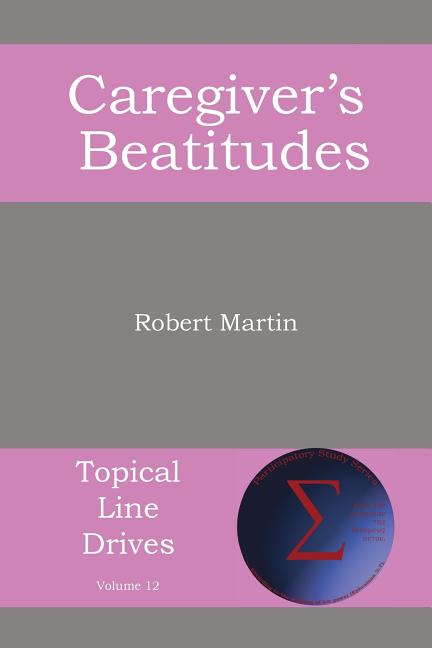
    In The Caregiver’s Beatitudes, one of the primary themes I express is the role that community plays in caring for a loved one and for the support of the caregiver. Alone, we will struggle, we will fight, but it will take everything that is in us. There are those who make it through alone, but those are extraordinary situations, I believe. Instead, I believe that the community plays an immense role in this dynamic. What do we do when a loved one suffers? We gather around them, we gather around the caregivers, and together, as a community, we support each other. This is what we do.


  • The problem with homelessness is us

    by Shauna Marie Hyde
    (For the complete post, click here)

    VicarRecently I lost someone who I never dreamed would be someone I would ever meet much less deeply love. Our story is told in the book, “The Vicar of Tent Town.” One day a few years ago I heard about some people living off the Elk River in West Virginia, so I went to see what was going on. It was a slippery muddy hike but I found them. They had cleared off an area and had tents set up with tarps overhead, a fire pit, and had made a fairly decent place to live.
    As I entered the camp, a man came up to meet me. We introduced ourselves and sat down to have a chat. Noah told me later that I was the first church person who had sat down and spent time in Tent Town. That simple act was what made him take me seriously and know that he could trust me.
    I began to visit often trying to bring needed items and to take them somewhere if they needed a ride. The church people began to accompany me or send donations if they were unable to go. Bit by bit they just became a part of the congregation. Noah became a dear friend. I learned a lot about homelessness from spending time with them and hearing their stories. I learned that many of them have jobs, many are educated, and many are cynical about church people. A lot of churches won’t help unless thy sit through a church service, have a long list of unobtainable rules and are so judgmental in their attitudes that they never treat homeless people as people. They get tired of the assumptions that they are lazy moochers, all of them are druggies, or are mentally ill, or are running from the law. There is plenty of that; however, there are two major populations of homeless people that might surprise you: veterans and kids running away from abuse and LGBTQ youth who have been kicked out of their homes.
    Did you know there are more empty buildings than there are homeless people in the USA? “There are more than five times as many vacant homes in the U.S. as there are homeless people, according to Amnesty International USA.” http://www.truthdig.com/eartotheground/item/more_vacant_homes_than_homeless_in_us_20111231 I could not even begin to guess at how many church buildings there are that often have empty rooms the majority of the time.
    How is someone living on the streets, working less than 30 hours per week because that was the only job they could find, supposed to save up enough money for rent, deposit, utilities and its deposit, etc.? What little money they make goes to food, required clothing for the job, and bus fare and basic survival.
    There was a time when anyone could find sanctuary in a church. Now people are more worried about their buildings, getting sued, vandalized, stolen from, and that something terrible will happen when they offer sanctuary. Guess what? Something terrible is happening without “those people” being around. We see life-threatening violence in schools, malls, and churches…and it isn’t “those people” doing it. That is a heartbreaking issue for another blog.
    When it comes to the homeless and working poor we are just too busy, too selfish, too focused on what we want, getting our way, etc., to offer people sanctuary. It is time to be proactive with world transformation! It is time to be the church and offer sanctuary to those who are hurting, lost, scared, unheard, and slipping through life as living ghosts.
    The irony is Christians worship someone who was homeless when he walked this earth. Possessions did not slow him down, people did. Guess what else? He was crazy – crazy in love with humanity! He was crazy enough to sacrifice a life of comfort and then life itself in order to offer the world sanctuary.   I propose revival! I propose we sell all the trappings and fancy accoutrements we believe we simply must have in order to worship a God who decided to become human and homeless in order to reach us. I propose we offer sanctuary to any and to all in the name of God who went to such great lengths to offer sanctuary to all of humanity.
    Who knows? Perhaps my friend Noah might still be alive and well on this earth.


    Order The Vicar of Tent Town here: http://direct.energion.co/authors/authors-d-k/shauna-marie-hyde/vicar-of-tent-town
  • Just how is God "recreating the world"?

    By Steve Kindle

    Somewhere in the world there should be a society consciously and deliberately devoted to the task of seeing how love can be make real and demonstrating love in practice….If God, as we believe, is truly revealed in the life of Christ, the most important thing [to God] is the creation of centers of loving fellowship, which in turn infect the world. Whether the world can be redeemed in this way we do not know. But it is at least clear that there is no other way. ~Elton Trueblood

    One of the most difficult realities for American Christians to accept is that nothing, and I mean NOTHING belongs to anybody. Every thing in the universe is the Lord’s. And every person. It’s difficult because we all conduct our lives in the midst of a consumer society that rewards acquisitiveness and power over others. As the bumper sticker proudly announces, “The one with the most toys wins.” So we live our lives competing against one another, and when we win, we feel very entitled to ownership of the spoils. As one of my parishioners put it when asked to help support a local “safety net” initiative, “I worked hard for what I have and no one’s going to take it from me.”
    No wonder congregations are uneasy during “Pledge Season.”
    Another strong disincentive for understanding biblical stewardship is that it has largely been reduced to issues of money. Our “Stewardship Moments” are confined to urging congregants to increase their annual monetary pledges. And on a typical Sunday, the worship leader may include the “many ways we give in addition to our bills and checks,” yet, the focus is on what goes into the collection plate.
    The only thing that can turn this around is a comprehensive understanding of stewardship that relocates the Christian from a consumer of church services to a caretaker in partnership with God of all that God gives us to manage on God’s behalf.
    Human beings were created for a high purpose—to collaborate with God in “tilling and keeping.” To till means to derive from creation what it is intended to yield for sustenance and comfort. To keep means to manage the tilling in such a way that those generations who follow will be able to derive from tilling the same level of sustenance and comfort. This two-fold process is intended to maintain a self-sustaining world into perpetuity, but only as long as we remember who owns it, and that it is not ours to usurp for our own advantage.
    God intended for Israel to be “a light to the nations,” a light that displayed for all to see how living by God’s intentions for the world would result in shalom, well-being for all.  The psalmists envisioned a time when all the world would ascend the hill to Jerusalem for instruction in God’s ways. Today the church’s calling  is to model a way of life built on, in Trueblood’s words, “the creation of centers of loving fellowship, which in turn infect the world.”

    My book is an effort to lift up this majestic calling that we humans are privileged to undertake by looking carefully at the biblical material, coming to see the world as God would have it, see how some of the Scriptures’ traditional meanings need to be reassessed, as well as find rich meaning in otherwise overlooked verses. I even provide a sermon in the final section.


    Here’s a link to a serious book review by a Bob Cornwall: http://www.bobcornwall.com/search?q=Stewardship

    Stewardship: God Way of Recreating the World can be ordered from Energion Publications at http://direct.energion.co/authors/authors-d-k/steve-kindle
  • Writers naturally want to share–You benefit

    Very soon you will be reading posts from Energion authors who have thought long and hard about issues facing the church and individuals, and put their helpful conclusions into books.  As the publisher of these writings, Energion wants to share with our readers some of these resources that you may have overlooked.
    Beginning August 3rd, each author who chooses to participate will provide three posts.  We hope you will read these and then offer your own helpful responses.  And if you discover value, there will be links for purchasing.
    So, here’s to good writing and good reading to come!

  • Watch This Space

    A new and highly collaborative program is about to be unveiled for this blog. If you are an Energion author, you will receive an email in the next few days announcing the program and soliciting your participation.
    Energion’s stable of 70 authors have published books across the theological spectrum and have raised questions and sought answers to the most important issues facing the church.  WATCH THIS SPACE and engage in the discussion of these issues. You may not always agree, but you will be challenged every day.

  • What Does Ordination Mean about Church Leadership

    What Does Ordination Mean about Church Leadership

    9781938434594Bob Cornwall, author of Unfettered Spirit: Spiritual Gifts for the New Great Awakening, has published an extract on ordination (The Biblical Call to Ordained Ministry). I think this would be a good launching pad for a discussion of the nature of ordination and what this means about church polity, if anything.
    Read Bob’s post first, but then think about this: Are there any functions of the church that should require the participation of an ordained minister? What are these things? Why does ordination only apply to one called to exercise pastoral gifts? (Does it?)
     

  • LaRochelle – The Meaning of Belief

    LaRochelle – The Meaning of Belief

    bob_for_netThis is the third in a set of responses to Philosophy for Believers. Links to all responses can be found in the introductory post to the series, along with a schedule of future posts.
    As I get older, I grow increasingly fascinated with the question of how one arrives where one does in terms of understanding one’s faith. In looking back over my life, I realize, as I have written elsewhere, that I was strongly influenced by a theological system that was built upon a philosophical foundation that emphasized the compatibility of faith and human reason. It is this background that I bring to this question and to the reading of Dr. Vick’s comprehensive overview.
    As I have come to see things, faith does not exist outside of reason. In other words, for faith to be faith, it need not be unreasonable. Intelligent, rational beings can accept scientific findings and theories, including that of evolution, and be able to posit a strong faith in both the presence and the current activity of the divine.

    While faith is not unreasonable, it does not depend on being proven.

    At the same time, faith does not require proof. While faith is not unreasonable, it does not depend on being proven. At the risk of jumping too far ahead in the argument to Aquinas, it must be noted that even Aquinas’ five ‘proofs’, in my view, point the evidence in the direction of God yet do not contain within them the absolute proof that would come from a direct manifestation of the divine in the present moment.
    Thus to Fred, I would say with Kierkegaard that for faith to be faith, there has to be the element of leap. I would also say that the leap is not only not unreasonable, but, to the contrary, is, in fact, quite reasonable. Thomistic claims of unmoved mover, first cause and the like make reasonable sense.  In asserting these arguments, one makes use of one’s mind to determine the validity of a claim for God. Yet the conclusion, while making sense, does not, as I see it, constitute absolute proof.
    With respect to Frederica, we are told that she believes that she can’t prove God’s existence. We are also told that she does not believe that you have to prove God’s existence to believe. It seems that Frederica, if she were to believe in God, would be more open to an experiential understanding of the divine, i.e. something that might move her spiritually and touch her heart. That experiential sense of the divine is very powerful in many people and has been in the history of religion.

    When it comes to the interplay of divine and human, there is so much that we simply do not know.

    When all is said and done, the bottom line for me is that for faith to be faith, it has to entail FAITH. In other words, when it comes to the interplay of divine and human, there is so much that we simply do not know. The not knowing does not negate the possibility or value of believing. It remains a necessary safeguard into thinking that we actually know more than we do, one of the great dangers in the history of religion!

  • Hushbeck – The Meaning of Belief

    Hushbeck – The Meaning of Belief

    Elgin Hushbeck, Jr.This is the third in a set of responses to Philosophy for Believers. Links to all responses can be found in the introductory post to the series, along with a schedule of future posts.
    There are a number of crucial issues in this chapter, but I think the best place to respond is on the issue of “proof” and “belief,” question #19 in the book exercises. “Fred believes that he can prove the existence of God. He believes that to believe in God you have to be able to prove that God exists. Frederica believes neither of these. What is the issue between them?”
    Having discussed what it means to believe, in chapter 3 of his book Philosophy for Believers  Edward Vick turns to the more controversial question of why we believe.  It is also where I have my first real disagreement with Vick.  I had two main issues with Vick’s discussion, the way he described the three main approaches, and his understanding of faith.
    Vick describes three main approaches to supporting religious beliefs, presuppositionalism, evidentialism, and fideism.  Unfortunately from my perspective the first two get a somewhat distorted presentation. For example, I would not fall into the presuppositionalist camp, but I was still somewhat surprised that as an example of presuppositionalism Vick choses the presupposition that:

    The Bible is to be taken as true and its world view is to be taken as the context and basis for all assertion we make. (p 58)

    While I agree with Vick that this is “a gross oversimplification” I have no doubt that supporters of presuppositionalism would say the same thing and would then go on to explain that the statement itself is an oversimplification of their views.
    Much the same can be said about Vick’s presentation evidentialism, though perhaps because it was closer to my beliefs, I found his presentation even more suspect.   For example, Vick writes that “both alternative views agree in their belief that the Bible is true. There is no need for proof or discussion of that assumption” (p. 59). That is not even close to my view. If, as an evidentialist, I believed that “there is no need for proof or discussion” about the Bible, then why did I write a book called “Evidence for the Bible?”
    Vick goes on to further claim that evidentialists make another presupposition that “the claims made in the very varied ‘books’ of the Bible can be shown to be true” (59).  Vick is not very clear on this point. If he means that evidentialists view at least some of them as testable and open to examination, he is correct. But this is a “presupposition” that investigators of any proposition make, be it in the realm of religion, history, science or any other type of claim.  As such it would be a valid point, but hardly an argument against evidentialism.
    If on the other hand, he means that evidentialists assume propositions are true before they can go “in search of ‘evidence’” that is at best simply false.   In addition, it would be a back handed way of claiming that evidentialists are biased and thus would be little more than a fallacious ad hominem attack.
    Finally, Vick claims the “hidden Presupposition is that faith is in some way depended upon possessing and understanding evidence” (p 60).  Again, this is simply false, but his error goes to the crux of the issue and is one of my major issue with Fideism, which Vick defines as, “We come to truth via faith, not reason.
    A big problem here is that Vick leaves faith undefined,except to quote August Sabatier, “Faith, which, in the Bible was an act of confidence and consecration to God.”  While I basically agree with this view of faith, it does not explain how in faith we come to truth.

    Faith is the confidence we have in a belief, more importantly it is the confidence we have that leads us to act.

    Faith is the confidence we have in a belief, more importantly it is the confidence we have that leads us to act.  We can believe that a bridge will hold our weigh, but it is only when we act and cross the bridge that we can be said to have faith.  We can believe in God, but if that belief does not affect how we live, then we do not have faith.
    In addition, faith cannot stand alone. It requires an object, i.e., something in which to have faith. An important aspect of faith is that it is separate and distinct from evidence.  While one’s faith may be supported by evidence, it can also be a blind faith that lacks evidence, or is even contrary to the evidence.  Likewise faith is independent of truth.  Different people can have a strong faith in differing and even contradictory beliefs.   In short, faith is a statement of confidence in a belief, it tells you nothing about whether or not the belief is true.
    As I pointed out last time, this is where evidence comes in.   To be clear, evidence is not required.  We are saved through faith, not through evidence and in fact, I believe many and probably most Christians came to a saving faith without any consideration of evidence.
    But if the question is asked, what should I have faith in, faith will not answer this question. The Mormon in the example I wrote about last time, had faith in Mormonism.  Atheists have faith in their beliefs.  Everyone has faith in a great many things, and live their lives accordingly.   Thus, with so many possible objects of faith how do we know what to have faith in?  Why should we have faith in Jesus but not Allah, Vishnu, or Buddha?
    This goes to the core of my problem with both presuppositionalism and fideism. Has God really left us to just randomly pick a presupposition or an object of faith?  Is it really, ‘You pays your nickel and you takes your chances,’ and then only after you die will you find out if you pick correctly?   The bottom line is that the only way one can objectively make a choice, or to know if your current faith is correct, is to look at the evidence.
    Having said this, let me say that I do agree with Vick’s closing remarks, i.e., these are not rigid camps and that we must beware of oversimplification.  In reality, probably no one is in a single camp.  We all hold some beliefs because of a presupposition, others because of evidence and still others because the way we live our life gives us confidence in our belief.
    But again, as Paul wrote in 1 Thess 5:21 “Instead, test everything. Hold on to what is good” (ISV).

  • Life and Death

    189372915x54But when they heard these things they became infuriated and ground their teeth against him. 55But being full of the Holy Spirit, he lifted up his eyes to heaven and saw the glory of God and Jesus standing at God’s right hand. 56And he said, “Look! I see the heavens opened and the Son of Man standing at God’s right hand!” 57But they cried out with a loud voice and blocked their ears and swarmed at him together. 58And they threw him out of the city and stoned him. And the witnesses put their cloaks at the feet of a young man named Saul. 59And they stoned Stephen as he called out and said, “Lord Jesus, receive my spirit.” 60Then he fell to his knees and cried out with a loud voice, “Lord, Don’t hold this sin against them.” When he had said this, he died.           Acts 7:54-60 (HN)
    Stephen gives us an outline of the right way to die. Now many of you may be thinking that you don’t particularly want to know how to die, and you don’t plan to get there very soon. But all of us will get there sooner or later, and it’s a good idea to know how to do it. But even more importantly, the way you’re going to die will have something to do with the way you live.
    One of the things Jesus came to rescue us from was the fear of death (Hebrews 2:14-18). Why don’t we have to fear death? For precisely the same reason that we don’t have to fear life. God is with us all the way!
    So what does Steven show us about dying:
    1. He died being God’s witness. The thing that made these folks angry was the testimony that Stephen was giving.
    2. He died filled with the Holy Spirit. He was able to know what God wanted him to know and see what God wanted him to see, because the Holy Spirit filled him.
    3. He died with his eyes heavenward, on Jesus. Think about it! He’s surrounded by people who want to kill him and he doesn’t look at them, or seek ways to get away. He’s looking at Jesus!
    4. He died forgiving those who hurt him. Like Jesus, it wasn’t people who asked forgiveness, it was people who were in the process of hurting him that he forgave.
    5. He died on his knees in prayer.
    6. He died trusting his life to God.

    The way we live is the way we will die.

    Now go back through the list, and replace each “he died” with “he lived.” Do you see what’s going on?
    The way we live is the way we will die. If God is with us, we have nothing to fear in either case.
    For I am already being offered, and the time of my departure has come. 4:7 I have fought the good fight. I have finished the course. I have kept the faith. 4:8 From now on, there is stored up for me the crown of righteousness, which the Lord, the righteous judge, will give to me on that day; and not to me only, but also to all those who have loved his appearing. 2 Timothy 4:6-8 (WEB)
    https://www.youtube.com/watch?v=Yp0_YyieyRY
    –written by Sabine Baring-Gould, sung by Jo Stafford & Gordon McRae
    (Cross-posted from Jody’s Devotionals. Used by permission.)

  • Introduction to the Psalter

    bob-2012-2sby Bob MacDonald
    What can I assume when I say introduction? I have met many who do a double take when I say the word Psalter. What is the Psalter? The Psalter is a set of 150 poems that were created between 2200 and 3000 years ago, and collected between 2200 and 2500 years ago. We call the poems ‘psalms’ but only 57 of them have this title in their inscription (in the Hebrew). The Jewish term is Tehillim, or ‘praises’.
    I have met one who asked if the Jews have the same Psalter as the Christians. From an introductory point of view, the answer is yes. If you worship in a Synagogue, you probably would recognize many of the psalms since they are the foundation of the opening of the Sabbath service. If you worship in a Christian congregation, you may, depending on your denomination, know several psalms from the Sunday services. But what do we mean by ‘the same’ Psalter?

    The Prayer Book leaves out several sections of the poems.

    The first translation of the Psalms from Hebrew was into Greek around the second century BCE. From that time, there were significant differences in interpretation. The Psalms were carried into the churches for over a millennium and even to today by Jerome’s Latin translation(s) from the 4th century CE. There are now for the English, so many different translations and presentations of the psalms that it is hard to begin to describe how different they are from each other. My Anglican colleagues will know the Psalms from the Prayer Book in a translation from the 15th century by Miles Coverdale. The Prayer Book leaves out several sections of the poems (see e.g. Psalms 109, 137). The Canadian 1959 Prayer Book leaves out Psalm 58 entirely. Psalm 58? The 58th psalm? If you were using the Greek or Latin translation, this would be the 57th psalm! So the differing Psalters even have different chapter numbers. And the English translations have differing verse numbers from the Hebrew.

    The Psalms teach us how to live with the multiplicity of troubles we encounter.

    How then can we begin to know this book? Do we even want to? The answer must be that we do want to but we won’t get there too easily. If we are Jewish, the psalms define for us our canonical history and lead us to our prayer for the nation, for the land, and for all peoples. If we identify with Jesus, the psalms teach us how ‘he learned obedience’.[1] Also they teach us how to live with the multiplicity of troubles we encounter. If we look at all the psalms used in the Epistle to the Hebrews in the New Testament, we could come to the conclusion that the Psalter is ‘the book of Scripture that represents the conversation between the Father and the Son’.[2] Christians particularly will want to learn the psalms for this reason alone.
    If we are of other traditions or none, these poems still represent an old and significant body of poetry that has been loved by many human beings. The Psalter is the most quoted of any Old Testament book in the New Testament. ‘Over one third of the 360 Old Testament quotations in the New Testament come from the psalms.’[3] Peter Flint at the Oxford Conference in 2010 listed for us the top 10 Qumran count of distinct scrolls as follows: Jeremiah – 6, Ezekiel and Numbers – 8 each, Daniel – 9, Leviticus – 16, Exodus – 17, Genesis – 20, Isaiah – 21, Deuteronomy – 31, and Psalms – 37. In the book arising from this conference,[4] his essay cites 43 psalms scrolls or manuscripts that incorporate psalms. Just these two statistics show us that the psalms were loved by the society of that inter-testamental period from the second century BCE to the end of the first century CE.
    An introduction must have some poetry – not just talk about it. Let’s read Psalm 3 first. The musicians among you will recognize that this is set by Henry Purcell in his verse anthem, Jehova, Quam Multi Sunt Hostes Mei. Here is the Coverdale version in modern English.[5]

    Psalm 3 Coverdale

    Lord, how are they increased that trouble me! Many are they that rise against me. Many there be that say of my soul, There is no help for him in his God. But thou, O Lord, art my defender; thou art my worship, and the lifter up of my head. I did call upon the Lord with my voice, and he heard me out of his holy hill. I laid me down and slept, and rose up again; for the Lord sustained me. I will not be afraid for ten thousands of the people that have set themselves against me round about. Up, Lord, and help me, O my God, for thou smitest all mine enemies upon the cheek-bone; thou hast broken the teeth of the ungodly. Salvation belongeth unto the Lord; and thy blessing is upon thy people.
    You will notice immediately that it looks like prose. A few carefully placed carriage returns will make this easier to read. Note that in the Hebrew, verse 1 is the inscription. The presence of an inscription often results in different verse numbering between the Hebrew (in parentheses) and English editions. Psalm 3 is the first psalm with an inscription.
    (1) A psalm: for David when he fled from his son, Absalom.[6]
    1 (2) Lord, how are they increased that trouble me!
    Many are they that rise against me.
    2 (3) Many there be that say of my soul,
    There is no help for him in his God.
    3 (4) But thou, O Lord, art my defender;
    thou art my worship, and the lifter up of my head.
    4 (5) I did call upon the Lord with my voice, and he heard me out of his holy hill.
    5 (6) I laid me down and slept, and rose up again; for the Lord sustained me.
    6 (7) I will not be afraid for ten thousands of the people
    that have set themselves against me round about.
    7 (8) Up, Lord, and help me, O my God,
    for thou smitest all mine enemies upon the cheek-bone;
    thou hast broken the teeth of the ungodly.
    8 (9) Salvation belongeth unto the Lord; and thy blessing is upon thy people.
    Coverdale ‘that trouble me’ is different from the translation that Purcell uses where ‘hostes’ would be translated as enemies. Yes, those who trouble me may well be my enemies, but they may well be just our own troubles, constraints, or worrisome thoughts too.[7]
    The repetition of ‘many’ underlines word recurrence, a common aspect of Hebrew poetry. Also to be noted is the parallel thought of verse 1 in the form a-b, a-b. Recurrence and parallelism are two techniques that are keys to reading and hearing the poem. These aspects of Hebrew poetry are often and sometimes unavoidably obscured by translation. In this case, what is obscured is the recurrence of ‘increased’ and ‘ten thousands’ that are from the same root and therefore have similar sounds in Hebrew, but not in translation. There are many translations in English, in Latin, and even in Greek. In the next section, the poem is from the Hebrew with a close translation.[8]9781938434419m

    Psalm 3 from Seeing the Psalter

    1

    A psalm of David,
    when he ran away from the face of Absalom his son

    2

    יהוה, how multiplied my straits!
    Many arise over me

    3

    Many say of me
    There is no salvation for him in God
    Selah

    4

    But you, יהוה, a shield about me
    my glory, and lifting high my head

    5

    My voice, to יהוה I call
    and he answers me from his holy hill
    Selah

    6

    I lie down and I sleep
    I awakefor יהוה supports me

    7

    I will not fear the multiplicity of people
    that surround set over me

    8

    Arise יהוה
    save me my God
    for you strike all my enemies on the cheek
    the teeth of the wicked you break

    9

    Of יהוה is the salvation
    On your people your blessing
    Selah

    Hebrew words: 70. Percentage of Hebrew words that recur in this psalm: 39%. Average recurring words per verse: 3.

    2 straits, צר (cr) or trouble, foe related to צרה (crh), צרר (crr), trouble, adversary, also part of the word for Egypt מִצְרַיִם (mitsraim lit. double straits). Straits imply a narrow space limiting or constricting movement. The Vulgate Jehova quam multi sunt hostes mei would imply that the straits are only external enemies. In this case, I think that is slipping from cause to effect.
    3 salvation ישׁע (ysh`) Note the related word הוֹשִׁיעֵנִי אֱלֹהַי (hoshieni elohai) save me, my God, in verse 8.
    in God, בֵאלֹהִים (b’lhym) Note that God is a frame in the poem. This is the first time we have seen this word Elohim. The preposition in is full of promise. It is possible that one could use an agency preposition, like by or even phrase the translation God won’t save him avoiding the preposition altogether. But doing this would impoverish our experience, for God is not the last minute cavalry in a Western film. Nor is God a distant hero who rides off in the dust after effecting salvation.
    8 strikeenemiescheek, teethwickedbreak is a reverse parallel, a-b-c, c-b-a.

    יהוה recurs six times in this poem, linking all three stanzas. God occurs twice and this is the first time this word is used in the Psalter. Multiplied – arise – salvation – God link the first and third stanzas. Verses 4 to 6, the second stanza, are linked to the outer stanzas only by the words יהוה, the connector כי (ky), and the word of unknown meaning, סלה (selah), often thought of as an interlude or pause, or even a change of pitch,[9] or da capo instruction (HALOT[10]), or weigh this (Vantoura[11]), but as will be seen repeatedly, not necessarily marking a sectional boundary. Many is the tie for the first stanza, verses 2 and 3. People frames the last stanza, verses 7 to 9.
    In this first psalm of David, the poet speaks in verses 2, 3, and 4 to יהוה, but in verses 5, 6, and 7, the point of view changes and the reader is addressed directly. Then in verse 8, יהוה is again addressed, with verse 9a perhaps for the reader’s ears also. Verse 9b may be the editor speaking to us. The point of view spans the stanzas determined by recurrence.
    Note the five repeated words in sequence that highlight the contrast expressed in the psalm between verses 2 and 3 and verses 7 and 8. The sequence highlights what it frames: verses 4 to 6. Rendtorff[12] (p. 323) notes how each verse of this psalm is Midrash on the story of David from 2 Samuel. One could imagine the poet meditating on his own or David’s life. Given also the effect of these psalms on an individual, one can imagine David’s writing this psalm from reflection on his own experience. Yet the psalm has people as a frame, so that we might not forget that wider context in which we live. The last frame in a psalm often acts as a focal point.
    Selected recurring words

    words1words2

    Some of the most touching music of the early polyphony of the 15th and 16th century comes from the story of David’s grief over Absalom (2 Samuel 18:33). It is perhaps significant that this first psalm of David begins with this inscription.

    Approaching the text

    The Psalter is not just a hymn book. It is also a story.

    There are so many possible questions. The one I have asked in Seeing the Psalter is this one: Is the Psalter a hymn book or is it a story? There are (only) 150 psalms in the Psalter. In many modern hymnbooks there are seven or eight hundred. No one would read a modern hymnbook in sequence. But the Psalter is not just a hymn book. It is also a story. Was the Psalter written all at once? No. Hymn books are collected over centuries and so is this collection of psalms. So – it is both hymn book and story, written over centuries and collected into a specific sequence.[13]
    The story in the psalms is the story of the history of Israel, a story meant to teach, a story with a purpose, a story that underlines Jesus’ statement from John 15:1: I am the vine. Before I began my study of the psalms, they were a jumble of ancient hymns to me. Goulder[14] has an apt phrase. The Psalms have been treated as so many independent units, flotsam washed up by the tides of the late centuries before our time. One of my objectives in my book is to see coherence in their organization.
    People often approach the psalms as if one could divide them by category or genre. This is a very difficult approach. For instance, there are traditionally 7 penitential psalms. In my summary of Book 2 of the Psalter, I note these 7 with a caveat that they are more than fits into the ‘penitential’ category.
    Perhaps the most remembered Psalm of Book 2 is Psalm 51, made famous by Gregorio Allegri in the sublime polyphony of his Miserere. Psalm 51, like Psalms 6 and 38, is a penitential psalm. Traditionally seven psalms are so named (6, 32, 38, 51, 102, 130, 143). Psalms 6, 38, and 51 are penitential. Each of these psalms, however, plays its role in the story of the Psalter in a way that this genre, as name, does not reveal. So Psalms 6, 38, 70, and 137 underscore a theme relating to remembering. Psalm 51, following Psalm 50, confirms that blood sacrifice is not the priority, but rather the offering of thanksgiving (Psalm 50), and the new spirit and clean heart (Psalm 51). Psalm 102, prior to the entr’acte of Book 4 is part of the frame for Book 4, balancing Psalm 90. Psalm 130 is one of the Songs of Ascent. Psalm 143 is part of the Davidic closing bracket for the Psalter.[15]

    A psalm reaches more deeply than can be encompassed in a one word summary.

    The terms ‘royal’ and ‘lament’ are equally problematic. They are too reductionist. A psalm reaches more deeply than can be encompassed in a one word summary.
    If we begin at the beginning, Psalms 1 and 2 are a pair framed by ‘Happy’:

    1.1 Happy the person
    who does not walk in the advice of the wicked
    and in the way of sinners does not stand
    and in the seat of the scornful does not sit …
    2.11 serve יהוה in fear
    and rejoice in trembling
    2.12 Kiss, each of you – pure lest he be angry
    and you perish in the way
    for he kindles as a hint of his anger
    Happy! all who take refuge in him

    If we move on to Psalms 3 to 6, we can observe the shape of the story. All these are psalms of David. David is in trouble (3.2); he makes demands and is answered with a one-verse rebuke (4.2-3); he makes promises and demands and describes his Lord (5); and then suffers a sharp rebuke for an unstated reason, but the result is known in that first penitential psalm 6. Psalm 7 reflects on the struggle, a shiggaion, a wild dance or a mistake. Psalm 8 celebrates the life of the children of humanity as a gift. Psalms 9 and 10 are the first of four acrostics in Book 1.
    Alphabetic acrostics are poems in which the initial letters of the verse or of sets of verses are sequenced by the letters of the alphabet. These occur only in Books 1 and 5. Psalms 9 and 10 taken together are a broken alphabetical acrostic. Seven of the twenty-two letters are missing or out of sequence.
    I say a great deal about the acrostics in Seeing the Psalter. They are the organizing principle of Books 1 and 5. They are marked in their places as play and as celebration, each one following a significant psalm. They mark the whole of the Psalter as a book collected and formed during or after the exile of Judea to Babylon.
    When we move on to Psalms 11-15, the stage is set with the question: who will guest in your tent, O Lord? Who will live with you? This question can serve as our approach to the Holy. The Psalter forms an approach to the Holy through the formation of a people who know mercy. Holiness is not then fully unapproachable, but it is to be approached through the covenant of mercy, a mercy that creates its own guest.[16] Book 1 continues with 8 poems leading to Psalm 24 which is followed by the second acrostic. Why these 8 poems? 16 – the claim that the one under mercy will not be abandoned; that the elect is ‘the apple of God’s eye’ (17), that there is a deep compassion going both ways (18); that the Torah is declared by the created order (19); that the king will triumph through great adversity, (20-23) and enter the Holy place (24). The people reach the Holy place in Book 5. The approach is long and difficult, yet only (in an image) a short distance up the 15 steps of the temple (the songs of Ascent, Psalms 120 to 134). One could see Psalm 120 as defining the movement from blackness and charade to the place of the Holy. You may remember Meshech and Kedar[17]. I recall many a chorister wondering where these places are.
    Woe is me, that I am constrained to dwell with Meshech,
    and to have my habitation among the tents of Kedar!
    woe to me for I am guest in a charade
    I dwell in tents of blackness
    I cannot say it is easy. Holiness has a reality that impurity cannot bear. But it is certainly not impossible and it is an invitation. We are instructed, again in the Epistle to the Hebrews, to approach the Holy place and to enter through the veil, that is to say, the flesh of Jesus, into the presence of God.[18] Here there is as our end, as shown at the end of the Psalter, continuous praise.


    [1] Hebrews 5:8, Revised English Bible.
    [2] Seeing the Psalter, Bob MacDonald, p. 5.
    [3] The Psalms through the Centuries, Susan Gillingham, p. 14.
    [4] Jewish and Christian Approaches to the Psalms, ed. Susan Gillingham, p. 11 ff.
    [6] Revised English Bible.
    [7] The other Vulgate is more like Coverdale: Domine quid multiplicati sunt qui tribulant me. Oh, how the translations multiply against me!
    [8] From Seeing the Psalter, pages 28 and 29.
    [9] Change of pitch would be inconsistent with the interpretation of the music proposed by Suzanne Haik-Vantoura.
    [10] Hebrew and Aramaic Lexicon of the Old Testament.
    [11] The Music of the Bible Revealed: The Deciphering of a Millenary Notation, Suzanne Haik Vantoura.
    [12] The Canonical Hebrew Bible, A Theology of the Old Testament, Rolf Rentdorf.
    [13] But note that some scrolls found at Qumran show differing orders especially in psalms from Books 4 and 5. See Flint (op. cit.) and Psalms dwelling together in unity, JBL Vol. 131, No.3 Ryan Armstrong p 502.
    [14] The Psalms of the Sons of Korah, Michael Goulder, p. 10.
    [15] Seeing the Psalter, op. cit. p. 228.
    [16] Come, my way, my truth, my life (3rd verse), George Herbert.
    [17] Psalm 120:5.

    [18] Hebrews 10:20.

Energion Direct
Privacy Overview

This website uses cookies so that we can provide you with the best user experience possible. Cookie information is stored in your browser and performs functions such as recognising you when you return to our website and helping our team to understand which sections of the website you find most interesting and useful.