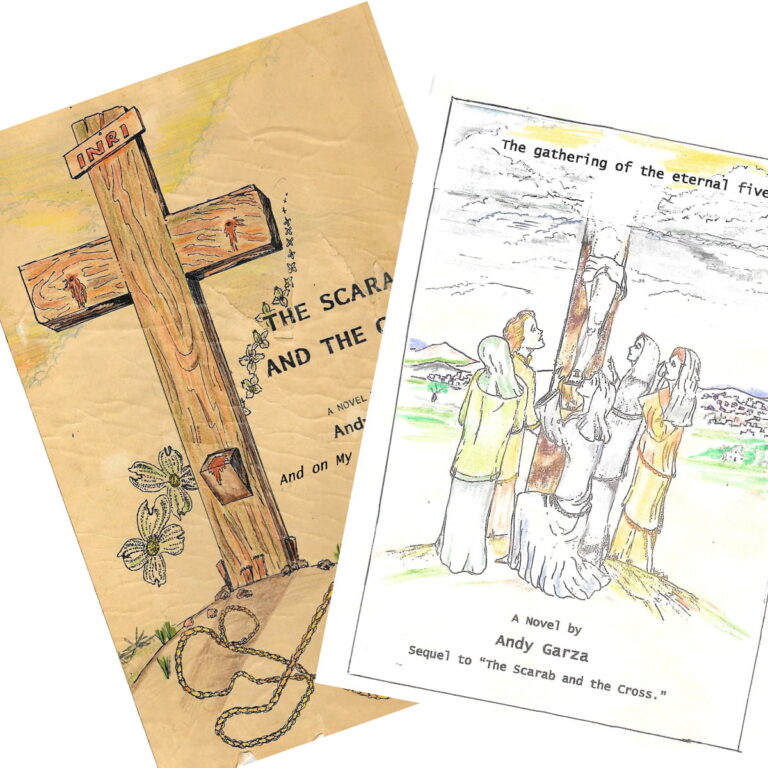
Category: Uncategorized

  • The Gathering of the Eternal Five: He Died – To Live Again

    CHAPTER FOURTEEN:  HE DIED – TO LIVE AGAIN


    MARY MAGDALENE AND THE OTHER MARY

    Our Master lies asleep and is at rest:

    His heart has ceased to bleed, his eyes to weep;

    The sun ashamed has dropped down in the west;

    Our Master lies asleep.

    Now we are they who weep and trembling vigil keep,

    and wrung heart in a sighing breast,

    While slow time leaps, and slow the shadows creep.

    Renew thy youth, as eagle from the nest;

    O Master, who hast sown, arise to reap;

    No cock-crow yet, no blush on eastern crest:

    Our Master lies asleep.

    CHRISTINA ROSSETTI, 1830-1894


    Through family gatherings in back patio comfort, Barroom chatter, back fence gossip spreaders and caravan news carriers, the stories of Jesus of Nazareth traveled to all ears that welcomed what they heard. In multiple languages and storytelling methods His life story became known to all that listened then re-told it like an echo throughout time. It was the season of life’s renewal over the earth. A world commanded by almighty Nature to rekindle the roots of olive and cypress trees alike. As a child awakening from a long sleep the entire world beamed with joy from the glorious rebirth of life all around. Nature restored the green blush on withered grasses into life once again. The white lily would rise once more from its enfolding tomb and bring joy to all by its resurrection. And like the lily rose from its moldy crypt to the life renewing sunlight, Jesus went from his grave to be with his father in heaven. Those with long memories and witnesses to the countless miracles of the Nazarene grew even stronger in their convictions by the numerous sightings of Jesus by reliable citizens. He was now regarded as Jesus, the Christ. The Messiah had lived among them, had endured the plots, ploys and schemes of men then died to rise into the kingdom of heaven. In his wake he left behind the only method by which man could find salvation from his sins. He left the keys to heaven in everybody’s hand.  Many worn out Gods and old faiths were thrown aside and from their worn out rubble emerged the birth of Christianity. The flawless white lily came to life.

    Then there were the disbelievers that came in droves to discredit the miracle of his return to life. It became a joke passed on by callous hearts that cautioned people to hold on to their clothes tightly. For if a gust of wind grabbed their garments, they could be mistaken for a rising Jesus.

    By so many efforts to discredit Jesus even the faith of his disciples suffered erosion. It was rumored that a reward was offered by the governing council to anyone who could find where the corpse of Iesus was hidden. Clearly stating by such an offer that they did not believe he walked out of his grave and was escorted into the sky on a cloud led by an angel. Others testified that money was offered to those that would discredit his miracles by offering logical explanations to how His tricks were done. People were rounded up and questioned severely regarding their miraculous cures. They searched for one person to admit they were not sick in the first place. They sought someone to say that his cures were a charade for publicity. They did it with malice and stone hearted effort to find no such individual. They sought false witnesses and found none, more than once. His disciples were hounded wherever they went and often found safe haven in burial caverns to escape the Hebrew council’s relentless pursuit. They branded Jesus a false prophet, a blatant trickster that stole away their congregations. The carpenter from Nazareth had dared to disrupt their profitable endeavors at the temple of God with his feverish tantrum. He was responsible for the loss of costly goods and money lost to his overthrowing of the money changers tables at the temple. To top it all he insinuated he was better and more righteous than the entire priesthood. He accused the Hebrew council of wrongdoing and misleading innocent people. He accused them of converting the house of God into a den of robbers. His behavior was a signed warrant for his death.

    Members that disagreed were cast out then sworn to secrecy. The carpenter had to die. Exile would not suffice. Many old members of their flock did not return to their religious leadership. Although their plotting was done in utmost secrecy, it was nonetheless known who would plot against the carpenter. Some members of their flock were silently displeased with their twisted sense of justice. It was clear to the man on the street that the carpenter with healing miracles and lessons coinciding with the laws of Abraham and the words of Moses was the target of the Hebrew council. Some members of the high level priesthood were so money hungry that a suffering citizen had to pay dearly for a simple prayer said in their behalf, as though their prayers had genuine medicinal value.

    And through all this they sought out the disciples of Jesus to castigate them and ensure that the works of the Nazarene were not repeated. The disciples were branded as outlaws and from there, a type of bounty hunter was born. Informers became co-workers of vigilante groups seeking to profit from the capture of the disciples of the Messiah. Mary Magdalene became a deeper subject of interest to the council. The Nazarene’s resurrection of her brother Lazarus was still a sore subject among some of the Hebrews in power. The cleansing of her spirit by the Nazarene was much talked about. She would be a stout devotee since it was also rumored she harbored a personal affection for Jesus. She was known to repeat many of his lessons in secluded corners and whispered voices.

    She, Martha and Lazarus were respectable high society members and to openly attack them would raise anger from the population. Mary Magdalene owned the castle Magdala and from several endeavors surrounding her property she reaped a handsome return, an          enviable handsome return. Her brother and sister owned large portions of property in Jerusalem as well as Bethany. Their adherence to the works of the Nazarene and their display of that devotion dubbed them outlaws and their properties a prize to capture.

    The scattered disciples fought to remain unknown and the more they hid and suffered the more their faiths eroded. Their devotion waned and rightfully so, without a leader to regenerate their trust they wandered aimlessly often seeking shelter to be denied. They went hungry and some people demanded a price to keep their silence. They knew their fate would be equal to that of Jesus, or perhaps stoning for repeating what was considered the blasphemous works of the Nazarene. They were human and frail of spirit without Jesus.

    UNBELIVING THOMAS

    There was a seal upon the stone,

    A guard around the tomb:


    The spurned and trembling band alone

    Bewail their Master’s doom.

    They deemed the barriers of the grave

    had closed over Him who came to save.

    And thoughts of grief and gloom

    Were darkening, while depressed, dismayed,

    silent they wept, or weeping prayed.


    He died; – for justice claimed her due,

    Ere guilt could be forgiven:

    But soon the gates asunder flew,

    The iron bands were driven;

    Broken the seal; the guards dispersed,

    Upon their sight in glory burst

    The risen Lord of Heaven!

    Yet one, the heaviest in despair,

    In grief the wildness was not there.


    Returning, on each altered brow

    With mute surprise he gazed,

    For each was lit with transport now,

    Each eye to heaven raised.

    Burst forth from each the ecstatic word –


    “Hail, brother, we have seen the Lord!”

    Bewildered and amazed

    He stood; then bitter words and brief

    Betrayed the heart of disbelief.

    Days passed, and still the frequent groan

    Convulsed his laboring breast;

    Then round him light celestial shone,

    And Jesus stood confessed.

    “Reach, doubter! Reach thy hand,” He said,

    “Explore the wound the spear hath made,

    The font by nails impressed:

    No longer for the living grieve,

    And be not faithless, but believe.”

    Oh! If the iris of the skies

    Transcends the painter’s art,

    How could he trace to human eyes

    The rainbow of the heart;

    When love, joy, fear, repentance, shame,

    Hope, faith, in swift succession came,

    Each claiming there a part;

    Each mingling in the tears that flowed,


    The words he breathed— “My Lord! My God!”

    I believe.

    THOMAS DALE,  1797-1870

    No such doubts reclined at the home of Tremiyo. There a stronger faith found comfort. The hysterical proclamations that the Nazarene was seen rising to heaven were simply echoes of prophesies long known and now glowing in reality. It was added stone and mortar to the faith that dwelled in the home of the faithful servant, Tremiyo. And his family followed suit. Samuel quickly learned not to voice any unfounded observations he may harbor regarding Jesus.

    It was here that Serou chose to speak of a subject lying near dormant in his mind. Almost apologetically he looked at his foster son and quietly asked him if he should relate what he saw Onofrio discover by entering the tomb of Jesus. Not knowing what Serou would say, but confident in the older man’s wisdom, Onofrio conceded with a silent nod of his head.

    “It was the first day of the week following the weekend that tormented and put Jesus in his grave. Monday morning, I decided to take Onofrio for a ride I thought would help mend the frightful weekend he spent sick and suffering nightmares. As we came through Yerushalayim, we met with huge crowds of panic driven people.  It seemed hysteria ruled the day and there was no end to it. “He has risen, unbelievers beware Jesus is alive. He has risen as foretold and was seen rising on a cloud into the sky”. “He has risen,” was the universal call. Not accustomed to Accept hearsay hysteria and with Onofrio’s consent, we drove to the site of His entombment to confirm the rumors for ourselves.

    In fearful hesitation, my son stood facing the tomb and I saw the few people loitering around, frightfully slither away when he entered that forbidden place. I stood by the entrance and could plainly see what Onofrio was searching for. We both saw the shelf cut into the wall and on it was a large dark stain. It had to be the dry blood of Jesus since the tomb was newly hewn, never been used before. I saw him run his hand over the dark stain then looked at his fingertips to confirm the blood stain was dry. He looked for smudges on the low ceiling left by an oily torch and found none. A burned out candle stub left behind by those doing such perilous work at night? And there was none. I could almost read his mind when he frowned while carefully looking around his feet. He looked for scuff marks on the dusty floor left by those struggling with an inflexible corpse. And he didn’t find any. It had rained heavily and not a muddy foot print was found. Not even a blade of grass caught on a sandal and left out of place within the tomb. As hard as he tried he found no evidence of human intervention and yet the body of Jesus was gone. Posted guards served four hour shifts and confident that no one could move the stone without an alarming sound rested in comfort. A guard struggling for sobriety and smelling foul claimed the disciples of the Nazarene slipped up and forced the sealing stone back up the slight incline and locked it in place with numerous stones without making the slightest sound.  I could see Onofrio’s sense of guilt come back from the false solution. Then a near sober guard added that an apparition of some sort came from the sky and with ease and calm enough to shame the puny strength of men gently pushed the sealing rock away from the opening. The apparition dressed in blinding white then added insult to injury by calmly sitting on top of the stone. The apparently seasoned soldier then added that as hard as they tried to stand up to the apparition, they were immobilized until all was done and Jesus was going into the sky. Then stated with sober resignation, “and there’s not a damned thing we could do about that.”

    With obvious reflection Serou stated in his diplomatic tone, “I have carefully removed all the physical possibilities and concluded that to move the massive stone up the slight incline without a grunt or a moan to wake up the guards would be impossible. That leaves only one conclusion and I for one am convinced that Godly intervention is the only answer. And to that statement several heads nodded in agreement.

    Here Onofrio chose to speak. “Part of me felt relieved that Jesus was taken unto heaven on a cloud as so many people reported. I felt that Jesus was home with his heavenly father as countless people said. But it did not discharge my sense of guilt. I feared vengeance from God for building the instrument of his son’s demise. In a way I cannot explain and in a recent dream I feel a closer bond to Jesus of Nazareth. I want to believe that Jesus and his heavenly father have forgiven me for my part in His death and yet a tinge of guilt and fear still simmers within me. I will tell everyone what I saw at Golgotha and found within the tomb ‘til I die. It is something no one can take from me. My day with the son of God and I will relate the fact that I found no evidence of human intervention within his tomb leaving only the obvious conclusion.”

    Impressed the semi-disbeliever son of Tremiyo, Samuel found room in which to reveal his thoughts. “Knowing your affection for truth, I believe what you say. Since carrying the inflexible corpse of a grown man without making a sound would be extremely difficult. I would say  almost impossible in that small confinement. And Onofrio found no evidence of human intervention. Then experienced grown men state that an apparition came from the sky and pushed the massive rock aside with an easy push can only be the work of a God sent emissary. People will long search for an earthly explanation when the truth shines bright before their eyes. We will all go to our graves knowing that we have lived with the son of God as our neighbor.” Then looking at Claudia Procula, he declared openly, “Sometime in the future I will look up this lady disciple of Jesus, Mary Magdalene and perhaps join her group to bring the facts of what we know to other disbelievers. Such stories could pay my way to China, someday.”

    The villa by the lake had been a revered place for Serou. It was where he brought his virgin bride Clavenia for their honeymoon. Here they languished in joyful pleasure for long hours and deep into every night. When their palatial home was finished, Clavenia was reluctant to move away from a beautiful place that brought so much joy to her heart. Nothing on earth could replace the happiness she found at the villa by the lake. Serou found ways to abbreviate his time away from her by using key personnel to fill in where he left off and still claim credit for an assignment well done. Without ever dreaming of it, here she was queen of the realm and every day her king proved it with flawless devotion. She preferred the isolation at the villa by the lake to the masquerade that often paraded through her new home. She despised it when she would see a guest slipping a spoon or fork under their clothes. It was her husband’s business that attracted so many people seeking favors, business opportunities or just a free meal with wine.

    Serou had soon regretted letting centurion Clemidius reside at the lakeside villa. But he chose to keep the centurion close at hand to learn his habits and the intentions of Rome. The centurion’s tenure at the villa served its purpose and the damage done to the home had been paid by Rome. The grounds were landscaped anew and replanted with indigenous trees and numerous flowering bushes. A smooth stone walkway lined with blooming plants now led to a small summer pavilion. Red clay shingles domed the circle of white marble columns with inviting benches therein. It was a choice location granting far away vistas, gleaming waters, serenity and could well serve as a place for the gods to come pray. On their weekend visits to this restful hideaway, Senobia preferred to pray at what she called the “little temple by the lake.” She liked to see the moon dancing on the water and the stars wiggling in the ripples created by the breeze. It was refreshing and peaceful here. It was also a place for lovers. A place to build memories that could last a lifetime.

    When Onofrio informed his foster father that he invited Pontius Pilate and the lady Claudia to come spend some time at the villa he did not meet with Serou’s immediate approval.

    “What in the world prompted you to do such a thing? I have that place in mind to be yours and Senobia’s as a happy home like it was for me and Clavenia. Eventually Tremiyo will be willing to see you and your family move into your permanent home. You can’t live with your in-laws forever, Onofrio.”

    “Father, I saw Pilate in dire straits. He was wrestling with what he labeled “petty gripes and foolish quarrels.” He yearned for relief from that situation and I thought my invitation would serve him well and strengthen our relationship. He’ll only be here for a week end or so. He and Claudia have been having spats. We could serve to mend their discord.”

    Serou hawkeyed his foster son while pensively nodding in silence as his face gradually brightened with newly discovered approval. He slowly saw favorable results from mending their marital dispute while they were guests at his villa.

    [Previous Episode] [Next Episode]
  • Introducing Reiki Healing Touch as Prayer with Your Hands

    Spirituality takes many forms – silence, breath prayer, visualization, and healing touch. Authentic spirituality embraces the body as well as spirit and mind. When you experience healing touch, your spirit is also transformed. Our cells and souls experience healing when God’s energy flows in and through us.
    In addition to my daily practices of centering prayer, prayerful walking, and breath prayer, I have practiced a form of healing touch, known as Reiki. Reiki has become an essential part of my prayer life and a way that I can reach out to others in a loving way. When I practice Reiki, whether hands-on or at a distance, I embody Jesus’ healing ministry in the twenty-first century.
    Reiki, or universal energy, has its origins in the healing work of Mikao Usui, whose mystical experiences enabled him to discover a way to mediate divine healing energy. The origins of Reiki are uncertain: some narratives maintain that Usui was a Christian who sought to recover the healings of Jesus for the modern world; others believe that Usui was a Buddhist and that his connection with Christianity was intended to make Reiki more palatable to Westerners in the wake of World War II. Regardless of its origins, Reiki healing energy is as old as creation. I believe Reiki joins East and West in the quest for a holistic spirituality for our time. It is the same energy that flowed from Jesus to cure a woman who had been suffering from a hemorrhage for twelve years. (Mark 5:25-34) My recently-published text, The Energy of Love: Reiki and Christian Healing integrates Christian healing and Reiki healing touch. I wrote this to enable pastors and laypersons to join their spiritual lives as Christians with their personal practice of Reiki.
    Reiki is “still touch” or hands-on healing, similar to the liturgical practice of “laying on of hands.” When I lay hands on a person in the spirit of Reiki, the healing energy of the universe, revealed in Jesus’ healing ministry, is awakened in myself and others. While Reiki practitioners speak of the energy flowing from one person to another, the energy of love, God’s healing energy, is present in all things. God’s healing energy is the reality in which “we live and move and have our being.” (Acts 17:28) Moving through all things, it can be focused to promote the well-being of ourselves and others.
    Jesus once said “I am the vine and you are the branches….connected to me, you will bear much fruit.” (John 15:1-9) Jesus transformed persons by his touch and we can be God’s partners through divine energy, mediated through Reiki healing touch. When I practice Reiki, I experience God’s energy flowing in and through me, bringing wholeness to myself and others.
    In addition to hands-on Reiki, I give Reiki from a distance. In the spirit of “quantum entanglement,” distant Reiki witnesses to the interconnectedness of God and all life in the body of Christ. I share God’s healing energy with persons across the globe to aid their healing in mind, body, spirit, and relationship. Reiki connects us, as members of the “divine vine,” regardless of how far away we may be. God’s energy of love flows through us and all things, giving birth to whole persons and whole communities.
    In the hospital setting, Reiki provides comfort, reassurance, and connection, and enhances the patient’s sense of well-being. Reiki often reduces the side effects of medical interventions and promotes the well-being of those who receive treatments. I regularly give Reiki healing touch to persons receiving chemotherapy treatments as a way of promoting healing and reducing the symptoms of chemotherapy.
    Reiki is a way of life. I give myself a Reiki treatment as a daily practice in order to promote feelings of wholeness, peace, and physical well-being. When I give myself a Reiki treatment, I feel myself connected to God’s ever-present healing energy.
    Reiki has an ethical side. Persons who are attuned to Reiki make a commitment to use their bodies – and their hands – only in healing ways. Those who practice Reiki commit themselves to practicing peace and being God’s partners in healing the earth.
    As a spirit-centered Christian, I believe wherever there is truth and healing, God is its source. God heals through prayer, liturgical laying on of hands, and anointing with oil; and God also heals through Reiki healing touch.
    (If you are beginning a reiki healing group at your church, I commend to you both The Energy of Love: Reiki and Christian Healing and Reiki Healing Touch and the Way of Jesus. If you have questions, please contact me at drbruceepperly@aol.com.)
    Dr. Bruce G. Epperly, pastor, professor, retreat leader, and Energion author of The Energy of Love: Reiki and Christian Healing, Healing Marks: Healing and Spirituality in Mark’s GospelProcess Theology: Embracing Adventure with GodGalatians: A Participatory Study GuideAngels, Mysteries, and MiraclesFinding God in Suffering: A Journey with Job and more.

  • Gathering of the Eternal Five: Haracio and Maria Elena Come to Call

    CHAPTER Thirteen

    And behold, there was a great earthquake;
    for an angel of the Lord descended from heaven and
    came and rolled back the stone, and sat upon it. His
    appearance was like lightning and his raiment white
    as snow. And for fear of him the guards trembled and
    became like dead men.   
    Matthew 28: 2-4     NIV


    And when the Sabbath was past, Mary Magdalene,
    and Mary the mother of James and Salome, bought
    spices, so that they might go and anoint him, And
    very early on the first day of the week they went
    to the tomb when the sun had risen.
    Mark 16: 1-2  KJV

    And they found the stone rolled away from the tomb, but when they
    went in they did not find the body. While they were perplexed about
    this, behold, two men stood by them in dazzling apparel; and as they
    were frightened and bowed their faces to the ground, the men said to
    them, “Why do you seek the living among the dead?”
    Luke 24: 2-5  ESV

    And he said to them, “Do not be amazed; you seek Jesus
    of Nazareth, who was crucified. He has risen, he is not
    here. But go, tell his disciples and Peter that He is
    going before you to Galilee; there you will see him
    as he told you.   
    Mark 16: 6-7  NIV


    The early evening was blessed with cool breezes coming from the desert. A late spring rain brought the smell of wet earth as a welcome balm to the purple canopy of sparkling stars. The children all found cozy places to nap peacefully close to their parents. Onofrio insisted on Senobia sitting next to him as he related his painful journey from Golgotha on that fateful day. Carefully he guided his thoughts into words,

    “The way to you was riddled with fearsome flashes of Godly fire and the resounding booms of thunder. My horses spooked and I fought them for control. But, I was strangely weak. Then I remembered a saying among sheep herders, “When lightning strikes, the sheep do not look at the lightning, they look to the shepherd for guidance.” I got off the chariot and walked between my horses talking to them and calling them by name as I stroked them until they calmed down. I vaguely became aware of my sodden clothes dragging by my belt. Together we faced the perils of the journey ahead. I could feel their hearts flutter from every clap of thunder. Slowly they braved the elements and like soldiers on duty obeyed my commands to get us home. The rain continued in gushers from a fearful black sky.


    The clouds looked like obese wrestlers shoving and pushing each other for dominance. In frightful hesitation I listened to the beastly roar of the wind and thought it sounded like the devil’s choir.  I felt certain that God was hounding me and it sent awesome fear coursing through my mind. I saw small gullies become angry torrents of muddy water filled with dangerous debris. I saw homes destroyed when the earthquake cracked the earth open. Animals and citizens swallowed in angry gulps. People suffered injuries while others grieved for loved ones lost to the wrath of God. Scenes of death and destruction came in instant flashes of vibrating lightning. Devine fury was the master of the day and I suffered from an enormous headache. I struggled to keep control of my senses as I feared falling off the chariot. I shivered and shook and by vision blurred several times as I urged my faithful horses to get us home. I drove directly to the barn behind your home and could not unfasten my frightened animals. I barely made my way to your front door. My legs felt heavy and I thought it was because of my drenched clothes. In a silent room without décor I found all of you in devotion to the father of the one I helped crucify. The God named “I AM”. I became filled with fear that if God sought me to avenge his son he would surely strike all of you for sheltering me. My legs turned to ice and I was immobilized. I struggled moving away from you to save you from the anger of a vengeful God. I was on the floor propelling myself on my buttocks to create a safety zone for all of you. I clenched my teeth and put all my strength to pushing myself away from all of you but I was frozen in place. Suddenly and without warning, I could not speak and my world went black and silent. Only for a flashing second did I think that God had surely found me and I was truly dead.” Onofrio took a pause from his compelling story and therein Senobia asked to speak. “You were in a frightful state. I thought your eyes would come out of their sockets. Your voice was not your own, you screamed and yelled in tones I never heard before. You were fighting something or someone and I could not help you. It tore me to pieces when I came to your aid and you yelled at me like an angry animal and viciously pushed me away. Father said you were drunk but somehow I knew you were not. It frightened me terribly when you went limp and surrendered to whatever you were fighting. We were sure you were dead and only Camia was convinced otherwise. Father and I brought you to safe place and a pair of workers came to clean you up. You were unconscious and covered with mud and blood. Your clothes could not be salvaged and were given to slaves. You yelled at me that “God would strike me dead for loving the killer of His son.” I prayed He would not then you went blank and limp  again. You seemed to be looking at something in your coma.” With Onofrio’s forearm in her grasp she waited to hear him speak.

    Having found his voice Onofrio continued, “In fluid motion I sailed unto a landscape of scalding sand and drought. Through a black and  fearsome world tongues of hellish red and yellow fire shot to the sky from startling places. I walked through the burning coals of an enormous furnace. The air was grossly hot and I could hardly breathe. Sprigs of white, four petal flowers began to sprout all around me. Hundreds of them, even thousands as far as my eyes could see. Only to quickly wither and die. As they withered, they slowly froze. In this hellish inferno? The petals on some of the flowers melted into teardrops. Blue and silver and glistening teardrops. The heat seared my senses torturing me without mercy. I fought to escape the hellish fires that raged within me. Then peacefully I drifted on mellow breezes before an endless sky of soft cooling blue. Traveling through time and space to gently settle on soil my feet had not touched since childhood. My home soil, the soil on which I was born. My father Horacio, my childhood mentor and only living God took me by the hand and in silence we walked to a nearby stream. Delighted and relieved I saw crystal clear water roiling musically over stone and fallen branch. The stream settled into a soothing, silent pool of arabesque tranquility. Overhead was a luxurious canopy of bright and muted green bathed in glowing sunlight and gently waltzing to a musical rhythm only a zephyr can make. A gentle mountain scented breeze brought the mellow fragrance of ripening wheat. The combined odors joyously filled my senses. No, it was not ripening wheat still in the field. It was the smell of harvested wheat on a wagon going home pulled by good hard working horses. It was golden, mellow, cool harvested wheat on a wagon on which I rested my tired arms. I was a little boy again. Comfortably sleeping, secure in the knowledge my father was close by. Without warning the wheat ignited and I was burning on the wagon going home. I screamed in torment. In a flash I knew that the agony Jesus suffered was far greater than my own. In precise detail I relived every moment I spent with Jesus on the cross I built. Then from somewhere or from nowhere my mother, Maria Elena touched my face with both hands in a gentle, soothing slide. I rose to walk with her hand in hand to a grass covered knoll and there she laid down and went to sleep. She laid in peaceful slumber as the sun glorified the end of the day with a marvelous display of stunning colors. And I felt my soul cry. I felt a cold hand grip my heart. My eyes filled with tears and I could not see.  My father took me to the nearby stream and gently dipped my entire body into the silent swirls of melted snow. I did not mind being so long under water nor did I suffer to breathe. I felt released from all the emotions that tormented me. From the depths of the pool I could clearly see my father holding me. Then, it was not my father. It was Jesus. Was it Jesus? NO! It was not Jesus. I broke in sheer panic to realize it was the father of Jesus that came to drown me. I struggled frantically to rise from the water and finally my father helped me and spoke as we walked away. His voice was clear and unquestioned, “Be a righteous man and all you seek will come to you.” Together we walked from that cooling pool and my mother’s grave. For now I knew, she was a voice in an angel’s choir. We sat on a grassy knoll overlooking the gentle stream and my father laid back to gaze into the infinite sky. His face was bathed in golden sunlight. His hazel green eyes were like sparkling jewels. His amber colored beard glistened with little drops of water that looked like tiny diamonds. His eyes peacefully surveyed the endless sky while silent birds floated gracefully by like silent kites. I was filled with love and peace such as I had not known since I was a boy. I joyfully basked in the cream of unity. I was home. I was home with my father close by. A raging fire broke out. The trees were suddenly ablaze. The underbrush became an inferno of twisting, swirling red and orange spikes consuming the vegetation in violent, blazing gulps. Yet my father lay silently appraising an endless sky of flawless blue. I saw limpid, fleecy clouds meandering in slow motion across an endless serenity. I felt the heat of the fire raging across the baptizing pool and I was in sheer panic, searching for an escape route. It was the peace and absolute tranquility conveyed by my father that calmed my fears down. Horacio laid in comfort and totally immune to the violence beyond. Through my uneasy calm I heard my father speak again, in that clear fatherly tone I heard so long ago. “The storms of men will be countless. The peace that heaven provides will always be one.” Horacio de Iberia rose to his enormous height. Like a child I looked up to my father. When our eyes met, I felt a silent delivery of love promised for eternity. Strangely I felt a sense of unity from my dip in the cool and silent pool. A pool I somehow knew existed close to my home. I realized my childhood was gone forever. It was a dream that long ago existed now blown away by the heartless whims of time. I also knew my mother and father no longer walked among the living. I labored to overcome an enormous sense of loss and finally I could not restrain myself and I cried out in heart tearing agony. When my grief was at a peak my father touched my shoulder and softly spoke, “come home, boy.” Together we walked down a long familiar path to the front door of our home. I was filled with happiness to see our cottage and I looked back to the fire. All that remained was the charred carcasses of trees that had a remarkable resemblance to the torsos of men. I felt cool entering our cottage. But I was hungry. I could hardly wait to eat. My mother was busy before the great fireplace. I smelled bread baking in the side oven. Delicious waifs of mother’s cooking filled my senses. I was wild with anticipation. Mother looked beautiful. She was graceful in her stride going from place to place in her domain. She had a loving face and a smile that made me smile with her. Her voice contained musical notes in my mind. It made me happy to hear her speak. The walk with my father, the cottage, the big fireplace, the odor of bread baking in the side oven, my mother’s cooking and I was home. At last I was home where love reigned supreme. My father held my mother close to him in front of the fireplace as little flecks of light began to break before my eyes, like tiny fireflies on a pleasant moon filled night. Horacio and Maria Elena were in a loving embrace as they began to slowly dissolve before me. I wanted to rush to them and stop the progress I knew was taking place. But I could not move. I remained galvanized to them, regrettably knowing oblivion would claim them and they would soon fade away. And I was an orphan child in pain.

    When I woke up, there was my darling, Senobia. Faint and distant at first then came clear as though out of a far away mist. Her beautiful bluish green eyes showed lines of deep concern. The touch of her hand to my face was a magical elixir that made me grateful to be here. This was my home now and I was home. The fragrance of her being aroused masculine feelings I thought were lost to me forever. She slipped her arm behind my head and urged me to sit up. I saw through her pretense that my medicinal bandage was not offensive as she struggled to hold her breath and not move away. I was shocked to learn it was Monday. I had been sick, filled with hellish nightmares and heart filling dreams ever since last Friday.

    [Previous Chapter] [Next Chapter]
  • I Am an Evangelical – Of a Liberal Sort!

    The word “evangelical” has taken on negative connotations in many circles. While it has traditionally been used (in the United States) to designate conservative Protestants who are Biblicist in their reading of the Bible (insists that the Bible is inerrant/infallible) and believe that one’s salvation is dependent on affirming Jesus as one’s savior and lord. In recent decades, it has come to designate persons of conservative political commitments, with strong focus on two social issues (abortion and gay marriage). Now, it is used to describe Protestant supporters of Donald Trump (the so-called 81% of White Evangelicals who are alleged to have supported his candidacy). While it is true that many evangelicals are among Donald Trump’s most fervent supporters, I’ve become increasingly uncomfortable with the development of this stereotypical view of evangelicalism. In my experience, evangelicalism, including white evangelicalism, is much more diverse politically and even theologically than the stereotype would allow.
    I am a left-of-center pastor of a mainstream/mainline Protestant church. I am also the graduate of the largest evangelical seminary in the world (M.Div. and Ph.D.). I may be more “liberal” than many evangelicals, but there is something valuable in my background that I want to retain. (Read more.)
     
    This blog was written by Energion Publications’ author, Dr. Robert Cornwall. His published books include Faith in the Public Square, Out of the Office: A Theology of Ministry, Ultimate Allegiance: The Subversive Nature of the Lord’s Prayer, and more which can be found at EnergionDirect.com, Amazon and Barnes and Noble, in written and electronic forms.
     
    [slideshow_deploy id=’2343′]

  • History, the Confederacy, and Monuments

    Recently here on EDN, Robert Cornwall had an excellent article on the need to study history. On that point I completely agree. That said, I thought the view of history in the article he recommended was a bit binary and one sided. To be sure, there is a lot of truth in the description of Confederate monuments being linked to the “the Lost Cause” and when I was younger (i.e., the 1960s and 70s) it was still not all that uncommon to hear at least some of the older southerners refer to “the war of northern aggression.”
    While there have been some attempts to remove the issue of slavery from the Civil War, instead trying to find some sort of economic justification, ultimately those attempts have failed. Whatever other factors may have been involved, they were clearly secondary. If one could somehow erase the issue of slavery from the early history of the United States, there would have been no Civil War.
    Granted, in the early part of the war, many in the North were focused mainly on preserving the Union. Any such pretext was removed with the Emancipation Proclamation, and in the latter half of the war both sides fought over slavery, the South to preserve it and the North to end it.
    Slavery, the original sin of the country, ran deep, dividing the it from its earliest days. It stained the Constitution, dragging it away of the goals of the Declaration of Independence where “all men are created equal” into a 3/5 compromise. It repeatedly plagued the early years of the country as a cancer eating away at its victim. Periodically, it would bubble to the surface, resulting in yet more compromises.
    While the Democratic Party was mostly pro-slavery, the Whig party was split between those who wanted to restrict or even end slavery, and those who were willing to accommodate it or did not care. As the abolitionist movement grew, this split among the Whigs eventually destroyed the party and out of its destruction emerged the clearly anti-slavery Republican Party. With the election of the first Republican President, Lincoln, the South, fearing what the anti-slavery Republicans would do, started the Civil War.
    The war ended, but the stain remained. While Republicans moved more towards the idea of the Declaration, Democrats continued to view issues through the lens of race. As Republicans began to lose political control of the South, the Democrats began to impose another form of racism: Segregation, which sadly would last until the 100th anniversary of the Civil war. While there are some notable Democratic exceptions, as there were for Republicans as well, for the most part the Democrats were the party of race, first supporting slavery, then of segregation, and the KKK was the base of many Democratic politicians who were often members themselves.
    I was recently asked by a young software developer how is it that this was turned on its head? I answered that in many respects it really hasn’t. Democrats still tend to see everything through the eyes of race while Republicans are still the party where the color of one’s skin just is not that important; what matters is what one does and believes.
    For many Democrats the focus on races and dividing people into groups is so strong that they have a hard time accepting that Republicans really do not care about skin pigmentation. Instead they take the resistance to dividing people into groups as itself a form of racism, and then create myths such as the southern strategy to project their former evils unto their political opponents.
    Yet a Republican can, as many did, oppose Obama and yet enthusiastically support Ben Carson because of their policies and positions not their skin color. For Democrats, Republican opposition to Obama is frequently portrayed as racism, and the explanations for Carson, when offered, range from the incoherent to the disgusting (i.e., portraying Carson as an Uncle Tom).
    So where do I come down on Confederate monuments? While, my mother was from North Carolina, my Dad was from Wyoming and I grew up as an Air Force brat, an Air Force that had been desegregated by Harry Truman, a Democrat, seven years before I was born. Most of my memories as a child come from Pennsylvania and California. I now live in Wisconsin. So I am basically a northern Republican and do not view the Civil War as a lost cause or a war of Northern aggression. After all, the South started it by firing on Fort Sumter. I view the Civil War as two things: A Victory, and Over.
    Something common among the military, but not always understood by civilians, is the way that true warriors can fight so hard during a war, but then see those on “the other side” as fellow warriors after the war is over, even getting together to commemorate those fallen in battle. Thus, I can read a book like Rod Gragg’s “Covered with Glory: the 26th North Carolina Infantry at the Battle of Gettysburg” and not be rooting for my side to win and them to lose, but instead seeking an understanding of what they went through and suffered.
    Towards the end of the first day of fighting, a federal solder, Corporal Charles H McConnell of the 24th Michigan was falling back. He took his last bullet, and aiming at a large man in gray 30 yards away, pulled the trigger. The large man was Colonel John R Lane, of the 26th North Carolina. The bullet hit Lane in the back of the neck exiting out through his teeth. It was a horrendous wound that nearly killed him. Yet 40 years later, at the anniversary of battle, Lane and McConnell met again and became friends. How is this possible?
    Ultimately, it is because warriors realize, better than most, that in war those on both sides are caught up in something larger than themselves. Once the conflict is settled, it is time to move on and turn swords into plowshares. I can admire as tragic figures “those on the other side” like Lee and Stonewall Jackson. I can get a glimpse of the internal struggle that some faced as they came up against good friends in battle like Armistead and Harrison at Gettysburg. In short, I see them as people who suffered, and not part of an issue to be fought over.
    In this light, when it comes to monuments in cemeteries or places like Gettysburg, I would be very strongly opposed to their removal. As for the others, I see them as much more problematic. I do believe that some of these celebrate the military tradition of the South, something that is much stronger than it is in the North, and it is a part of who they are, or at least were. Note that what is often called the Confederate flag was not actually the flag of the confederacy but a battle flag. Like it or not it is their history. But I can also understand the difficulty in separating this from the reason for which the war was fought, the preservation of the evil of slavery.
    The love of history in me would hate to see their blanket removal as something akin to how Islamic radicals seek to purge the areas they conquer of any vestige of the things they oppose. Ultimately, I wish those involved would learn to be more like Lane and McConnell and I wish we could look back on the Civil War as a tragedy which engulfed the nation, caused by our compromise with the evil of slavery.
    Frankly it should be much easier for us than it was for Lane and McConnell, after all no one alive today actually fought in the Civil War. Maybe a solution is that, rather than remove the Civil War monuments, we should focus on the positive endeavor of building more monuments to those who fought so hard to end the legacy of segregation in the Civil Rights movement.
    Elgin Hushbeck, Jr., Engineer, teacher, Christian apologist, and author of Preserving Democracy, What is Wrong with Social Justice?, A Short Critique of Climate Change, Christianity and Secularism, and Evidence for the Bible.
     
    [slideshow_deploy id=’2411′]

  • Myths, metaphors, mysteries and making it up: theology meets fiction

    There is a saying which I’ve seen variously attributed to African, Amerind and Asian wise men, which goes “I don’t know if it happened this way, but I know this story is true”.
    A little while ago, I blogged on the back of a short story by Ursula le Guin called “The Ones Who Walk Away from Omelas”, which is most definitely “made up”. On the other hand, through an entirely fictional place and people, it conveys a really important truth about how I, at least, feel about morality, and in particular the utilitarian concept that the individual should be sacrificed for the greater good. It rests on the concept that the entire happiness of an otherwise idyllic, utopian society is founded on them keeping a vulnerable innocent in appalling conditions, and never even speaking a kind word to the victim – and, on learning of this truth about their society, some elect to walk away, then or later, despite leaving also all the positives of their society. (Read more)
     
    Chris Eyre is an editor for Energion Publications and a retired solicitor.

  • The Gathering of the Eternal Five: Yerushalayim

    The Gathering of the Eternal Five: Yerushalayim

    Chapter 12

    YERUSHALAYIM, The cradle of miracles

    Onofrio and Samuel would never find two better mentors than Serou and Tremiyo. Serou, grand gallant Serou even won the attention and admiration of his lovely wife of almost twenty years. Glistening eyes admired the eloquence of his speech, demeanor and gesturing habits. He was the only man she admired and loved for so many years.

    “I remember you talking about that miracle. It must have impressed you deeply to remember it in such great detail.”

    Serou simply smiled at his wife. “I came home late that night and you fussed at me.” Even Serou had a wife he must answer to as he continued.

    “The greatest miracle of all is the resurrection from his death.”

    Onofrio was urged to speak, he could not help it. He looked at Samuel as if to apologize, for he had refused to speak of his ordeal. In obvious reluctance Onofrio began to relate his story.

    “I had been to Pontius Pilate on business that morning and missed the trial. I noticed Pilate was visibly disturbed by the previous case. He was short tempered and I was quickly dismissed without ceremony when our business was concluded. He was drying his hands as if he just washed them and there was a dripping basin nearby.

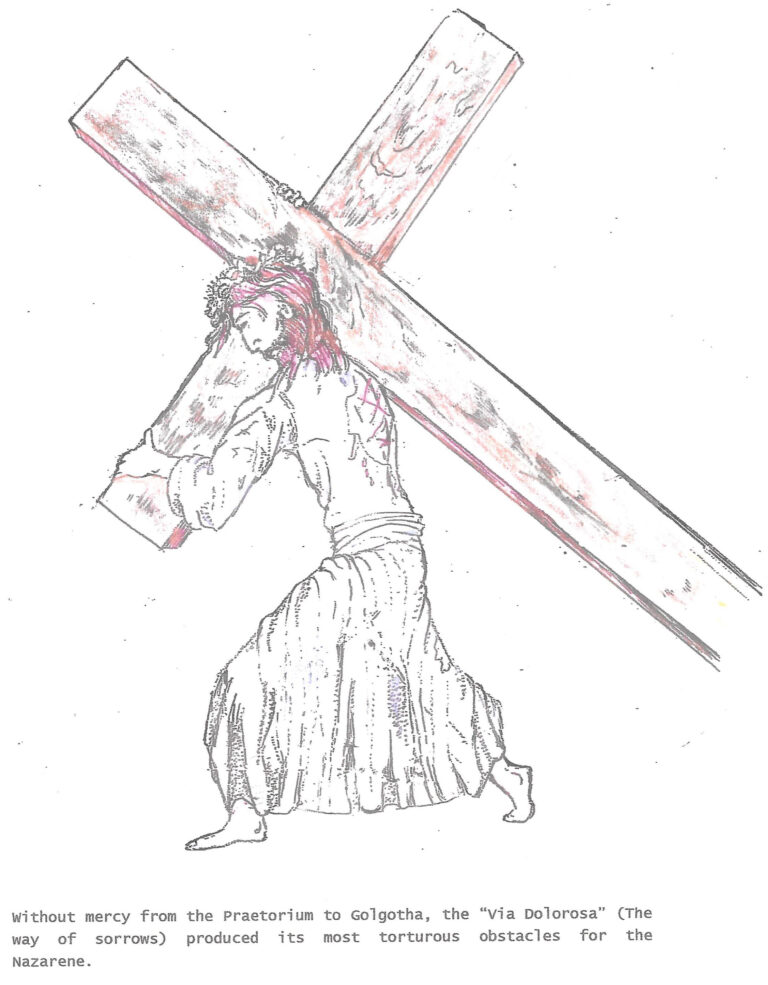
    I left the Praetorian in no particular haste as I had ample time to see about my other duties. It surprised me to almost immediately be swept into a mob of people going to see Jesus struggling with a ponderous cross on his shoulder.  I managed to see through the crowd that he had been brutally lashed. His back was a deep and ugly criss-cross pattern of bright red lacerations. Little strips of flesh hung from the injuries adding pain where the cross rubbed on the open wounds. The people were pushing, shoving, crying, yelling and some even cursing the rude mob. I tried several times to get to my chariot and horses. I had business elsewhere and no time to witness another crucifixion. Forced in the opposite direction I struggled uselessly against the mob. An old woman we helped a few days prior approached me out that mad herd of distorted faces. Her once black and blue swollen ankle was healed. The old woman was crying painfully bewailing in a highly animated state. She screamed at me and her scream became a command. “Do something. They are going to kill him. Oh, by all the gods in heaven, why him? He does not deserve this death. He is my savior. You can do something to save his life.” The old woman was consumed with uncontrolled hysteria and with borrowed strength forced me into the brainless herd. They had ceased to be human. They were beasts driven by an unknown power. Swept away from the old lady I heard her screams die out in the roar of the pack. I was captured by the mood of the multitude. Unconsciously I fought everybody for an inch forward and a single view of what was happening. When I finally had a clear view of his whip lashes, I felt his pain on my own back. I tried to reason with it, but the hurt was real. My hands were trembling out of control from the pain and agony Jesus was suffering. It was unreasonable and I knew it, but the biting stings on my back were real. My back was in utter torment from the lashes I never received. Through what seemed a foggy mind I heard two men talking alongside me, “They gave him thirty-nine lashes” One said in a tone of no concern. “It was forty-two according to someone nearby,” the second man stated. “The Raven miscounted, again.”

    “Who in the hell is the Raven? Asked the first individual.”

    “He’s the official scourger that delivers legal punishment in most cases.”

    I was too engrossed with the torment of Jesus to join their conversation. Then through my pain, the third man lent his voice to the proceedings.

    “Look! Some thoughtful individual braided a wreath of thorns with which to crown the king of the Jews.”

    “I strained my neck to get a view and suffered added shock to see the fierce thorns from the wreath piercing the skin around his head. How could I have missed it? Adding to his agony was the hideous crown of thorns. My mind rang with the question, what kind of senseless brutality is this? And what does it prove? Nothing! It proves nothing but a sheer undiluted demonstration of senseless brutality. I felt a sense of anger rising within me and realized the helplessness of my efforts. Kneaded into a perplexing and chocking sensation, I was in pain from multiple sources. Added to my torment came a yell from an upper balcony, “If you’re really the son of God why then do you not save yourself.” From another unseen voice was heard, “You ran out of miracles too soon. You need one for yourself.” “I looked to the flawless sky and remember seeing a single black vulture with wings spread wide slowly circling the rising smell of the blood of Jesus. I took it to be an evil omen and lost hope that a miracle would save the street healer from Nazareth.” He took Senobia’s hand held it close then continued, “Our jeweler friend from Mecca accosted me in a frightful state. He was grief torn beyond recognition and almost yelled at me, “Onofrio, these idiots are going to kill the son of God. There will be such wrath come down from heaven that the world will never be the same again. Make peace with all your Gods. For, the end of the world will soon be upon us all. For all of those that condemned him and equally so for those of us without the courage to prevent it.” The jeweler looked to the infinite sky as if expecting bolts of lightning to come down and burn the earth to a cinder. Maniacally he pleaded with Allah to intervene in this mad injustice and save the Nazarene. I have never seen a man so torn with emotion as our jeweler friend was that day. He promised to atone for all his sins and dedicate his life to the service of Allah if only he saved Jesus from this terrible wrong. In painful tears he told me how he had started searching for Jesus ten years prior and knew Jesus to be the rightful son of god. He praised the pureness of the Nazarene’s spirit, his mind and body. He claimed to have known what Jesus taught before finding him. The jeweler even stated that such pureness of spirit crowned the Nazarene as the sacrificial lamb. Although he wished it not be so. And our ragged jeweler friend disappeared into the frenzied mob still bewailing insanely.” Onofrio looked at Serou to confess, “What I say next will sound  childish, but it’s what I thought at the time. I seriously fought my way forward to rescue Jesus and bring him home to us. Here we have an army to protect him and you could hire a clever attorney to dismiss the false charges against him. I was convinced that a second trial would bear more favorable results. I have much faith in you and even thought at the time that you, Serou the Egyptian master of public works could even heal a scar on the ocean.”

    Serou could do nothing but bow his head, touched by such enormous praise he never expected. He took a swallow of wine and saluted his foster son with a simple “thank you,” and recorded the thought.

    “Based on that conviction, I charged myself forward. I pushed and shoved and even kicked my way to the forefront where I could reach Jesus and pull him away from his destiny. I knew we could fight for a better outcome for him. I confronted a low class Roman soldier and made an effort to pass beyond him to my objective. He stood solid at his post and I made a second effort. This time he proved that a shielded elbow was mightier than my ambition. He slammed me hard between jaw and chin and I went flying backwards to become carpet for ruthless feet all using me to push forward. I grabbed someone’s robe and pulled myself up to meet with an angry face that shoved me back to the ground. When I finally stood up, I felt a warm trickle running down my face. My clothes were a collection of street dirt and my blood. No low class Roman was going to do that to me and simply walk away. Anger boiled within me. I started grabbing people by their clothes and shoulders projecting myself through walls of living flesh that gave no leeway. With all my strength I fought the mob for an inch of progress to get nowhere. My head was reeling and I shook it to clear my swirling vision. My mouth was bleeding and I spit it out several times. From somewhere in the noisy confusion a hand grabbed me and pulled me to the relative safety of somebody’s front entrance. It was the Syrian overseer from the manufacturing plant where we worked together. He ripped my ruined turban and poured wine on the cloth then pressed it against my wound to stop the bleeding. When I made an effort to pursue my quest, the Syrian kept me from going, advising to remain safe behind the angry maniacal herd. Reluctantly I accepted the wisdom of his advice. He soon spotted a small wiry man and hoisted him up on his shoulders and urged the man to tell us what was happening up front. Painfully reeling I progressed with the Syrian and his shoulder high reporter. We shared a wineskin and I thought I felt better but, perhaps it was the excitement of hearing the progress reports.

    “Jesus has fallen. Wait! There’s a woman coming to his aid. No. She’s not helping. She is. She is his mother. Yes. That is Mary, the widow of Joseph the carpenter of Nazareth. Yes, that’s his mother. They’re talking. I’m too far away to hear what they’re saying. Mary of Magdala is there also. They are talking to Jesus. He is still fallen. But wait, he is getting up. Yes, he’s gotten up. He’s taking the cross again.”

    Just then the Syrian planted a big foot in the middle of the person in front of him and gave a mighty shove. More than a dozen people started falling in all directions taking many others down with them. He looked at me and I needed no urging to follow. We worked our way forward over fallen bodies and vile insults. Soon the wiry man started reporting again. I was helplessly galvanized to his voice. “Jesus has fallen again. A soldier grabbed a black man and forced him to carry the cross for Jesus. They just made Jesus lead the black man.

    And as they led him away, they seized one

    Simon of Cyrene, who was coming in from

    The country, and laid on him the

    Cross, to carry it behind Jesus. And there

    Followed him a great multitude of the people

    And of women who bewailed and lamented him.

    Luke 23: 26-27     NIV

    The black man has the cross over his shoulder. Another woman is coming to help Jesus. I know who that is, that is a woman named Bernice.  She is cleaning the face of the Nazarene with her head scarf or maybe a damp rag. I can’t tell for sure. She sneaked behind the soldiers to help Jesus. She’s wiped his face now. It looks a little cleaner of dirt and blood. Awh Awh. A soldier just caught her and shoved her back into the crowd. Poor Bernice, she a good woman and she’s not hurt. Jesus is up and limping. He is weak. He has lost a lot of blood and he looks drained. He is reeling. He will never make it to the top of skull hill. That hill is also known as Golgotha in Hebrew, you know. Loose stones make it very treacherous for an able bodied man, let alone for Jesus who is apparently very weak. The black man has stopped. He’s waiting for Jesus to recover and lead.”

    When a group of soldiers came by I urged the Syrian to fall in behind them. The wiry little man never stopped reporting, “Some women have come to his side. They are talking to him and trying to give him some help and perhaps, courage. The women look Jewish. But, I’m not sure. Mary of Magdala is there. Whoa, a soldier just tried to push her away and she stood up to him and refused to move. That takes a lot of courage. Romans are trained to hurt people, you know. This man, Jesus has every woman in Jerusalem crying for him. If I had that many women aching for me, they would not ache for long. Jesus is leaving the women now. He’s shaky. He’s fallen again. This is his third fall. He could never carry that cross up the hill without the black man.“ From an upper balcony I heard a woman yelling out, “Hang the blasphemer. Who needs more Gods? Sons of Gods or sons of bitches, they all end up here.” The crude sign over the scarlet door read “Food, wine and women” in Greek. The wiry little man tapped my shoulder with his toe and pointed to a muscular unshaven man standing at ease by the scarlet door with a goblet in hand. In a near whisper he announced, “That’s Barabbas. Apparently he came to see his cross being used by somebody else.” The Syrian spotted the man and confirmed the report. “Yah! That’s him. He’s got a right to celebrate. But he don’t got the right to show it off.

    I saw an elderly man richly dressed like a statesman and his family  behind an iron fence, each one in solemn prayer. They were in obvious trauma over the mad parade passing before their eyes. I could not read the plaque over his door but symbols indicated he was a Roman official. They were all safely away from the tangled menagerie of near human beasts. I heard the cry to spare Jesus his ordeal but it was only a whisper in a raging storm. Momentarily, I leaned on the elderly man’s fence and through the rails he reached to lay his hand on my shoulder. His swollen but kind and gentle face was washed in silver tears running down his beard. In a tormented voice the old man stated, “It’s a terrible day in Judea. But it’s a fine day in heaven. The son of God is coming home.” Mysteriously mechanized I fell in behind a separate set of soldiers along with the Syrian and our happy reporter. He was up high, with a clear view ahead, a free ride and wine.

    I looked back just in time to see the elderly gentlemen cleave the sign of the cross in mid-air like a blessing or a farewell.

    The crowd was dwindling as we were well out of the city walls now. I was no longer plotting to rescue Jesus but drawn to the finish of this maniacal drama without a will of my own.

    “We’re going up the hill to Calvary,” the wiry man reported. “Some call it Golgotha. Oh, I told you that already.”

    At the summit, the black man was ordered to drop the cross from his shoulder. Relieved the black man eased the cross off his shoulder to land with a resounding wallop atop Golgotha. The Syrian put the small wiry man down and frantically started pointing at the cross. “Look, Onofrio. Look! That’s the cross you built. They’re gonna crucify Jesus of Nazareth on the cross you made. Look at the bottom of it. It’s got your burned “O” on the upright beam.

    It took me moments to break down what he said and understand his excitement. When the Syrian’s yammering finally came clear and I understood what he said. My eyes focused on the bottom of the cross and I was horrified to see my burned “O” on the bottom of the upright beam. Sheer terror swept through me in a flash. I shook violently and could not stop. I looked again and there was no mistaking my burned circle shone brightly in the noon day sun. Memories of that day flashed through my mind. I even remembered an insistent little four petal flower that made such a valiant effort to survive. I scanned the rough hewn beam carefully and was sure I spotted the exact location where that insistent little blossom existed. I could not be wrong. It was my cross. When I made a move forward to confirm it, I was stopped again. I could not take my eyes away from the fearsome instrument of death. I saw Jesus speaking painfully to the black man. The bearer of his cross was crying profusely. Streams of silver tears ran down his black, shiny face, now a contorted map of pain. The Syrian tapped my shoulder to cheerfully claim, “One thing for sure, this fellow Jesus got the best we had to offer. Some people have all the luck. My two crosses got used by a pair of common thieves. Your cross was used for the son of God. Some people are just born lucky.” I was disturbed by the Syrian’s cryptic statement but was forced to the unfolding scene. I could not discharge the thought that Jesus would die today on a cross I built.

    Slowly the crowd began to disperse all around us. Small hazy clouds were forming in the distant horizon. People were receding down Golgotha since a storm brewing in the far away hills was creeping our way. People had seen crucifixions before and some had lost interest. Crucifixions were a common occurrence to most sightseers. The name “Jesus” was simply one more name soon to be forgotten, like so many others. The festering storm in the distance was slowing advancing forward. No sensible reason to get soaked over some criminals getting their just reward. Disgruntled, disappointed or just bored, thrill seekers found reason to leave the scene. The oncoming tempest slowly dimmed the day like an evening out of time. Brave hearts surrendered to suspenseful apprehension by the eerie silence of the birds and whispering voices riding on the wind.

    Two men, both thieves were already secured to their penitent crosses. Jesus stood facing Calvary, examining the cross at his feet. I was unable to move. I was galvanized to the man named Jesus of Nazareth. I was unflinching and immobile before the horrifying spectacle of death so nearby. I could not grasp a single reason why this man should be here to suffer the agony ahead. A trooper came forward and ripped off the clothes draped on Jesus’ shoulders, leaving him naked to the world with only a cloth to cover his genitals. I froze in horror when someone produced a handful of sharp spikes with  a large hammer then tossed them to the ground near the cross. I wanted to lunge forward and stop this raging lunacy but I was immobilized not able to move. Frozen in place staring at the unbelievable proceedings. I felt paralyzed and only my mind and eyes seemed to work. I saw the lacerations on his back still bleeding in tiny trickles. Unceremoniously Jesus was positioned on the cross without a trace of concern.  Not a sign of pity showed in the cold eyes of the trooper well accustomed to the sight of someone else’s blood. Jesus saw the spikes. His face projected a portrait of resignation. A soldier stretched an arm on the patibulum (crossbar) and with only two quick blows drove the spike through the wrist very close to the palm of Jesus’ hand. A task performed with the efficiency of experience. In rapid motion he stepped over Jesus and repeated his performance on his other arm. With the help of added troopers they positioned a foot atop another on the wooden block. The trooper looked carefully at his work. Notably calculating the trajectory of his hammer and with two skillfully delivered blows drove the spike through both feet. I heard the ringing sound of steel hammer striking steel spike and pass through living flesh. My breath failed me and I was unable to scream.

    A deathly grip choked me as I literally felt the pain Jesus was suffering. I was crying profusely and found myself completely alone. The Syrian and the small wiry man were gone and I never saw them leave. Thunder was booming and clattering closer in the dimming horizon. I saw Jesus being abnormally quiet. He had not let out a whimper or a scream. He suffered his agony in silence. Not giving his enemies reason to gloat. Such strength could only be God-sent as he intently looked unto heaven armed only with his full hearted devotion.

    Down in the heart of the outrageous mob was the mother of Jesus. She and her companions were shoved and pushed aside as they struggled to be close to Jesus. It took their breath away to see him spiked to hardwood timbers. There to suffer painfully until the last breath is forced slowly from his body by his own weight. The rude crowd all too engrossed on achieving the best view showed no concern or mercy for His grieving mother. Finally a strong armed man shoved people aside to allow Mary and her companions safe passage to the front. Having been forced aside an angry voice asked, “Who the hell are those women and what are they doing in this madness?” “Shut up, idiot. That’s the mother of the one on the center cross,”came the stern reply.

    Imagine then the agonizing torment of Mary struggling painfully through that unruly mob to witness her son’s death. Grief beyond measure dwelled in her heart. The child she carried in her womb was now the subject of scorn and obnoxious ridicule. She was subject to obey the law and the law forbade her to help her child. At the summit she waited with painfully beating heart for the end to come and prayed in earnest for the moment not to arrive. But Mary had been recipient and first hand witness to many miracles her son delivered. Can we not speculate that on this fateful day she would pray deeply for Godly intervention and save her son? Of course, we can. Imagine then, the super human strength of his little woman to forge ahead half in prayer and half in acceptance of his pre-ordained fate. Through this terrible ordeal she suffered a thousand deaths and held together by a power she herself did not know. Let alone understand.  In humble solace she had long ago accepted this cruel and unwelcome destiny. Not until the third torturous day would she know peace. When news would come that her son rose from the dead and was seen ascending to heaven. But, that as three long painful days away.


    When Jesus saw his mother,

    and the disciple whom he loved

    standing near, he said to his mother,

    “woman behold your son!” Then he said

    to the disciple, “Behold your mother!”

    And from that hour the disciple took

    Her to his own home.

    John 19: 26-27     NIV


    Workmen materialized and with considerable effort lifted the cross and edged it to the mouth of the pre-dug pit. With a resounding wallop the cross landed at the bottom of the hole. A loud thud echoed from the bowels of Golgotha joined by a resounding clap of approaching thunder. The living body of Jesus shook from the torment. Blood flowed freely from his hands and feet and still not a moan was heard from him. The crown of thorns dug deeper into his flesh with the slightest move. He hung limp on the rude timber, breathing with painful effort. Some stout hearted sightseers still lingered along with a company of soldiers. The work crew used stones, dirt and wooden wedges to position the cross perfectly upright. A rude plaque was secured before the cross went in the hole. It read “INRI” in three languages, meaning “Jesus, of Nazareth king of the Jews.” Jeers, shouts and foul insults all fell from his ear without meaning. Instead he made an effort to give comfort to the pair of thieves on the adjoining crosses. He told them that before this day passed, they would join him in heaven. After an unmeasured length of time, he looked to heaven and clearly stated, “Forgive them father, For they know not what they do.” The words rang in my ear and they seemed senseless considering the reality of the moment. The crown of thorns shifted when the cross landed at the bottom of the pit. New trickles of blood eased their way down his face and chest. The sight seemed to add joy to the callous troopers as they doubled their foul cheers and insults. “Hail, King of the Jews” rang unanimously through their ranks and stout hearted sightseers. “If you be the son of God, your father has forsaken you,” jeered a young soldier. I looked to the sun as my usual time keeper. It was shortly past noon. I noticed a grayish veil began to fill the sky stretching from horizon to horizon. Not like the coming of sunset but like an encircling gloom, coming from all directions. Hardly noticeable at first, but the bright day was slowly dimming like an evening before its time. Again I heard the distinct silence of the birds and whispers in the twirling wind. Could they be conversations between the Gods? My face was stung by the sand blown up in the coming storm. The caustic merriment of moments ago transferred to apprehensive awe and disquieted whispers. Still I could not remove myself from this man now nailed to the center cross. For a brief moment I imagined smelling sulfur, perhaps from the mines in the distant hills. More obvious was the smell of fear coming from the remaining soldiers. I saw tempered warriors gazing at each other in shaded trepidation, while others seemed to grow pale. And the light of day continued to fade into the gloomy veil of an unexpected evening. Two thieves and a Jewish rabble rouser were secure on their crosses. A weird storm was closing in. Their orders had been carried out and some soldiers began to withdraw from the stony hill. A voice perhaps inspired by Jewish dictate called out, “He that cannot save himself, would destroy the temple and rebuild it in three days, ha, ha, ha.” His voice was followed by mocking laughter. It gave leave for others to launch their insults like stones at the impaled Nazarene. Suffering tremendously and totally helpless he endured their foul mockery. I stood helplessly gazing at the devotion and strength of this slender man. A man of greater physical strength would have long ago cried out in shameless pain. Yet, Jesus with absolute resolve languished on my cross. Bearing Jeer, insult and agony with equal silence. Another unseen voice urged the Nazarene to come down to them and prove he was truly the son of God. I calculated he had been on the cross no less than two hours. I heard him cry for water and someone came with a sponge at the end of a long stick. The individual poured sour wine on the sponge and raised the stick to the face and mouth of Jesus.

    Jesus knowing that all was now finished,

    Said (to fulfill the scripture),”I thirst.”

    A bowl of vinegar stood there; so they put

    a sponge full of vinegar on hyssop and

    held it to his mouth.

    John 19: 28-29    NKJV

    Still not a single word of anger or retaliation came from Jesus.

    When Jesus had received the vinegar,

    He said, “It is finished”; and he bowed

    His head and gave up his spirit.

    John 19: 30

    NKJV


    It was while I stood gazing at the unfathomed devotion of this man that I realized my memory had returned. I saw images of my childhood happiness as clear as if they happened this morning. Years of mystery dissolved into absolute clarity. As graphic as the reality of this man that hung painfully by his bleeding hands, feet and head on a cross I built for pay. This man of healing miracles, a teacher of God’s laws was as innocent of criminal activity as a new born lamb. This was a man devoted to the path of righteousness. A man of such spiritual strength as no ordinary person could ever hope to match. Only the most wanton, depraved and ignorant person could not see that.

    It came to be the third hour of his ordeal when he surrendered his spirit. Although many people lingered nearby obsessed by what they saw. Others came to see and weep anew. Some misaligned individuals simply came to enjoy the view. A separate group in black hooded robes was solemnly on their knees, praying in earnest before the son of God. I remained honed into the pain and agony this man suffered. An innocent man condemned to this torturous death by the masters of plot, ploy and scheme.

    There was darkness over the whole land until the ninth

    Hour, while the sun’s light failed; and the curtain of

    The temple was torn in two. Then Jesus, crying in a loud

    Voice said, “father, into thy hands I commit my

    spirit!” And having said this he breathed his last.

    Luke 23: 44-46  ESV


    CRUCIFIXION TO THE WORLD BY

    THE CROSS OF CHRIST.

    When I survey the wondrous Cross

    Where the young prince of Glory died,

    My richest gain I count but loss,

    And pour contempt on all my pride.

    Forbid it. Lord, that I should boast

    Save in the death of Christ, my Lord;

    All the vain things that charm me most,

    I sacrifice them to his blood.

    See from his head, his hands, his feet,

    Sorrow and love flow mingled down;

    Did e’er such love and sorrow meet?

    Or thorns compose so rich a crown?

    His dying crimson like a robe

    Spreads o’er his body on the tree,

    Then am I dead to all the globe,

    And all the globe is dead to me.

    Were the whole realm of nature be mine,

    That were a present far too small;

    Love so amazing, so devine,

    Demands my soul, my life, my all.


    ISAAC WATTS, 1674-1748


    When the soldiers had crucified Jesus they took his garments and made four parts, one for each soldier; also his tunic. But the tunic was without seam, woven from top to bottom; so they said to one another, let us not tear it, but cast lots for it to see to whose it shall be.”

    John 19: 23-24   ESV

    And when evening had come, since it was the day of preparation, that is, the day before the Sabbath, Joseph of Arimathea, a respectable member of the council, who was himself looking for the kingdom of God, took courage and went to Pilate, and asked for the body of Jesus.

    Mark 15: 42-43  NWT

    And Joseph took the body and wrapped it in a clean linen shroud and laid it in his own tomb, which he had hewn in the rock; and he rolled a great stone to the door of the tomb, and departed. Mary Magdalene and the other Mary were there, sitting opposite the sepulcher.

    Matthew 27: 59-61    NIV


    As if performing nothing more than a menial task, a soldier drove a spear into the ribcage of the lifeless body of the Nazarene. It proved Jesus was truly dead. Blood eased out of the wound followed by a surprising amount of water. Joseph of Arimathea along with a collection of stout men came to the scene. Joseph showed the Roman guardsman a document signed by Pilate granting him permission to dislodge the corpse and carry it off to a proper burial place. With great effort the cross was carefully dislodged from the pit by strong arms paid to do the work. Gently the cross was brought to the ground atop Golgotha. Joseph insisted with strong demand that no added harm be done to the lifeless body. With the help of an added timber and a metal tool the spikes were carefully extracted and the corpse then smoothly transferred to a makeshift liter. The tempest was drawing ever closer. Black roiling clouds advanced without hesitation. It was raining in the hills nearby. I saw Mary in the company of her other sons and some women. Our eyes met but neither one of us knew each other, so Mary only nodded gently in acceptance of my obvious grief. I bowed my head to her acknowledging her sorrow. My mind raced to the fact that she, the mother of Jesus was another victim of the cross I built. Her unfathomed anguish and pain clearly visible on her face and limp movements. My sense of guilt amplified tenfold at the sight of her despair. The grief and pain of her ordeal became my own. In that fleeting moment and in painful bond Mary and I became as one in shared agony. The cross broadcast pain in wholesale fashion and I was the architect of grief.

    Jesus died in thirst and excruciating pain. I experienced physical agony and intense torment such as I have never known. Then without warning an enormous sense of guilt filled me. I was responsible for building the instrument of his death. The Nazarene never did anything to harm me and it was my work that ended his life. I was instrumental in his murder. False accusations condemned him to the cross but I was the executioner. I tried to reason with my guilt and could not free myself of the enormous self reproach that gripped me. I then saw soldiers tossing a leather dice cup for the robe of Jesus. It was a hand-woven seamless garment, colored with walnut stain. I could not fathom how men could be so callous. Jesus was barely dead and these men already contested for the spoils. It was a way of life for these men and I realized that once upon a foggy dream, I had seriously considered becoming one of them.

    Suddenly the earth heaved in fierce convulsion, forcing the world to shudder in unmeasured violence. Tongues of angry fire raced across the purple sky in repeated shows of Godly force. Horrendous thunder clapped and roared with savage fury. Each crashing boom louder that the last and close enough to strike fear in the bravest heart. I knew it was mid-afternoon, yet this storm discharged the sun of day into the blackest void. As if the Gods willed this day to cease as my friend, the ragged jeweler had earlier predicted. There was ample reason to believe the Gods were furious because one of their own had been murdered. And I was among those that helped commit that felony. Brave men ran like frightened children seeking shelter. The mob dispersed as fast as scared legs could carry them. Only a few of the more seasoned warriors stood their post. They were captured by the awesome display of godly fury upon the land and sky. I somehow felt that fury directed at me. A soldier standing close by visibly scared and deathly pale looked at Jesus had said, “This man was truly the son of God.”  I fell to my knees expecting the next bolt of lightning to strike me dead as I felt I justly deserved. I had seriously offended the Gods and my penalty was death. Rain fell from the darkened skies in furious gushers. The hill became awash with mad, dashing streams hauling debris, twigs and small stones down the incline. I found it difficult to make my way down the rocky knoll. Lightning struck close by and a small bush ignited in hellish white and blue fire. Only to be quickly extinguished by the heavy downpour. I knew the angry Gods were aiming their vengeful bolts at me and I did not expect to survive the noon day night. From a distant corner in my mind I remembered the words of my father, Horacio Vega de Iberia. “When a man has done wrong, he should be man enough to accept the result of his actions.” My actions were undeniable and my guilt unquestioned. In that light, I resolved to meet my doom when it arrived. I labored for every step down Golgotha. I could not stop trembling violently. I surmised that it was partly in fear and partly in knowing my death was on the way. I imagined a bolt of lightning coming at me and then I saw total darkness. I would be condemned to utter silence and total darkness for eternity. God would not glorify my part in his son’s murder. Emblazoned in my mind was the suffering of Jesus in precise detail. Into myself I asked Jesus to forgive me and gave him logical reason to deny my request. The tempest raged upon me and all around me as far as I could see. I wanted to run but then, to where does one run from an angry God?  Another bolt of lightning struck a water puddle ahead of my next step. Gaseous blue flame raced across the drenched earth as if looking for a victim to strike dead. It was intended for me. I resolved to walk upright and meet my destiny as a man deserving what the Gods dole out. Finally the incline gave way to level ground and I could not hasten my pace. I was drenched to the skin and my clothes were heavy with water. I collected the dragging hems to lessen the burden on my stride. I walked upright although I knew it was with false courage. My very soul was shaking painfully.  I feared to take the next step, thinking it may be my last. There could be no shame in being struck dead by Godly fury. Even the Gods have a right to justice. Hiding my face behind my hands would do no good. The father of Jesus knew who I was and picked me out from the lessening crowd to deliver punishment on me. I knew that if someone murdered a child of my own, I would seek that individual out and destroy him. A life for a life is rightful justice.”

    Onofrio stood up and took Senobia in his arm while he caressed her face with his free hand. Eyes the color of the Mediterranean looked back into his in wonder as he softly spoke to her before the gathered families. “Like a soothing breeze that comes when a storm is over, you eased into my troubled mind. If God struck me dead as I struggled away from the murder scene, you would in due course marry someone else. To add injury to my penalty, I would see you in the arms of another man from wherever dead people go. I truly felt pain invade my heart at that realization. Yet, I knew somehow that God, your God would have mercy on my soul and not deny me this very moment with you in my arms. I could not fully believe that, but it was vibrating hope that kept me walking away from the murder at Golgotha. It was the image of you, my love. The image of you and I in this embrace that kept me walking away from that hill and not expecting to make it home to you. I trembled in fear and could not stop. Only the image of you kept me going.” He kissed her forehead and simply held her gently within his arms. And she felt him crying and clearly heard him say in her ear,” Thank you God. Thank you.” She wiped his tears with her sleeve and went to refresh his wine. Never had he said “I love you”, with so much proof in hand.

    [Previous Episode] [Next Episode]
  • The Gathering of the Eternal Five: Golgotha, Revisited

    The Gathering of the Eternal Five: Golgotha, Revisited

    The Messiah

    had been to earth on his mission. Men chose to ignore the signs and tormented, mutilated and crucified their own savior. They cast aside that the name Jesus in their own language meant “save” and he that saves is therefore a savior. They chose to forget that the angel Gabriel commanded his mother, the Virgin Mary to name her son “Jesus.”


    Chapter 11


    Then he led them out as far as Bethany,

    and lifting up his hands he blessed

    them. While he blessed them, he parted

    from them and was carried up into

    heaven. And they returned to Jerusalem

    with great joy.

    Luke 24: 50-52 (New Revised Version)


    When Samuel came home to the house of his father, he was greeted with great joy. Even Senobia’s children were all anxious to spend time with their uncle Samuel. Neither Samuel nor his father could get enough of stealing looks at each other. They exchanged many stories of joy and sorrow while Senobia and Onofrio simply watched the display of love reunited. His most recent exploit with the wife of Pontius Pilate and Mary of Magdala governed his conversation. Extracting a solemn promise to keep what he said about the two ladies within the family. Furthermore he admonished his sister Senobia, for keeping an unfounded opinion of Mary of Magdala in her mind. He supplicated Senobia to cleanse her mind and heart of rumors she did not know as fact. Only once did Senobia rebuke her brother’s appeal with a stinging barb.

    “As a man you would be one to enjoy her demeanor and shows of open flesh. I am not surprised that you would defend her so.”

    Brother and sister have quarreled since the dawn of time. Today would not be one of those days. Samuel with easy calm quietly asked,

    “Have you ever been in the presence of Mary of Magdala?”

    “Of course not,” why do you even ask?” She pouted in near anger.

    “I have. And I saw a dedication rare among people. A dedication to He that cleansed her soul of human faults. She said it herself when she said that her savior, Jesus had shown her the way to walk on rainbows.

    Remember this; she will pay for her brother’s resurrection with devotion to Jesus of Nazareth for the rest of her life. Also learn from this, the first casualty of truth is always gossip. Don’t fall victim to those that embellish stories for gain of their own.”

    With due respect Samuel asked Tremiyo if he could proceed and was granted approval with a degree of admiration.

    “Baby sister, I love you so. It delights me to see you so happy. But you are suffering from one of the sins that Mary of Magdala is accused of. I believe you are suffering from a case of groundless jealousy. Fear not baby sister. Your husband would never seek Mary of Magdala out for sinful pleasure. You may rest assured of that. That leaves you with a blemish on your soul. Pray to your Jesus that he forgive you or condemn your soul to hell for raising falsehoods against one that has done you no harm. You betray father’s teachings by harboring such thoughts.” Tremiyo sat in awe at his son’s hard gained maturity.

    Tremiyo literally roasted the fatted calf for his son’s weeklong visit. The invitation went out to all four corners of Judea, “come feast with the son of Tremiyo, Stewart of the house of Serou”. Unexpected Serou, the lady Clavenia (his wife) and their two daughters Banafrit and Irisi now near teen agers attended the day long festival. An event carefully planned by he that had planned so many others. Barrels of wine, tubs of vegetables, stacks of condiments and wagon loads of bread made for an awesome feast for so many guests. There were tables stacked with tid-bits to eat of unimaginable variety. And nobody was shy to try them all. Senobia and Onofrio dressed in all white. They were specially groomed and transmitted a near regal appearance. Onofrio’s once tinge of premature gray had progressed and he was now crowned with a collage of gray and dark brownish copper hair, adding dignity to his character. He remained clean shaven and although tempted refused to grow a beard. Senobia held her chin high filled with pride at the side of her husband always clinging to his forearm. She never let a moment pass without showing her love for him. In spite of delivering three children her figure had expanded very little and granted her a more appealing figure. The children behaved well, except Horacio who preferred to be close To Banafrit and Irisi.

    Since their relationship had developed into a closer bond, Serou came to Onofrio and borrowed a bit of his foster son’s humor. “I’m here to tell you to keep your son away from my daughters, as I fear the wolf has come to call.” Serou had reason to experience premature concern as Horacio was keenly interested in the younger sister, Irisi. They were close to the same age and appeared to prefer each other’s company. Both men enjoyed a laugh watching their pre-teen children and lodged their thoughts for a later time.

    Samuel spent the best part of the afternoon greeting guests and shaking hands. Conversations bloomed in all directions on multiple subjects by different languages. While the story of the father and son’s reunion was repeated many times. Two sets of musicians entertained the crowd, while jugglers and acrobats added zest to the festivity. When the sun started painting the western sky with Nature’s majestic artistry the crowd began to wane. As the purple veil of early evening settled upon them the last few guests paid their respects and departed. Young Samuel would never be a stranger in Judea. His father had seen to that.

    Appointed personnel were assigned to clean up and set all things right after such a celebration. Under candle light and pest repelling torches members of two families sat to enjoy the evening and mull over passing events. A delightful sense of ease blessed the guests as bits of conversation floated free among them. Clavenia, Serou’s wife spoke directly to her foster son, “Onofrio, not long ago we spoke of Judea being the cradle of miracles. I would like to know which the greatest miracles of Jesus were.”

    Serou’s attention went on call. He was surrounded by the ladies in his life. The two girls leaned their heads against their father in sleepy nods seemingly happy to be there. In noted admiration Clavenia turned her attention to her husband, knowing he was always well informed. Patiently she waited as he gathered his thoughts. An easy task for the master of public works.

    “Two or perhaps even three of the miracles he performed deserve volumes of historical attention. Let there be no doubt that all his cures and miracles deserve being noted. I am addressing his greatest Godly acts. I was in transit along the shores of the Sea of Galilee when I was literally mobbed by an immense crowd. I had grown accustomed to running into mobs anxious to hear Him speak. I even knew the scribes by name that hounded him for the latest word to drop from his lips. The landscape was infested in all directions with people. Mothers, fathers and their children all drawn to the same location. It was late afternoon, close to evening when I discovered the cause of such attention. I stopped a man and woman in possession of fish and barley bread, each with a respectable portion. I found it difficult to accept their gladdened revelation. Jesus and his disciples were passing out fish and loaves of barley bread to all that came to them. Jesus instructed his disciples to have those that were served to sit on the grass. Seated indicated they were fed. I lost count of the people I saw. I stopped my chariot and surveyed the area in all directions. People looked like ants whose nest has been disturbed. All coming to attend the feast of Jesus. My estimated guess arrived at upwards of three thousand people. I had no choice but to stop with so many people blocking my way and gauge for myself the end result of such abundance. Barley loaves and fish came from an endless source. There was no stopping the eternal flow. I was sorely tempted to avail myself of such abundance but my pride kept me from it. It amazed me that I actually felt a calling to come to his presence and receive what he had to give. I later remembered that bread is considered the staff of life and fish is the symbol of his mission. He was in effect inviting the endless mob to dwell in his words. I shamed a man that came to his donkey and filled a bag on the animals back with what he received. After he made the second trip, I stopped him to say, “What you do is stealing. Plain and simple theft.” Without shame he quickly answered, “You’re the rich Egyptian Master of public works. You don’t Know what it’s like to be hungry. I’ve got a family to feed,” and never stopped his endeavor. Not everybody ate bread on the spot. I saw many carrying away the benefit of their efforts. I even suspected in silence that some would sell what they gathered in the city. As the crowd subsided; I reined my animals close to the source of such generosity. I saw this man named Jesus and four others passing out the vestiges from their boundless cornucopia. They were five tired men with just enough left to feed themselves. But they had miraculously fed a crowd of uncounted people. My guess was only an estimate. I’m sure many people escaped my count. Nowhere in my knowledge of godly deeds have I known of such unrequited bounty. I had no cause to investigate how this was done. I simply added this to the list of his accomplishments. I recognized the men with Jesus but I am not sure of all their names. One was a fellow named Matthew, another was named Luke. I recognized a third individual as Mark and the last, I think was John. I had seen these men before but since they did not affect my concern, I always discharged their identity. They were among the followers of the Nazarene and so be it.”

    Lifting up his eyes, then, and seeing that a

    multitude was coming to him, Jesus said to

    Phillip, “How are we to buy bread so that these            

    People may eat?” This he said to test him, for

    He himself knew what he would do. Andrew, Simon

    Peter’s brother, said to him, “There is a lad

    here who has five barley loaves and two fish;

    But what are they among so many?”

    John 6: 5-9 (NIV)


    [Previous Episode] [Next Episode]

  • The Gathering of the Eternal Five: A Council for Claudia

    The Gathering of the Eternal Five: A Council for Claudia

    Chapter 10

    Across the entire eastern sky a hazy line of golden light pushed the purple shroud of night gently away. A few dim stars twinkled here and there flirting with the brightening clouds. It was Onofrio’s favorite time. A time he cherished with his prominent God, Nature the god of all living things. No golden altars required. No priests in costly robes to instruct followers on how to praise nature’s promise of a fruitful day.

    He had several scrolls to deliver among them some for Pontius Pilate regarding the finished improvements to the water way. Now cleansed of rotting debris and widened to supply ample water to Yerushalayim. The fields already flourished in such abundance. He had scrolls to deliver to the Hebrew council pertaining to border line adjustments between properties they would have to address among themselves. The new military commander would be invited to Serou’s home for continued discussions regarding improvements to the military facilities. In all, Onofrio would have a full day mingling with the heads of power in the city of David.

    He dressed in light blue with a white leather belt over his outer robe. A new pair of black shiny boots graced his feet. He wore a white turban headdress with a blue ornament at the forehead. He only wore his wedding ring and a copper bracelet he was fond of. It was said to protect one’s health.

    His favorite two horses pulled his chariot with ease. They seemed to know where Onofrio wanted to go. He often spoke to them in transit and perhaps, they understood his missions and hastened to oblige.

    It was past midmorning when he finally entered Pilate’s outer chamber, a private place where he rested between cases. After a few minutes wait, Pilate appeared. He wore an elegant purple toga adorned with three inch wide symmetrical bands of Gold thread going from foot to shoulder. Very Impressive. He looked tired and overly groomed. His face brightened at the sight of Onofrio. After amiable greetings Pilate proceeded to his usual seat. Refreshments were soon provided and Pilate spoke in abbreviated sentences. “I’m so tired all the time. I need to go someplace and be by myself. Get away from these “Jewish gripes and petty quarrels.” He examined the scrolls and was seemingly pleased with what he read.

    “Serou is a remarkable individual. “Every concern is carefully addressed and neatly answered in sequence. Remarkable. It’s the badge of a brilliant mind. In total amiability Pilate continued non-sop.”My wife, Claudia will soon be here. I would like for you to meet her. You’ve never met my wife, have you?”

    Onofrio was momentarily displeased with the proposal pulled on him so unexpedctedly. He had other stops to make. But courtesy to Pontius Pilate took first place and so he answered courteously,

    “No sir. I’ve never had occasion to meet your wife, Claudia. I’ve been told she is a brilliant and lovely woman. I would be pleased to meet the lady.”

    Soon thereafter, Claudia made her appearance. She was truly beautiful. She had high cheek bones and sensuous lips. Her stride revealed an admirable elegance and she dressed in a light green gown with fine gold jewelry. Her lips were lightly tinted in a delicate shade of pink making her appear even younger. Her eyes were filled with a friendly glow and he could not tell what color they were in haste. Proper introductions were made and she sat next to Pilate. By way of apology, she looked at Onofrio and silently bid for a private moment. She caressed her husband’s face and spoke in a voice invented by angels, “I was hoping to find you resting. Has it been a busy morning?” Her concern had no place to hide. Before Pilate answered, her face lit up with a recovered realization and spoke in astonished tones.

    “You’re the young man known for building the cross on which Jesus of Nazareth died. Aren’t you? She was obviously thrilled by it.

    Onofrio had no place to hide. He had grown to despise the question but could not deny the wife of Pontius Pilate an answer.

    “Much to my regret yes Mam, I built the cross on which Jesus died.” Onofrio stated calmly taking a deep breath and looking for an escape route. He had no desire to rekindle painful memories. He swiftly became uncomfortable, apparent to Pilate and Claudia. She sensed his discomfort as if she saw visions wandering through his mind.

    With undeniable regret she reached to touch his hand and spoke with a warm and gentle kindness.

    “I’m sorry. I heard of your ordeal after the crucifixion. I have no desire to stir unpleasant memories but if I may, I’d like to ask you one question.” She saw his glassy eyes and felt a kindness toward him. Noticeably Onofrio bowed with visible reluctance. He could not deny a request by the wife of Pontius Pilate.

    She looked at her husband and cocked her chin. A signal he knew well to mean, “I’m going to do it. Whether you agree or not.” Then she beamed her eyes on the handsome young man before her.

    “I have every reason in the world to believe that our son’s presence before Jesus healed his club foot.” Again she reached to touch Onofrio’s hand.

    “Do you think that since He is now dead that our son’s affliction will return?” Glassy eyes never demand explanation. She was on the brink of tears. She had suffered much from Pilate’s attitude towards her for delivering unto him a crippled child. She could not bear to be castigated again for the same reason.

    For a fleeting moment Onofrio and Claudia Procula suffered a similar anguish. Onofrio took only a moment to think and clearly stated, “I cannot answer your question honestly. As much as I would like to ease your concern my answer would not be truthful. However, allow me to tell you this real to life story and perhaps it will give you strength to face the future. What I tell you now is verifiable truth. On our way to Yerushalayim not long ago, we rescued an old lady that was injured on the road. She had a swollen, black and blue ankle she claimed to have suffered with for years. We took her close to the market square where Jesus was healing multiple afflictions. Later that day we met the old lady and her ankle was healed. She told us that Jesus assured her that if her affliction returned to think of him and she would again enjoy the benefit of his cure. She promised to always think of him in order to keep the cure in effect. My dear lady Claudia, I do not know if it would apply to your son. I am not one to give you false hope. But from what I know and have seen, I say there is no harm in keeping that thought alive. I would dare to say that your son may be too young to think of Jesus very often. This leaves you and your husband to share the burden of that aspiration.”

    Through all that Pilate sat intently listening to Onofrio and logged it in his mind. Then he spoke again, “My wife and I disagree on how Pilo’s cure came about. I say Mighty Jupiter is the reason for my sons cure.” And he chuckled a bit as if to sting her harmlessly. Claudia was never one to accept being put aside as she promptly replied with an equal sting.

    “My dearest Lucius, let us not disagree on who is most benevolent to our child. Instead, you pray to your Jupiter and I reserve the right to pray to whom I wish. That way we both contribute to our child’s welfare. This tongue in cheek compromise could well be the only genuine peace in all Judea.”

    Her smile was clear acceptance of what Onofrio proposed. But in the process of all this Onofrio saw a way to even give Pontius Pilate a time off from his arduous tasks. Without effort he mustered his most diplomatic tone, “Sir, I have an excellent suggestion to make. I urge you to accept it.  The villa by the lake on Serou’s property is newly refurbished. It is even better now than it was before. It would serve you well to consider spending fruitful time there with the lady Claudia. You would be well away from “Jewish gripes and petty quarrels”. And he clicked his jaw twice and winked an eye at the mighty procurator. “My wife Senobia and I spend much time there. Last week we caught a nice size fish we grilled over an open fire and slept al fresco in a tent with the children. They loved it. Senobia and I dipped in the lake like children on holiday. There’s no one to bother us for miles. There are slave quarters in back that could see to your comfort.  There’s a fully stocked kitchen and the water well is close by. There’s also a large barn to shelter your horses with access to good grass and fresh water. It would please me immensely if you accepted my invitation.”

    With crimped eyes and chin in hand Pilate thought for a moment and commented, “We have children to consider you know,” and seemed pleased to accept the invitation by pensively nodding his head.

    Claudia tuned in with,” we have nannies to see about them, you know.”And so with no further ado, it was clear that the couple would avail themselves of such an inviting offer. A second honey moon was in a budding stage. Onofrio cautioned, “Tell only your most trusted associate where you will be. In case you are urgently needed.” To which Pilate bowed in silent acknowledgement.

    Serou had seriously suggested Onofrio move his family to the Villa by the lake. It was peaceful there and the children would adore it. Their household staff would find adequate accommodations and all would be comfortably happy. It was a gift from the Egyptian Onofrio had not decided to accept.

    [Previous Episode] [Next Episode]


  • The Gathering of the Eternal Five: A Tale Worth Repeating

    The Gathering of the Eternal Five: A Tale Worth Repeating

    Chapter 9

    And he said to them, “Do not be amazed;

    You seek Jesus of Nazareth, who was

    crucified. He has risen, he is not here.

    But go, tell his disciples and Peter

    that he is going before you to Galilee: there

    you will see him, as he told you.

    Mark 16: 6-7      NIV


    Having stood closely by as a guardian to their privacy Samuel was host to all that was said. He could not help but feel a certain wonder for these two women. He never imagined that women could possess such deep thoughts. It was a revelation he would not soon forget.

    Magdalene turned her robe inside out to a different color. Discreetly she left going in one direction while Claudia led Samuel to their surrey by an opposite route. On the way Claudia had to ask, “Did you get an earful of what we said?” It was petty and she knew it but she wanted to know if what they said was going to her husband’s ear. “I learned that women can surmise and shelter deeper thoughts than what is granted them by men. I was surprised but equally delighted that you two ladies share such a sisterly bond. I will consider that a lesson for me alone. I was not near enough to hear what was said, should anybody ask me.” And taking unprecedented liberty he looked at her directly in her eyes then smiled and blinked an eye at her. It was all Claudia could do not to chuckle under her breath. It was more than she ever expected from a young camel herder. She liked the sound of his loyalty.

    Two days of waiting finally put Samuel before Pilate to ask for leave. “Sir, I would like to spend some time with my father and sister.” Only a moment passed through Pilate’s mind as he swiftly answered, “Claudia has let it be known that she approves of your work ethics. She feels confident in your ability to handle and protect the animals, yourself and her in turn. See my paymaster and draw your pay, go visit your family for a week only. We will be going to Caesarea then and I want you nearby.”

    Before submitting them to record, historians will long debate the validity of some life changing events in the lives of Bernice (Veronica of the veil) and Mary of Magdala (Mary Magdalene).

    On her quest to recruit help from Emperor Tiberius she found herself attending a sumptuous feast in his honor. Food in excessive amounts, alcoholic drinks of infinite variety made for a grotesque display of unwarranted waste. Musicians played risqué tunes, dancing girls displayed their feminine attributes in betrayal of common decency. Sinful pleasures abounded in every secluded and not so secluded corners. Men were seen with young boys and women playing intimate games with each other. It was Rome at its gala best. Jugglers and acrobats fought for attention. Wrestlers and magicians lost favor among so many other pleasures so readily available. The stone canopy of the palace filled with odorous smoke from the torches was offensive to Mary of Magdala’s senses. She preferred the briny scented breezes of Galilee. It would not be Rome if an elegantly dressed woman did not appear with two cheetahs on a leach to sit imperiously on a high back chair and review the human circus before her. She was the wife of Emperor Tiberius and known as Julia, the elder. She surveyed Mary of Magdala keenly as Mary’s reputation had arrived long before her person. Women of Mary’s reputation had been known to disrupt happy marriages before. Her husband though not a young man anymore could fall victim to an exotic and well formed woman as Mary of Magdala lavishly displayed. It was rumored she used ways to revitalize weary soldiers of love. And where Julia could not allow a fleck of jealousy to show, she nonetheless made it difficult for Magdalene and her husband Tiberius to be close or alone. Already Magdalene’s visit claimed the attention of no less than three men anxious to share her couch in vain. This night, she seemed possessed with thoughts of her own. Sipping water from a golden cup she enjoyed the risqué tunes with impish smiles and kept time with a dainty foot. She had formally requested an audience with Tiberius and received no response. She was effectively not invited to this decadence but she had a case to present and would risk much to get results. Her families properties were at stake and all else she may desire could wait for a better time and place.

    On this night Tiberius was the model of sobriety. A messenger came to his side and eyeing Mary of Magdala with a tilted eyebrow pointed her out to the emperor. From across a field of debauchery, the emperor bid her come to him. Julia the elder adjusted her hold on the cheetahs and moved closer to her husband. Along the way for reasons Mary of Magdala could never explain, she picked up a fresh egg from a decorative chicken nest basket and toyed with it as she approached the venerated presence of the mightiest voice in all of Rome. Mary of Magdala had every conceivable reason to be nervous in such opulence and raw power.

    Introductions were made by the proper official and Magdalene’s letter given to the emperor. With significant disregard over such a petty request he placed it aside. Not too gently. He was annoyed by it.

    After giving her silent scrutiny from flank to flank and top to toe, he finally spoke, “Oh yes. You come from a land where carpenters walk on water and dead men get up and stroll away from the grave of their destiny, don’t you?” He said it in open mockery with a near chuckle under his breath, inviting others to join.

    And when evening came, the boat was

    out to sea, and he was alone on the land.

    And he saw that they were making headway

    Painfully, for the wind was against them.

    And about the fourth watch of the

    Night he came to them, walking on the sea.

    Mark 6:47-48   NIV


    Knowing full well that Tiberius referred to the resurrection of Jesus of Nazareth, Mary of Magdala prepared her most diplomatic answer. “Yes Sire. It is true. I was first hand witness to his death and I was there when he left the tomb and spoke to me the morning after.”

    Mary of Magdala was notably nervous as the emperor finally saw her toying with the glossy white egg in her hand. He spoke openly and not too courteous. “You have been deceived, young woman. You are the victim of a sinister plot. A scheme invented by demented and self serving minds. I repeat no man walks away from  his grave. Your low-born carpenter is not God enough to do that. Neither can he walk on water.”

    Mary of Magdala had by now recovered some of her self assurance and was empowered by the emperor’s disbelief, on the brink of calling her a liar. She had much at stake and must keep her wits in check.

    “All mighty Emperor Tiberius, I did not come all this way to insult you with lies. What I know to be is fact and what I have seen with my own eyes is not a fabrication, sir.”

    Unruffled Tiberius continued, “Your name is Mary of Magdala. Your exploits have reached my ear. I’ve heard many stories about you” and did not hide an unbecoming smirk on his face.

    “Not as many stories as I have heard about myself sire. It would take a herd of lawyers to prove any of them true. As you so clearly stated, I am a victim of demented minds for a separate reason.” Mary had regained her self-assurance and it was clearly visible. Not cocky but in a respectable stance and words carefully chosen.

    With certain pensiveness the emperor clearly stated. “Be your reputation whatever it is does not apply to your reason for being here. Your devotion to the resurrection of that carpenter is not likely to be true as that egg in your hand is not likely to ever turn red. Mary of Magdala opened her hand and before more than a dozen startled witnesses the egg in her hand turned to a blushing shade of red. Having seen countless tricks by would-be magicians the emperor was outwardly displeased with such a blatant display of disregard for his intelligence. How dare this woman of ill repute try a cheap trick on him?

    “Young woman, you stand close to raising my ire with such a trick.”

    Mary of Magdala raised her hands and tearfully exclaimed in near shock visible to all. “Lord, Tiberius, I am not a trickster. I only know what is true and now you have seen the miracles the man Jesus of Nazareth is capable of. My dear Lord, I would never attempt to make a mockery of your intelligence. The proof of his ability is before your eyes and delivered to you on your request. I do not know how this happened but, here I see another one of his miracles. Eggs have long been the symbol life’s rebirth, my Lord. His resurrection in the period of life’s renewal has to be mandated by a superior God. The father of Jesus of Nazaeth.   My own people have turned their backs to him and yet he was raised to heaven by a host of angels. Sire, my dear Emperor Tiberius do not shut the door to this miracle as I feel certain others will follow.” Mary of Magdala was a stream of painful tears before a growing circle of sobering guests all eager to disqualify the red egg. Equally struck by unprecedented awe, Mary of Magdala felt a gentle hand grip her heart as she fully accepted His message. Jesus, the Christ had spoken to her before. She took assurance that He was close by. No one had ever seen a red egg before. Tiberius had the egg confiscated. When no logical explanation came forth, he was forced to accept what he saw as a possible miracle. As the emperor, could he believe it was an invitation to alter his faith? Every God known to man has been jealous of every other God. He could well be jealous of that carpenter from Nazareth that walked away from his grave and rose                           to heaven escorted by a host of angels. It was no doubt, an impossible act to follow. Tiberius was a mortal man and was granted Tribunician power for life. It made him sacred and inviolable to other men. In effect he was a living God. He had the power to cut down any law devised by his most learned scholars. From his seat of power he could condemn the whole Hebrew nation to hell for castigating Mary of Magdala. If only he would. He clearly chose to disbelieve the shaded egg as being a Devine message. Judea was full of unexplainable tricks. Virgins don’t give birth and remain virgin. Two men walked away from their graves. First Lazarus then the convicted carpenter from Nazareth. Dead men do not rise to heaven escorted by angels. Never having seen an angel, he found it easy to discharge the thought as one more trick. He chose to accept what the written testimony reported, “It was somebody’s laundry caught up in the desert wind that made fools out of seemingly intelligent people. Not that dead carpenter.” Tiberius was an intelligent man not swayed by gossip and fairy tales. No one can truly say that he felt a twinge of reserved acceptance of what he saw and heard. Mary of Magdala presented her case intelligently. She was an educated woman with a keen grasp of court etiquette. Her reputation did not match her conduct on this occasion. She was seen expelling various attempts to win her attention. She remained aloof of the celebration in progress. She dressed in tones of creamy white and mellow green. A reserved array of glittering jewelry decorated her wrists and a fine gold chain favored her slender neck. Her hair was neatly arranged to present her face at full value with no pretense or grand exaggeration. She even                                            possessed a certain royal attitude in her stride and gestures. Tiberius was informed that an impressive carriage complete with proper escort brought her to the palace front entrance. She had a hand maiden attending her and she kept the maid safe from distractions. For which Tiberius granted her silent praise. But a ghost of her reputation stayed close by. Women of her vocation were known to be great actresses. This could well be the cleverest Charade he ever saw. Tiberius promised to look into her case and turned his attention elsewhere.  Mary had one more task to perform. One she had almost forgotten in her state of mind and near shock over the red egg.

    “My dear Emperor Tiberius, I have something special for you before I leave.” With obvious annoyance, he gave her a sidelong look with a tinge of contempt. She was overstaying her welcome. From her inner robe Mary of Magdala brought out a small scroll. It was a letter from Claudia to her grandfather. Politely yet clear enough for all to hear Mary made her statement. “I apologize sincerely for my absence of mind. I was so engrossed in my own mission I forgot a letter addressed to you from your granddaughter Claudia Procula in Judea.”


    An instant change in attitude along with a faint smile transformed the stone mask of Tiberius into a mellow face of anticipation. “You know my granddaughter, Claudia?” He asked in near surprise and disbelief.

    “We are best friends, sire. We had lunch prior to my coming here and she entrusted me with this letter for you.”

    Anxious hands received the scroll and swiftly rolled out the message. He read it slowly as if not to miss a word. Smiling he rolled it back and slipped it into his inner robe. He flayed his hands to discharge other people waiting to see the mighty Tiberius who was now a docile grandfather anxious to ask about the little girl that grew up behind the curtains of his office. He bid Mary of Magdala come closer and so did Julia the elder with both her cheetahs.

    “Tell me, how is she? I last heard that she now has three children and the two little girls look like their mother. Is that true?” He never gave her a chance to answer. Unbecoming the Emperor of almighty Rome, he was overly anxious to hear about his granddaughter and his great grandchildren. Rank and high position never deny the heart to love one’s family. “I hold a reserved spot for your miracle healer and escapee of his tomb, Jesus of Nazareth. As you well know. I have it on good report that my great grandson, Pilo was healed of his club foot by this tricky homeless carpenter. Is that true?”

    “Yes Sire. It is true. Young Pilo walks without restraint and is a happy boy. Marcella and Horatia both look very much like Claudia.

    Sire, Claudia has developed into lovely women. She has gained much knowledge since living in Rome. Pilate does not always know which little girl is which. It is much to your granddaughter’s chagrin that Pilate often calls his own little girls by the wrong name. But, I think he does it to get Claudia’s attention and squeeze a smile out of her. They’re a happy family, sire. The children rile their father by playing hide and go seek around his desk at home in Caesarea. Pilate wanted his son Pilo to enter the military to serve you, sire. Since the recovery from his club foot, I do not know where that decision is as of now. The boy mimics his father’s every move. Tutors come every day to instruct the children separately. I could tell by the look on Claudia’s face that she misses you. Her eyes were glassy when she spoke of you. I am not sure but I think she gave thought to coming with me and visit you.” Tiberius and Mary spoke at length with Julia the elder close by, keeping her cheetahs at close rein and even found joy in the report that pleased her husband. Begrudgingly Tiberius was forced to end the visit in lieu of other high ranking callers. As a passing note he said, “We should speak again. Hopefully soon.”

    Volumes of legendary stories would pursue the truth of these events. Tiberius had become a sick man and suffered much from unknown causes. He had been called to the attention of the miracle worker in Judea. But he chose to regard it as a homespun fabrication. A fairy tale to put children to sleep at night. None of those things had a sound base. It was impossible for him to accept a speck of truth in all he heard. His logic was often sound and gave much thought to publically accepting the words of the Nazarene which would denounce Jupiter, the God of his fathers and his people. Such an action would incite riots. Rebellion would ensue. Blood would paint the streets of Rome in flowing crimson. Armies would rise against their own brothers. The empire could be ripped in pieces and cause devastating wars. It was far wiser to be compassionate to the Jewish predicament. Judea was the smallest, least significant colony of the Roman Empire. His own people lived there now. A sizeable contingent of soldiers held the land in simmering peace. No, he could not envelop Jesus and his teachings into the fold of Roman thought. No one need know what he held in his heart. That was his alone.

    Accepting the life mode of the time, one must realize that news of an ailing Emperor would fan out in all directions. Rambling stories of cancers affecting his Royal person and rumors of worms infesting his intestines. It was even reported by travelers that the streets of Rome buzzed with Tiberius being plagued by a face full of pimples.

    Such voluminous news did not take long to reach the humble Bernice in faraway Judea. Tiberius was her emperor.  He was a sick man and she had a possible cure in her home. Friends and relatives were living proof to the miracles her head scarf delivered. A single look at the face of a tormented Jesus clearly imprinted on Bernice’s head cover was a miracle cure enjoyed by a number of people. On that ground Bernice would take a journey full of obstacles to reach Emperor Tiberius. She gave no thought to the hardships ahead or the reality that she would not be allowed in his presence. She did not accept the awesome certainty that the Emperor would cringe and refuse to be touched by her sweat rag. A kitchen towel she used over her head. Determined and empowered by unprecedented faith she set forth on an expedition from which she may not return. Her destination was the city of Caesars, all mighty Rome. Her mission was to bring a possible cure to the mightiest power of the known world, Emperor Tiberius.

    Her way to the emperor would be through the back kitchen door. Where slaves and the poorest of people clustered and fought for throw away food. Vendors and low class household personnel entered through these congested and filthy doors. It was her lucky day experienced house cleaners were needed to service the emperor’s quarters. She carried the precious mantle carefully wrapped under her clothes and eagerly accepted the task. A portly woman in charge of domestic help led the awe stricken Bernice to her assignment. She would dust, wipe, scrub and clean the hallways leading to the Emperor’s quarters. Walls of impeccable white embellished with bigger than life paintings of Rome’s past glory. An entire wall portrayed panoramic views of the Seven Hills of Rome. Romulus and his brother Remus being suckled by their foster mother wolf took up part of another wall. A separate alcove portrayed Julius Caesar and the Egyptian queen Cleopatra painted close to reality. It could be said that Cleopatra was not the epitome of feminine beauty. An opinion formed even by the less informed Bernice. On a large door leading to a meeting chamber hung a huge golden wreath with the letters SPQR boldly centered (Senatus Populus Que Romanus) in bold red. Such spectacular images of Roman power intimidated the humble soul of Bernice. How in the world was she to present her                           miracle sweat rag to the mighty Tiberius? Her Lord, Jesus must have been close by that day because suddenly the door swung open to a scramble of boisterous men in a rush. At a step down on the floor she saw someone in the crowd stumble and fall painfully on his twisted ankle.The individual cringed in need of help almost screaming in pain and doubled over to rub the injury. She saw her opportunity and took it. Weaving herself through the crowd, she squirmed her way to the fallen individual. She retrieved her precious mantle then allowed him to see it. In an instant flash of panic the man looked at her scarf then saw her. Perhaps dumbstruck by such audacity in his condition. As he made an effort to get up, he realized he was not hurt at all. His pain dissolved instantly. iHis He just had a bad Slip at the ankle and was in top form. The mantle swiftly went back into hiding. One man of keen observance saw what happened and summoned her come with him. She followed in fear knowing she had no choice but to obey the tall burly man. He was a close associate of Emperor Tiberius and brought Bernice to his presence. He spoke to Tiberius in whispers looking at the humbled and frightened woman with side glances. Finally he called her to come forward and spoke softly as if being courteous to someone of her class. “Are you Bernice from Judea?” he asked.

    “Yes, my lord. I am.”

    “Are you the woman who is said to possess a rag that heals people?” “Yes, my Lord. I am. It bears the image of Jesus of Nazareth and many people have found remedy to their ills by looking at the image. I came to Rome in hopes of having the glorious Emperor Tiberius look at itand hopefully cure him of his maladies.” Bernice, poor Bernice was so frightened she could hardly speak. “And how is it you know the Emperor suffers maladies?” he asked in true wonder. “Sir, it is common knowledge in Judea. And it came to me from various sources.”  The second man whom Bernice had not seen laid semi prostrate on a luxurious couch. He looked at her with tearful eyes and called her forth. From where she found the strength to obey, she did not know. She only knew that the mightiest voice of Rome called to her and Jesus had his hand on her shoulder.

    On her knees she approached the emperor and addressed him with all the courtesy she knew. “Sire, on this humble mantle is the image of Jesus of Nazareth. He was a healer and provider of many miracles in Judea. I did not know if his miracles followed him here. But, I tried it on a man that had fallen and had a serious bump on his ankle a few moments ago. I showed him the mantle and the man stood up unharmed in an instant. I did not know how I was going to reach you and give you the benefit of the cloth.” Her escort looked at Tiberius and nodded his head in compliance. Without a medical report it was obvious Tiberius was in pain. As if desperate for relief he bade her rise and come to him. Agony glistened in his eyes and the emperor looked like any other man in pain. Cautiously Bernice came to her feet, retrieved the mantle and allowed the image to show in clear light. Tiberius took a deep breath and clearly stated, “I saw that man’s face in a dream a few nights ago.” He looked at the image and only Tiberius could rightly say if he prayed to the face on the humble mantle. Could it really be a portrait of the son of God? Only Tiberius could confirm or deny his innermost feelings regarding his unorthodox cure. The mightiest voice of Rome felt the touch of the son of God and could not announce it publically. What he felt in his mind and heart went to the grave with him.

    Relief came in notable installments. Within days the doctors found no trace of his former condition. He summoned Bernice, now sheltered in a reserved location and relieved of duty as an honored guest. In top form he spoke in reserved whispers and abbreviated phrases. “Does your Jesus desire to return to earth and rule Judea as king of the Jews?”Seemingly his greatest concern was addressed first.

    “My dear Lord, his kingdom is one of kindness to others. His mission as I know it was to come to earth, be sacrificed and his sacrifice be payment in full for the sins of mankind. He never sought an earthly throne as you know it, Sire. His mission was to correct those that tell lies, steal from others, and disrespect their fathers and the law. To heal the sick and bring goodness to the forefront.”  The Emperor would not soon forget the miracle he recently hosted. He called to someone close by and gestured the person with a prearranged signal. A large leather purse was brought forth. No doubt containing more gold than Bernice would see in a life time. The person delivered the heavy purse to Bernice, who held it for only a second and returned it immediately. “Sire, I cannot accept payment for something I did not do. Sire, your gratitude is misdirected. You need to praise him that brought forth relief from your maladies. I am only a person delivering his request to bring you release from pain.

    “Your Jesus works in mysterious ways. He rejects the crown of kingship and refuses gold to feed you with. You are penniless and a stranger in Rome. Your wardrobe is close to rags.  How do you propose to get back home without passage on even the poorest ship?’

    “Sire, He devised a way for me to reach you and bring you comfort that you may conduct your business with ease. You know and I know that I would never be allowed in your presence. Let alone touch your royal person with my sweat cloth without a miracle in the working.”

    “You’re saying that this Jesus individual performed a miracle so you could be in my presence?”

    “Sire, if you have a better explanation I beg you share it with me.”

    He bowed and shook his head, “Have it your way. You’re welcome to stay in your quarters as long as you wish.  I’ll have someone see to your wardrobe and food. When you’re ready to go home, I will arrange passage for you.”

    [Previous Episode] [Next Episode]

Energion Direct
Privacy Overview

This website uses cookies so that we can provide you with the best user experience possible. Cookie information is stored in your browser and performs functions such as recognising you when you return to our website and helping our team to understand which sections of the website you find most interesting and useful.