Category: Biblical Studies

  • Unjumbling the Gospels – John

    John’s Gospel is radically different from the Synoptic Gospels. So much so that the Jesus presented here is unrelated to the others. It’s difficult to conclude they are the same person. Why does John depart so much from the earlier depictions of Jesus? The answer is that John is not interested in the human side of Jesus as were the Synoptics. He wants us to get to know the interior Jesus.

    John uses the theme of the incarnation to develop this. We trace the history of the Hebraic and Greek Wisdom idea and compare it to John’s version of Jesus. The results are startling and revealing. We also look at the problems facing John’s congregation that require not only wisdom to surmount but the example set by Jesus as Wisdom incarnate.

    AVAILABLE March 29, 2023

  • Unjumbling the Gospels – Luke

    The major question before Luke’s congregation is how can we survive as worshipers of Jesus when the Empire will execute us for not worshiping Caesar? This is a treacherous time. Roman inquisitions led many to the lions, and Jews (as early Christians were thought to be) were naturally suspected because of their revolt in Judea where the temple was destroyed.

    Luke paints a picture of the Jesus Movement (with the help of his companion volume, Acts) as one that practices benevolence, is non-violent, and gives deference to Roman officials, producing great benefit to society. But he also undermines the Roman worldview by subtle comparisons of it with the kingdom of God. We will follow how Luke weaves these themes through his Gospel and find parallels with how Jesus’ followers of today can successfully navigate our world.

    AVAILABLE February 15, 2023

  • Unjumbling the Gospel According to Mark

    This Gospel is usually titled, “The Gospel According to Mark.” “…According to Mark” is an especially important distinction. Mark writes from a unique point of view that arises out of his and his congregation's experience in the early days of the Jesus movement. The other Gospel writers tell their stories from their unique perspectives as well. This distinction is often missed by those for whom the Gospels remain jumbled up in their minds. It is the major goal of this course to make each of the Gospels stand out as the unique and purposeful stories of Jesus they were intended to be.

    MARK is the first of the four New Testament Gospels written, around 70 CE, although MATTHEW is the first in the New Testament.  Its author is unknown, but for convenience's sake, we shall refer to the author as Mark. When referring to the Gospel, we use all caps MARK. When referring to the author, we use lowercase Mark.

    Matthew and Luke each used MARK as the pattern for their Gospels. You have seen how that came about in the previous study, Unjumbling the Gospels—Backstory. MATTHEW, MARK, and LUKE are known as the Synoptic Gospels because (syn–together; optic–see) they follow the pattern Mark laid out and add their own material to his work. This is why we begin with MARK.  With our knowledge of MARK, the purposes of the other Gospels become clearer.

    Mark, although Jewish, is part of the diaspora (Jews living outside of Palestine) and is very much at home in the Hellenistic culture. His congregation certainly was filled with Gentiles. Many scholars see his presentation of Jesus as the Roman ideal. His Gospel is quick-paced, almost breathless in its narrative journey from Jesus' baptism to the cross.

    Since Mark was not an eyewitness to the accounts he narrates, he depended on sources that are not now known. In fact, he is credited with creating the genre of Gospel, a theological exercise in biography that depends more on creating spiritual lessons than literal facts. In this way, Mark has brought us a more useful life of Jesus than an uninterpreted itinerary of his movement through Galilee and Judah.

    When you are finished with this course you will be able not only to have an understanding of MARK but a foundation for engaging productively with the other Gospels. That's my goal for you.

  • Unjumbling the Gospels—Backstory

    Before attempting to learn about a specific Gospel, there are important issues that must be considered that will help us understand all the Gospels (and much of the Bible, as well). One question that is often raised is why there are four Gospels. Wouldn’t one do? When we see why four (at a minimum) were necessary, we will begin to understand the nature of Gospels in general and what we need to know specifically about any Gospel.

    Each Gospel has a specific reason for why it was written that makes it unique and valuable. You will learn why the Gospels seem so much alike and how to use their similarities and differences to determine their purposes. You will also learn about the churches for which these Gospels were written and the first-century church in general.

    This course is a prerequisite to any of the Energion courses on the four Gospels. Although it takes into consideration the results of biblical scholarly research, anyone interested in learning more about the Gospels will find it accessible. It is presented at no cost to anyone enrolled in a Gospel course.
    The chorus from Jesus Christ Superstar asks life’s most important questions. It goes

    “Jesus Christ, Jesus Christ,
    Who are you? What have you sacrificed?
    Jesus Christ
    Superstar
    Do you think you’re what they say you are?”

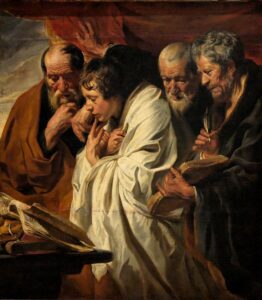
    Each of the canonical gospels provides an answer to these questions. Matthew, Mark, Luke, and John each have their own unique understanding of what Jesus was all about. You may be thinking they all teach the same thing because they often use the same stories and events. But they are all very different. Consequently, what is missed – these differences – provides us with very important insights into who this Jesus really is. This course will uncover for you how our gospel writers fashioned their understanding of Jesus so that each Gospel and its picture of Jesus will become unique and memorable.

    We will also discover how each gospel presents the nature of the church, the differences in how the disciples are depicted, and how each sees the purpose of the ministry and death of Jesus.

    We will finish up by posing a question not addressed by the Gospels: How do we use these very different portrayals of Jesus to understand Jesus in our day? After all, these Gospels were for the people who followed Jesus in the first century. What about us in the 21st century? To answer this question requires immersing ourselves in each Gospel.


Energion Direct
Privacy Overview

This website uses cookies so that we can provide you with the best user experience possible. Cookie information is stored in your browser and performs functions such as recognising you when you return to our website and helping our team to understand which sections of the website you find most interesting and useful.