Blog

  • Does the biological Theory of Evolution explain our world? —NO (sort of)

    [EDITOR’S NOTE: This post is part of our series on controversial questions. A NO post will normally follow a YES post. Join in by posting your comments.]

    by Elgin Hushbeck, Jr.

    PicOne of the longest running battles between science and religion is over the theory of evolution, a battle which started as soon as the theory was published. There is a lot to criticism on both sides and I will not be going into this long, complex and sordid history. Here I will simply address the question of whether or not the biological theory of evolution can explain our world. But even here there are many problems. Just what do we mean by “explain our world?” For simplicity sake I will take this to mean, as the title of Darwin’s founding work put it, the Origin of Species.  Biological evolution says nothing about how life got here in the first place, and scientifically that still remains a conundrum that has only gotten vastly more difficult the better our understanding has become.
    But if we set aside this question for the moment and restrict ourselves to what happened after life got started, does evolution at least explain the diversity of species we see all around us? To answer that question, we first must deal with the fundamental problem of just what actually is this theory? This is a fundamental problem because there is no easy answer to this question.
    At times there seem to be as many answers as there are people pushing one side or the other. A common and somewhat neutral definition is that evolution is, in a very general sense, that life started in simple forms and then over time evolved into more complex forms finally resulting in human beings. Ok, but this is more descriptive than an actual scientific theory.
    This would probably be a good time to point out that I have no theological problems with evolution, unless it is defined, as some atheist I have heard define it, as a process that excludes God from creation. In simple terms, my view is that God created the universe, and that Genesis’ description is vague enough that it can be made to fit or conflict, depending on the desire of the interpreter, any number of theories. Frankly, I think this debate often overshadows the main message of Genesis, which is that God created the universe, and to put into perspective where we fit in the scheme of things.
    The key problem with the theory of evolution given earlier is that it is not an explanation. It at best states what happened but not why it happened. Darwin’s theory suggested two additional factors to allow evolution to be an explanation. The first is that the small changes that normally occur in each generation would be selected by natural circumstances, i.e., those best adapted to survival would do so and produce offspring and thus over time those traits would become dominant. Second, these changes would accumulate until the changes were significant enough (from whatever arbitrary starting point you picked) to produce a new species.
    Even the most committed creationist would accept the first of these, though there is often some dispute about where the boundaries are. But since I am limited in space, I will just take this as a given. Where I, and many others, start to have problems is with the second factor, i.e., that these changes are cumulative to the point of creating something significantly different than what was started with. The evidence, in fact is quite to the contrary, and herein is the rub.
    Virtually all the “evidence for evolution” is from the first category that even literal creationists accept. The problem comes in when evidence for the first factor is just assumed to apply to the second. Those critical of evolution often distinguish between these two factors as micro-evolution in the first case, and macro-evolution in the second, accepting the first and rejecting the later, whereas supporters assume they are all the same, and that evidence of micro automatically applies to macro.
    To illustrate these two factors, consider the breeding of dogs. People have been able to breed all sorts of dogs (micro-evolution) but the more they try to refine traits, the more secondary problems are introduced. It is as if you can selectively breed only so far at which point the animal becomes unstable. In short, micro-evolution does not automatically lead to macro-evolution.
    Another problem with natural selection is that Darwin postulated that these small changes would take a long time to accumulate and thus be seen in the fossil record. The problem is that the fossil record does not show any such slow progression. On this Darwin was clearly wrong. Rather, the fossil records show that there are very long periods of stability marked by geologically brief periods of change. This has led to a competing theory called punctuated equilibrium. Punctuated equilibrium has a much better correspondence with the fossil record but again this is just descriptive. It lacks a mechanism that would explain why there were such long periods of stability and short periods of change.
    There is a further problem in the theory of evolution presented by a characteristic of the fossil record called Cambrian Explosion. Again, evolution postulates that lifeforms developed in a progression over a very long period of time, and yet the fossil records show that there was very simple life and then in a geologically very short period of time the Cambrian period began, which basically had all the various forms of life without any progression.
    So we are left with neither theory really providing a good explanation. Darwin’s theory is great at explaining why we have, for example, so many types of dogs, or perhaps even canines, but not why we have dogs and cats. Punctuated equilibrium describes the fossil record but does not explain why it is this way.
    This is not to say that there are not a lot of possibilities. But this is yet another problem I have. The history of science is full of nice sounding ideas that once tested turned out to be completely wrong. Evolutionary theory is full of ideas that have not, and in some cases, cannot be tested. Whatever these may be, they are not science, and certainly not a fact, as defenders of evolution have written into law. In some cases defenses of evolution have become virtual tautologies: arguments that are always true, but tell you nothing about the real world.
    So in short, I do not believe any of the various theories of evolution provide any real explanation. Thus when it comes to how, in a very real sense, I am agnostic on the question, except in the belief that God is ultimately responsible. How he did it, in my mind, remains to be determined.


    Elgin’s books can be viewed and ordered here: https://energiondirect.info/authors/authors-d-k/elgin-hushbeck-jr
  • Does Biological Evolution Explain our World? —YES!

    [EDITOR’S NOTE: This post is part of our series on controversial questions. A NO post will normally follow a YES post. Join in by posting your comments.]

    Evolution and the Character of God
    by Allan R. Bevere

    Bevere picDoes biological evolution explain our world? I’m not sure how that question in and of itself is significant. I answer “yes” to that question, but it seems to me the importance of the question can only be found in the inquiry that must lay behind it– “Is biological evolution consistent with the character of God who created the world and the universe?” Without that prior concern, the main question for discussion here is of little significance, at least for those who believe in God. So, in answering the question given to me, I will make in initial case that evolution is consistent with the character of the God, who created all things including life on Earth.
    Prior to the main subject of this post, a few caveats are in order:
    First, I don’t think we can separate the biological evolutionary questions from the evolutionary nature of the universe itself. If the universe has evolved and is evolving than it reasonable to assume that biological evolution on Earth makes sense. When we isolate how human life came to be from the rest of the cosmos, I think we confuse one issue making it two. Why would God create the universe in one fashion while bringing human life in another? Thus, I must deal with the question of evolution in general, which includes the cosmos and life on Earth.
    Second, since I accept evolutionary theory, that means I do not believe that Genesis 1 and 2 should be interpreted, as they say, “literally” (an oft abused term). There’s a mythology in many fundamentalist and evangelical circles that the church unanimously interpreted the creation narratives literally until Charles Darwin came along in the nineteenth century. In fact, the church has debated for almost two thousand years how to read the creation material as Daniel Harrell points out quite well.1 The reason I mention this is that often creationists will do a bait and switch arguing that only those who hold to a literal reading of the creation narratives believes in the authority of Scripture. But what is authoritative is Scripture, not a particular hermeneutic. One can hardly accuse St. Augustine, for example, of denying the authority of the Bible. So, let’s take that criticism off the table and stick to the actual substance of the debate.
    Third, that means those who take issue with my position on evolution must do so based on the science alone, not on guilding the data to fit a particular interpretation of Genesis. For me, Genesis is one thing, and science another. Genesis 1 and 2 answer the why of creation. Science answers the how. My use of Scripture in this post will highlight the character of God and why I think his character is consistent with evolutionary creation. My concerns with Scripture are theological, not scientific.
    Now, on to the main argument.
    First, God is truth and does not create deception. The Bible is clear on this:
    God is not a human being, that he should lie,
    or a mortal, that he should change his mind.
    Has he promised, and will he not do it?
    Has he spoken, and will he not fulfil it?
    (Numbers 23:19; see also Titus 1:2)
    1 John 1:21 states, 21I write to you, not because you do not know the truth, but because you know it, and you know that no lie comes from the truth.
    The point for our purposes in this post is that since God is truth God cannot create in a deceptive way. Creation itself and its coming into existence with reflect that character. If the age of the universe is not 14.6 billion years and if the age of the Earth is not 4.5 billion years, and the appearance of homo sapiens on our planet was not approximately 200,000 years ago, why is that not obvious? It would seem that God in creating rocks that appear old God himself has created a deception. And those who believe that the universe and the Earth are not obviously old are clearly guilding the evidence. We can accurately measure light from distant stars that tell us their distance. The farthest stars known to us are anywhere from 750,000 to 900,000 light years away, and those stars are not close to the center of our galaxy or for that matter the center of the universe. Contrary to what some will argue, scientific dating is an accurate way to assess the age of rocks and bones and other earthly things as well. The oldest rocks discovered on our planet are anywhere from 3 to 4.4 billion years old.2 Again, we must wonder why God would deceive us in creating a universe and our Earth that only appear old? This is not in character with the God of the Bible.
    Moreover, why would God work in a microevolutionary way, something that even creationists acknowledge, but fail to do so in a macroevolutionary manner since microevolution happens by the exact same mechanisms as macroevolution?3Is this not inconsistent? Why allow evolution to occur within a species (microevolution), but not between species (macroevolution)? Is God’s character inconsistent and doesn’t this make God even more deceptive, to create one way on a large scale and a different way on a small scale?
    Second, evolution is about a relational universe and world, and God is inherently relational. One does not need to know the Bible forward and backward to know that God is relational and desires to be in relationship with human beings and all of creation. Theoretical physicist and Anglican priest, John Polkinghorne has argued cogently that the universe is inherently relational4 and we should expect it to be no different in character from its Creator.
    In Romans 8:19 St. Paul writes,
    For the creation waits with eager longing for the revealing of the children of God; for the creation was subjected to futility, not of its own will but by the will of the one who subjected it, in hope that the creation itself will be set free from its bondage to decay and will obtain the freedom of the glory of the children of God.
    Salvation in the New Testament is cosmic in scope. The cross and resurrection of Jesus is not about individual human salvation alone, but about the redemption of creation. Just as God desires to be in relationship with men and women, so God desires relationship with the cosmos he created. Just as our relationship with God grows as we evolve (mature) as disciples, so creation itself evolves as God enjoys seeing the cosmos develop and mature. Indeed, even creation itself is inherently relational with itself. John Polkinghorne writes,
    Einstein went on to develop the theory of general relativity, showing that space, time and matter are closely interconnected in a kind of integrated package, in which matter curves spacetime and spacetime curves the paths of matter. The cosmic ‘container’ and its contents are not separable, but intimately linked with each other.5
    The interrelatedness between matter and spacetime is only one of many examples. This inherent relationality not only reflects the character of a Trinitarian God, which St. Augustine referred to as a fellowship of love, but it also strongly suggests that this cosmic relationality is revealed in the evolutionary process. One cannot have microevolution, which we know takes place, without a macroevolutionary process that is intimately related to it.
    Third, creation is dynamic just as God is dynamic, not static, as creationist accounts suggest. In creationist accounts of the universe the world was created in six twenty-four hour days and when it was completed, it was done. The problem with this notion of creation being completely finished is that we know it is simply not true. The universe even now is expanding. New galaxies and stars and worlds are being created. The cosmos is not statically finished, but it is still being created. Alister McGrath notes,
    The twentieth century saw dramatic changes in our understanding of the origins and development of the universe. The first two decades were dominated by the assumption that the universe was static…. The solution of his [Einstein’s] equations indicated that the universe was not static, but expanding.6
    McGrath goes on to argue that such a dynamic universe that is evolving does not reflect the static deistic God of the Enlightenment, but better reflects the dynamic Trinitarian God of Christianity.7 It seems to me quite problematic for creationists to reconcile the dynamic, relational God of Scripture with their static understanding of how God created.
    Fourth, and finally, through the evolution of creation, God allows the universe freely to make itself. In a sense, God has built freedom into the universe. If God is inherently relational and wants to be in relationship with his creation, he must allow the freedom of creation. This does not deny God’s providence, but “a balance is struck between the actions of God and the actions of creatures.”8As human beings are free to choose their own way, so the evolution of creation is consistent with the character of God that allows creation itself to go its own way. Once again, I quote John Polkinghorne:
    A creation allowed to make itself can be held to be a great good, but it has a necessary cost not only in the blind alleys and extinctions that are the inescapable dark side of the evolutionary process, but also in the very character of the processes of a world in which evolution takes place. The engine driving biological evolution is genetic mutation and it is inevitable in a universe that is reliable and not capriciously magical, that the same biochemical processes which enable germ cells to produce new forms of life will also allow somatic cells to mutate and become malignant That there is cancer in creation is not something that a more competent and compassionate Creator could easily have eliminated, but is the necessary cost of a creation allowed to make itself.
    God acts within the open grain of nature and not against it. God interacts with creatures but does not overrule them, for they are allowed to be themselves and to make themselves. It follows from this that not everything that happens will be in accordance with God’s direct will. The divine sharing of the causality of the world with creatures will permit the act of a murderer or the incidence of cancer, though both events run counter to God’s desires9
    Such freedom is seen countless times throughout the Bible in reference to human beings who also unfortunately all too often choose to go their own way. Why would it be any different with the entire creation? And it is in such freedom and in God’s desire to be in relationship to his creation, that God takes the risk of becoming human in Jesus Christ; and in the cross and resurrection, displays his willingness to allow human beings in their freedom to reject him on Calvary, and in his providence to insist otherwise in the empty tomb.
    Does evolution explain our world? Indeed it does. It explains the very character of the universe because all of creation reflects the character of God.


    NOTES

    1. Daniel Harrell, “How was the Genesis account of creation interpreted before Darwin? http://biologos.org/common-questions/biblical-interpretation/early-interpretations-of-genesis
    2. Becky Oskin, “Confirmed: Oldest Fragment of Early Earth is 4.4 Billion Years Old,” http://m.livescience.com/43584-earth-oldest-rock-jack-hills-zircon.html
    3. Evolution at different scales: micro to macro http://evolution.berkeley.edu/evolibrary/article/0_0_0/evoscales_01
    4. See John Polkinghorne, Science and the Trinity: The Christian Encounter with Reality. New Haven: Yale University Press, 2004, pp. 60-87.
    5. Polkinghorne, Science and the Trinity, p. 73.
    6. Alister McGrath, A Fine-Tuned Universe: The Quest for God in Science and Theology. Louisville: Westminster/John Knox Press, 2009, p. 112-113.
    7. McGrath, A Fine-Tuned Universe, p. 118.
    8. Polkinghorne, Science and the Trinity, p. 99.
    9. Polkinghorne, Science and the Trinity, p. 72.
    Allan’s books can be viewed and ordered here: https://energiondirect.info/authors/authors-a-c/allan-r-bevere
  • How Does Science Inform Biblical Interpretation?

    by Steve Kindle

    “By identifying the new learning with heresy, you make orthodoxy synonymous with ignorance.”
    ~Erasmus

    What follows in this post is my personal reflection on Dr. Vick’s post which ran yesterday. Although I hope he finds this compatible with his own view, he may not. He is only responsible for prodding me to think through some of the implications of what he wrote.

    Head-Brown smallThe heliocentric model of the universe changes everything.
    Since the Copernican revolution, we can no longer accept the Ancient Near Eastern three-tiered universe with heaven “up there,” and Sheol “down below.” Paul’s vision of a man transported to “the third heaven” reveals a psychology steeped in that worldview. Elijah taken to heaven in a fiery chariot, and even the ascension of Jesus, can no longer be taken literally. Given the vastness of the universe, the psalmist’s question, “what are human beings that you are mindful of them, mortals that you care for them?” takes on deepened meaning. Can we still speak of God “in the heavens,” or literally understand that “The Lord came down to see the city and the tower, which mortals had built.”? I think not.
    The biological Theory of Evolution changes everything.
    No longer can we think of the world as created in six days, or Bishop Ussher’s 6,000 years ago, or the Creationist’s 10,000. The creation narratives in Genesis can no longer be taken literally, but as a poetic ode to creation and the Creator. Adam and Eve can now be seen as a primordial myth that speaks to the human condition, not of the actual First Parents. The Flood has shrunk to the area surrounding the Black Sea about 12000 BCE. (The universality of flood stories can be traced back to the melting of the great ice sheet that covered most of the northern hemisphere at the same period, and how it affected its people.)
    The only answer that literalists can give in response is that the Bible is the word of God and must take priority over any other presumed authority…regardless of the overwhelming scientific evidence to the contrary. “The Bible says” trumps scientific findings.
    Literalists do claim a kind of science on their side, Creation Science. They marshal “evidence” that no scientist in the academies supports, even continuing to cite long overturned arguments from John Whitcomb, Henry Morris, and George McCready Price. The Creation Science movement proved too embarrassing for many scientists of faith, because it was tied too closely to biblical arguments. They began the Intelligent Design movement and eschewed any taint of religion in their deliberations. However, virtually all are aligned with some form of Christian Evangelicalism or Fundamentalism, which drives their efforts, not pure science. They have yet to make significant inroads into the wider scientific community.
    So what does the consensus scientific worldview do for biblical interpretation and theology?

    • It removes biblical supernaturalism as an explanation of events.
    • God’s transcendence is not physical (out there), but “wholly other.”
    • Literalism is no longer the first and preferred reading.
    • The biblical notions of sin and salvation (atonement) need to be understood as arising from the ancient milieu, and not appropriate today.
    • The Bible, rather than being a scientific textbook, can be recognized as the record of a people trying to understand their world and their place in it. It is the people’s record, not God’s.
    • The apocalyptic undergirding of the New Testament needs to be seen as a yearning for hope in a world gone mad, not as a timetable for the ages.
    • It ends the dualism that turns the world into a battleground instead of a paradise.

    What are some of the applications that can be made from these assertions?

    It removes biblical supernaturalism as an explanation of events.
    God can no longer be seen as acting from outside the cosmos upon the Earth shaping events and suspending natural law at will. Things have proceeded over the past 14.5 billion years in a natural fashion and continue to do so. We know that the Earth rotates about 25,000 miles per hour and orbits the sun, which is stationary (relative to the earth). The story of the battle for Jericho includes God causing the sun to stand still in the sky to allow for more daylight. This is a perfect example of the ancient worldview’s explanation for how Israel wins battles: God intervenes for them. This, for me, serves as an archetype for all such interventions.
    God’s transcendence is not physical (out there), but “wholly other.”
    By removing God from beyond the cosmos (heaven), we have not demoted God, but made God immanent—within all things. In certain ways, God is closer to humanity than before. Gone are such notions as “the Man upstairs,” “the Old Man in the sky,” and other figures of speech that make God remote and far removed from human life. God being intimately related to and involved with every aspect of life, from the smallest subatomic particle, to the fullness of the cosmos, makes everything sacred and gives humans motivation for proper care of creation.
    Literalism is no longer the first and preferred reading.
    Knowing that we are reading ancient documents that are informed by a worldview vastly different from our own, we can no longer accept their understanding at face value. Taking the text literally is to overlook this fact. We begin interpreting by asking what informed the author to understand the text in this way, and then compare it to how we find things in our world today.
    The biblical notions of sin and salvation (atonement) need to be understood as arising from the ancient milieu, and not appropriate today.
    Can you imagine anyone operating out of the modern worldview attaching the remedy for sin to blood atonement? The gods of the Ancient Near East were capricious and vengeful. In agrarian societies, the only thing they had to offer the gods to appease them were what they grew or the livestock they raised. They saw these things as an extension of themselves, and, in a way, the offering of themselves. Blood, life, in exchange for their lives.
    Even the Bible comes against this notion from time to time. From Amos: I hate, I despise your festivals, and I take no delight in your solemn assemblies. Even though you offer me your burnt offerings and grain offerings, I will not accept them; and the offerings of well-being of your fatted animals I will not look upon. Take away from me the noise of your songs; I will not listen to the melody of your harps. But let justice roll down like waters, and righteousness like an everflowing stream.
     Even the pagans such as King Nebuchadnezzar found peace with God away from blood atonement. From Daniel: Therefore, O king, may my counsel be acceptable to you: atone for your sins with righteousness, and your iniquities with mercy to the oppressed, so that your prosperity may be prolonged.”
    Not all the atonement theories arising from the New Testament and later required a blood sacrifice for efficacy. Specifically, Luke sees salvation arising out of being faithful to the end, even as was Jesus, who models our means of salvation.
    The Bible, rather than being a scientific textbook, can now be considered a record of a people trying to understand their world and their place in it. It is the peoples’ record, not God’s.
    Rather than this being woeful, it is an amazing realization. Humans are capable of spiritual insights and profound realizations about the world and themselves. God will be seen as a participant in this, but the record is from humans. Therefore, for humans to engage the Bible as human to human is to do precisely what the ancient people were doing that resulted in the Bible. The tradition continues into our own time and much spiritual good is reaped in the process.
    The apocalyptic undergirding of the New Testament needs to be seen as a yearning for hope in a world gone mad, not as a timetable for the ages.
    Apocalyptic theology, that is, the understanding that God shapes all world history according to God’s will, and that good will ultimately triumph over evil, arose out of a need, indeed, a longing, that this is the case. I believe that God will ultimately prevail in securing a world typified by shalom, and I recognize this as a faith statement. But the notion of God superintending history, much as a mother hen, doesn’t give free will its due.
    The Hebrew Bible is full of instances where God is depicted as “changing his mind.” First, with being sorry, actually repenting making humankind, and rectifying this by the genocide of the race. Then there is Moses pleading with God in the wilderness not to destroy Israel. God relents when Moses argues that the Egyptians will laugh at him. These and many other examples suggest that not all things are set in place “before the foundation of the world.” That the future is unknown and not predicable, as apocalyptic would have it.
    It ends the dualism that turns the world into a battleground instead of a paradise.
    Religious dualism is the idea that there are two supernatural forces diametrically opposed to one another vying for dominance. For nearly 4.5 billion years of the formation of planet Earth, down to our own day, dualism was irrelevant. Actually, the idea that there is God and an anti-god (Satan), is very new to humanity. In fact, the Hebrew Bible’s recording of the history of Israel from creation to the return from Babylonian exile got along without it. Satan, as known in the New Testament is absent. Dualism emerges in the Intertestamental period and flourishes in the New Testament. Many scholars believe that Jewish theologians were introduced to dualism during the Babylonian captivity with their exposure to dualistic Zoroastrianism. Dualism tends to divide people, institutions, and things into good or evil. Monism (the metaphysical and theological view that all is one, that there are no fundamental divisions) promotes world unity and peace and is the basis of Shalom.
    Conclusion
    We in the 21st century have been given a marvelous inheritance in the Bible. If we can learn to view it as a human enterprise encapsulating the wisdom of a people who earnestly sought to find answers to the human predicament, we, too, will find our way out of darkness and into the light. But only if we are not imprisoned by an outmoded and now harmful worldview that would keep us from finding our own way.


    Steve’s books can be viewed and ordered here: https://energiondirect.info/authors/authors-d-k/steve-kindle
  • Should we assume a scientific worldview when we come to interpret Scripture? —YES

    [EDITOR’S NOTE: Not all post will have an opposing response. If you disagree with this one, please make your case in the comments.]

    by Edward W. H. Vick

    FOREWORD
    After presenting a definition of the term ‘worldview’ we consider two specific examples, the ancient and the modern.
    Then we note that one worldview has replaced another, and that the scientific worldview becomes the modern worldview which we accept as given. It has, shall we say since Galileo, come to replace the ancient worldview. Refusal to change leads to the irrationality of obscurantism.
    The modern worldview becomes comprehensive and demands either inclusion or rejection of .previous patterns of thinking. We all live by this worldview, even if we create an opposite worldview when we tell our infants fairy tales and delude them about Christmas and its delights. We stand aloof from it to give the nippers a good time with Santa. They will have to come to terms with the problem later. Then we will have to be honest.
    We then discuss what this implies for our interpretation and understanding of Scripture.
    THE PROBLEM
    Let’s first be clear that the worldview of most, if not all of us, who will read this is the modern worldview, within which we all do all of our thinking and decision making. This modern worldview is the scientific worldview. It provides the context for all of our thinking and decision making and acting. I say ‘all’ but some of us may want an opt out when it comes to making religious claims, and in our approach to Scripture. An anomalous situation arises if one takes a Scripture book to have divine authority and attempts to take all its claims as literal. It’s worth talking about!
    This modern worldview emerged to replace an ancient and medieval worldview, the one which assumed that the earth was flat, that the earth was the center of the universe, that there was intercourse between the terrestrial and the supernatural, that remarkable things took place in the natural world. Indeed supernatural beings, demons and angels were to be taken into account to explain events that took place in the world for which no ‘natural’ explanation could be given. Demons and angels brought about evil and disease. Angels were the cause of good. Remarkable, previously unique, inexperienced and unrepeatable events demanded explanation from beyond the human and natural.
    Ancient documents took for granted in their claims and in the stories they told that the universe was structured in three stories: the earth (flat), the heavens above and the waters beneath. Part of their worldview was that there was interaction between celestial beings, the gods or God above, and human beings below.
    Scripture was produced within the context of such an ancient worldview. In its writings we find accounts of events the like of which we do not experience, have never experienced and do not anticipate we shall experience. Not being within the limits of our experience we believe they do not happen. We put them outside the bounds of possibility. So we do not think even remotely of their probability. We have no expectation that similar events might happen. We then question reports of such events, past and present. What this means for our understanding of such reports in Scriptural writings is that we look for a meaning within and behind the statements and narratives. The child, who once believed the narratives about Christmas to be literal accounts of past events, learns in becoming more mature later that there is a meaning behind the account of what he took once to be an historical account.
    So we are faced with a basic question. How shall we interpret those passages and the overall story the Bible tells?
    EXPOSITION
    We do whatever thinking we do within particular frameworks. This is of course a metaphor. It designates the set of assumptions and beliefs we hold whenever we consider how to assess or interpret things. We hold different frameworks for different areas of our concerns. A framework is a set of assumptions. Some are very limited. But there is also an overall framework that provides for all our beliefs and attitudes. This we call a ‘worldview’. When we think about the world around us, the sky above, the depths of the oceans, the existence of microbes and the extent of the universe as well as the sensations we experience, and the demands made on us for belief and action, we exercise our thoughts within an overall framework. What we take for granted as background we call our ‘worldview’. We may not be able to articulate this set of assumptions even to ourselves. For example, the ancient person could not articulate that all his thinking was done within the assumption of a three storied universe: waters underneath, sky above and flat earth accompanied with the assumption that there was activity between the divine transcendent and the human earthly. (See diagram below).
    We assume a causal relationship between certain events and reactions, historical, personal and physical. We have learned to make this assumption, at least after a childhood when we were bombarded with impossible and improbable tales. We know that some kinds of thing just do not happen, and we learn, if we pursue the matter, to give an account of the principles we take for granted in believing this and acting on our belief. Some kinds of thing are impossible. We have constructed a worldview, very different from that of our childhood. If we retained some of the assumptions inherited from our childhood, we would be led to give credence to very questionable beliefs.
    It seems that it is so easy to focus on one issue and forget that a whole set of assumptions lies behind our thinking about it. It is easy to focus on the first chapter of Genesis and neglect the background of the ancient Hebrew assumptions behind it. We have our own and different set that leads to our conclusions about its interpretation. For to our thinking as a whole there is a background of assumptions and beliefs that determine how we shall think. That background differs from age to age and from culture to culture This package we call our ‘worldview’. It provides an orientation that influences, determines how the individual or society interprets and acts within the world.
    As cultures differ worldviews differ. As cultures advance and knowledge increases so adjustments take place in the worldview. One worldview replaces another, or may sit side by side within a multi-layered culture. What has happened is that one worldview may become dominant and demand inclusion and if necessary replace another. The scientific worldview replaces the ancient worldview and then becomes the modern worldview. “Time makes ancient good uncouth.” Refusal to change means irrationality and regress. That exhibits itself in bad judgment and irrationality in reasoning and in act.
    What happens then when one who lives within the modern, western culture attempts to understand and interpret writings and artifacts from another world, from within a previous worldview? It is sometimes necessary to bracket one’s own assumptions in order to get within the mindset of the culture and the literature one is studying, to understand their world from an ancient or medieval point of view. But the bracketing ends with a return to one’s own worldview.
    Obviously there is conflict, whether within the individual or within the society when worldviews get replaced. Remember Galileo? His discovery that the earth was not the center of the universe was the immediate issue. What it called into question however was a whole system of religious thought underwritten by a powerful autocracy. That society endorsed a worldview now becoming outmoded, even if not recognized at the time.
    What are we to make of the struggle to hold incompatible worldviews? It is the situation where one cannot reconcile religion with the rest of one’s knowledge and so one wants and tries to cling to both in the belief that both are good. So arises what has been called the problem of the two compartments. It does not solve the problem but restates it. It produces the unstable equilibrium of the divided mind. One is reminded of the report of the words of a little girl.  “Of course I know that Santa Claus isn’t real, but I don’t want anybody to tell me.” That stance is similar to what some biblical literalists are thinking. To maintain such double-think leads to self-deception. The cure is to acknowledge the repression of the one attitude, and the incompatibility of the two views in unresolved conflict.
    Literalism is the interpretation of biblical statements for their literal meaning. Literalism is an extreme view of Scripture. It involves assuming an ancient worldview, the worldview that provided the context in which the Hebrew and Christian Scriptures came into being. When a story is told or an account of an event is given, it is to be taken as a true report of an actual event or phenomenon. This is an extreme view, especially when taken with the belief that the words and sentences are divinely inspired. This assumption constitutes part of a religious worldview. How can an ancient worldview we do not and cannot apply in our ordinary and contemporary living and thinking do service here? An ancient worldview accommodates all kinds of miraculous events. Hebrew and Christian Scripture emerged within the context of such a worldview. Can we allow for them what we would never allow if similar such ‘reports’ were presented to us today?
    So what results when the literalist, who for all practical purposes takes quite for granted the modern worldview as we all do when living our ordinary lives, for religious purposes, brackets or replaces it with the ancient worldview, in the hope that he can thereby justify his interpretation of Scripture. As we have seen, the result is the divided mind of the two compartments. Something has to change to restore unity.
    If we understand what can and cannot happen we have criteria for assessing reports, or purported reports in ancient documents. We understand what can and cannot happen, what is probable and what is not probable from our own experience and from reports, contemporary and historical, and so we are justified in the assumptions that constitute part of our contemporary worldview. We cannot take literally, as true reports of actual past events statements about animals speaking (Balaam’s ass), about the sun and moon standing still in the firmament above the flat earth by command (Joshua), extra terrestrial beings producing wholesale massacre (in the Assyrian camp), claims that human bodies move from earth into space etc. etc.
    A worldview will contain various paradigms. A paradigm is a mode of thinking, a set of assumptions or a basic principle that guide particular areas of our thinking. Within the worldview the use of different paradigms will lead to different interpretations, theories, assertions about reality. Take these examples: the paradigms of God as judge with apocalyptic intentions, and God as loving and merciful and forgiving.
    1. God as judge is in cosmic conflict with opposing supernatural, celestial creatures and the conflict involves earth and its creatures. It is exemplified in the apocalyptic passages in the book of Revelation. The classic example is Milton’s Paradise Lost. A contemporary example is expounded in the book, The Great Controversy. God is eventual master in a continuing cosmic conflict. But only after painful destruction of the opposition in a universal blood bath of fire.
    2. God as love, giving life freedom and meaning freely to humanity in the person of Jesus.
    The paradigms, taken as basic models for an overall interpretation of Scripture, and for the construction of a theology with their dominating images of God, lead to conflict. At certain points if not overall, these two directing and conflicting images of God will be set against each other, and one be preferred as the dominating one in a church’s theology. There is no question which one that should be.
    We have now considered how our worldview makes it possible or impossible for us to believe some reports of extraordinary events, non-repeatable events that run counter to the regularity of the natural world. But in approaching and interpreting Scripture we must ask an essential question. Since the writings of Scripture are expressed within the context of an ancient worldview, that worldview providing the context for its overall message, how do we get that essential message while recognizing that we do not and cannot accept the framework within which it was and is expressed? That is the task for serious interpreters to answer when they assume quite rightly that Scripture, carefully interpreted, is to provide the basic material for constructive belief. The questions are: “What is the message behind the form in which it is expressed?” And, “What is an adequate way of expressing that message?”
    SUMMARY
    1. We accept the modern worldview for all intents and purposes.
    2. We reject the ancient worldview.
    3. We also replace its forms of expression.
    4. The urgent task is to find the essential message of Scripture plus our own adequate means of expressing it.
    ________________
    Diagram 1 is of the flat earth of the ancients. In the languages of the Bible (and in others) ‘heaven’ means ‘sky’. The sky was above a flat earth. God dwells above the firmament above the earth, the terms ‘above’, ‘below’, ‘up’, ‘down’ to be taken quite literally. Sun and heavenly bodies move across the firmament.
    Diagram 2 represents the spherical earth, moving around a central sun, as do the other planets. The spherical earth has a second motion as it rotates on its axis. The earth is a small body in an expanding universe of staggering extent, measured in millions of light years.


    Hebrew worldview
    Diagram 1
    Earth


    Diagram 2


    Dr. Vick’s books may be viewed and ordered here:  https://energiondirect.info/authors/authors-t-z/edward-w-h-vick
  • SHOULD CHRISTIANS ENDORSE CAPITAL PUNISHMENT? —NO!

    [EDITOR’S NOTE: This post is part of our series on controversial questions. A NO post will normally follow a YES post. Join in by posting your comments.]

    by Rev. Dr. Robert R. LaRochelle

    Bob LaRochelleI wish to begin by stating my fundamental conviction, one that undergirds the convictions expressed in this brief reflection: When exploring questions of ethics, one who calls herself/himself a Christian needs to explore the insights that Jesus brings to the ethical question at hand!
    While Jesus does not address capital punishment as such, one does not have to look very far to conclude that, in the life His followers seek to emulate, Jesus advocated nonviolence, redemption, forgiveness, second chances, and God’s abiding mercy, poured out even to those who committed some rather egregious moral actions. Without taking a proof texting approach, one could quite legitimately look to Jesus’ admonitions to love even our enemies, and His insights about the dangers of ‘taking up the sword’, along with His approach to facing His own execution as indicators, that Jesus favored a nonviolent approach to living. It is really difficult to quarrel with these facts.
    I find it ironic that so many who espouse literal interpretations of Scripture shy away from citing Jesus’ language and teaching as they defend the use of capital punishment. It is curious that so many states with such large numbers of ‘evangelical Christians’ also have such high rates of executions performed by agents of those states.
    The topic of capital punishment can be approached from many different starting points. While I would argue against it on many grounds (lack of effectiveness, danger of executing innocent people, waste of money, etc.), it seems to me that, in this space, we need to limit ourselves to commenting on it in the context of the ethical approach of Jesus. This is not a simplistic  ‘What would Jesus do?’ (WWJD) approach, as we understand that God allows us free will to make free, informed ethical decisions.
    However, it IS an approach that takes into consideration that in our moral decision making, if we call ourselves Christians, we need to turn to Jesus and examine his SPIRIT and the ethical orientation of His life. In other words, I think that if you want to argue in favor of capital punishment, it is pretty hard to cite the example and the teachings of Jesus as sources through which you will defend your position.
    If you are going to endorse the death penalty, I think, even though I would disagree with you, that you would make a better case talking about it in terms of deterrence or in some broad, general moral terms not connected, than you would if you were, at one and the same time, claiming that you seek to follow Jesus’ ethics and that you also support capital punishment.
    It strikes me as problematic that so many Christian conservatives, so deeply troubled with same sex marriage and other ‘signs of the secularization of America’, are so comfortable running away from that victim of capital punishment himself, Jesus, the One we as Christians espouse as our Lord and even our Savior as well….
    I invite your comments and our dialogue….


    Bob’s books can be viewed and ordered here: https://energiondirect.info/authors/authors-l-m/bob-larochelle
  • Science Fiction: What’s It All About?

    Science Fiction: What’s It All About?

    Book with science fiction scene and open doorway of light
    Book with science fiction scene and open doorway of light (Credit: Adobe Stock Images 93800711)


    By Joseph G. Whelan

    Energion publisher Henry Neufeld requested that I explain science fiction because I am the first independent author to be featured in his latest imprint, Enzar Empire Press.  I claim no scholarly expertise but I grew up reading science fiction and now I write it.  Originally it was called scientifiction and according to Merriam-Webster the word first appeared in 1916, so in that sense the field is almost exactly 100 years old.  The word scientifiction has fallen out of use and these days science fiction is the generally accepted term, although SF and sci-fi are also common.

    As a boy devouring what I thought of as sci-fi books I was shocked one day to find out that a favorite author intensely disliked the phrase science fiction and he hated my favorite word, sci-fi.  Later I learned that other authors in the field felt the same way.  It was one more mystery of the adult world that I, as a young person, did not understand.

    Today as a “sci-fi” author, I do understand.  It comes down to money.  There is a prejudice against science fiction in certain people, especially women, and they assume they won’t like it so they don’t buy it.  Knowing this, some authors resented being consigned to what they felt was a literary ghetto that trivialized their careers, marginalized their art, and reduced their incomes.  Ironically I find myself swimming against the same current, so Henry and I struggled to come up with a description for my science fiction novel that didn’t use those bad words.  We settled on Henry’s invention, “a novel of speculative science,” which appears on the front cover.

    Prejudice often results from misinformation.  Merriam-Webster is my favorite dictionary but even their definition of science fiction is not—in my opinion—correct:

    http://www.merriam-webster.com/dictionary/science%20fiction

    noun : stories about how people and societies are affected by imaginary scientific developments in the future

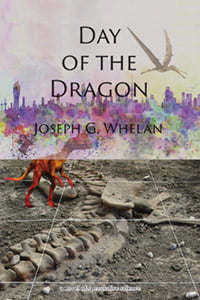
    One counterexamDay of the Dragonple that immediately comes to mind is a story wherein (1) people are not the main characters, (2) there are no imaginary scientific developments, and (3) no part of it takes place in the future.  This story immediately comes to mind because I wrote it.  It is called Day of the Dragon.  The main characters (1) belonged to a hypothetical species of intelligent dinosaur, who (2) lived their lives in a society based on science and engineering you would recognize, and (3) existed entirely in the past: their story ended a long time ago.  So with all due respect to my favorite dictionary, Merriam-Webster swung and missed three times.

    Just as it is possible to define science fiction too narrowly, it is also possible to define it too broadly, and this has been done.  At least one author in the field pointed out that a subgenre of science fiction called “alternative history” technically includes just about every novel ever written.  An example of alternative history is a story in which Hitler obtains nuclear weapons first and takes over the entire world.  Under this overly big umbrella Gone with the Wind is science fiction: in an alternative history the characters and situations in that classic book could have existed.

    Here is my definition:

    Science fiction stories ask and answer the question what if?

    For example, when I was growing up, everybody “knew” that all dinosaurs were big in body and small in brain.  But what if there had been even a single solitary exception?  What might such a world have been like?  You can find out by reading this book called Day of the Dragon….

  • Should Christians endorse capital punishment? —YES

    [EDITOR’S NOTE: This post is part of our series on controversial questions. A NO post will normally follow a YES post. Join in by posting your comments.]

    by Elgin Hushbeck, Jr.

    PicOne of the hardest aspects of the Christian walk is balance. The Bible teaches us many values, some of which at times are in conflict. Whether it be compassion and justice, truth and love, or any number of competing values, rarely does it seem that the body of Christ has the right balance and when it does, sadly it is not for long. This is, I believe, the case when it comes to the rejection of the death penalty.
    A qualification needs to be made here. Support for the death penalty does not mean support in all cases.   When it comes to individual cases, the death penalty can be rejected on any number of practical grounds from the motivation for the crime, extenuating circumstances, etc. So the question is not are there times it should be rejected, but rather is there ever a time it should be applied?
    A popular reason for rejecting the death penalty completely is that it precludes correction in the event of a mistake, but this is more of a practical objection than one grounded in Christianity. The same could be said about all punishments once the person punished dies. Nor does this address those cases in which there is no doubt and thus no room for error.
    Ultimately we must separate the question of when the death penalty should be applied, from should Christians endorse it at all.   Should a person who commits particularly heinous murders of innocent people, where there is no doubt about their guilt and no justification for their crime, people such as the Oklahoma City Bomber, or the Colorado Movie theater murderer, be put to death?
    Biblically this is pretty easy.   The death penalty is taught in both the Old and New Testament. In fact, a sign of the importance of the law is the fact that there is only one law that is given in all five books of the Torah; that murderers are to be put to death. This is also taught in the New Testament as a legitimate power of government in Acts 25:10-11 and Rom 13: 1-4.
    While there are also examples of compassion, these cannot be legitimately seen as anything more than what they are, example of compassion. It should be noted that the act of compassion requires an exception to a rule based on the circumstances. If the rule says you cannot cross the street in the middle of the block, but a police officer sees that you are in a real hurry, and lets you cross anyway, he has shown you compassion. If the rule is that you can always cross, there would be no compassionate in his letting you cross.
    In addition compassion must be limited based on circumstances, lest it become harmful. As the Jewish saying goes, compassion for the cruel, become cruelty to the innocent.
    Others argue that the death penalty conflicts with our Christian duty to forgive. While there is not space to go into detail here, I believe this is based on a misunderstanding of our duty. More to the point, whatever the duty we as Christian have to forgive, murder is both a crime against an individual on the one hand, and society on the other, often leaving a wreckage of devastation for numerous others in between. While we, as individuals, may forgive murders that is not the same thing as the state forgiving them. Then again, if taken literally, it would argue that we should not have any punishment at all. After all, if our forgiveness precludes the death penalty, why doesn’t it preclude life in prison, or any punishment for that matter?
    The real problem is that the persons most affect, those who were murdered, are no longer around to forgive, thus in a very real sense earthly forgiveness is impossible.
    Some argue that Christians cannot support the death penalty because all killing is wrong.   Other than a mistranslation of the 6th commandment (you shall not kill instead of you shall not murder) I see no support for such a view in the Bible.
    On the other hand, it is quite easy to come up with examples of instances of where I believe not only would it be OK to kill, but where not killing would be immoral. For example say a killer was in a preschool killing children. If killing him was the only way to stop him, and yet instead you allow him to continue his murder spree, your inaction would be immoral.
    Finally, some argue that the death penalty cheapens human life. Far from it, the ultimate punishment, for the ultimate crime is a statement of how important human life is. What cheapens human life, and causes great suffering to at least some of the family members and loved ones of those murdered, is the fact that while their victim is gone from this earth, their murderer continues to live life. Sure they are in prison, but they still live, laugh, see the latest movies, visit with their families, and in some cases get married and have families, things that their victims will never do. Long after the memory of their victims and their crime fades some build up followings of supporters pleading their case, and thus tormenting their victims’ families even more. Compassion for the guilty, is often cruelty for the innocent. But then the victim is gone while the murderer remains in the news, and in our visual based culture, “face time” is what matters.
    One the best things that happen with the execution of the Oklahoma City Bomber, is that despite being a routine fixture in the news from the time of the bombing until his much deserved execution, he virtually disappeared overnight from the public consciousness. All that remains is the memorial to the victims, the families of whom are still suffering from the damage that he did. He is gone, and that is how it should be.


    Elgin’s books can be viewed and ordered here: https://energiondirect.info/authors/authors-d-k/elgin-hushbeck-jr
  • “Does Capitalism best express Christian economic values? —NO!

    [EDITOR’S NOTE: This post is part of our series on controversial questions. A NO post will normally follow a YES post. Join in by posting your comments.]

     by Chris Eyre

    Chris has been with Energion Publishing since 1997 and fills a variety of rolls, mostly behind the scenes. Expect to hear more from him in coming months. The English spelling in this post reflects his London roots.

    Eyre picThe question asked is “Does Capitalism best express Christian economic values?”, which I interpret as meaning free market capitalism, rather than (for instance) the nascent Chinese authoritarian-capitalist model.
    So, what passages in scripture best enable us to see what Christian economic values might be? One might start with the account of the early Jerusalem church in Acts 2:44-45, “And all who believed were together and had all things in common, and they sold their possessions and goods and distributed them to all, as any had need”.
    Having all things in common would be an expression of the second part of the Great Commandment from Mat. 22:36-40 “You shall love your neighbour as yourself. Selling their possessions and distributing them to all would seem to flow from the parable of the rich young man in (inter alia) Mark 10:17-31, “And Jesus, looking at him, loved him, and said to him, ‘You lack one thing: go, sell all that you have and give to the poor, and you will have treasure in heaven; and come, follow me.’” He went on to say, “Children, how difficult it is to enter the kingdom of God!  It is easier for a camel to go through the eye of a needle than for a rich person to enter the kingdom of God.” Also, of course, according to Luke’s version of the Beatitudes (Luke 6:20-26), “Blessed are you who are poor, for yours is the kingdom of God.”
    Many reading this will immediately think that this had to be a short term situation, perhaps having regard to the expectation of Jesus’ imminent return and the institution of the Kingdom of God on earth. And some will think of Paul’s collection for the Jerusalem church, referred to in 1 Cor. 16, 2 Cor. 8 and Rom. 15, and suspect that the Jerusalem church had effectively beggared themselves. I am, however, mindful that Jesus also said (Matt 6:25-34), “Therefore take no thought, saying, What shall we eat? or, What shall we drink? or, Wherewithal shall we be clothed?” and “Take therefore no thought for the morrow: for the morrow shall take thought for the things of itself. Sufficient unto the day is the evil thereof.”
    If there is a major fault I can see in the Jerusalem church attitude, it is that the evidence is that it shared equally only between its own members. Implementing the principle of “love your neighbour as yourself” however has guidance as to who your neighbour is in the parable of the Good Samaritan (Luke 10:25-37), in which it is clear that your neighbour includes those of another religion and race, and traditional enemies. These days, it should probably be the parable of the Good ISIS insurgent. Help should have been for the whole community, and not just the group of followers of Christ.
    But, I hear said, this is just totally impractical, it cannot work. G.K. Chesterton however said “The Christian ideal has not been tried and found wanting. It has been found difficult; and left untried.” There have been some decent attempts (generally shorn of explicitly Christian content, for instance the anarchist communal enterprises during the Spanish Civil War), but never a widespread trial. I should underline that a statist controlled economy (which is often seen as the only alternative to unbridled free market capitalism) is not what I think is the nearest to a system Jesus might have approved of. However, something like the Jerusalem church might well be a halfway house to a truly Christian economics.
    Let’s turn to free market capitalism. At first sight, a free market looks a wonderful idea. You produce something which someone wants, and you agree a price with them. If someone else sells cheaper than you do, you have to lower your price to compete with them, and without any conscious decision making other than everyone getting the “best buy” and, on the other hand, selling at the “best price”, prices are kept low and competitive.
    There are two problems with this. The first is in the motivation it assumes on the part of both buyer and seller – the buyer is looking to pay as little as possible for as much as possible, the seller to sell as little as possible for as much as possible. Both are assumed to be working entirely out of self-interest. Self-interest is not a Christian value; it ignores the command to love your neighbour as yourself.
    The second is that it fails to work in practice except in very limited circumstances. What we actually see are monopolies (even on a very small scale you get those – there just is not room for two competing sellers of some goods in my town, for instance) and, where there isn’t quite a monopoly, a cartel, agreeing not to compete on price. As time goes by, one supplier becomes dominant because they can sell a little cheaper, and then economies of scale kick in and they become cheaper yet, and you have another monopoly (which is then protected from someone else entering the market by selling at a loss until the new entrant fails, at which point the losses are recouped by raising the price).
    Another problem kicks in when talking about markets in, for instance, stocks and shares. What governs those prices is more what people think is going to happen to the price in the future than a dispassionate view of how well the underlying company is doing, so they are prone to boom and bust cycles.
    Of course, except on a very small scale (without economies of scale), it is not a matter of a single person producing something, it is a matter of an employer with multiple employees, it is a matter of needing capital from somewhere in order to set up the business; both separate the work of production from the sale of the product. But, I hear, workers contract freely to work for the capitalist, and there is again a free market. The fact that the employer or the provider of capital makes most of the money, and not those who actually produce, is fair because it is a free market.
    This is just not the case. A free market demands that both seller and buyer are free from overwhelming need to contract at whatever price the other demands. Except in circumstances of labour shortages (which rarely arise except in the case of people with specialist skills), the employer can employ anyone, the worker fears starvation and the gutter and is compelled to accept what the employer is willing to give. This is good free market capitalist economics; it reduces the cost of production for the employer and increases the profit margin.
    It is not, however, remotely Christian. The employer is not only failing to love the employee as himself, but is taking advantage of rather than benefiting the poor (for instance by giving them all his money…). In a truly Christian economy, the fear of starvation and the gutter would not be there, because the rich would be queuing up to give the poor money.
    Indeed, free market capitalist economics value people only as units of production or units of consumption. The less you pay in wages the better, the more they pay for what they buy (and the more they buy) the better. A Christian economics would value them as people and, I suggest, value them the more if they are poor (hungy, thirsty or unclothed), a stranger, sick or imprisoned (Matt. 25:31-46). Capitalist economics, in other words, values only money. If you work for a capitalist enterprise, you are likely to be sacked for giving anything away or for selling it at a lower price than the employers demand; you are forever going to be pushed to produce more at a lower cost and sell more at a higher price. To make more money. As Gordon Gecko says in “Wall Street”, “Greed is good”.
    There is the problem. Paul said “The love of money is the root of all evil” (1 Tim. 6:10) and Jesus said “You cannot serve God and money” (Luke 16:13). The word used for money there is “Mammon”, which Christian theology has traditionally seen as a false god or prince of hell (Gregory of Nyssa, Cyprian and Jerome certainly thought this way; Gregory equated Mammon with Beelzebub).
    All this for something which you cannot eat or drink, which you cannot wear, and which has only the value we permit ourselves to be deceived into giving it unless and until it is converted into something real. In addition, if you consider Maslow’s hierarchy of needs, while the lowest level (physiological) can be attended to fairly readily with money, safety requires more than money, and having more money links badly with all the higher needs of humanity (“Money can’t buy you love”), though we are deceived into thinking that money gives us security and others are deceived into esteeming us more for “having” more of it.
    It is also the case that in every free market capitalist system (and the more so the more nearly that approaches the ideal), the principle of “trickle down economics” which benefits the poor because it benefits everyone does not work. Marx got a lot of things wrong, in my eyes, but the one thing he got right was that free market capitalism concentrates wealth (and so power and the ability to choose what one does with life) in fewer and fewer hands, particularly where there is no labour shortage. “Thus says the LORD:  For three transgressions of Israel, and for four, I will not revoke the punishment; because they sell the righteous for silver and the needy for a pair of sandals – they who trample the head of the poor into the dust of the earth and push the afflicted out of the way. “ (Amos 2:6-7)
    So, capitalism gives us a system which results in us valuing each other by the amount of this Satanic fiction we consider each of us to have and concentrating that in fewer and fewer hands. We live in fear of not having it (which is a primary reason why we do not try a truly Christian economics) and are compelled into getting more of it, and letting others have as little of it as possible.
    I therefore think that I was entirely justified in a recent Global Christian Perspectives webcast in calling Market Capitalism the “system of Satan”. It is the opposite of a Christian economic system.
    The trouble is, just as Jesus observed when he said “render unto Caesar that which is Caesar’s” (Mark 12:17), we are stuck with this system. I am myself too consumed with the fear of destitution to go as far as I think I should towards a truly Christian view of economics, and can only chip away at the edges (by, for instance, not buying from companies which I know oppress workers particularly badly, and by paying more than I need to where a seller is plainly poor, as well as the normal charitable imperatives for which there is no justification in Market Capitalism). The fact that we are stuck with it, however, should not blind us to its Satanic character and the fact that we should aim at something better.
    Capitalism is not a matter of “best expressing Christian values”, it’s a matter of expressing their opposite.
     

  • Does Capitalism Best Express Christian Economic Values? —YES!

    [EDITOR’S NOTE: This post is part of our series on controversial questions. A NO post will normally follow a YES post. Join in by posting your comments.]

    by Elgin Hushbeck

    PicThe quick and easy answer is a resounding yes. However, many have a distorted view of capitalism and thus will be puzzled by such a response so it requires some explanation. To begin with we must define what is meant by Economics, then Capitalism and finally we must determine just what Christian Economic values are.
    Economics is the study of the means for creating and allocating scarce resources. At first blush an equal distribution might seem to be the best, but many factors quickly arise. What if there is not enough to go around? These are, after all, scarce resources. How do need and desire factor in to the distribution? Numerous other such questions and concerns can be raised and in dealing with these the study of economics is born.
    While historically there have been a number of economic systems, today there are two main camps, differing in their method of controlling the allocation of resources. The earliest of these camps, Capitalism, dates from the late 18th century, seeing the means of control in a marketplace governed by competition in which individuals are the ultimate deciders, choosing what is best for them.
    In the early to mid-19th century others saw Capitalism as too chaotic and began developing an alternative theory. Inspired by the tremendous advances in science, advances that led to improvements in the quality of life by taming and controlling nature, the proponents of socialism sought to adapt scientific principles to likewise tame and control the economy.
    Now the preceding descriptions are by necessity brief, but it is the means of control, whether in the chaos of the marketplace, or the scientific determination of planners that marks the major division today. It is also noteworthy that these two camps are mutually exclusive. The more you pursue one, the less you can pursue the other.
    It is also important to point out that the common characterization of Capitalism, i.e., that of corporate leaders controlling the economy, is as antithetical to Capitalism as it is to socialism. The key to capitalism is a marketplace governed by choice and competition, not central planning. It does not matter whether the central planning is done by government, or by corporate leaders acting in their own self-interest; it is still centralized planning and therefore not capitalism. To be clear, I would not see planning by corporate leaders as a form of socialism, just a corruption of capitalism, though at times business and government do act together to control the economy. This is crony-capitalism, a corruption of both Capitalism and Socialism.
    As for values, just what, as Christians, should we seek in an economic system? While the reduction of poverty, is fairly easy, I am not sure a completely biblical list can be given. This is because the concerns of the Bible are somewhat different than our daily economic well-being. Nor are economic systems themselves inherently concerned with values. That said, some of the things I look for in an economic system beyond just the reduction of poverty, are more abstract concepts such as an improved quality of life, self-determination, and empowerment.
    When it comes to judging Capitalism and Socialism against these standards, some final factors need to be considered. First while theory is all well and good, what is more important is what the system actually produces in a long term and sustainable fashion.  Second, while it is important to compare likes, in reality, critics of Capitalism often compare the goals of socialism against the worse failures, or even a distorted caricature of capitalism.
    In fact, Capitalism is often caricatured as grounded in greed and producing selfishness. To the contrary, the studies are pretty clear that those supporting free market approaches tend, on the whole, to be more generous and charitable.
    Nor should this be much of a surprise. In any actual marketplace governed by choice and competition, the caricatured Capitalist would fail as people took their business elsewhere. Rather than greed, the core of capitalism is mutual exchange, and this exchange encourages a concern for others. While, as in all human endeavors, examples of human failings are all too common, that does not change the core. Thus management books and seminars deal with topics such as keeping your employees happy, providing better customer service, developing long term relationships, the importance of honesty and integrity, seeking Win-Win situations, etc..
    Capitalism encourages individuals to improve themselves, deferring satisfaction today, and working hard for the future. In doing so it encourages the earned success that studies show is strongly linked to happiness, and as I mentioned earlier its focus on others also results in people who given more of their time and money to others than do their socialist counterparts.
    In addition, the closer one moves to capitalism, i.e., the more competition and choice there is, the better things will be. In contrast, while space does not permit a complete explanation here, socialism faces three huge problems. The first is that the economy is so large and complex that understanding all the various factors needed to create a plan is impossible. Second, the power to enforce a plan results in a loss freedom, which for large plans move the state towards and sometimes to totalitarianism. Third, there is a question about long term sustainability of large socialist governments on issues of debt and demographics.
    Nor is government immune from the same human failings that afflict every other human organization. When you are wronged by a business in a free market you can go elsewhere, and even appeal to government for redress if need be. When government wrongs you, where can you go?
    Ultimately, the key advantage of Capitalism is that it focuses on the creation of wealth rather than its redistribution, resulting in a better standard of living and providing the means to being more generous. The results of this are seen in the fact that since 1970s the worse form of poverty has fallen by 80% as a result of the introduction of capitalist programs such as micro-credit.
    Thus while not really Christian, Capitalism reduces poverty, allows people to live better and happier lives, and results in people who are more generous in their giving to those in need. Not bad for a system who primary focus is the efficient creation and distribution of resources.


    Elgin’s books can be viewed and ordered here: https://energiondirect.info/authors/authors-d-k/elgin-hushbeck-jr
  • Is America morally obligated to resettle Syrian refugees? —YES

    [Editor’s Note: Not all post will have an opposing response. If you disagree with this one, please make your case in the comments.]

    by Doris Horton Murdoch

    Murdoch picYes, Americans are morally obligated to resettle Syrian refugees. This resettlement assistance of any global group of oppressed persons is a collective international responsibility. According to World Vision, there are 13.5 million people in Syria needing humanitarian assistance. The total population in (2013) is 22.85 million. So more than half of the population needs humanitarian care.
    There are 4.3 million refugees and 6.6 million displaced in Syria and half of these displaced individuals are children. Most of the Syrian refugees have remained in the Middle Eastern countries. Only about 10% of the Syrian refugees have moved into Europe. The United States has pledged to take 10,000 refugees in 2016 with fewer than 2000 finding refuge in the United States in 2015. The United States is a large country in land mass and is the 7th wealthiest country in the world (US Insider). As a world leader, is the United States really doing our equal share by accepting 10,000 refugees?
    What do our American values prompt the nation to do in this resettlement issue? As a nation under God, what does scripture tell us to do with refugees? How does the Great Commission direct our efforts in an evangelism opportunity? Is it possible that our American values, God’s Word, and a missional opportunity are weaving a tapestry of final judgment for the end times?
    America is built on the respect of human values. The Declaration of Independence states that all men are created equal; endowed by their Creator (For those of the Abrahamic faiths [Christian, Jew, Muslim], this is God and/or Allah and/or YHWH and/or Jehovah.) with certain unalienable Rights, that among these are Life, Liberty and the pursuit of happiness. As Americans, do we truly believe in these rights for all people or for a select few and, if so, who are the select?
    Throughout history, America has been composed of immigrant populations seeking peace free of oppression and violence, job opportunities, religious freedoms, security and hope for a better life. Are we now consumed in the idea of survival of self with prosperity in life of the select? As I type this term select again and again, I’m convicted to look at my own inner prejudices, fears and desires. I believe Thomas Merton, an American Trappist monk and writer, would respond to select with, “Our job is to love others (all of the world) whether not they are worthy.” It is not for us, as Americans, to judge the people of the world. As Americans, we are to offer love, respect and humanitarian assistance in as many ways as possible, even if it means allowing Syrian refugees to resettle on American soil. As a nation under God, it is our commission to open our arms and hearts to all, especially the marginalized people of the world, in this argument, Syrian refugees.
    The Great Commission (Matthew 28:19-20) tells us to make disciples of all the nations, baptizing them in the Name of the Father, and the Son, and the Holy Spirit. This same scripture states that God is with us always. We’re reminded in scripture that God is always with us, so we never stand alone. Where is our faith and hope in Jesus Christ? Jesus is my Savior. He is your Savior and He is the Savior of and for the world. In Jeremiah 22:3, we read, Thus says the Lord, “Do justice and righteousness, and deliver the one who has been robbed from the power of his oppressor. Also do not mistreat or do violence to the stranger, the orphan, or the widow; and do not shed innocent blood in this place. Through scripture, we are commanded to respond with righteousness and justice. We aid in delivering others from the oppressors. We oppose the shedding of innocent blood. We oppose violence and mistreatment of the weak to include children, women, elderly, disabled, refugees, etc.,—the marginalized.
    As we continue to scan through the Bible, we read about Boaz assisting a refugee as he allowed Ruth to glean sheaves of wheat from his fields (Ruth 2). In Matthew 2:13-14, we read how Joseph, Mary and infant Jesus refugees and fled to Egypt for safety from the violence and oppression of King Herod. We read about the good Samaritan in Luke 10:30-35. Are we the priest, the Levite or the Samaritan? Malachi 3:5 warns against judgment if we turn aside the alien and do not fear Me (God). We are all aliens, sojourners or refugees of this world; the earth is the Lord’s and we’re only borrowing the earth for a time. Leviticus 25:23 speaks of this; we only leave the refugee position when we are redeemed through Jesus Christ and our permanent home becomes eternal in God’s Kingdom. So, technically, we’re no different than Syrian refugees. Isaiah 16:4 instructs us to be a hiding place for the outcasts or marginalized. When we reject refugees for fear of our own personal safety, are we truly displaying Christian behavior? II Samuel 22:3 states, My God, my Rock, in whom I take refuge, My Shield and the horn of my Salvation, my Stronghold and my Refuge; My Savior, You save me from violence. If we really believe this scripture as the Truth, fellow followers of God, then why do we fear for our own safety from common humanity?
    Culture is all that separates us from others, within the United States and the world. Our human needs are the same. The concepts of courage, fear, joy, compassion, pain, etc. are felt by all people of this earth. As Americans, we are blessed to live in a country like the United States.   As a blessed nation with many believers in Jesus Christ, is it possible that God is bringing unreached people (Muslims) to the USA? Could God be providing an opportunity for victory in the gospel word of Jesus Christ? In our churches, we: pray for world evangelism; send missionaries to witness to unbelieving populations of the world; and we provide humanitarian aid and support through much of the world. About 4 million broken people of Muslim faith desire to move westward (McCrabb). As Christians, we must stand up in this refugee crisis and approach it as a gospel opportunity.
    As living and faithful Christians, we are constantly being delivered over to death for Jesus’ sake, so the life of Jesus may be manifested in our mortal flesh (II Corinthians 3:2-18). The Holy Spirit has literally written on our hearts and we are daily being transformed in righteousness for the glory of God. Someday, as transformed beings, we will approach the throne of God and finally clearly see and understand Him. So out of 10,000 refugees, one terrorist steps forward in violence, do we reject the other 9,999 refugees (half of them children) for our personal safety? In this decision, we’re refusing the God of hope and accepting the god of this world. We must take courage for the advancement of the gospel of Jesus Christ. We must shut out the fearful voices of this world and focus our eyes on Jesus, our Strength and our Redeemer.


    Cited Sources:
    Baig, Mehroz. “International Collective Action for Refugees is Slow but Crucial. 2015.
    Crabb, David. http://www.desiringgod.org/articles/building-his-church-in-a-refugee-crisis . 2015.
    Goddard, Anne. “The Case for Empathy”. 2015
    Gregoire, Carolyn. http://huffingtonpost.com/entry/refugee-crisis-mental-health_55f9b694edf55c73. 2015.
    Jesse, Andreozzi. “Turning Away Syrian Refugees is Exactly What ISIS Wants”. 2015.
    Mavromichalis, Margarita. “From Athens: The Human Face of the Refugee Crisis. 2015.
    Merton, Thomas. Christian History. “In Defiance of the Gods”. Issue 116. P.43. 2015.
    Sprinkle, Preston. http://www.patheos.com/blogs/theologyintheraw/2015/11/a-christian-response-to-the-syrian-refugee-crisis . 2015.
    The U.S. National Archives & Records Administration. www.archives. 2015.
    World Vision. http://worldvision.org/news-stories-videos/syria-war-refugee-crisis . 2015.


    Doris’s books, Testify: By the Blood of the Lamb and the Word of Our Testimony; Constructing Your Testimony, can be ordered here: https://energiondirect.info/authors/authors-l-m/doris-horton-murdoch
Energion Direct
Privacy Overview

This website uses cookies so that we can provide you with the best user experience possible. Cookie information is stored in your browser and performs functions such as recognising you when you return to our website and helping our team to understand which sections of the website you find most interesting and useful.