Blog

  • REFLECTING ON THE VISIT OF POPE FRANCIS

    REFLECTING ON THE VISIT OF POPE FRANCIS

    by Rev. Dr. Robert R. LaRochelle

    X:/Energion Publications/Bob LaRochelle/9781938434013-cov.slaNow that a few weeks have passed since the whirlwind visit of Pope Francis to the United States, I think it would be worthwhile to pause and explore some of its significance. However, I have to begin with a disclaimer. For the first forty five years of my life, I was a Roman Catholic. I was active in the Catholic Church and spent nine years as an ordained clergyman within it. The heart of the struggles that led me to leave Catholicism had to do with the issue of authority in the church. When you talk authority in the Catholic Church, the Pope is a pretty significant figure. If you want to look at this struggle in more detail and examine some of these โ€˜authorityโ€™ matters in more depth, you may want to check out my book entitled Crossing the Street (Energion, 2012). In this book, I look at the issue of authority in the church by including my own personal journey as a way of explaining it.
    So, the bottom line regarding the Papal visit for me is that it was most certainly of high interest! It seems to me that this interest was shared by many in this country for a variety of reasons. I am optimistic enough to believe that deep within the human person there lies a longing for that which we would call spiritual, and Francis, because of the way he comports himself, strikes people as one who has some depth and whose priorities are in the right place. I am not the first to say that the timing of his visit in the heart of a nasty political campaign was quite the stark contrast. I want to believe that most Americans know that there is a qualitative problem with our political discourse and that Francis was here to talk about those things in life that REALLY matter.
    Upon further reflection, I also considered a few things I think important enough to share with you:

    1. The Pope is uniquely positioned to make an impact as a well known religious leader. No other religious group has a leader who commands the attention the Pope receives. I say this objectively. I am not contending this is good or bad theology. It simply IS a fact!
    2. With the long standing dissent and the real pain that has been experienced within the Catholic community, how this particular Pope presents himself represents a certain degree of hopefulness within the Catholic Church, something that has been missing for a while. Even if church doctrines are not going to change, there is a different tone ( dubbed the โ€˜ Francis effectโ€™) which has already made a difference in local Catholic churches.

    The great political leader, former House Speaker Tip Oโ€™ Neill, said something once that has become rather famous. Oโ€™Neill noted about politics that โ€˜all politics is local.โ€™ I would contend that, in a very real sense, such is the case with the church: Catholic, Protestant or Orthodox alike. The local parish or congregation is the body which most people associate as โ€˜churchโ€™. A highly charismatic Pope may increase peoplesโ€™ interest in things spiritual, but, ultimately, it is in smaller groups, i.e. local churches, where people have concrete opportunities to learn, worship and serve. Sadly, it is the church on the local level, and the leaders of the church, who have let too many people down, people searching for meaning and depth from their religious faith.
    No large scale visit will render the necessary effects unless that visit has somehow inspired people to build communities of faith that are inspirational to others. These are communities where worship really strikes an internal chord, where preaching speaks to both our minds and hearts, and where people are clearly DOING FOR OTHERS!
    Thus, for me, the bottom line is this: It was a great visit. It really was. Now where does the Christian church, and I donโ€™t just mean Roman Catholic, go from here?
    I would invite your commentsโ€ฆ


  • Grace Beyond Belief: A Meditation on Galatians

    Grace Beyond Belief: A Meditation on Galatians

    by Bruce Epperly

    Galatians coverAs a child growing up in a Baptist church in the Salinas Valley, California, I remember altar calls in which the congregation sang:

    Just as I am – without one plea,
    But that Thy blood was shed for me,
    And that Thou bidst me come to Thee,
    -O Lamb of God, I come!

    Child and adult alike were challenged to place their lives in Godโ€™s hands. Regardless of the past, they could become a new creation. Sin, guilt, shame, fear, no longer had power. We no longer saw ourselves through human eyes or self-judgment or the judgment of others, but through Godโ€™s eyes, saved by grace, welcomed home, forgiven, and restored.
    Galatians has been called the magna carta of Christian freedom. In Paulโ€™s Letter to the Galatians, the โ€œradical Paul,โ€ as Marcus Borg and John Dominic Crossan assert, lets loose in a hymn to grace that overcomes all alienation between God and humankind and humans and each other. In Galatians, Paul describes a grace that accepts sinners like himself and gives them a new identity and purpose in life. We canโ€™t earn this grace, claim this grace, or assume this grace. We canโ€™t build walls around it or exclude anyone from it. It is Godโ€™s to give and in Christ, Jew and Gentile, slave and free, male and female are one.
    Following Jesus is not about rules, even the well-intended traditions of Judaism or any other religious tradition; it is about a relationship with a living God, who loved us into life and receives us in love at the end of our days. Grace is audacious and contagious. It shows up where we least expect it and makes a way where there is no way. It is the mercy and healing touch of a power greater than ourselves that liberates us to love and frees us from the shackles of shame, guilt, and self-justification.
    Many have tried to make grace another rule or work. They connect receiving grace with making a public proclamation or confession of faith. They assume that apart from an altar call, sacrament, or testimony, grace eludes us. But, making a particular emotion or belief a requirement makes grace just one more human effort, another bar we must jump over to be loved by God or others. Grace is simply not grace if there are conditions. God is not like the spouse or partner who says โ€œI will love you ifโ€ฆโ€ Nor does God love us โ€œin spite of ourselves.โ€ I certainly donโ€™t love my grandchild in spite of themselves, but because of who they are, bone of my bone and flesh of my flesh.
    For several weeks, a group of congregants and I studied Galatians at our midweek Bible Study at South Congregational Church in Centerville, Massachusetts. The fruit of that study was Galatians: A Participatory Study Guide. We wrestled with grace and with Paulโ€™s affirmation that regardless of ethnicity and prior religious commitments every follower of Jesus has a place at the table. There are no second-class Christians, nor absolute rules that dictate entrance into the faith. Broken yet accepted, there is room at Godโ€™s table for Rowan County, Kentucky clerk, Kim Davis and gay and lesbian persons seeking marriage licenses. In Godโ€™s realm, there is neither gay or straight, citizen or immigrant, faithful or seeker. Even doubters are welcome at Godโ€™s banquet table. We all belong as Godโ€™s beloved. We just donโ€™t know it yet! As one of my teachers, Ernie Campbell asserted, โ€œThere are only two kinds of people in the world: those who are in Godโ€™s hands and know it and those who are in Godโ€™s hands and donโ€™t.โ€
    I invite you to take time reading Galatians, and discover that you can become a new creation. Perhaps you are already and just donโ€™t know it. Let me close with words that have sustained me over the years. In his sermon โ€œYou are Accepted,โ€ Paul Tillich describes moments of grace that emerge in the darkest valley when we are unsure of ourselves and the future, and discover a grace that opens the door to new life and hope. Unexpected, this grace changes everything. Let me conclude with these words of grace:

    Sometimes at that moment a wave of light breaks into our darkness, and it is as though a voice were saying: “You are accepted. You are accepted, accepted by that which is greater than you, and the name of which you do not know. Do not ask for the name now; perhaps you will find it later. Do not try to do anything now; perhaps later you will do much. Do not seek for anything; do not perform anything; do not intend anything. Simply accept the fact that you are accepted!” If that happens to us, we experience grace. After such an experience we may not be better than before, and we may not believe more than before. But everything is transformed. In that moment, grace conquers sin, and reconciliation bridges the gulf of estrangement. And nothing is demanded of this experience, no religious or moral or intellectual presupposition, nothing but acceptance.


    Order Galatians: A Participatory Study Guide here: https://energiondirect.info/study-guides/galatians
  • Process Theology: Theology for Progressive Christians

    by Bruce Epperly

    When you mention process theology, often peoplesโ€™ eyes glaze over. As one person noted in a Facebook comment, โ€œIโ€™ve read a little Whitehead, and couldnโ€™t really grasp the language.โ€ A pastor I know preaches a yearly process theology sermon. The congregants comment to the pastor as they shake hands at the end of the service, โ€œThat was really a heavy sermon, pastor. You really gave us something to think about.โ€ But, out in the parking lot, Iโ€™ve been told, they shake their heads and note, โ€œI really didnโ€™t understand a word he saidโ€ฆ.What was his point?โ€
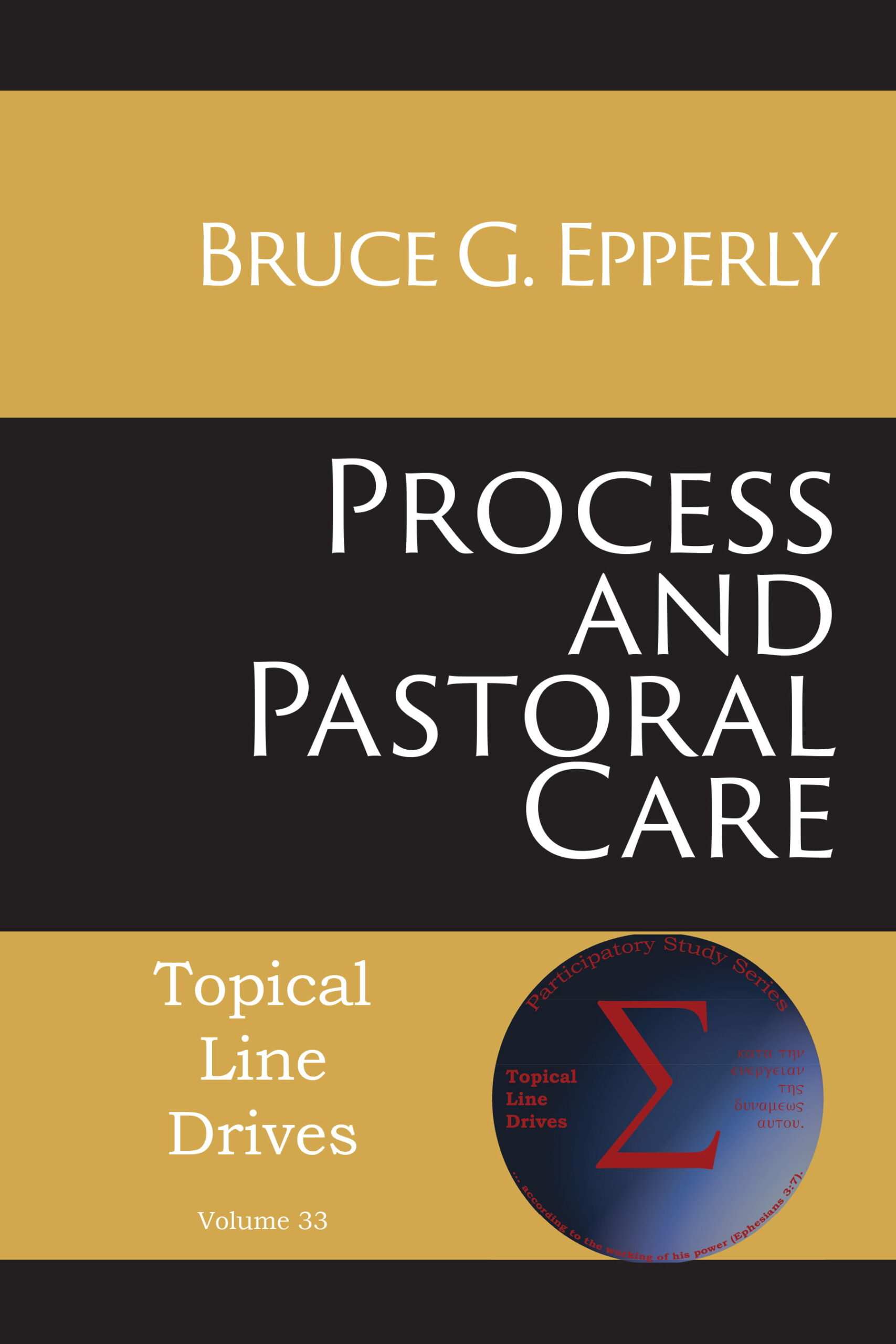
    The language of process theology and philosophy is unique and often difficult, and off-putting to the layperson and educated pastor. Thatโ€™s one of the reasons I took up the challenge of writing a 40 page introduction, Process Theology: Embracing Adventure with God, as part of Energionโ€™s โ€œTopical Line Drivesโ€ Series. I had written a longer introduction, Process Theology: A Guide for the Perplexed, but I wanted something that a layperson could pick up, read for a couple hours, and get the heart of process theology.
    I believe that process theology is too important to be left to the academics. I believe that progressive and mainstream Christians need accessible theologies that illuminate what it means to be a Christian in todayโ€™s pluralistic, postmodern, and rapidly change time. We need theologies that can inspire world loyalty, care for the earth, hospitality, and congregational vitality.
    I have been living and breathing process theology for over forty years, first as an undergraduate and graduate student, and then as a professor and working pastor and university chaplain. I believe that process thought can be translated in ways that inspire personal and congregational transformation and address the questions of those for whom paternalistic, rule-oriented, and hell-fire and brimstone images of God no longer work. Process theology can speak to church people, providing new horizons for understanding God, and also to the growing โ€œspiritual but not religiousโ€ community.
    Progressive in spirit, process theology can be described by a number of life-changing affirmations:

    • The world is a dynamic, forward moving process.
    • Reality is relational. All things are interdependent.
    • Experience is universal, though variable, and extends beyond humankind.
    • The universality of experience leads to the recognition that every creature is inherently valuable and deserves moral consideration.
    • Freedom and creativity are essential to reality.
    • God is the primary example of the dynamic, process-relational nature of reality. ย 
    • The future is open-ended and we have a role in shaping the future, for good or ill. God is not aloof from history, but is acting within history, shaping and being shaped by history.

    The concept of God is the most challenging of process theologyโ€™s contributions to Christian theology. Here again, let me share some affirmations about Godโ€™s relationship with the world:

    • Godโ€™s power is relational, not domineering or unilateral. God works within the world, shaping the world, and God acts in relationship to the freedom of Godโ€™s creatures.
    • God aims at a world with maximal freedom and creativity, congruent with the well-being of both individuals and communities.
    • God is truly changed by what happens in the world. While God influences us, we also influence God. God truly hears our prayers and responds to them with possibilities and energies.
    • God is adventurous, constantly doing new things, and urging us to be creative. Following God means honoring innovation as much as tradition. God is still speaking and Godโ€™s inspiration is at work in ethical advances involving persons of color, gay and lesbian persons, economic justice, and the care for the earth.
    • Godโ€™s inspiration and love embraces all creation. Revelation is found in scripture and also in the worldโ€™s many faith traditions. Faithfulness to God involves embracing Godโ€™s wisdom and healing wherever it is found.

    Process theology gives us the vision of a faithful, intimate, lively, adventurous, and loving God, for whom this world truly matters. It pushes us beyond old orthodoxies and unbending rules to live adventurously, exploring new ways of life, and prizing relationship over rule.


  • Liberty vs Law

    Liberty vs Law

    by Elgin Hushbeck

    Democracy coverA recent Global Christian Perspectives focused on the subject of rights and during the discussion the claim was made that liberty is not a biblical concept (@ 35:45). Personally I found this to be surprising. I believe liberty, and the nearly synonymous freedom, goes to the very heart of the Bibleโ€™s message. God created us with the ability, not just to react, but to make choices, the most important of which is whether or not we choose to love and serve him.
    Then there is the verse that on the Liberty Bell: Leviticus 25:10 โ€œSet aside and consecrate the fiftieth year to declare liberty throughout the land for all of its inhabitants. It is to be a jubilee for you.โ€ Why bother declaring liberty throughout the land if liberty was not important?
    In the New Testament Paul writes in Galatians 5:23 โ€œFor you, brothers, were called to freedom. Only do not turn your freedom into an opportunity to gratify your flesh, but through love make it your habit to serve one another.โ€ 2 Cor 3:17 says โ€œNow the Lord is the Spirit, and where the Lord’s Spirit is, there is freedom.โ€
    The defining event of the Old Testament is the Exodus, where God brought his people out of slavery, and in fact a state of slavery is pretty much the opposite of liberty. The defining event of the New Testament is the death, burial and resurrection of Jesus by which we are set free from the bondage of sin (Romans 6:7), and brought into the liberty spoken of in the verses above.
    Now perhaps some will counter with Roman 6:18 โ€œAnd since you have been freed from sin, you have become slaves of righteousness.โ€ This is true. The freedom we have in Christ is not a freedom to do whatever we want. As Paul says โ€œShould we go on sinning because we are not under Law but under grace? Of course not!โ€ (Romans 6:15).
    But it would seem that many are uncomfortable with liberty. If people are free to make choices, they might make choices that we disagree with. They might choose to do something other than what we think they should.
    The history of both Judaism and the Church is full of those who have sought to create a whole range of new rules to limit peopleโ€™s freedoms. Thus, over the years Judaism, surrounded the 613 laws of the OT with thousands of additional laws. Christians down through the ages have also had a tendency to add new rules that Christians should follow such as prohibitions on drinking, smoking and dancing.
    This problem of seeking to limit freedom has afflicted both the right and the left. But in recent years those on the left have begun to push a new form of legalism. Not only do they seek to add a series of religious rules and regulations that we should follow as Christians, now they want to put the power of the government behind their rules and force everyone to follow their new legalism under threat of violence. If any should object to the phrase โ€œthreat of violenceโ€ here, they are neglecting that this is what government does. If you do not believe this, just say no to the government and see what happens should you resist.
    For me, this is a real problem. Galatians 5:1 says โ€œThe Messiah has set us free so that we may enjoy the benefits of freedom.โ€ Liberalism seeks to put us again under a yoke of a law of their making. They justify this claiming that they are only seeking to legislate biblical principles, such as helping the poor, or that the Bible demands 100% of our money and that justifies a high rate of taxation.
    Yet I would argue that there is a significant difference between voluntarily choosing to give to the poor because you seek to follow the teaching of our Lord on the one hand and having the state automatically take money out of my paycheck that I do not see, so they can spend it on programs I am unaware of to help people I do not know.
    The studies on giving and happiness are clear. There is a reason conservative tend to give more of their time and money to charity than liberals. In addition they are as a general rule happier. As Christians do we have an obligation to help the poor? Of course we do. But the fact that we, as followers of Jesus, have an obligation does not mean that we should make this a function of the state, funded by taxes, which at least in the United States are paid by an ever decreasing number of the people. In the United States, for example, for the bottom 40% of those filing income tax returns, the income โ€œtaxโ€ is actually a source of income rather than something they pay, as they get more money back in refunds and credits than they actually paid in.
    Then there is the problem that the government makes what would have been a gift of charity and an expression of the love of Christ working through us, into an entitlement that is demanded. These entitlements often build a dependence that is itself a new form of bondage.
    As such I do not believe that our obligations as Christians should be transformed into mandates from the state. To do so makes a mockery of the liberty that God has given us and is often detrimental to all involved.


  • Why Apologetics?

    by Elgin Hushbeck

    EvidenceChristian apologetics has its ups and downs. At times it is seen as a positive force defending the Christian faith against the attacks of critics. At other times it is seen in a far more negative light as trying to argue people into the kingdom, or even worse, arguing for argument’s sake. Most of the time it is just ignored. As the author of two books that hopefully fall in the positive-force category, (Evidence for the Bible and Christianity and Secularism), with a masterโ€™s degree in Christian Apologetics, and who has been doing this for several decades, I do consider myself to be a Christian apologist. As such, I would address the proper role for apologetics and how I believe it should be done.
    First,I would agree that there is merit in these criticisms. I would certainly agree that apologetics can be misused, i.e., done incorrectly or for the wrong reasons, though I would quickly point out that the same could be said about most things. Just think what damage a pastor can do if not working as a true servant of God. But that would hardly be a reason to give up on the role of pastor; rather it would be a call to do it correctly.
    I would also agree that we should not try to argue people into the kingdom of God and, in fact, I have consistently taught in my ministry that the role of apologetics is not to do this. The reason is simple: it cannot be done, and if this is why someone does apologetics, they are wasting their time.
    Of course this raises the question of why do apologetics? A simple one is that we are commanded to do so in passages like 1 Peter 3:15-16,

    Instead, exalt the Messiah as Lord in your lives. Always be prepared to give a defense to everyone who asks you to explain the hope you have. But do this gently and respectfully, keeping a clear conscience, so that those who speak evil of your good conduct in the Messiah will be ashamed of slandering you.

    The first part of this verse may be familiar to you. I would hope the second half would be equally familiar. Unfortunately often the โ€œgently and respectfullyโ€ part gets left off. It should not as it is a key part.
    There are practical reasons for doing apologetics as well.ย ย  True, no one is or can be argued into the kingdom, but they can be helped to the foot of the cross.ย ย  One of the ways I teach this is with the metaphor of a wall. We all like to build walls to keep God at a safe distance. Christians build these wall was well, but our focus here is on the non-believer who builds walls of excuses so they can ignore God. It is the role of apologetics to remove those walls block by block till there is nothing standing between the believer and the cross. At that point the role of apologetics in evangelism ends. What happens next it is between the person and the Holy Spirit.
    So while no one is argued into the kingdom, some have been brought to the foot of the cross, and thus apologetics did play an important role in their conversion. I know this to be the case, for I was one of them. I was an atheist who had a long list of reasons why I could safely ignore God. But one by one over several years, Christians answered these objections.
    True, not everyone has such questions or objections, and thus for them discussions on the reliability of the Bible, etc., would be irrelevant at best, possibly even counter-productive. This is why I stress that the first and most important step in apologetics is to listen. Find out what it is that is keeping someone from the cross.
    Now to be clear, I do not expect, or even believe, that everyone would be a trained apologist, ready with all the answers at their fingertips. For me the best answer is often, โ€œthat is a good question, and I donโ€™t know. Let me find out and get back to you.โ€ I like this answer for many reasons. First you donโ€™t need to have all the answers, only a resource where you can get them. If you do not know of one, then I recommend that you start with your pastor.
    Secondly, it opens up a dialogue and builds a relationship. I encourage people to be a safe place where those with questions can get answers; to be a person someone can ask a question to without getting a full come-to-Jesus sermon. Perhaps it is because of my conversion experience, but I see conversion as more of a process than an event. A process that can take a long time, and one in which, while there are many stages, there is no set order. Everyone is different and this is why listening and building a relationship is so key to apologetics.
    I do want to say something in favor of intense debates. I have been in many. But intense does not mean disrespectful. In fact I came to the attention of my editor many years ago because he noticed me in an online forum engaging in some pretty intensive debates, but remaining respectful, even when my opponents were not. At times I would wonder to myself, what is the point? These people never seem to change, and at times the argument would just seem to be going in circles.
    Two things would keep me going. 1) When I was on the other side, I never told the Christians I was debating that they were right. But afterward I would reflect on what they said and I now believe the Holy Spirit used those arguments to work on my heart.ย ย  2) As a Christian working with non-Christians, when I was really discouraged, inevitably I would get an email from someone I had never heard of expressing thanks for what I was doing and letting me know how my responses had blessed and helped them. This is a second dimension of apologetics, strengthening believers. It is important to note that a lie unanswered will be taken as the truth. Currently the lies about God, the Bible and Christianity are rampant and are overwhelming what little apologetics is out there.
    The Bottom line is that I do not judge what I do by how many debates I win or souls I save, because the first doesnโ€™t matter and I canโ€™t do the latter in any event. My goal is to be a faithful servant, and I will leave the results to God.


  • Why I Donโ€™t Argue for Inerrancy โ€“ Too Much

    Why I Donโ€™t Argue for Inerrancy โ€“ Too Much

    by Elgin Hushbeck

    I believe the Bible to be the inerrant word of God. While I believe the Bible to be inerrant, rarely do I argue for inerrancy.   First off, let me briefly explain what I mean by the Bible is the inerrant word of God. While it is possible to be much more explicit, basically I believe that the Bible as written by the Apostles and Prophets is correct in all that the authors intended it to say. (Those wishing a more in-depth discussion should google The Chicago Statement on Biblical Inerrancy, or get Norman Geislerโ€™s excellent book, Inerrancy).

    Note that this brief definition avoids all of the problems of textual issues, translations, and interpretation and in fact most of the issues that are behind a lot of disagreements we have as Christians. This is in fact part of the reason I do not argue for Inerrancy, though my main reasons fall into two categories, one for non-Christians and one for Christians.

    Why I donโ€™t argue inerrancy with non-Christians.

    For Non-Christians, this is pretty straight forward and easy. It is pointless, I donโ€™t need to, and in fact it only makes things harder.   Inerrancy is a theological doctrine, grounded on many beliefs, some of which are an integral part of being a Christian. For example, a key underpinning for inerrancy is the belief in the existence of God. Thus how can one argue for inerrancy with an atheist?

    More importantly, when dealing with non-Christians, inerrancy is not required. That one does not need to accept inerrancy is amply demonstrated by those Christians who reject the doctrine. Thus for me, why would I want to put a potential stumbling block in the path of someone who needs Christ?

    Not only is it not required it makes things harder. Even when I was an atheist I never bought the argument that if there is even one error in the Bible the entire book should be tossed out. Apply that rule universally, we would not have any books. When I claim inerrancy, I take on an impossible burden of proof. How could I ever demonstrate that there was not even a single error in any of the books? I couldnโ€™t.

    Instead of taking on this impossible burden, when dealing with non-believers I discuss reliability, not inerrancy. If the Bible is reliable when it talks about the life, ministry, death and resurrection of Jesus, and the implications of this in our lives, what else do I need? Showing the Bible is reliable is actually fairly straight forward, and it is the critics who have to come up with special rules and exceptions so as to avoid conclusions they do not wish to reach. (See my books, Evidence for the Bible, and Christianity and Secularism) Finally, when you get right down to it, the problem of conversion is not a rational problem of arguments and evidence. It is a spiritual problem of the heart.

    Why I donโ€™t argue inerrancy with Christians.

    While the above reasons are valid when talking with non-Christians, they donโ€™t apply, or apply only secondarily with other Christians. With other Christians my reasons for not arguing inerrancy center around relevance. In short inerrancy simply does not come up that often. As I stated above, a key feature of the definition of inerrancy is that it avoids all the problems of textual issues, translations, and interpretation. While that is good for the doctrine of inerrancy, it does not help when settling other doctrinal disagreements and it is just a fact that there are doctrinal disagreements even among those who those hold to inerrancy. Thus inerrancy is usually the last place I go when attempting to resolve doctrinal disputes.
    In addition, Inerrancy is not a clear teaching of scripture in the sense that there is a passage that says: the Bible is inerrant. While I believe there is a solid scriptural basis, there remain a few steps of faith and issues of interpretation, and so I can see where rational people could reach a different conclusion.

    So does all this mean that I think the doctrine is unimportant? Not at all. But I think there is a deeper issue here: How do we see ourselves in relation to Godโ€™s word. Do we sit in judgment of Godโ€™s word or does Godโ€™s word sit in judgment of us?

    There are those verses in the Bible that I wish were not there; verses that do not conform to my understanding of the way I think things should be. It would be far easier to say, โ€œthat apostle didnโ€™t know any better,โ€ or โ€œthat prophet made a mistake,โ€ so I could simply ignore the passage. A key โ€œdisadvantageโ€ of inerrancy is that this is not an option. On the other hand, there are a lot of people who profess inerrancy and yet avoid all such troublesome issues simply because they do not read the Bible in the first place.

    Instead I must wrestle with the text, digging deeper, trying to understand the background and the setting, trying to figure out why God would say such a thing. Most of all, I must pray for understanding, seeking the guidance of the Holy Spirit. Granted, this is no guarantee. At the end of the process it is still not hard to find ways to ignore troublesome and difficult passages. The line between being a judge of the text, and being judged by the text is often quite fine, and I do not make any claims of perfection in this area.

    So even though I believe in the doctrine of inerrancy, I rarely argue for it. Instead, I argue that we place ourselves under, not over, the word of God. That we wrestle with those passages that we find difficult, and that by doing so we let the Holy Spirit transform our lives.


  • The Way Out: Finding Our Way Home

    by Steve Kindle

    I'm Right coverIn my two previous posts, I attempted to make the case that finding a way for everyone to agree on how to understand the Bible is an impossibility. For various reasons, such as language nuances, psychological makeup, differing worldviews, hidden agendas and the like, we are presently, and probably always will be, unable to see eye to eye. This is true not only of the mundane (What swallowed Jonah?) and certainly the โ€œessentials of the faithโ€.
    I donโ€™t see this inability to understand alike as a problem, per se. In the first place, it is a gross misunderstanding of human nature. We are all very different and come to scripture with all those differences intact. To expect conformity is to downgrade humans to the status of androids. Part of being created in the image of God is the ability to think for ourselves, unlike other animals.
    Secondly, the idea that a text can yield only one true interpretation is to misunderstand even how the Bible works. Only one example is necessary, that of how Matthew plucked meaning from Old Testament passages that could never have been conceived of by their original authors or hearers. (You may want to fall back on Matthew โ€œbeing guided by the Holy Spirit,โ€ yet more meaning was in those texts than one.) Some of us may legitimately see things that others miss.
    Thirdly, as long as the hermeneutic circle exists (in order to understand the Bible, one must understand every verse in the Bible. In order to understand every verse in the Bible, one must understand the whole Bible), there will never be a comprehensive or complete interpretation. In the meantime, we struggle.
    So, in a world where ultimate assurance of a given interpretation is wanting, what are we to do? We need to acknowledge the value of disagreement. Disagreement is inevitable and therefore necessary. Necessary? Yes, as it points to the limitations of the human capacity to discern ultimate truth. Itโ€™s another way of acknowledging that we need each other. Your strengths may shore up my weaknesses and vice versa. But this can only happen if we allow it to.
    The problem is not disagreement. Disagreements often arise because some interpreters fail to recognize their own baggage that they bring to the task, and believe they are operating in a โ€œbaggage free zone,โ€ where oneโ€™s assumptions, if they are thought of at all, are assumed to be true, untainted by human error. The real problem is when those with a point of view insist all others must conform to it. This is the original sin of Fundamentalism. โ€œI derived my interpretation from the Bible, therefore it is equal to the Bible itself.โ€ R. W. Dale noted way back in 1889 โ€œthat to put a meaning of [oneโ€™s] own into a Bible sentence and to claim Divine authority for it, was just as bad as to put a sentence of [one’s] own into the Bible and to claim Divine authority for it.” We need to be constantly reminded that in Protestantism there are no popes.
    Where we go wrong, it seems to me, is not respecting human finitude. We must begin with the proposition that regardless of the beauty and sublimity of a particular interpretation, there is no perfect, absolute, final understanding. Even though we may reach profound heights, we still see in a mirror, dimly. The threat to the church is not different outcomes, but those who would insist on their particular understanding at the expense of all others. The โ€œone who knowsโ€ is like the person holding one piece of the jigsaw puzzle believing itโ€™s the whole picture. Paul warned us about those who think of themselves more highly than they ought. Humility before the Bible is a prime requisite of meaningful interpretation. Diversity (spice) is inevitable, and to try to force everyone into the same mold is not only futile, it goes against what it means to be human. And, I believe, Christian.


  • The way in: how we got to be who we are

    by Steve Kindle

    I'm Right coverThe history of philosophy has been aptly summed up thus: โ€œNo matter what is considered the ultimate in metaphysical understanding today, tomorrow it will be replaced by another received as the ultimate in metaphysical understanding.โ€ The same can be said for how the Bible has been interpreted throughout the centuries. I ask you, when was the last time you heard a sermon detailing truth derived from the allegorical method of interpretation? Could we say never?
    I recently led a seminar on the four Gospels. You can be sure I didnโ€™t follow Irenaeusโ€™s lead (the leader of the church in France circa 70 CE) who declared that, “There actually are only four authentic gospels. And this is obviously true because there are four corners of the universe and there are four principal winds, and therefore there can be only four gospels that are authentic.โ€ Somehow that logic escapes me, yet it was obvious to Irenaeus.
    Psalm 19:4b-6 states, In the heavens he has set a tent for the sun, 5which comes out like a bridegroom from his wedding canopy, and like a strong man runs its course with joy. 6Its rising is from the end of the heavens, and its circuit to the end of them; and nothing is hid from its heat.
    Before the Copernican revolution was finally accepted as โ€œthe way things are,โ€ biblical interpreters were excused for taking this passage literally. Today, however, few, if any, would want to make a geocentric case. I cite these examples because as worldviews change, so does the manner in which the Bible is interpreted. It could be no other way, as how we look at the world informs how we interpret the Bible.
    Being born into the world is like moving into a fully furnished house that was completely designed, decorated, and landscaped with no input from you. No thought was given to your taste, interests, preferences, needs or desires. You had no say whatsoever in any regard to your new abode. Our individual part of the world is like that. We had no choice as to our country of origin, language, form of government, even our religion. All of these preceded us in our world. The childโ€™s whine that โ€œItโ€™s not fair!โ€ is our first recognition of this reality. No, the world is not set up with us in mind.
    The world we inhabit presents itself to us as the โ€œgivens,โ€ the things we take for granted, the things that โ€œjust are the way they are.โ€ I doubt you worry too much that the sun may not rise tomorrow, or that the laws of aerodynamics may change mid-flight. Most of us reading this are well situated in our Newtonian universe.
    Generally speaking, we seldom give much thought to how we live, or why we do the things we do, or why things are the way they are. We accept our โ€œhousesโ€ as they are presented to us and generally donโ€™t object to much that is there. We easily accommodate the world around us, and this has been true from the beginning of human life. Whether this is good or bad is beside the point. Itโ€™s the way it is. This only becomes a problem when we fail to recognize that we are not self-made, that our opinions, sense of the real, values, and even mores are preconditioned in us. It is virtually impossible for us to completely step out of ourselves and examine our a prioris. And, failing to do so, we truly believe we are able to read the Bible without any encumbrances whatsoever, that we understand what we are reading as though it came from an angel from heaven. With Irenaeus, itโ€™s just so obvious!
    It needs to be stated very forcefully and unequivocally that NO ONE looks at the world totally objectively. Although our โ€œworld housesโ€ are all arranged differently, we all inhabit one. That means that all of us share one thing in common: our worlds, of necessity, will be seen differently. We cannot escape this; it is part of the human condition. This is one of the major reasons we see the Bible differently, and why those differences are often incomprehensible from another point of view.
    I believe that confidence in oneโ€™s opinions increases in direct proportion to the lack of perception of the forces that make us who we are. Conversely, as we become more alert to these forces, we find agreement of our views by others less important than the relationships formed themselves, that truth is found in grace more than in (elusive) absolutes, and that humility before the text opens more widows to heaven than any interpretive scheme. The answer to our differences is found in valuing the person more than needing to devalue that person’s opinions. But this is only possible if we don’t think of ourselves (and our opinions) more highly than we ought.
    Tomorrowโ€™s post: โ€œThe Way Out: Finding Our Way Homeโ€


  • The Battle for the Bible

    by Steve Kindle

    I'm Right coverThe Christian church has never had a uniform understanding of how to interpret the Bible, nor has it had uniformity of belief over its now nearly 2000 years of attempts to do so. The historic creeds were an effort in this direction, but failed to unite all parties. Even among the proponents of the creeds, not all agreed on how to understand each proposition. There is no reason to expect that universal agreement will ever happen; in fact, there is every reason to believe it will never happen. Why? Because truth is ultimate and human beings are finite, incapable of accessing ultimate truth, though we likely touch the “hem of the garment” on occasion. I have no problem with that. My problem is with those who claim to have accessed the ultimate and want to make me (and you) conform to their notions of what the Bible means.
    The title of this post is also the title of a book written by a former editor of Christianity Today, the late Harold Lindsell, back in 1976. He argued that if an interpreter or institution began from the position that the Bible is not inerrant, it could only end in error. The battle that surfaced from this firestorm wasnโ€™t among those Evangelicals who fought for inerrancy against the liberals, but over just what inerrancy meant among Evangelicals! Even here, agreement is hard to come by.
    My book, Iโ€™m Right and Youโ€™re Wrong! is an effort to understand why committed Christians, including even the loftiest of intellectuals and holiest of saints, read the Bible differently, and come to varying, even contradictory conclusions. This is no mere intellectual enterprise, for it involves the very nature of being human, our relationships with others, and our attitude toward those with whom we disagree. How we comport ourselves in relation to others who are involved in interpreting the Bible may well be the best evidence of our Christ-like spirit.
    The focus on inerrancy seemed like a good way to approach biblical interpretation until we dive even a little below the surface. Even if we acknowledge that the โ€œautographsโ€ (original canonical writings) were divinely inspired and free from error, we donโ€™t have them. This makes that point moot. Add to this that the writings must, by necessity, be interpreted, and for inerrancy to have any immediate meaning, they must be inerrantly interpreted. And there are no inerrant interpreters (that I know of).
    Add to this that translations of the Bible are, themselves, interpretations. Any number of articles have been written to demonstrate that theologies often control how certain verses are translated. No matter how good a translation might be, it is always two to three thousand years removed from its origin, and replicating the mindset of the original writer is fraught with difficulty. Even knowing the biblical languages is no panacea as the linguists argue over interpretation as much as everyone else.
    Everything we read is filtered through our worldview, personality, and even our moods. Once, in an adult Bible study, I averred that there is no such thing as an uninterpreted verse in the Bible. One member said, โ€œI can think of a Bible verse that needs no interpretation.โ€ Tell us, what is it?โ€ He quoted, โ€œGod is love.โ€ My response? โ€œWhat do you mean by God, and what do you mean by love?โ€ My challenge is still on the table.
    I think the title of Lindsell’s book is a misnomer. It’s not a battle for the Bible as much as it’s a battle for my interpretation of the Bible to prevail.
    So, whatโ€™s a diligent reader of the Bible to do? That will be the subject of my next two posts. So, please stay tuned!

  • Hospice & Palliative Care: A Quality Alternative to Assisted Suicide

    by Jody Neufeld

    ย What words come to mind when this question is posed: What is a life with quality?
    Dignity
    Purpose
    Comfort
    Joy/Peace/Happiness
    ย Humans have wrestled with the concept of quality vs quantity of life, ever since medication was discovered to both heal disease and prolong a life. With technology, we can keep a 20-something athlete with a brain injury alive almost indefinitely. Cancer, neuro-muscular diseases, chronic lung disease, Alzheimer’s and other dementia continue to be some of the difficult life-journeys which bring us, not just as a family or a community, but as humanity to the question of defining a quality life vs. the quantity of that life.
    Thirty years ago, I (as an RN) left my job as a critical care nurse in a hospital and took a job with the local hospice. It was a relatively small hospice with an average patient census of 25-30 patients over a four-county area. In the next decade, it would grow to over 400 patients, covering a six county area and be ranked in the top 25 hospices in the United States.
    In the 12 years that I worked with hospice, we went from the National Hospice Organization which โ€œtook care of dying patients,โ€ and after much public education, some people, like doctors and social workers, now know that the organization is actually Hospice and Palliative Care. What is the difference?
    Hospice does not just make sure a patient is clean and dry and support the family as everyone waits around for the last breath. The hospice team (nurses, doctors, social workers, homecare assistants, chaplains, volunteers, pharmacists and the family) actively create a plan of care for the patient that will give them life in each day! Nurses are available 24/7 to answer questions and make visits whether it is 2 o’clock in the afternoon or in the dark morning. With so many medications available to help control discomfort and so many different ways to give the medication, I submit that pain is always controllable in patients with a life-threatening illness. Yes, I have had to sit families down to have a difficult conversation which explained that the two options open were: awake with pain or sleeping without pain. But out of control โ€œtormentโ€ should never describe a hospice patient’s situation.
    In my time with hospice, I saw the aftermath of 12 suicides. The families were devastated. All but four were done with handguns. The cleanup, not just of the physical location, but of the families’ shock and mental anguish was very hard to watch. Our counselors found the bereavement period was often indefinite. Families had to process not only their loved one’s death but what they perceived as their inability to meet needs or know their loved one’s mind and do whatever to keep them comfortable.
    If you know someone who is caring for someone who has been told that curative treatment is no longer an option for their life-threatening illness, or caring for someone who is experiencing pain and discomfort which is creating a life without quality, encourage them to consider hospice. The National Hospice and Palliative Care Organization can give you a list of hospices in your local area. If you know someone who has received care from a local hospice, a personal recommendation is always good. Many hospices now employ physicians as part of the care team who are well educated in palliative care and will even make house calls! Options in pain control may also include daily assessment by the patient’s assigned RN, so that the administration of medication and non-pharmaceutical treatments are carefully monitored and, what I used to call, โ€œdialed inโ€ to balance with the person’s pain.
    Let me quickly answer just a few questions that are often asked about hospice care:

    • Once I sign up for hospice care, can I change my mind? Of course!
    • How much does hospice care cost? Most health insurance policies (now!) have hospice benefits. Like in any other medical treatment, ask up front how a particular hospice does billing. The hospice I worked for was a non-profit and patients did not pay any fees. Each hospice is different so ask questions.
    • Are all hospice patients placed on morphine for pain control? No. While morphine is an excellent drug for the pain management of advanced cancer, there are several options. My son who died from cancer (rhabdomyosarcoma) only required Tylenol #3 (codiene). This is why the field of medicine is an art, not a science. Each person must be assessed individually.
    • Are all hospices the same? No. Like hospitals, there are non-profit and for profit hospices. Some have inpatient facilities. Some โ€œspecializeโ€ in the care of children.

    I hope that while what I have shared here is a preliminary overview, it may encourage those who are struggling in a difficult situation to know there are options. As I was scanning the Internet for โ€œwhat’s new in palliative care,โ€ I found a website called โ€œNext Step in Care.โ€ It had some wonderful information about hospice, home care, and facility care. Assisted Suicide is not the only option; I do not believe it is even the best option.
    And finally, as a hospice team member, the daughter of a hospice patient, and the mother of a hospice patient, I have stood as a witness in the final months and weeks of someone’s life. It can be a time to reflect on good memories and share heart-felt words which may bring healing in the spirit to the one moving on and comfort in the days ahead to those left behind.


Energion Direct
Privacy Overview

This website uses cookies so that we can provide you with the best user experience possible. Cookie information is stored in your browser and performs functions such as recognising you when you return to our website and helping our team to understand which sections of the website you find most interesting and useful.