Blog

  • Bob LaRochelle: Mystery at the Core

    Bob LaRochelle: Mystery at the Core

    BobAt the very core of my Christian faith is my conviction that Jesus is risen. That conviction does not include absolute certainty about all of the details. It also allows for the existence of literary elements in the telling of the story. What it does include is a faith that death did not defeat Jesus AND that, at this present moment and forever, Jesus is and will be alive.

    At the very core of my Christian faith is my conviction that Jesus is risen. … That conviction IS based on the trust I place in the testimony of others.

    That conviction IS based on the trust I place in the testimony of others. Dr. Vick is so accurate in asserting this dynamic in how people come to faith. A wonderful Jesuit New Testament professor in college once told our class something I can never forget. He said that, when all is said and done, when we look at the recorded testimony that affirms the Resurrection of Jesus, we all have to make a choice: Either we claim that the people who believed this were crazy and delusional OR we affirm that they are really on to something and that what they believe is real.  I place my faith in that testimony and I believe it is real!
    As to contemporary testimony, I offer two observations. First, I believe that real life changes in a person can occur and that the power of God is present in that happening. So, I see and hear recovery stories, for example, testimonies of people turning away from alcohol and other drugs one day at a time, and I see through them to the active presence of a living, breathing God, yes!

    Not everything can be explained simply.

    On the other hand, I am also cognizant of the line Paul Simon used in The Boxer  as he reminded us that ‘ A man (or woman) hears what he ( she) wants to hear and disregards the rest.’  What I mean here is that because people have been raised with exposure to religious language and thinking, they might very well be predisposed to interpret events in their lives through the lens of Christian faith and doctrine.  Understanding this is NOT to say that God is not working through these events. Instead it is to offer a necessary cautionary note that not everything can be explained simply.
    So, to answer the question, the testimony of others often corroborates my own faith, even as I am skeptical of explaining the specifics of why things happen. At the heart of faith lies an affirmation of mystery. When mysterious things are explained with certainty, the power of mystery is lost in the process. I am sure I will be saying more about this in future responses.

  • Elgin Hushbeck: The Evidence Is Not All Equal

    Elgin Hushbeck: The Evidence Is Not All Equal

    elgin_100x119The crucial question for a Christian in the second chapter is the relationship between testimony, belief, and knowledge. How important is historical testimony to your beliefs as a Christian?  What about contemporary testimony, for example, claims of a miracle?
    In the second chapter of his book Philosophy for Believers  Edward Vick reviews and clarifies some very complex questions about what it means to believe something.   More importantly, he explores how we go about validating these beliefs.  A lot of this we simply take for granted without realizing the distinctions and differences Vick points out.
    A key question is the importance of historical testimony to Christian beliefs.  I happen to think they are very important. For example, it is common today to hear people claim that all religions are alike, they are all based on faith, and there is no real basis for choosing between them.

    Christianity and Judaism … involve certain beliefs about history and make certain historical claims, claims that can be tested.

    If this were true, we would be left to pick a faith with no way to know if we were correct until after we had died, and it was too late, unless reincarnation turns out to be correct.  I do not believe this is the case. The simple fact is that various faiths have various means of support.  Christianity and Judaism are historical faiths in the fact that in addition to their theology they also involve certain beliefs about history and make certain historical claims, claims that can be tested.
    For example, Mormons differ from Catholic, Orthodox, and Protestant Christianity in that they make different claims about Scripture. The historical Christian view is that the Bible is the inspired word of God. Mormons believe that the Old and New Testaments, while the word of God, have been corrupted.  They also believe that the Book of Mormon was preserved and given to Joseph Smith.  These are competing and contradictory claims. While both could be wrong, both cannot be correct.
    This is not an issue of “you pay your nickel and you take your chances.”  The evidence for and against these claims can be examined and tested.  When this is done, the evidence is pretty clear.
    There are thousands of ancient manuscripts and tens of thousands of early translations that support the text of the Bible.  Not only does this support the reliability of the transmission of the text, it stands in stark contrast to Joseph Smith’s claims about what the text of the Bible was supposed to be.   On the other hand there is not a single ancient manuscript or translation of the Book of Mormon, not one.
    In addition there is other evidence as well.  Many of the countries, places, people and events mentioned in the Bible are known to have existed. We do not have to wonder about the existence of Egypt, Jerusalem, King David, or the Babylonian exile.   As for the Book of Mormon and its corresponding description of the new world, not a single country, place, person or event has been found, not one.
    So when it comes to the evidence, there is simply no comparison. While one may argue about whether the evidence for the Bible is strong enough to warrant acceptance of its claims, there is certainly a vast array of evidence that is simply non-existent when it comes to the Book of Mormon.
    A Mormon I once talked to was unconcerned about this.  In fact for him the lack of evidence was a big plus. As he put it, the less evidence there was, and the harder it was to accept Mormonism as true, the more faith he must have to believe it! Since having faith was a good thing, this must be a good thing.  This claim is based, I believe on a misunderstanding of the nature of faith, something Vick touches on, but I believe will address more fully later on, and so I will postpone my discussion of faith till then.

    The evidence for the various religions and religious views is not equal.

    The key point here is that I believe that evidence is important, and that the evidence for the various religions and religious views is not equal. Some views have more evidence than others, and some views run contrary to the evidence.
    Where the issue of evidence becomes problematic is when it comes to miracles. Despite claims of relying on evidence and reason, many skeptics simply side step this with claims that miracles are impossible.  I find such views suspect, not only in their reasoning but because they ultimately cast doubt the entire process.
    If miracles are impossible, then the accounts of them, such as those in the Bible, must be wrong. If the biblical accounts are wrong, then they were either written by eyewitnesses who were dishonest and lied, or more likely by people who did not really know what happened. Either way, the accounts are unreliable.  So when we encounter skeptics who claim the Bible is unreliable, is that a position based on a careful analysis of the evidence, or one driven by the presupposition that miracles are impossible? Often it is the latter. After all. why waste time on an in-depth examination of the evidence supporting the reliability of something you already “know” to be unreliable?
    Nor does this simply involve ancient events or just skeptics.  Religious claims continue to be made today.  It is easy for people to dismiss accounts of the gifts of the Holy Spirit, if one believes they ceased after the 1st century.  Correspondingly it is easy to accept claims about the gifts of the Holy Spirit if you believe they are wide spread.  Paul wrote in 1 Thess 5:21 “Instead, test everything. Hold on to what is good” (ISV). That remains excellent advice today.

  • Life and Death

    189372915x54But when they heard these things they became infuriated and ground their teeth against him. 55But being full of the Holy Spirit, he lifted up his eyes to heaven and saw the glory of God and Jesus standing at God’s right hand. 56And he said, “Look! I see the heavens opened and the Son of Man standing at God’s right hand!” 57But they cried out with a loud voice and blocked their ears and swarmed at him together. 58And they threw him out of the city and stoned him. And the witnesses put their cloaks at the feet of a young man named Saul. 59And they stoned Stephen as he called out and said, “Lord Jesus, receive my spirit.” 60Then he fell to his knees and cried out with a loud voice, “Lord, Don’t hold this sin against them.” When he had said this, he died.           Acts 7:54-60 (HN)
    Stephen gives us an outline of the right way to die. Now many of you may be thinking that you don’t particularly want to know how to die, and you don’t plan to get there very soon. But all of us will get there sooner or later, and it’s a good idea to know how to do it. But even more importantly, the way you’re going to die will have something to do with the way you live.
    One of the things Jesus came to rescue us from was the fear of death (Hebrews 2:14-18). Why don’t we have to fear death? For precisely the same reason that we don’t have to fear life. God is with us all the way!
    So what does Steven show us about dying:
    1. He died being God’s witness. The thing that made these folks angry was the testimony that Stephen was giving.
    2. He died filled with the Holy Spirit. He was able to know what God wanted him to know and see what God wanted him to see, because the Holy Spirit filled him.
    3. He died with his eyes heavenward, on Jesus. Think about it! He’s surrounded by people who want to kill him and he doesn’t look at them, or seek ways to get away. He’s looking at Jesus!
    4. He died forgiving those who hurt him. Like Jesus, it wasn’t people who asked forgiveness, it was people who were in the process of hurting him that he forgave.
    5. He died on his knees in prayer.
    6. He died trusting his life to God.

    The way we live is the way we will die.

    Now go back through the list, and replace each “he died” with “he lived.” Do you see what’s going on?
    The way we live is the way we will die. If God is with us, we have nothing to fear in either case.
    For I am already being offered, and the time of my departure has come. 4:7 I have fought the good fight. I have finished the course. I have kept the faith. 4:8 From now on, there is stored up for me the crown of righteousness, which the Lord, the righteous judge, will give to me on that day; and not to me only, but also to all those who have loved his appearing. 2 Timothy 4:6-8 (WEB)
    https://www.youtube.com/watch?v=Yp0_YyieyRY
    –written by Sabine Baring-Gould, sung by Jo Stafford & Gordon McRae
    (Cross-posted from Jody’s Devotionals. Used by permission.)

  • Elgin Hushbeck: All Beliefs are Beliefs

    Elgin Hushbeck: All Beliefs are Beliefs

    elgin_100x119Response #1 to Philosophy for Believers.
    Edward Vick in his book Philosophy for Believers  opens with a statement that is, I believe, undoubtedly true, yet also controversial.  Vick claims that, “We all have many and varied beliefs.”  It is true because of course different people have different beliefs and not all beliefs are created equal. Different beliefs can have differing levels of support.  Even people who hold the same belief may do so for differing of reasons.
    For example, studies show that most people get their political beliefs from their parents.   Many end up with political beliefs which are fairly similar to those of their parents.  However while this is possibly acceptable as a general rule, it is hardly a universal one.   Some, for reasons of family dynamics, will adopt views in conflict with their parents.  Still others will make their own assessment of the evidence and reach their own conclusions. A wide variety of beliefs held for a variety of reasons.

    Different people have different beliefs and not all beliefs are created equal.

    Where this gets controversial is that for some skeptics, there is an additional factor when it comes to considering religious beliefs.  For some skeptics religious beliefs are not just another classification of beliefs, like we might classify beliefs about politics, history or science.  Religious beliefs are an inherently different type of belief, a type of belief that is by definition false, though some would soften this somewhat by saying that they are simply unknowable.   On the other hand, they do not see their beliefs to be beliefs at all; they are just facts to be accepted.
    This is why some skeptics are able to make claims such as ‘there is no evidence for the existence of God.’  Such claims have little to do with the evidence or lack thereof.  Rather, this is more an expression of the skeptic’s belief that there can be no evidence because it is a religious belief. Such views are untenable.  One can have a legitimate debate about the evidence for God, and whether or not it is sufficient to accept a belief in God, but not whether or not any evidence exists.
    Vick’s approach is particularly valuable, in that because of the success of science in discovering the laws that govern the natural word, this has led to the attempt to label a great many beliefs “scientific” on the one hand, and a tendency to automatically accept any belief that is so labeled on the other.   If nothing else, the history of science shows this to be questionable as it is full of examples of accepted scientific views which were later to be over turned by further discovery.
    Ultimately, Vick’s approach is helpful in that it sees beliefs as something not just to be accepted or rejected, but as things to be considered and evaluated.


    Elgin Hushbeck, Jr. is both a Christian apologist and a businessman. He is author of Energion titles Evidence for the Bible, Christianity and Secularism, and Preserving Democracy.

  • Bob LaRochelle: The Value of Raising Serious Questions

    Bob LaRochelle: The Value of Raising Serious Questions

    BobResponse #1 to Philosophy for Believers.
    I very much appreciated the way in which Dr. Vick begins what I think is a wonderful book. With the simple statement, ‘We all have many and varied beliefs’, he opens up for us an in-depth philosophical exploration of the nature and dynamics of faith and belief. In my view, he leads us into a process of serious self examination on both the intellectual and the spiritual levels.
    The statement itself expresses a simple reality. Whether one looks at the wider world around us or at our local communities, one cannot help but recognize that there is a pluralism of belief systems that coexist with one another. Some might be inclined to bemoan this reality and would prefer to help lead people to the ‘truth’ as they understand it, usually posited by them as objective reality from a source outside of themselves.
    In my view, the simple fact is that when we are born, we are thrust into a world which is mysterious to us. As we grow and develop, the specifics of that mystery unfold. Simply because we are human and are capable of thinking, many questions come into our minds as we experience life. We wonder about how life began and who or what might have been there at its beginning. Facing the simple fact that such a thing as death exists, we ask questions about what happens to us individually and collectively after we die. Recognizing the fact of our finite limitedness, we wonder about the inherent meaning to be found in how we live our days.
    As I see it, that which we call RELIGION is our personal response to the mysteries of life as set within the wider context of the MYSTERY that is life itself. Within the world as we know it, there exist many and varied responses to these mysteries of ORIGIN (Where did I and we come from?), DESTINY (where am/are I/we going?), and MEANING (what is the purpose of it all while we are here?).

    I can gladly claim that in honest response to that mystery, faith emerges, faith in the One whose greatness cannot be fully grasped or explained over the course of our mortal existence.

    The different approaches to this mystery are evidenced in a variety of different ways.  They certainly shape the theologies that are part and parcel of the multiplicity of world religions. They also emerge in the various creative processes in which human beings engage. Profound philosophical positions on life’s greatest mysteries are to be found in literary works, dramatic performances and the art work and music of different cultures. Whether one explores Shakespeare’s great soliloquies, the absurdist dialogue in Beckett or Ionesco, or the lyrics of a Bob Dylan, one sees human beings responding to life’s mysteries in many and varied ways.
    Writing as a believing Christian and as a pastor in the church, I find myself observing this multiplicity of responses within the Christian community as well. The fact that there is some diversity of approaches within Christianity is troublesome to those who are convinced that the objective answers are clear and that the work of the church involves presenting that objective truth to others so that they accept it for their own well being and salvation. Sadly, there are some in the churches who dismiss honest intellectual inquiry and the value of raising serious questions. They see this as antithetical to the the practice of religion and even to faith itself.
    Over the course of church history, some church communities have focused on the church itself as the definer of objective truth. They have encouraged their adherents to look to the church for the specific answers to the great mysteries of life and thus to the important decisions they must make in their own personal lives.
    In reaction to this, other church communities, concerned that the institutional church had strayed too far from the Word of God as found in Scripture, have focused on turning to the Bible as the source of objective reality and truth.
    Thus historically, within the Christian church, there has been tension between those who have advocated that truth may be found in turning to the Bible without benefit of church teaching and others who have argued that Scripture must be interpreted in light of ongoing tradition.
    Simply put, some Christians believe that one can find objective truth by turning to specific interpretations of faith by the church. Others believe that truth is found by simply looking inside the Bible. Both positions emerge from the deeper position that God has intended either the church or the Bible to be the vehicle by which objective truth is conveyed.
    As I see it, both views assume that mystery can be defined clearly either through interaction with the sacred text or by adherence to the rules and doctrine of the community. Ongoing tensions exist within the Christian community between these adherents and those who see these issues and questions as far more complex, involving the use of intellect (God given, I would contend) and the exercise of human conscience.
    These brief comments are not intended as a fully developed commentary on the place of Scripture and tradition in the life of the individual believer. Instead I am attempting to state how Dr. Vick’s simple assertion that there exists in our world  a diversity and multiplicity of beliefs resonates with the core reality of human experience- that we are thrust into the world and, as we grow, we ask questions, questions about the BIG QUESTIONS- life, death, the meaning of it all…..
    As a result of people coming up with different answers to these questions, there has emerged a wide variety of philosophical approaches and systems throughout the course of human history. We have seen the work of an Aquinas who has spelled out specific proofs for the existence of God and the actual qualities of that deity. On the other end, we note the work of those existentialists for whom the presence of the divine has essentially been dismissed.
    These differing philosophical positions have led to diverse theologies as there is a fine line between the two disciplines. Within the rather large continuum of positions, we each take our stands, philosophically and theologically.
    In essence, Dr. Vick’s opening remarks state the obvious. In my view, there is a relationship between the fact that there are different beliefs and that life itself is a mystery. Having said that,  I can gladly claim that in honest response to that mystery, faith emerges, faith in the One whose greatness cannot be fully grasped or explained over the course of our mortal existence.


    Dr. Bob LaRochelle is a pastor, educator and an author. His Energion titles are Crossing the Street, So Much Older Then …, and the forthcoming What Protestants Need to Know about Roman Catholics. Early next year, there will be a companion volume to the last book, What Roman Catholics Need to Know about Protestants.

  • Responding to Philosophy for Believers

    9781938434549mI have asked two Energion authors for an extended response to our recent release, Philosophy for Believers by Edward W. H. Vick. These responses will be posted once each month for the next 13 months, covering all thirteen chapters of the book.
    There are two purposes for these responses. The first is to discuss and respond to the approach taken in the book. But the second is more important. It is to see how to people who are in the trenches, so to speak, apply this material in their work.
    Dr. Bob LaRochelle is a pastor, educator and an author. His Energion titles are Crossing the Street, So Much Older Then …, and the forthcoming What Protestants Need to Know about Roman Catholics. Early next year, there will be a companion volume to the last book, What Roman Catholics Need to Know about Protestants.
    Elgin Hushbeck, Jr. is both a Christian apologist and a businessman. He is author of Energion titles Evidence for the Bible, Christianity and Secularism, and Preserving Democracy.
    Each response will be published as a separate post using the category Philosophy for Believers. They will be posted near the end of each month.
    Feel free to comment on these topics. We’d love discussion. If you blog about the topic at or around the same time, we will be happy to post a link here to your post. Join the discussion in whatever way works best for you.

    Publication Dates:

    Nov. 1
    Nov. 29
    Jan. 31
    Feb. 28
    Mar. 28
    May 2
    May 30
    June 27
    Aug. 1
    Aug. 29
    Oct. 3
    Oct. 31
    Nov. 28

    Topics

    1. The first sentence is: We all have many and varied beliefs. Dr. Vick builds the book around this point, saying there is a difference in the meaning of various types of beliefs and how they are justified, but they are nonetheless “beliefs.” Many skeptics, on the other hand, would maintain that there is a much greater distinction between belief in a scientific and a religious context. Since this is a fundamental idea for the entire book, how do you respond to this? Do you find Vick’s approach to this topic viable? Helpful? (Elgin Husbheck’s Response, Bob LaRochelle’s Response)
    2. The crucial question for a Christian in the second chapter is the relationship between testimony, belief, and knowledge. How important is historical testimony to your beliefs as a Christian? What about contemporary testimony, for example, claims of a miracle? (I note here that I can no longer see this as a liberal vs. conservative issue with liberal author Bruce Epperly maintaining that Jesus did, in fact, heal [Healing Marks, Energion, 2013], and also that God can and does act in the world. So I’m not asking “Do you believe in miracle stories in the Bible?” but rather “How does the testimony of others relate to your belief, whatever that belief is?”) (Bob LaRochelle’s Response, Elgin Hushbeck’s Response)
    3. There are a number of crucial issues in this chapter, but I think the best place to respond is on the issue of “proof” and “belief,” question #19 in the book exercises. “Fred believes that he can prove the existence of God. He believes that to believe in God you have to be able to prove that God exists. Frederica believes neither of these. What is the issue between them?” (Bob LaRochelle’s Response, Elgin Hushbeck’s Response)
    4. I’m taking question #4 from the exercises: “What is a ‘world-view’? Do you have a world-view? Is there a common modern world-view about the cosmos?” Then I would add, “How important is “world-view” to the way we respond to new information?
    5. Again, from the exercises, this time question #6: “Should we distinguish between different kinds of explanation, for example: common sense explanation, ad hoc explanation, scientific explanation, historical explanation? Do these or some of them have anything in common? Do different subject matters require different kinds of explanation?” I would be most interested in looking at the difference (if any) between explanation of a religious claim, a historical claim based (potentially) on the supernatural, and scientific claims.
    6. This time building from question 3, though you may want to include 4: “Does religious experience provide us with a reason for believing in God? Specify an argument from religious experience to the existence and activity of God.” The handling of religious experience is key to Dr. Vick’s thinking, not only in this book, but in others, such as his From Inspiration to Understanding: Reading the Bible Seriously and Faithfully (Energion, 2012). If you have not, and would like to read that, I’ll be happy to send a copy.
    7. I’m going to use question #1 from the exercises: “Relate the doctrine of God’s providence to the conviction of the uniformity of nature, and the consistency of natural law.” I use this because it is one I hear rather frequently, and there are a number of different explanations.
    8. I don’t have a specific question to raise, but rather a section, #8, pp. 167-168 on open theism. Relate open theism, process theology, and more traditional understandings of God’s foreknowledge. This might get too broad, but if you try to stick to understanding providence in connection with the apparent uniformity of nature (if that is correct), it should narrow things down a bit. You probably should avoid getting into the Calvinist vs. Arminian debate, though perhaps you can’t!
    9. I’m taking the question from the chapter summary: “But is it possible to tell ourselves a lie and then believe the lie we tell ourselves? Is such irrationality a feature of human life?”
    10. From the chapter summary: “An explanation of how to account for mental activity cannot speak only in biological terms of brain activity. We may not neglect the fact that our experiences have a particular quality of ‘feeling’.” Does Dr. Vick successfully take us to the conclusion that the mind is more than biological function?
    11. Does the concept of “identity” matter to you in your understanding of the afterlife, resurrection, or similar concepts?
    12. I’d almost like to make up another question, but the one asked in the chapter summary is too classic to ignore: “How does the occurrence of miracles relate to well established natural or scientific laws?”
    13. State your basic understanding of how faith and science relate, if they do. Can there be conflict if both are done properly? How should it be resolved.
  • Introduction to the Psalter

    bob-2012-2sby Bob MacDonald
    What can I assume when I say introduction? I have met many who do a double take when I say the word Psalter. What is the Psalter? The Psalter is a set of 150 poems that were created between 2200 and 3000 years ago, and collected between 2200 and 2500 years ago. We call the poems ‘psalms’ but only 57 of them have this title in their inscription (in the Hebrew). The Jewish term is Tehillim, or ‘praises’.
    I have met one who asked if the Jews have the same Psalter as the Christians. From an introductory point of view, the answer is yes. If you worship in a Synagogue, you probably would recognize many of the psalms since they are the foundation of the opening of the Sabbath service. If you worship in a Christian congregation, you may, depending on your denomination, know several psalms from the Sunday services. But what do we mean by ‘the same’ Psalter?

    The Prayer Book leaves out several sections of the poems.

    The first translation of the Psalms from Hebrew was into Greek around the second century BCE. From that time, there were significant differences in interpretation. The Psalms were carried into the churches for over a millennium and even to today by Jerome’s Latin translation(s) from the 4th century CE. There are now for the English, so many different translations and presentations of the psalms that it is hard to begin to describe how different they are from each other. My Anglican colleagues will know the Psalms from the Prayer Book in a translation from the 15th century by Miles Coverdale. The Prayer Book leaves out several sections of the poems (see e.g. Psalms 109, 137). The Canadian 1959 Prayer Book leaves out Psalm 58 entirely. Psalm 58? The 58th psalm? If you were using the Greek or Latin translation, this would be the 57th psalm! So the differing Psalters even have different chapter numbers. And the English translations have differing verse numbers from the Hebrew.

    The Psalms teach us how to live with the multiplicity of troubles we encounter.

    How then can we begin to know this book? Do we even want to? The answer must be that we do want to but we won’t get there too easily. If we are Jewish, the psalms define for us our canonical history and lead us to our prayer for the nation, for the land, and for all peoples. If we identify with Jesus, the psalms teach us how ‘he learned obedience’.[1] Also they teach us how to live with the multiplicity of troubles we encounter. If we look at all the psalms used in the Epistle to the Hebrews in the New Testament, we could come to the conclusion that the Psalter is ‘the book of Scripture that represents the conversation between the Father and the Son’.[2] Christians particularly will want to learn the psalms for this reason alone.
    If we are of other traditions or none, these poems still represent an old and significant body of poetry that has been loved by many human beings. The Psalter is the most quoted of any Old Testament book in the New Testament. ‘Over one third of the 360 Old Testament quotations in the New Testament come from the psalms.’[3] Peter Flint at the Oxford Conference in 2010 listed for us the top 10 Qumran count of distinct scrolls as follows: Jeremiah – 6, Ezekiel and Numbers – 8 each, Daniel – 9, Leviticus – 16, Exodus – 17, Genesis – 20, Isaiah – 21, Deuteronomy – 31, and Psalms – 37. In the book arising from this conference,[4] his essay cites 43 psalms scrolls or manuscripts that incorporate psalms. Just these two statistics show us that the psalms were loved by the society of that inter-testamental period from the second century BCE to the end of the first century CE.
    An introduction must have some poetry – not just talk about it. Let’s read Psalm 3 first. The musicians among you will recognize that this is set by Henry Purcell in his verse anthem, Jehova, Quam Multi Sunt Hostes Mei. Here is the Coverdale version in modern English.[5]

    Psalm 3 Coverdale

    Lord, how are they increased that trouble me! Many are they that rise against me. Many there be that say of my soul, There is no help for him in his God. But thou, O Lord, art my defender; thou art my worship, and the lifter up of my head. I did call upon the Lord with my voice, and he heard me out of his holy hill. I laid me down and slept, and rose up again; for the Lord sustained me. I will not be afraid for ten thousands of the people that have set themselves against me round about. Up, Lord, and help me, O my God, for thou smitest all mine enemies upon the cheek-bone; thou hast broken the teeth of the ungodly. Salvation belongeth unto the Lord; and thy blessing is upon thy people.
    You will notice immediately that it looks like prose. A few carefully placed carriage returns will make this easier to read. Note that in the Hebrew, verse 1 is the inscription. The presence of an inscription often results in different verse numbering between the Hebrew (in parentheses) and English editions. Psalm 3 is the first psalm with an inscription.
    (1) A psalm: for David when he fled from his son, Absalom.[6]
    1 (2) Lord, how are they increased that trouble me!
    Many are they that rise against me.
    2 (3) Many there be that say of my soul,
    There is no help for him in his God.
    3 (4) But thou, O Lord, art my defender;
    thou art my worship, and the lifter up of my head.
    4 (5) I did call upon the Lord with my voice, and he heard me out of his holy hill.
    5 (6) I laid me down and slept, and rose up again; for the Lord sustained me.
    6 (7) I will not be afraid for ten thousands of the people
    that have set themselves against me round about.
    7 (8) Up, Lord, and help me, O my God,
    for thou smitest all mine enemies upon the cheek-bone;
    thou hast broken the teeth of the ungodly.
    8 (9) Salvation belongeth unto the Lord; and thy blessing is upon thy people.
    Coverdale ‘that trouble me’ is different from the translation that Purcell uses where ‘hostes’ would be translated as enemies. Yes, those who trouble me may well be my enemies, but they may well be just our own troubles, constraints, or worrisome thoughts too.[7]
    The repetition of ‘many’ underlines word recurrence, a common aspect of Hebrew poetry. Also to be noted is the parallel thought of verse 1 in the form a-b, a-b. Recurrence and parallelism are two techniques that are keys to reading and hearing the poem. These aspects of Hebrew poetry are often and sometimes unavoidably obscured by translation. In this case, what is obscured is the recurrence of ‘increased’ and ‘ten thousands’ that are from the same root and therefore have similar sounds in Hebrew, but not in translation. There are many translations in English, in Latin, and even in Greek. In the next section, the poem is from the Hebrew with a close translation.[8]9781938434419m

    Psalm 3 from Seeing the Psalter

    1

    A psalm of David,
    when he ran away from the face of Absalom his son

    2

    יהוה, how multiplied my straits!
    Many arise over me

    3

    Many say of me
    There is no salvation for him in God
    Selah

    4

    But you, יהוה, a shield about me
    my glory, and lifting high my head

    5

    My voice, to יהוה I call
    and he answers me from his holy hill
    Selah

    6

    I lie down and I sleep
    I awakefor יהוה supports me

    7

    I will not fear the multiplicity of people
    that surround set over me

    8

    Arise יהוה
    save me my God
    for you strike all my enemies on the cheek
    the teeth of the wicked you break

    9

    Of יהוה is the salvation
    On your people your blessing
    Selah

    Hebrew words: 70. Percentage of Hebrew words that recur in this psalm: 39%. Average recurring words per verse: 3.

    2 straits, צר (cr) or trouble, foe related to צרה (crh), צרר (crr), trouble, adversary, also part of the word for Egypt מִצְרַיִם (mitsraim lit. double straits). Straits imply a narrow space limiting or constricting movement. The Vulgate Jehova quam multi sunt hostes mei would imply that the straits are only external enemies. In this case, I think that is slipping from cause to effect.
    3 salvation ישׁע (ysh`) Note the related word הוֹשִׁיעֵנִי אֱלֹהַי (hoshieni elohai) save me, my God, in verse 8.
    in God, בֵאלֹהִים (b’lhym) Note that God is a frame in the poem. This is the first time we have seen this word Elohim. The preposition in is full of promise. It is possible that one could use an agency preposition, like by or even phrase the translation God won’t save him avoiding the preposition altogether. But doing this would impoverish our experience, for God is not the last minute cavalry in a Western film. Nor is God a distant hero who rides off in the dust after effecting salvation.
    8 strikeenemiescheek, teethwickedbreak is a reverse parallel, a-b-c, c-b-a.

    יהוה recurs six times in this poem, linking all three stanzas. God occurs twice and this is the first time this word is used in the Psalter. Multiplied – arise – salvation – God link the first and third stanzas. Verses 4 to 6, the second stanza, are linked to the outer stanzas only by the words יהוה, the connector כי (ky), and the word of unknown meaning, סלה (selah), often thought of as an interlude or pause, or even a change of pitch,[9] or da capo instruction (HALOT[10]), or weigh this (Vantoura[11]), but as will be seen repeatedly, not necessarily marking a sectional boundary. Many is the tie for the first stanza, verses 2 and 3. People frames the last stanza, verses 7 to 9.
    In this first psalm of David, the poet speaks in verses 2, 3, and 4 to יהוה, but in verses 5, 6, and 7, the point of view changes and the reader is addressed directly. Then in verse 8, יהוה is again addressed, with verse 9a perhaps for the reader’s ears also. Verse 9b may be the editor speaking to us. The point of view spans the stanzas determined by recurrence.
    Note the five repeated words in sequence that highlight the contrast expressed in the psalm between verses 2 and 3 and verses 7 and 8. The sequence highlights what it frames: verses 4 to 6. Rendtorff[12] (p. 323) notes how each verse of this psalm is Midrash on the story of David from 2 Samuel. One could imagine the poet meditating on his own or David’s life. Given also the effect of these psalms on an individual, one can imagine David’s writing this psalm from reflection on his own experience. Yet the psalm has people as a frame, so that we might not forget that wider context in which we live. The last frame in a psalm often acts as a focal point.
    Selected recurring words

    words1words2

    Some of the most touching music of the early polyphony of the 15th and 16th century comes from the story of David’s grief over Absalom (2 Samuel 18:33). It is perhaps significant that this first psalm of David begins with this inscription.

    Approaching the text

    The Psalter is not just a hymn book. It is also a story.

    There are so many possible questions. The one I have asked in Seeing the Psalter is this one: Is the Psalter a hymn book or is it a story? There are (only) 150 psalms in the Psalter. In many modern hymnbooks there are seven or eight hundred. No one would read a modern hymnbook in sequence. But the Psalter is not just a hymn book. It is also a story. Was the Psalter written all at once? No. Hymn books are collected over centuries and so is this collection of psalms. So – it is both hymn book and story, written over centuries and collected into a specific sequence.[13]
    The story in the psalms is the story of the history of Israel, a story meant to teach, a story with a purpose, a story that underlines Jesus’ statement from John 15:1: I am the vine. Before I began my study of the psalms, they were a jumble of ancient hymns to me. Goulder[14] has an apt phrase. The Psalms have been treated as so many independent units, flotsam washed up by the tides of the late centuries before our time. One of my objectives in my book is to see coherence in their organization.
    People often approach the psalms as if one could divide them by category or genre. This is a very difficult approach. For instance, there are traditionally 7 penitential psalms. In my summary of Book 2 of the Psalter, I note these 7 with a caveat that they are more than fits into the ‘penitential’ category.
    Perhaps the most remembered Psalm of Book 2 is Psalm 51, made famous by Gregorio Allegri in the sublime polyphony of his Miserere. Psalm 51, like Psalms 6 and 38, is a penitential psalm. Traditionally seven psalms are so named (6, 32, 38, 51, 102, 130, 143). Psalms 6, 38, and 51 are penitential. Each of these psalms, however, plays its role in the story of the Psalter in a way that this genre, as name, does not reveal. So Psalms 6, 38, 70, and 137 underscore a theme relating to remembering. Psalm 51, following Psalm 50, confirms that blood sacrifice is not the priority, but rather the offering of thanksgiving (Psalm 50), and the new spirit and clean heart (Psalm 51). Psalm 102, prior to the entr’acte of Book 4 is part of the frame for Book 4, balancing Psalm 90. Psalm 130 is one of the Songs of Ascent. Psalm 143 is part of the Davidic closing bracket for the Psalter.[15]

    A psalm reaches more deeply than can be encompassed in a one word summary.

    The terms ‘royal’ and ‘lament’ are equally problematic. They are too reductionist. A psalm reaches more deeply than can be encompassed in a one word summary.
    If we begin at the beginning, Psalms 1 and 2 are a pair framed by ‘Happy’:

    1.1 Happy the person
    who does not walk in the advice of the wicked
    and in the way of sinners does not stand
    and in the seat of the scornful does not sit …
    2.11 serve יהוה in fear
    and rejoice in trembling
    2.12 Kiss, each of you – pure lest he be angry
    and you perish in the way
    for he kindles as a hint of his anger
    Happy! all who take refuge in him

    If we move on to Psalms 3 to 6, we can observe the shape of the story. All these are psalms of David. David is in trouble (3.2); he makes demands and is answered with a one-verse rebuke (4.2-3); he makes promises and demands and describes his Lord (5); and then suffers a sharp rebuke for an unstated reason, but the result is known in that first penitential psalm 6. Psalm 7 reflects on the struggle, a shiggaion, a wild dance or a mistake. Psalm 8 celebrates the life of the children of humanity as a gift. Psalms 9 and 10 are the first of four acrostics in Book 1.
    Alphabetic acrostics are poems in which the initial letters of the verse or of sets of verses are sequenced by the letters of the alphabet. These occur only in Books 1 and 5. Psalms 9 and 10 taken together are a broken alphabetical acrostic. Seven of the twenty-two letters are missing or out of sequence.
    I say a great deal about the acrostics in Seeing the Psalter. They are the organizing principle of Books 1 and 5. They are marked in their places as play and as celebration, each one following a significant psalm. They mark the whole of the Psalter as a book collected and formed during or after the exile of Judea to Babylon.
    When we move on to Psalms 11-15, the stage is set with the question: who will guest in your tent, O Lord? Who will live with you? This question can serve as our approach to the Holy. The Psalter forms an approach to the Holy through the formation of a people who know mercy. Holiness is not then fully unapproachable, but it is to be approached through the covenant of mercy, a mercy that creates its own guest.[16] Book 1 continues with 8 poems leading to Psalm 24 which is followed by the second acrostic. Why these 8 poems? 16 – the claim that the one under mercy will not be abandoned; that the elect is ‘the apple of God’s eye’ (17), that there is a deep compassion going both ways (18); that the Torah is declared by the created order (19); that the king will triumph through great adversity, (20-23) and enter the Holy place (24). The people reach the Holy place in Book 5. The approach is long and difficult, yet only (in an image) a short distance up the 15 steps of the temple (the songs of Ascent, Psalms 120 to 134). One could see Psalm 120 as defining the movement from blackness and charade to the place of the Holy. You may remember Meshech and Kedar[17]. I recall many a chorister wondering where these places are.
    Woe is me, that I am constrained to dwell with Meshech,
    and to have my habitation among the tents of Kedar!
    woe to me for I am guest in a charade
    I dwell in tents of blackness
    I cannot say it is easy. Holiness has a reality that impurity cannot bear. But it is certainly not impossible and it is an invitation. We are instructed, again in the Epistle to the Hebrews, to approach the Holy place and to enter through the veil, that is to say, the flesh of Jesus, into the presence of God.[18] Here there is as our end, as shown at the end of the Psalter, continuous praise.


    [1] Hebrews 5:8, Revised English Bible.
    [2] Seeing the Psalter, Bob MacDonald, p. 5.
    [3] The Psalms through the Centuries, Susan Gillingham, p. 14.
    [4] Jewish and Christian Approaches to the Psalms, ed. Susan Gillingham, p. 11 ff.
    [6] Revised English Bible.
    [7] The other Vulgate is more like Coverdale: Domine quid multiplicati sunt qui tribulant me. Oh, how the translations multiply against me!
    [8] From Seeing the Psalter, pages 28 and 29.
    [9] Change of pitch would be inconsistent with the interpretation of the music proposed by Suzanne Haik-Vantoura.
    [10] Hebrew and Aramaic Lexicon of the Old Testament.
    [11] The Music of the Bible Revealed: The Deciphering of a Millenary Notation, Suzanne Haik Vantoura.
    [12] The Canonical Hebrew Bible, A Theology of the Old Testament, Rolf Rentdorf.
    [13] But note that some scrolls found at Qumran show differing orders especially in psalms from Books 4 and 5. See Flint (op. cit.) and Psalms dwelling together in unity, JBL Vol. 131, No.3 Ryan Armstrong p 502.
    [14] The Psalms of the Sons of Korah, Michael Goulder, p. 10.
    [15] Seeing the Psalter, op. cit. p. 228.
    [16] Come, my way, my truth, my life (3rd verse), George Herbert.
    [17] Psalm 120:5.

    [18] Hebrews 10:20.

  • Useless Biblical Knowledge

    by Greg May, reposted from Greg’s Watering Hole and used by permission.
    A while back a guy, upon finding out I was a Believer, said to me: “I didn’t know you were religious.” Nowadays that word “religious” doesn’t necessarily mean “Jesus follower” to me. Yet I knew what he meant and I was disappointed in myself that I had been around this fellow for so long and he had no idea of my faith. That said something about my lack of living it out in front of him.

    Anyway, that’s another blog. The topic of the short conversation that ensued about the Bible led me to tell him of a Men’s group I have had at my house. He was interested and told me to let him know if I had another group because he wanted to study the Bible. I said I would and explained that we studied the Word and how to apply it in our lives. He informed me that he didn’t care about the application part, he just wanted to study the Bible to gain knowledge.
    The Bible tells us to seek out and gain knowledge. It also tells us the reason for gaining knowledge is to apply it in our lives. Jesus taught His disciples and others who heard Him teach how to apply the Word in their daily lives. Knowledge should be gained and then applied or it is useless! What good is unapplied knowledge? The Bible may as well be a paper weight on our coffee table if we won’t apply the knowledge gained from it to our lives.
    I installed a laminate floor in my living room a week or so ago. I’m a pretty handy guy but I had never installed flooring. I read the instructions first to gain the knowledge I would need. I ask plenty of questions of people experienced in actually installing laminate. There is a lot of info and instruction that I received that made the project go much smoother than it might have gone otherwise.
    Life can be so much smoother if we will just take the time to gain knowledge by “reading the instructions” and listening to an instructor that’s “been there and done that.”
    In life we need knowledge. Then we need to know how to apply that knowledge. We have the Word of God (His instructions) for knowledge. Whenever possible we need to seek out those who can help us apply that knowledge in our lives. The disciples had Jesus in the flesh to teach them how to apply the things of God to their lives. Timothy had Paul, and all through the Bible people had teachers prophets, leaders and family members who taught them how to apply the knowledge they had gained.
     But as for you, continue in what you have learned and have become convinced of, because you know those from whom you learned it, and how from infancy you have known the Holy Scriptures, which are able to make you wise for salvation through faith in Christ Jesus. All Scripture is God-breathed and is useful for teaching, rebuking, correcting and training in righteousness, so that the servant of Godmay be thoroughly equipped for every good work. (2 Timothy 3:14-17)
     
    Do not merely listen to the word, and so deceive yourselves. Do what it says. (James 1:22)
    We should read the Word to gain knowledge. We should also seek out someone who has applied that Biblical knowledge to their own lives to guide us in applying it in ours.
    Drop me a line,
    Greg
     

  • DOES ANY OF THIS MAKE A DIFFERENCE?

    A reflection on the Meaning of Communion
    Rev. Dr. Robert R. LaRochelle
    It was a Sunday morning just a couple of weeks ago. As a matter of fact, it was the day on the worship calendar of many Protestant churches that goes by the name World Communion Sunday. My sermon was aptly entitled ‘IS IT REALLY COMMUNION?’ and in it I tried to examine as best as could what Communion might really mean for those of us who come to worship and partake of it, at least on occasion.

    … the sacrament of Communion, by the very fact that it is considered a sacrament, has to be seen as an outward sign that both signifies something very important and also serves as the cause of that which it signifies.

    My sermon had made its foray into history, including the long history of separate Communion wherein the usual practice has been that Protestants and Catholics not receive Communion in each others’ churches. Though I resisted the tendency to speak at great length about any of the questions involved, by the time the sermon was drawing to its end, I could not resist finishing up by explaining that the sacrament of Communion, by the very fact that it is considered a sacrament, has to be seen as an outward sign that both signifies something very important and also serves as the cause of that which it signifies.
    Now, I knew in my head and at least as importantly in my heart what I meant by saying this. But something dawned on me then and later on in the day and then during the week as I reflected back on that sermon. It struck me that the sheer emotional investment I had made in speaking the right words from the pulpit and in articulating as best I could what the essence of Holy Communion might mean might very well not mean all that much to many of those people in the pews that day who had little choice but to sit in their pews and listen to my sermon.

    Is it really a sign of what we are supposed to be when some of us might sit on our comfortable pews and want nothing at all to do with others who are sitting around us?

    Is it really a sign of unity?, I wondered, when a few hundred yards down the street Roman Catholics were holding their own Communion ritual with no invitation to Protestant Christians to come join them at table? In fact, in some of those churches the suggestion that one NOT partake is explicitly advertised in the worship materials that are used or the words spoken by the priest from that very table.
    Is it really a sign of what we are supposed to be when some of us might sit on our comfortable pews and want nothing at all to do with others who are sitting around us?
    As I reflected more upon this, it dawned on me that this issue has really been an emotional one for me throughout my life. Raised a Roman Catholic and having served for years as a teacher of religion in Catholic schools and churches and having served for nine years as an ordained clergyman within that church, I both loved the Catholic Church deeply, yet yearned passionately for change within it, including the simple (I thought) realization that Catholics and Protestants cannot be divided at Jesus’ table.

    X:/Energion Publications/Bob LaRochelle/9781938434013-cov.sla… most of us are very comfortable with Communion as being something we share with each other, kind of disconnected from what is going on at those other churches, including sometimes even the one across the street.

    Yet …. It wasn’t just emotional for me from that perspective. In my twelve plus years as a Protestant pastor, I have discovered, much to my chagrin, that the zeal and desire for shared Communion isn’t really there within most Protestant churches. While some of us advertise ourselves as having a table where ‘all are welcome,’ I think most of us are very comfortable with Communion as being something we share with each other, kind of disconnected from what is going on at those other churches, including sometimes even the one across the street. Even most World communion Sunday services, really, tend to be shared just within our own churches, among ourselves!
    In fact, though, it cuts even deeper than any of this. Some would argue that this is a battle that has already been won. Think of all the Catholics and Protestants, they would say, who very freely receive Communion at funerals and weddings in churches other than their own, who are, in fact, already engaged in ecumenical Communion, if even, in some cases without the approval of their churches.
    As wonderful as I think it is that they are, I also think of all of those who would never consider doing so either because the rules of their own church don’t allow it or because they feel that, way down deep, they are not really welcome at that other church’s table.
    And even more, as favorable as I am to individual persons, in acts of conscience, doing anything they can to break down barriers that, in my view, are both unnecessary and absurd, I yearn for something more.
    What I would REALLY like to see is good, serious discussions by Catholics and Protestants together about what Communion really means and about how the language each tradition has used to discuss it has both HELPED and HINDERED our understanding of sharing in Jesus’ Communion with us. Wouldn’t it be great if all of these churches which worship in such close proximity to each other, such as my own and  the neighborhood Catholic parish, could find ways to talk to each other about this sacrament in which Jesus calls us all to be ONE?

    Wouldn’t it be great if all of these churches which worship in such close proximity to each other could find ways to talk to each other about this sacrament in which Jesus calls us all to be ONE?

    Some would contend that I am woefully idealistic and impractical, but I will contend in reply that Catholic and Protestant young people and adults alike would greatly benefit if, alongside one another, they could learn what it means when we do what we do separately in our own churches. And I am idealistic enough to believe that if we enter these discussions together, if we hold up and examine these very real, historic differences for what they are, we will yearn ever more deeply for that day when we can freely and officially sit side by side at the table that belongs not to us, but to God!
    WHAT DO YOU THINK?
    TO BE CONTINUED……………..
    Rev. Dr. Robert LaRochelle is a pastor and educator who lives in Connecticut. He is author of Part-Time Pastor, Full-Time Church, Crossing the Street, and So Much Older Then …. His next release will be in Energion’s Topical Line Drives series and is titled What Protestants Need to Know about Roman Catholics.
    In the next article in this series, Rev. Dr. LaRochelle discusses specific differences in the  understanding of Communion between Protestants and Catholics.

  • Teach How to Think, Not What to Think

    Teach How to Think, Not What to Think

    As an educator, I am deeply concerned with what people think. But I am equally concerned with how people think. Unfortunately, due to the tragic condition of the American school system, most students are simply told what to think rather than being equipped with tools to think for themselves. This is not a time for evangelicals to ignore biblical truth. Still less is this a time for mindless conformity.

    It is no longer possible to ignore the academic vacuum that exists at all levels in our churches. Even pastor-teachers fall prey to what I call educationism – the belief that one can’t know anything unless one learns it from this or that “expert.” Such an attitude actually produces a shallow conformism since it leads us to believe that we need others to tell us what to think. Many well-meaning friends once warned me about going to the University of Basel for my doctorate. “You’ll lose your faith!” they exclaimed. Actually, one of the many reasons I ended up in Switzerland was to have my faith challenged. Thank God I came though still believing in unchanging standards of truth and goodness, but my point here is that students today seldom look for ways to have their beliefs challenged. When I was in college and seminary, I allowed my professors to dictate what the questions were and the method of approaching them. I was told that Mark was our earliest Gospel, that Paul could not have written Hebrews, that the Byzantine Text was secondary. I was rarely asked to look at the evidence for myself and make hard choices. What I sought and desired in school, but rarely found, was a map or a guide by which I could know what questions to ask.

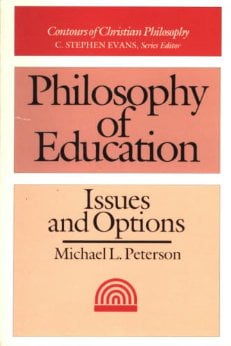
    Modern education in the U.S. has largely forsaken the scientific method of inquiry. The result has been unreflective rigidity. This inattention to discovery and heuristics is often a product of an anti-intellectual stream in our past. This is very unfortunate. I want my students to leave seminary with solid biblical convictions, of course, but I also want them to understand how one comes to know (epistemology) and to think (logic). Pedagogy matters. It matters because the systems that are opposed to biblical Christianity use logical arguments and philosophical methods. Michael Peterson, in his magisterial work Philosophy of Education (p. 83), writes:

    A complete Christian view of knowledge recognizes that reality is complex and that each of its domains must be known on its own terms. There is no single way to discover all the different truths there are. We must discover empirical truths through observation and experiment, historical truths through records and artifacts, logical and mathematical truths by abstract reasoning, and so forth. Christians have no shortcuts in these areas, butphileducation share basic noetic capabilities as other humans.

    In other words, if our business as Christians is to glorify God, then that includes glorifying Him with our minds. Whatever it takes, whatever it means, whatever happens to me, am I willing to obey His lordship over my thinking? Students, beware of the pedagogy that says, “You sit still while I instill.” And to my fellow educators I say: let us teach our students how to think and not only what to think.

    (From Dave Black Online. Used by permission. And yes, we’re featuring a book that we didn’t publish!)

Energion Direct
Privacy Overview

This website uses cookies so that we can provide you with the best user experience possible. Cookie information is stored in your browser and performs functions such as recognising you when you return to our website and helping our team to understand which sections of the website you find most interesting and useful.