
Tag: Christianity

  • I Run Out to Meet Him!

    I Run Out to Meet Him!

    A trumpet is sounding, I see a bright cloud,
    I hear a great shout, and it’s loud!
    And lightning is filling the sky up above,
    And now I can see Him, my Love!
    My eyes fill with tears, and my heart beats so fast –
    I’ve prayed for this day, and it’s here at last!
    I run out to meet Him, I don’t look around,
    But look at my feet! They are leaving the ground!
    And wonder is filling up all of my soul,
    As the King’s coming closer – BEHOLD!
    I see others above me in robes of pure white –
    He snatches us upward, His presence so bright.
    Those in the graves He allowed to go first,
    My parents, my husband! My heart almost bursts!
    When we’re past the danger, His wrath is poured out,
    The wicked are judged, and saved are the devout.
    I’m singing a new song and given a new name,
    I see all my loved ones, they don’t look the same!
    Their faces are glowing, they arrived ahead of me.
    We’ve left all our cares, and now we are free!
    We’re given gold crowns, and we fall to our knees
    And cast our crowns at His feet – He is pleased.
    Then He shows us the place He’s prepared for us!
    But I’ve got to write this down! I must!
    It was only a dream, but it still is true!
    One day He will come right out of the blue!

    By Nancy Petrey ~ April 16, 2019

  • Gathering of the Eternal Five: Samuel, Son of Tremiyo

    Gathering of the Eternal Five: Samuel, Son of Tremiyo

    Chapter 6

    Samuel, Son of Tremiyo

    (74)

    A pleasant coolness filled the evening where the sun had spent the day. Tremiyo and Camia found their usual sitting places after a busy day in the city with Senobia and the children. They had decided to have dinner in the patio where it was cooler. Remnants of clouds were painted in awesome shades of purple with glowing embers of copper and gold. They looked like windblown banners frozen in place. Birds still squawked and chirped overhead as if arguing over their bedroom accommodations. Bathed and refreshed, they waited for their staff to serve dinner. Anxiously they anticipated Onofrio, Senobia and the children to join them as an expected ritual. They had grown accustomed to sharing the evening meal together and discuss issues at hand. It was a private family time cherished by all. Baby Sintia would not be happy unless she sat close to her papa. Horacio was always seated next to his dad. While Senobia tended to Angelica and remained ready to serve her husband’s needs. In that happy aura of peace and love there was no space for disruption. No sooner had the thought occurred that a messenger from the outer gate came to Tremiyo. “Sir, two strangers are at the gate asking to be brought to you. The older man said he knew you from the days when you had an inn not far from here.” Not ready for unexpected company and guessing that the visitors were looking for a place to sleep and a free meal, Tremiyo reluctantly shrugged his shoulders and signaled with his head to bring the guests in. Joyful tidbits of conversation continued as Tremiyo hand fed his pride and joy, baby Sintia. Tremiyo could not measure the degree of joy he felt sharing a meal with the little girl. He felt rewarded by such a happy union with the child.

    In hobbled a dark skinned man seemingly in his middle years, with an unkempt bearded wearing an eye patch and struggling with a crutch. With him came a hooded man whose stride indicated a younger individual and was attentive to the older man’s physical impairment. The older man directed his gaze at Tremiyo to exclaim in obvious joy, “Tremiyo, you old camel trader. You haven’t changed a bit.” By then the man had Tremiyo’s hand firmly in his grip and shaking it almost off the socket. His look became one of disappointment when he clearly saw Tremiyo did not recognize him. “I know, you’re wondering who in the devil’s name this is? I lost an eye to road bandits and an arrow in my leg makes it hard to walk. I am Amin Hassan, the caravan chief. It took almost two heart beats for Tremiyo to grasp and fit the name into his understanding. Stunned and incredulous Tremiyo sought to sit down while Amin still held on to their handshake. “Almost twenty years ago, I bought a boy from a road bandit I did business with a few times. The boy was scared near out of his wits and was docile and obedient. He gave me one look that pleaded, I save him. Having lost my wife and son a few years back, I bought the boy to replace my loss.” Tremiyo’s heart was in furious rhythm. He was shaking severely as old memories went racing through his mind. Onofrio came to lay a hand on his distraught father-in-law’s shoulder. “Easy now, papa,” Onofrio cautioned. Having heard the story of Sintia’s abduction and murder along with his son being kidnapped Onofrio suddenly grasped the depth of Amin’s statement. Tremiyo struggled to stand up with his hand still firmly in Amin’s grip. His look was one of shock as he looked around to Amin’s companion.

    “Tremiyo, this is your long lost son, Samuel. We’ve been to China and had many adventures together on the way to you.” The young man dropped his hood and looked at Tremiyo with hesitant and doubtful eyes. He was a young Tremiyo that nobody could deny. Tremiyo was shaking violently and looked to Onofrio in silent supplication for help. Onofrio slipped his arm around the old man and held him up. Senobia came to his opposite side and was devastated to see her father in such a tormented state. He let go of the arms that supported him and fell to his knees in agonizing wails and torrents of tears. All three were now on their knees with Tremiyo and helped the old man stand up. But, he could not speak. He could only look at the young man and shed rivers of tears with a hand over his lips. He was having trouble accepting the miracle before him. Senobia went to the young man and studied him momentarily then spoke in her muted tone of authority. Satisfied that the young man looked like her father she calmly stated, “If you’re my long lost brother, then I am your sister, Senobia.” Brave hearted Senobia struggled to keep her emotions in check. Samuel responded, “I remember you. I rocked your cradle when you were a baby at “la posada Inn.” No words could have been said that meant more to Tremiyo. Nobody would remember the name of his Inn was “la posada” (the guest house.) except someone that lived there. “La posada,” had been Tremiyo’s pride and joy when Sintia and he lived there. Tremiyo now looked at his son partially recovered from his shock and in silence bade him come into his arms. Family fusion is seldom recognized as such. It is that unique sensation the soul feels when in the presence of a lost relative. It’s the blood calling to be with its own kind. Family reunions come and pass in all degrees. Few could have the depth of Tremiyo’s joy that filled him beyond capacity. His children, His real children were in his arms and the only thing missing was their mother, Sintia. How tormenting it is to have a heart half full of unmeasured happiness and the other half torn in bitter grief. Unashamed Tremiyo kissed Samuel on both cheeks and for a long moment held him close where two hearts beat as one. Tremiyo’s heart was filled to capacity and reached overflow when Samuel took his face to say, “You’re just the way I always remembered you.”

    Camia, poor orphan Camia suddenly felt very much out of place. She knew in her heart that stories of Tremiyo’s love for the deceased Sintia would be coming forth soon. And she had no place to run. With Samuel on one side and Senobia on the other Tremiyo sat to ask an infinity of questions. He need not have asked, Amin Hassan was there to fill in the missing years. Onofrio seeing Camia’s lament came to her side and held her close. She was in a sense, Onofrio’s extra mother. Gently, lovingly he whispered in her ear, “It’s time to make your place be known. Do it bravely.” Then gently nudged her into the presence of the reunited family. She would be forever grateful to Onofrio for once there Tremiyo happily introduced her to Samuel, “This is your step-mother, Camia. She practically raised Senobia after your mother’s demise. We married four years ago along with your sister and her husband, Onofrio de Iberia.” Once the introductions spread all around the guests were invited to dinner and more wine came forth on Tremiyo’s request.

    Through all this the caravan chief related an awesome story. “After a long period of prosperity, I decided that a trip to China could double my good fortune. I traded and sold and bought things to trade and sell again. When the call from China grew too strong, I geared my assets in that direction. I did not set out to buy a boy. When he was offered to me, I rejected the idea. I was on my way to China. I did not need a young boy to worry about. But he appealed to me with those soulful brown eyes and I relented having lost my wife and only son not long before. It was quite a long time before he revealed who his father and mother were and where he lived. By then, we were too far from here to return him to you. I knew your Inn, my caravan rested there a few times. Samuel became my son. I came close to selling him to a ship’s captain. But I remembered he was your son and I did not need the money he would bring. I would not want my real son abused by a ship’s captain or crew. So, Samuel won a place in my concern for him. But, if I am allowed to say, I fell in love in China. Got married and spent almost three years in blissful honeymoon. My stock in trade dwindled while I lolled in my good fortune. Samuel and I lived a life of luxury while there. I arranged classes for him with a learned English Priest  that traveled to that world. After a respectable length of time the Chinese authorities came to say that my presence in their country had exceeded their hospitality. They were not happy to have Chinese blood mixed with that of foreigners and would not allow me to bring my wife, Miyako out of their country. Unfair. Totally unfair.

    Sam and I struggled to leave their precious country and find the way back to our own. We were attacked a few times by road bandits, I suspect came from the Chinese authorities. My goods were reduced to mere leftovers nobody would buy and some nights we went hungry. He would periodically go into spells where nothing pleased him, except to go home to Tremiyo and Sintia. He wanted to live over La posada Inn again. He often said that it was the happiest time of his life. That dream never left him. When I lost my eye, he was there to look after me like a devoted son. Again when I took an arrow in my leg he withdrew the shot and did all he knew to do to make it well. Had it not been for him, gangrene may have claimed me. Through cold nights and despair He’s been there when I needed a friend or a nudge on my behind to keep me moving. As a son, he repaid the price I paid for him in joy alone. I would be less a man if I did not grant him his wish to come home to his rightful father. He’s my son too and most likely love him as much as you. The way has not been easy, but here we are.” The group around Amin Hassan were glued to his every word. Camia held on to Onofrio’s arm as she struggled to keep her heart in check. She physically feared that Sintia would appear next. And if she reappeared what would Camia do? Samuel spoke out with resolve. “After we spend some time together, I want to go search for the men that kidnapped me and killed my mother. I saw the beaded one strike her very hard with the pommel of his knife then peeled off her clothes to do what he wanted even though she was dead.  She was weak from hunger and his tormenting her with constant attacks. I want to find them and kill all three of them.” His voice was an echo of rage too long in storage. “Amin and I have been asking about them. Nobody seems to know where they went.”

    Before Tremiyo gave thought to his mind he put his hand on Samuels shoulder and clearly stated. “They’re dead and buried. I hunted them down and killed two of them. I decapitated the bearded one. The third one I left for the jackals and buzzards but he survived long enough to accuse me of murder and I was convicted for it. I served on a slave ship then got sold to a rich merchant in Macedonia. Serou, the master of this estate bought me to eventually become Stewart of his domain. When he felt I had paid my debt, he granted total freedom to me and your sister. We thought it over very carefully and chose to remain here.”

    Conversation, wine, good food and joyful company found its way to midnight. The moon overhead was a glowing disk of light that rivaled daytime and the stars seemed to fade in such brilliance. Camia was first to resign from the circle of happy voices. With baby Angelica in her arms, she went to put the baby to bed. Followed by Senobia with heavy weight Horacio. Onofrio had a hundred questions he wanted to ask

    his new brother in law. But saw it fit to take baby Sintia from Tremiyo’s weary arm nest and put her to bed. Tremiyo was best left alone with his newly found son.

    Two weeks of stories by Samuel filled Tremiyo’s life with boundless joy. Camia, the one that thought she would be left out of the family circle responded vigorously when Tremiyo demonstrated his need for her presence in all the festivities. Tremiyo took his son to all his  routine stops in the city and introduced him to all his contacts.

    Suddenly Samuel had a host of friends and admirers he never imagined before. Often Camia and baby Sintia joined in these journeys into town. It made the complete family group Tremiyo had often dreamed of.

    Serou’s villa by the lake had been completely remodeled. It was like a new home for the wealthy. His sense of hospitality added to the joy he saw in his long time friend and companion. Tremiyo opened the doors to the villa for Samuel and Amin Hassan. It has been said many times that a man can be removed from his caravan ways. But you cannot remove the caravan ways from the man. Soon Amin Hassan had pitched his tent by the lake and had his camels secured nearby. There he was happy, not inside rock walls and cozy bedse was not happy living in comfort, he missed the hardship of road life. There was glory in hard earned rest. China was still an unforgotten call. He explained his feelings to Samuel and alerted him to his sudden disappearance when it came about. Adding that he could never stand painful departures. It was best for him to leave with his sorrows silently in his pocket.

    Tremiyo was busy making his son’s stay as comfortable as possible. Whereas Samuel was soon bored with the controlled routine in which his father lived. He was unable to accept free meals and the money his father offered and stayed busy with menial tasks to justify the expense of keeping him . Tremiyo told him countless times that he need not concern himself with anything. His needs were Tremiyo’s needs and that after all this time home was the best place to be. And he was home.  “I cannot stay papa, I have a lust to wander. The manager of my soul ha become a very restless gypsy. But I’d like to do some useful work in my travels. What can you tell me of this woman named Magdalene?  Trail talk says that She is the silent leader of the pack that runs with  Jesus of Nazareth, a prophet  of dubious distinction. I’m interested in knowing more about her friend Claudia the wife of Pontius Pilate. It is said they became friends while serving as priestesses at the temple of Isis. Some real saucy stores seem to follow those two women.”

    The description of Iesus by young Samuel was a hard slap to the face of Tremiyo. He found it difficult to turn the other cheek. It’s never easy to forgive loud voices short on knowledge and Samuel was his son too long lost to jeopardize a rift between them. Hard set minds take time to turn around. After a long breath and a slow release Tremiyo spoke in measured words, “I (sigh) think I have a solution to your quest. Your brother-in-law Onofrio is often in Pilate’s audience with

    Work he and Serou do for Yerushalayim and the Hebrew council. Pilate is in search of a chariot driver to take him where he needs to go. The same charioteer will escort his wife Claudia, where she wants to go. If he accepts you, it will put you at the fountain of your quest. As for Magdalene, ask anybody on the street and you will hear a dozen concepts to the saucy stories you have heard from far away critics  with old worn out information. Your concept of Iesus, I will let the street and Onofrio guide you to a better understanding.

    Meet Pontius Pilate

    To greet the first light of day was a ritual practiced by Onofrio since childhood. Nature called to his soul for daily praise. A delicate shade of mauve tinted the eastern horizon with tiny flecks of gold peeping through transparent veils of clouds. Overhead fading stars seemed to bid him goodbye. He knew them well and cherished their presence. Senobia was asleep on her side with a toy doll on her pillow as a childhood companion she refused to abandon. It was Adonis.

    He would dress for the occasion and take Samuel before Pilate to introduce him and request the position of charioteer. Tremiyo was his usual commanding officer in the vast kitchens of Serou. Samuel spit polished and looking anxious waited by the huge table that served as Tremiyo’s headquarters desk. Outside the window people were already working harvesting, weeding and planting the vast garden. Soon trays of breakfast choices began to arrive.  The delectable aroma of fresh baked bread, bowls of honey, figs, dates and milk drinks were a virtual feast for young Samuel not accustomed to such abundance. Small selections of cheeses, containers with melted butter to go on hot bread, the smell of it all could rouse a man from deep sleep.  A familiar servant girl brought a tray of Red and orange pomegranates and put it close to Tremiyo’s usual place. The ritual of breakfast had become routine for Onofrio who dug in with zest. It was long time since dinner last night.

    After what seemed an eternity, two young men appropriately dressed waited in obvious anticipation to see Pontius Pilate. The governor was in a fierce screaming contest with a host of Hebrew priests. He pounded his fist on a table and in resolve terminated the interview with the disgruntled dignitaries. They left in anger and ill content. No question about it, they called Pilate everything in the book of Hebrews except a son of god. It was in the Hebrew council’s system to always leave a point to discuss further at another time. It was a strategy to win time and turn an argument in their favor. It worked. The governor took time to himself, apparently some cooling off time. Seemingly refreshed, he even had his hair re-brushed into place and wore a long burgundy tunic with gleaming white sleeves. The garment announced royalty with its gold braid trim in symmetrical oblong patterns down his arms. He returned to attend a gentleman ahead of Samuel and Onofrio. Their business was conducted swiftly, congenially and with the proper handshakes, the man was escorted out a secondary door. After pushing around some forms on his huge desk, he looked up as if he just now recognized Onofrio. It seemed a pointless gesture but Onofrio chose to ignore it. He was expected to look busy. He seemed to reassure himself or perhaps Onofrio imagined it. Pilate nonetheless took a deep breath and visibly rearranged his face then extended his hand to Onofrio like a long lost kin. The man could be a genial host under the proper circumstances. He greeted Onofrio warmly even if his voice sounded a bit insincere. “Onofrio de Serou, it’s good to see you. What brings you to me this day? With matching sincerity Onofrio grasped the Roman forearm salute and smiled amiably.

    “I bring my newly recovered brother-in-law to present to you as a new citizen of Yerushalayim. This is Samuel son of Tremiyo, Stewart of the house of Serou.” “Onofrio, you don’t need to remind me of Tremiyo’s social station. I know who Tremiyo is.” A bit annoyed the governor soon lost his geniality but quickly recovered it. “ I heard about the lost boy being restored to his father by a caravan leader. I’m glad to know for sure it was the son of Tremiyo. But, please tell me first. Please. Is he Jewish? Laughingly and understanding why the question came about. Onofrio had to assure the governor, “No sir. His father is from Iberia and his mother was true Greek. And three men found joy in laughter. “We learned that you seek a charioteer to take you on your daily business and also escort the lady Claudia to her needs although it is known that she is a good chariot driver. Since Samuel refuses to accept money from his father, we came to ask you to consider this young man for your needs and those of your wife.”

    “I have a charioteer already,” Pontius replied giving thought to the offer. Slowly, he came to Samuel as if to gauge the boy barely in his twenties. A young hardy individual, his looks, profile and general appearance met approval. Since he didn’t look Jewish. He could make use of such a young man. Might even give his household staff something new to think about. He was confident of his wife’s fidelity to think anything out of propriety regarding her. Claudia was stain proof virtue in the flesh.

    “Be here in the morning, I’ll have someone outline your duties and escort you to my home for your quarters there and equipment you’ll be using. Bring your clothes, you’ll not be going home soon. You have much to learn about my requirements. I yell loud, but you’ll learn I bite easy. Pontius reached to a container on his desk and retrieved two gold coins of respectable denomination and gave them to Samuel. “Have a haircut and a professional shave. You’re too young to grow a respectable beard. So shave off that fuzz. I expect to see a good

    Roman style haircut next time I see you. Have Onofrio help you buy some clothes suitable to your new position. You want to look, clean and impressive being in the governor’s company. I don’t run a caravan of camels and donkeys here. You now represent Rome. You must look the part. Take lessons from your new brother-in-law, he has much to teach you.” “With a tone of finality the interview was terminated and Pontius went to his next challenge waiting in the hallway.

    Leaving the praetoriun for their chariot Samuel was a long time silent. Wild thoughts running like a scared creature through his mind. Suddenly he wasn’t sure he wanted the position. It called for routine, confinement, restrictions and the same boring place every day. He was forced to question why he wanted the position in the first place. He listened to camp fire stories about the Prophet, Iesus. His women, that all loved him and paid to hear him simply speak. Women that paid for his food, clothes and provided him with sleeping accommodations, almost every night. Elaborate fantasies exploded from those exaggerated campfire chapters. He wanted to meet the disciple’s disciple and her Priestess friend, Claudia the Procurators wife. Now that the door was flung wide open to all that, Samuel was awed by his own ambition. He felt as though it was far more than he anticipated.

    He never dreamed that his goal could be so easily attained. But here he was living in his father’s house, treated like an honored guest. He now had money in his purse, a paid trip to the barber with all the trimmings and new clothes to show for no effort of his own.

    Could he copy the works of the Nazarene and preach his way to China, all expenses paid plus gratuities and special favors? He could install many definitions to the term “special favors.”

    Onofrio did not feel qualified to discuss the works of the Nazarene. Iesus’ mission was best explained by Mary of Magdala. Now known as the disciple of the disciples within closed circles.

    At a place where disciples of Iesus were known to meet Onofrio bought lunch complete with wine. Lounging at ease they waited for familiar faces to show up. The wine girl had shown an interest in Onofrio before and seemed glad to see him today. He gestured her to come close and quietly asked, “Do you know where I can find Mary of Magdala today?” Almost angry she raised to full posture to ask, “Why her? There’s others younger and prettier. Then there’s me.” Onofrio waved his hands before her face and pointed a finger for her to see. He dipped his finger in his wine glass and outlined the image of a fish on the table and pointed to Samuel. “Ooh, she said happily. For him? She has the experience he might need as young as he is.” The girl was a one tract mind in the flesh. “It’s important we find her,” Onofrio added with a coin in his finger tips. “I’ll find out. Be back in a few minutes,“ the girl stated and went into the crowd. Shortly after the girl returned. “I know where she might be later. But it’s going to cost you two coins. One for me and one for my husband.” “Your husb—?” Onofrio almost blurted out. “Well”, the girl responded “you went off and got married without asking me first.” She made a successful grab at her coin and held her other hand palm up with fingers signaling “gimme.” Onofrio complied with a smile and the girl reported “they Meet at the cave of the nativity in Bethlehem at dark, tonight. Magdalene is preaching.” The men stood up to leave and for pure boyish meanness Onofrio smacked her on the butt and asked, “Couldn’t wait for me, Huh?” “Well, I would have, if you asked me,” was her naïve reply. The incident produced a laugh among brothers. Both knowing the girl would always be a bedroom toy and perhaps never a permanent fixture.

    Samuel was first to bring up the subject of Iesus and his teachings that had the world in a stir all the way to China. He wanted to know if the man wore magician’s clothes when he performed healing miracles and made the dead walk and breathe again. His own laughter when he presented his view was cause for Onofrio to decide that his brother-in-law would have to decide for himself what the virtues of Iesus were. To impose his views at this time may not serve their relationship well. That point made clear in Onofrio’s mind, he stated it clearly to Samuel. “Every man should place his faith within the realm of his own understanding and acceptance. A man should depend solely on himself and not be influenced by others. A man that can do that becomes dedicated to his convictions.” As if the book had been shut, the inquiry met an end.

    The way to Bethlehem was a mere five and a half miles. An easy stroll for his tireless horses. Once away from Yerushalayim the road grew lonely for travelers. For a short distance they had the road all to themselves. Then the few walking people they passed multiplied into tens and soon they multiplied again into twenties. Next the road was congested with travelers that spooked the horses and made it difficult to navigate safely. Samuel laughed quietly and stated, “Looks like the circus come to town.” No comment from the driver.

    The cave of the Nativity was reputed to be the birthplace of Iesus of Nazareth. Although never truly confirmed, it basked in the fame and attention just the same. The businesses close by all prospered without mercy and each merchant could guide you to the precise location of the birth of Iesus, for a fee of course.

    In a field reserved for animals, Onofrio found a barn to shelter and care for his horses. He paid the man a fee in advance and asked his horses be fed quality grain and fresh grass with clean water. “Treat my animals right and there will be more of this, when we return,” and he plunked down some coins in the man’s open palm.

    Language and attire went berserk as the melee grew denser close to the entrance of the cave. Vendors tried to attract attention to their wares by a heedless crowd. Screams and yells became the language of the mob. Shoves and pushes the message of the day. Finally they entered a vast room that glowed with torch lights. At the front of

    the congregation, stood a woman dressed in all white. Regal, stone hard yet in unquestioned feminine grace. Surrounded by men of respectable stature, she was the Focal point of the gathering. Samuel like a boy gone to circus was amused and curious as to what this attractive woman offered that drove this crowd into a frenzy?

    With arms spread out and without a word spoken, Maria de Magdala brought the restless crowd to a receding hum. Then respectful silence. The humor seeking young Samuel was awed by such a silent command so graciously accepted without argument.

    “I am Mary of Magdala. I am one of you among you. I seek solace for my heart at our loss of the son of God, Iesus of Nazareth. I come before you as a student of his words, deeds and mission on earth. I am honored to the highest degree that I should be his spoke person. I bring to you the keys to your salvation from sin. I bring to you the door knob to heaven. I will attempt to lay that knob to heaven in your hands, here. Tonight. The words I speak to you come from my heart and my heart is guided by my trust in our Lord and savior, Iesus.

    Six days before the Passover,

    Jesus came to Bethany. They

    made him a supper; Martha

    served and Lazarus was one

    of those at the table with him.

    Mary took a pound of costly

    Nard and anointed the feet

    of Jesus and wiped his feet

    with her hair; and the house

    was filled with the fragrance

    of the ointment.

    John 12: 1-3  KJV


    THE TRIUMPHANT ENTRY

    Come, drop your branches, strow the way,

    Plants of the day!

    Whom sufferings make most green and gay.

    The king of grief, the man of sorrow

    Weeping still, like the wet morrow,

    Your shades and freshness come to borrow.

    Put on, put on your best array;

    Let the joyed road make holy-day,

    And flowers, that into field do stray,

    Or secret groves, keep the high-way.

    Trees, flowers and herbs; birds beasts and stones.

    That since man fell, expect with groans

    To see the lamb, come, all at once,

    Lift up your heads and leave your moans!

    For here comes he whose death will be

    Man’s life, and your full liberty.

    Hark! How the children shrill and high

    “Hosanna” cry;

    Their joys provoke the distant sky,

    Where thrones and seraphim reply;

    And their own angels shine and sing

    Into a bright ring;

    Such young, sweet mirth

    Makes heaven and earth

    Join in joyful symphony.

    Henry Vaughan 1622-1695

    The crowd cheered unanimously and those that did not understand followed suit to keep from looking ignorant. If the majority agreed, it must be right.

    “I was at the cross where he was crucified. I was there with his mother and her aunt Mary Salome. We were united in agony and faith that his ordeal was not suffered in vain. And yes, I loved him. I loved him dearly from the very depths of my soul. He was my brother. He was my mentor. He was my soul mate but never my lover.”  And she pointed a finger to heaven for emphasis. “Our God in heaven works many miracles for those of us that have the strength to answer to his demands. Within this crowd is a man, a young man whom many of you may know. He is Onofrio el Segundo, adopted son of Serou. If I am not imposing, I will ask this young warrior of faith to speak to you about his assignment given to him directly from God.

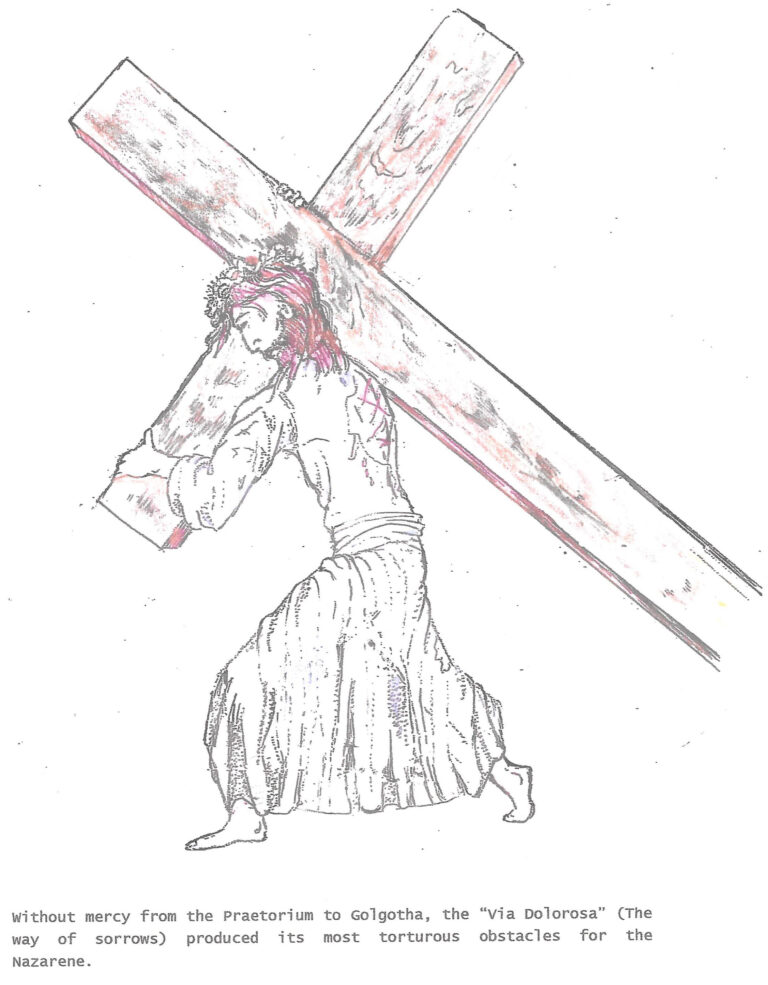
    He was given the task of building the cross on Which Iesus died. Without that cross, the keys to salvation would not exist. Iesus died on that painful cross to sanctify us from our sins. He paid the penalty for all of us. Without that cross, I would not have the door knob to heaven to give you. Accept Iesus as the Lord of your life here in this place of Devine blessings. For it was in this area that my Lord Iesus was born. It was here that the keys to eternal salvation first saw light. It is here tonight, shedding light and asking with arms wide open that you come into his arms and be eternally free of sin, that you may dwell in paradise.” Samuel looked up to his brother-in-law to see rivers of crystal tears rolling down his face. He thought he saw a golden crown around his head, but it was only the flickering light from the torches playing in his hair. Onofrio’s head was bowed in deep reverence and remained speechless. His heart beat to a rhythm he never felt before. It was musical, it was warm, it was inspiring to speak and yet he could not. It was his brother-in-law that broke the spell, “What’s the matter? Devil got your tongue?”

    Samuel’s quirky look on his face shone brightly in the torch light. And Onofrio saw Senobia in her brother’s face. She would be proud of her husband if he spoke to this group about his day with Iesus at Golgotha. He need not go to Iberia and tell the crowds of his day with the Lord. The crowds had come to him. Sent to him by God. There could be no other explanation. Armed with her love in his left side secret pocket the young warrior of faith politely began to excuse himself through the crowd, followed by Samuel. Halfway to the front a hand reached out to Onofrio. It was the once ragged jeweler that designed his wedding rings and was present at Golgotha. “If you need me to confirm  what you say. I am your witness. I was there also, remember?” Gently Onofrio accepted the man’s assistance and pointed to the head of the crowd. Never in his wildest dream had he expected to be so cheered. And yet here was the echo of adoration of which he felt unworthy. He was only a working man doing his job. And he did it for money and that part seemed to hurt the most. “Rather than me telling you of my day with Iesus perhaps I can answer your anxiety better by answering ten questions. I will answer ten questions, like the ten commandments written by God’s finger for Moses on a stone tablet.” Had not an old woman and Centurion Clemidius told him that he had the power to lead when he found the reins of his destiny? Yes, they had and was this his destiny? To stand before a crowd of strangers and offer them salvation of their sins and a place to reside in heaven? He Looked to the sky not visible from inside the cave and had to plead, “Lord I am in your hands. Lead me to where I can do the most good.” Samuel and the jeweler stood back as if gently pushed aside by an unseen force. A gruff looking man pushed himself forward, “I have the first question” And waved his hands to silence all. “Is this raggedly carpenter from the pits of Nazareth really the son of God? Answer loudly because I want to hear you condemn yourself to eternal hell for lying to these good people. They came here for a dose of faith not a bag of lies. So think well before you answer.” Suddenly Onofrio felt a calm overtake him. He felt at peace. The momentary annoyance this rude man caused simply slipped off his shoulders with ease.

    “A very good question sir, I think that question dwells in the mind of most people here. I welcome it and will personally give you my best answer. How many of you good people here believe in the Greek God Zeus. Fear not, answer with hands raised.” And many hands went into the air. “How many of you believe in Jupiter, god of Rome?” And a separate selection of hands took to the air.

    “Both these gods came to earth on missions of godly design. Both of these gods became fathers to earthly beings by way of human females. Jesus is the son of the god Yehwah. An unknown god by many but no less Devine. He performed his first miracle by instilling in holy Mary of Nazareth a child and not disturb her virginity. That virginity existed after the child was delivered. Physical evidence of that existence was verified by the women that examined her personally. One woman’s hand was gnarled to disfigurement for doubting the works of Yahweh. With that as proof, I answer your question. Yes, Jesus is the son of God and He was sent here on a godly mission just like Zeus and Jupiter. None of those old gods promised eternal salvation, a clean soul on which to rest in eternal peace. The most precious element in man is his soul and it’s given free of charge by Yahweh. But please allow me to answer your question further. Think on this, sir.” And Onofrio unwillingly saw the face of Satan on his tormentor but it did not stop him.

    “God changes caterpillars into butterflies by death and resurrection. He makes pearls from sand and converts coal into diamonds. Using time and pressure, He is also working on you, sir. Tonight, God has installed an embryo of faith in your heart. Given time it will grow.”

    Onofrio had never been intimidated by aggressive forces. He had lived with some to them and overcome their infestation of his soul. To the best of his borrowed ability, he answered nine more questions and was won over by booming applause. He learned on the spot to respect the power of adoration. It could consume the soul given a chance.

    Magdalene beckoned him to her side. She thanked him profusely and Onofrio took the opportunity to push this follow-every-step Samuel into her presence. “The reason I came to you is because my brother-in-law Samuel wanted to meet you and perhaps be of service to you. He is in quest of knowledge regarding the Nazarene.”


  • Tuesday Night Hangout: Elgin Hushbeck, Jr. on Witnessing

    consider christianity header“Witnessing” is a much abused term, not least by the way people often go about what they call witnessing. So last night Energion owner Henry Neufeld interviewed Christian apologist Elgin Hushbeck, Jr., author of the Consider Christianity Series, starting with the simple question: When someone asks you why you’re a Christian, what do you say?
    There are some very important points in this video, including these: Your answer is about your own testimony, not about your extensive (or not) theological and biblical knowledge; It’s OK to say “I don’t know” and go try to find out; You need to start in prayer and consideration of what your Christian faith means to you; An apologist doesn’t argue people into Christianity or even convert anyone, but rather removes objections; Changing people is up to the Holy Spirit and them.
    Here’s the video:

    I also want to call your attention to two other books we publish: Constructing Your Testimony (from the Topical Line Drives Series, and thus short!), and Testify! by Doris Horton Murdoch. These are books that might be useful if you wonder what a testimony is and how you might give it.

  • Creativity in Emotional Extremes

    Creativity in Emotional Extremes

    Girl showing different emotions with icons“Often our best creativity comes from the extreme emotions that we work so hard to avoid.”

    I believe it was legendary music producer Phil Spector that once said that there were only four songs we could ever write; I love you, I hate you, go away, or come back.  He wasn’t all that wrong.  Those emotional extremes probably produced most of the songs that you love.

    Often we are taught in our lives to avoid our emotional extremes, but in my short life it’s been in those places that I feel like I’ve created some of the best art of my life.  Whether celebration or hurt when I allow myself to feel those things deeply it produces something in me and something emerges that clearly and powerfully communicates what I’m feeling.

    As a Christian I believe I should constantly be creating better art because as a Christ-follower my goal is to live in a perpetual state of emotional extremes.  Let me explain.  On the positive side I have a hope beyond all hope.  I have a hope in Jesus Christ and because he is my Savior I will live forever in eternity.  There is no g9781893729919reater joy, no higher high, no more euphoric sense than to know Jesus as Lord.  So there I seek to draw from the emotion of that truthful and extreme joy. But on the negative side I also live in a state of brokenness. Broken for my own sin and the sin of this world.  Broken for the lost who without Christ will be sentenced forever to the most broken place.  That brokenness draws me to an extreme place of sorrow and sadness only to be restored to extreme joy by the fact that I have been rescued by my Savior and the sin I weep for has been atoned for in full.  It’s not cyclical.  It’s paradoxical.  One doesn’t lead to the other, but the truth is that both exist simultaneously and drive me to deeper realities of each other.

    So here I sit in a state of perpetual paradox desiring to exist in 2 emotional extremes simultaneously.  That is my desire as a believer in Christ.  I want to live in the highest state of celebration and create art from that place, but I also want to live in the state of brokenness that God desires (Psalm 51:17) and create from that place as well.

    I believe this desire to be exclusively Christian because only through Jesus can I find joy in brokenness and brokenness in joy.  It is a paradox of extremes that I am grateful to navigate.  Most people who sing of brokenness do so to alleviate it, but as a Christian I do so to celebrate it.  Most people who sing of joy do so in hopes that it will never leave, but as a Christian I do so that it may drive me to deeper brokenness.  As these extremes grow in my life I hope the power of their expression grows as well and that the power of that expression would better serve the Kingdom of God.

    (This post is from thoughts on worship leader creativity and is reposted here by permission.)

  • Fourfold Gospel Hypothesis: A Call for Discussion

    Fourfold Gospel Hypothesis: A Call for Discussion

    9781893729872fI have a question for our authors and readers: Is the confidence in Markan priority, generally combined with acceptance of ‘Q’ as a source, justified?
    I’m not asking whether you think Markan priority is likely, but rather whether you think the level of confidence in it amongst biblical scholars is justified.
    David Alan Black has just posted a blog about it, which I copied to WhyFourGospels.com (allowing me to link to the specific post), discussing this very question. Dave’s position is not in doubt. I publish his book Why Four Gospels? in which he outlines his case for the fourfold gospel hypothesis.
    I often avoid giving my opinion in these things, but let me just note that I believe one’s view depends to a large extent on how one weighs external vs. internal evidence, and, of course, your evaluation of particular forms of external evidence. If you favor internal evidence, then you’re likely to support Markan priority. If you think it unlikely that the church fathers either knew or accurately reported information about the authorship of New Testament books, you’ll likely support Markan priority. If not, well, not so much!
    I did such study of the New Testament as I did under people who took Markan priority as a given. I was barely aware that there was an alternative, and paid it very little attention. One might think that my mind was changed by publishing a book on the topic, but that actually came second. My belief that Markan priority was essentially a given was shattered by reading William R. Farmer’s The Synoptic Problem. I followed that up with looking at some other material by him and others.
    I am not convinced of everything Dave writes in Why Four Gospels?. I’m less concerned with issues of historicity than he is, I believe. (Note please that I did not say “unconcerned with issues of historicity.” I do believe that historical foundations are important.) But despite some remaining issues, such as that I do not see a convincing explanation for the state of the text of Mark, I think Matthean priority is more probable than that there was a hypothetical document ‘Q’.
    So what think you all?
    Henry Neufeld

  • Responding to Philosophy for Believers

    9781938434549mI have asked two Energion authors for an extended response to our recent release, Philosophy for Believers by Edward W. H. Vick. These responses will be posted once each month for the next 13 months, covering all thirteen chapters of the book.
    There are two purposes for these responses. The first is to discuss and respond to the approach taken in the book. But the second is more important. It is to see how to people who are in the trenches, so to speak, apply this material in their work.
    Dr. Bob LaRochelle is a pastor, educator and an author. His Energion titles are Crossing the Street, So Much Older Then …, and the forthcoming What Protestants Need to Know about Roman Catholics. Early next year, there will be a companion volume to the last book, What Roman Catholics Need to Know about Protestants.
    Elgin Hushbeck, Jr. is both a Christian apologist and a businessman. He is author of Energion titles Evidence for the Bible, Christianity and Secularism, and Preserving Democracy.
    Each response will be published as a separate post using the category Philosophy for Believers. They will be posted near the end of each month.
    Feel free to comment on these topics. We’d love discussion. If you blog about the topic at or around the same time, we will be happy to post a link here to your post. Join the discussion in whatever way works best for you.

    Publication Dates:

    Nov. 1
    Nov. 29
    Jan. 31
    Feb. 28
    Mar. 28
    May 2
    May 30
    June 27
    Aug. 1
    Aug. 29
    Oct. 3
    Oct. 31
    Nov. 28

    Topics

    1. The first sentence is: We all have many and varied beliefs. Dr. Vick builds the book around this point, saying there is a difference in the meaning of various types of beliefs and how they are justified, but they are nonetheless “beliefs.” Many skeptics, on the other hand, would maintain that there is a much greater distinction between belief in a scientific and a religious context. Since this is a fundamental idea for the entire book, how do you respond to this? Do you find Vick’s approach to this topic viable? Helpful? (Elgin Husbheck’s Response, Bob LaRochelle’s Response)
    2. The crucial question for a Christian in the second chapter is the relationship between testimony, belief, and knowledge. How important is historical testimony to your beliefs as a Christian? What about contemporary testimony, for example, claims of a miracle? (I note here that I can no longer see this as a liberal vs. conservative issue with liberal author Bruce Epperly maintaining that Jesus did, in fact, heal [Healing Marks, Energion, 2013], and also that God can and does act in the world. So I’m not asking “Do you believe in miracle stories in the Bible?” but rather “How does the testimony of others relate to your belief, whatever that belief is?”) (Bob LaRochelle’s Response, Elgin Hushbeck’s Response)
    3. There are a number of crucial issues in this chapter, but I think the best place to respond is on the issue of “proof” and “belief,” question #19 in the book exercises. “Fred believes that he can prove the existence of God. He believes that to believe in God you have to be able to prove that God exists. Frederica believes neither of these. What is the issue between them?” (Bob LaRochelle’s Response, Elgin Hushbeck’s Response)
    4. I’m taking question #4 from the exercises: “What is a ‘world-view’? Do you have a world-view? Is there a common modern world-view about the cosmos?” Then I would add, “How important is “world-view” to the way we respond to new information?
    5. Again, from the exercises, this time question #6: “Should we distinguish between different kinds of explanation, for example: common sense explanation, ad hoc explanation, scientific explanation, historical explanation? Do these or some of them have anything in common? Do different subject matters require different kinds of explanation?” I would be most interested in looking at the difference (if any) between explanation of a religious claim, a historical claim based (potentially) on the supernatural, and scientific claims.
    6. This time building from question 3, though you may want to include 4: “Does religious experience provide us with a reason for believing in God? Specify an argument from religious experience to the existence and activity of God.” The handling of religious experience is key to Dr. Vick’s thinking, not only in this book, but in others, such as his From Inspiration to Understanding: Reading the Bible Seriously and Faithfully (Energion, 2012). If you have not, and would like to read that, I’ll be happy to send a copy.
    7. I’m going to use question #1 from the exercises: “Relate the doctrine of God’s providence to the conviction of the uniformity of nature, and the consistency of natural law.” I use this because it is one I hear rather frequently, and there are a number of different explanations.
    8. I don’t have a specific question to raise, but rather a section, #8, pp. 167-168 on open theism. Relate open theism, process theology, and more traditional understandings of God’s foreknowledge. This might get too broad, but if you try to stick to understanding providence in connection with the apparent uniformity of nature (if that is correct), it should narrow things down a bit. You probably should avoid getting into the Calvinist vs. Arminian debate, though perhaps you can’t!
    9. I’m taking the question from the chapter summary: “But is it possible to tell ourselves a lie and then believe the lie we tell ourselves? Is such irrationality a feature of human life?”
    10. From the chapter summary: “An explanation of how to account for mental activity cannot speak only in biological terms of brain activity. We may not neglect the fact that our experiences have a particular quality of ‘feeling’.” Does Dr. Vick successfully take us to the conclusion that the mind is more than biological function?
    11. Does the concept of “identity” matter to you in your understanding of the afterlife, resurrection, or similar concepts?
    12. I’d almost like to make up another question, but the one asked in the chapter summary is too classic to ignore: “How does the occurrence of miracles relate to well established natural or scientific laws?”
    13. State your basic understanding of how faith and science relate, if they do. Can there be conflict if both are done properly? How should it be resolved.
  • Book Review: The Questioning God

    Reviewed by Robert Danielson, Ph.D.
    Faculty Associate and Affiliate Faculty at Asbury Theological Seminary
    Wilmore, Kentucky
    Ant Greenham presents an intriguing analysis of the world’s monotheistic religions and their view of God, through the lens of how God is perceived to relate to the questions of human beings. Using broad strokes, he paints a generalized picture of this situation. In essence, he argues that Islam suppresses the questioning of God through its focus on submission to the will of Allah. On the opposite end of the spectrum, Greenham presents the Jewish faith as being so open to questioning God that this questioning has undermined an ultimate certainty in God. This leaves the Christian faith, which Greenham examines in both its Roman Catholic and Evangelical forms. While Vatican II opened the Roman Catholic Church to a more positive view of questioning, it has left certain theological positions too sacrosanct to be questioned. Evangelicals, in the meantime, have become too closed to the questioning of authority (both political and religious) and Greenham outlines some of the potential dangers inherent in this lack of questioning.
    The author presents some very solid scriptural arguments for his position and he outlines a strong biblical view of questioning from the example of Christ’s words to his followers in the gospels. He recognizes several times that he does not have the space to do a thorough analysis of each religion’s position and Greenham also validates that individuals vary within each religion presented. Beyond these obvious concerns, I found myself left with several additional questions.
    First, the author presents this spectrum of current positions regarding questioning as the norm for these religious traditions. He would be better served to bring out the temporal and cyclical nature of questioning. Judaism was forced into a greater openness to questioning as a result of the Holocaust and its horrors, which replaced a much closed rabbinic tradition. Christianity as well was forced into a more open position with regard to questioning by the Enlightenment. Even then the Church fought Copernicus and other scientists through the Inquisition and the Counter Reformation for their questioning of the theology of their day. The Islamic world was the seat of scientific knowledge and openness during the Dark Ages, when the Christian Church demanded blind obedience to the faith. Greenham mentions a number of these factors, but does not really tie them into a theory which would be more cyclical. While Islam may be going through a current phase that is closed to questioning, this does not mean this period is permanent or unable to be changed given historical events. Evangelical Christianity may be going through a similar cycle of closing itself to questioning stemming back to the Scopes trials and a distancing of Evangelical Christianity from scientific inquiry. All religions may go through such cyclical transformations.
    Second, Greenham does not really tie in the role of mystery and faith in religious traditions. While questioning is indeed one important aspect of how people interact with God in religion, all of these traditions also call for some ideas to be accepted as matters of faith. The mystery of the Trinity, faith in the divinity of Jesus, acceptance of the faithful transmission of the Qur’an to Muhammad, or the acceptance of the Jewish nation as a specially chosen people of God, are all matters which a believer must chose to accept by faith. No amount of questioning can prove or disprove these fundamental concepts. Religion, in its basic difference from science, is found in its concepts accepted without question by faith.
    Third, in terms of mission and evangelism from an evangelical perspective, the author does not really deal with the role of the Holy Spirit. In terms of previenient grace (from a Wesleyan point of view), the Holy Spirit is active in all parts of the world, all cultures, and all religions, before Christianity even appears. It is the Holy Spirit who compels people to begin to question what they believe and why. It is the Holy Spirit that is the reason for individual variations in how people move to conversion and personal transformation. In the same way, it is the convicting power of the Holy Spirit that moves us to self-critique our own ideas and values as Christians. The dynamic power of questioning would be nothing without this theological groundwork from a Christian perspective.
    From my reading of Greenham’s book, The Questioning God, I feel he understands these issues and concepts, but lacked time and opportunity to elaborate on them. Nevertheless, I feel they are important, even vital additions to this conversation. Greenham has provided a fascinating foundation for a beginning discussion on how people should deal with questions about God, both from inside and outside the Church. His biblical principles for Christians are sound and need to be heard in the Evangelical Church today. While his perspective of questioning in the Muslim and Jewish communities provides a good starting place for a discussion on evangelism, it is not the end of the discussion. Much more remains to be said and analyzed in terms of history and the theology of world religions, but it is a refreshing place to begin to develop new and more fundamental questions to ask about what we believe.

  • Missions – What about It?

    (Today’s post is from Pastor D. Kevin Brown. Pastor Brown is author of the book Rite of Passage, forthcoming from Energion Publications. He blogs at, you guessed it,  D Kevin Brown’s Blog.)
    Last year in the association in which the church I pastor is a member, there was reported 200 people baptized with total receipts of almost $8 million. Do you know what that tells me? That tells me we as an association spent almost $40,000 per person to get them baptized and brought to Jesus. This is well above the per capita family income of a typical family in our county! That’s an amazing statistic! If you think we spent $40,000 on evangelism and missions per person to reach them, you would be mistaken. We spend our money tithing to ourselves. We spend money on our “fun.” Most churches (and ours is no different and we’re working on it), spend as much money on literature, supplies and utilities as we do on missions. God help us for our misplaced priorities!
    The Bible says in 2 Chronicles 7:14:

    If my people, who are called by my name, will humble themselves and pray and seek my face and turn from their wicked ways, then will I hear from heaven and will forgive their sin and will heal their land.

    It’s up to us, the Church, to start reaching this nation again. I read recently in the NC Baptist “Connect” magazine that a church that has been around for 10-15 years or more gains nearly 80% of their new members by transfer growth (that’s swapping members), while a church that is a new church plant will gain nearly 60-80% of their new members from folks that have never attended church anywhere and are most likely lost. Why? Because the older churches get lazy!
    You see, we have to pay off our buildings, in which we see less than a couple handfuls of people saved each year. We have to pay for our buses and our vans, as they cart us to and fro from activity to activity that reaches few if any with the gospel. We must pay for our burgeoning staffs (because the lay people don’t want to do much of anything anymore.) It seems we’d rather pay to have it done than get our hands dirty. It’s almost like people are saying: “Don’t try this at home—let the professionals do it, because it may be dangerous for our health.”
    We continue to fund a myriad of programs (of which, many are so ineffective for reaching people with the gospel that we’re afraid to ask why we still have them), yet we hang on to these sacred cows because we’re afraid of a little blood just so we can keep the flock happy. And all the while, the new church plant is nimble enough and may I say hungry enough to “seek and save that which is lost,” because they “don’t know any better.” They aren’t burdened down yet with all the stuff that a “good” church is supposed to have.
    We are involved in a war—a war for the hearts, souls, and minds of our children and our families. The Church in the last 50 years has failed to transmit its religious heritage to the next generation. Sermons, in many of our churches across America, are now more “therapeutic” than instructional; our worship services have become grounded more in what we “feel” than in what we think and know about Scripture.
    Why is it that the Church, by and large, no longer represents the power of the “action” of God in the world?” I’ll tell you why. Because we have compromised the gospel. The Church has quit training and evangelizing. The church is literally dying a slow death in America; that is imperceptible to most, but nonetheless is happening simply because we are not reproducing ourselves. Church attendance continues to drop in America and we’re down now to around 30% of Americans attending services on a given Sunday. You see, the goal of Christianity must be to advance God’s kingdom on earth. Let me be very clear. The purpose of the Church is to be God’s “missionary people” in the world. We are to be adding to the flock…not just fattening those that are already in the flock, those who are already safe and sound.
    Isn’t it time to seriously look at all of our programs and ministries and ask if they are effective and if they’re not…then, let’s pull out the butcher knife. I am firmly convinced there is no partnership in Christ without partnership in missions. Are we mission-minded? Is it really our TOP priority or just “one” of many priorities in our churches?
    Oh have we forgotten our mission? If we are going to be relevant to this “lost and dying” world, we are going to have to remember what our purpose is and what our mission is to be. We’ve got to care about and love what Jesus loved. What did He love? Not a “what,” but a “who.” People, people, people! He said, “I have come to seek and to save that which is lost.” That’s our mission! As congregations, we must intentionally live as God’s missionary people. It’s only then that the church will emerge to become what Christ created it to be and it’s only then that we will truly be salt and light and see dramatic changes within the cultural fabric of our churches and thus, this nation. The purpose of the body of Christ is to make Jesus visible to the world Monday through Saturday…not just to ourselves on Sunday. Are we on mission at our jobs in our schools on the ball fields and dance studios? You don’t have to be a preacher or missionary to be in the “ministry.” We are all ambassadors of the Gospel…remember?
    But, if we’re going to be on mission then we must overcome a significant hurdle. What is that? The great American Dream? Has the Church in this nation become like the church of Laodicea. Rev. 3:17 shows us this type of church: “We are rich, having acquired great wealth and are in need of nothing? But we don’t realize that we are wretched, pitiful, poor, blind and naked.” Jesus called that church lukewarm and it makes Him sick to His stomach to the point of vomiting. Is that what He sees when He looks at us? Oh, please forgive us Lord!
    You know when you boil it down; it all comes down to priorities doesn’t it? We must remember who we are and what we are to be about as the Church. After all, aren’t we the body of Christ? We must remember we are to be His hands and feet. The Apostle Paul tells us so in Ephesians 3:11-12:

    It was he who gave some to be apostles, some to be prophets, some to be evangelists, and some to be pastors and teachers, to prepare God’s people for works of service, so that the body of Christ may be built up…

    So, it’s my job as a pastor to equip. Right? That’s what we just read…yet…churches expect the pastors to do everything in many cases. And do you know what else? People like me, (pastors and preachers), have made things this way. We’ve spoiled our people. Think about it. The average pastor puts in around 15-20 hours a week in message preparation. He gets paid on average a salary of around $45,000 a year, (I’m estimating here), and there are somewhere around 310,000 churches in the U.S. Add all that up, and you’ll see that every week American churches invest right at $140 million in preaching. That’s a major investment, and what’s the return on that investment? Church attendance is on the decline. The percentage of people claiming to know Christ is plummeting, and the moral fiber of our culture is ripping apart. Can’t we see that we’re missing the boat as Christians and as churches?
    Preaching alone is good, but it won’t save the masses. We must personally be ambassadors for Christ as we daily “take up our crosses and follow Jesus and bear fruit for Him.” We must be paramedics with the Gospel (take it to them), not just ambulances (trying to get them to a building). Once we lead them to Jesus, we must disciple them. But, discipling is hard. It’s time-consuming and not easy because we have to roll up our sleeves and invest in other’s lives.
    So, will we do it? Will we do the hard things and make our churches mission-minded? Will we brandish the knife and slaughter some sacred cows and stop tithing to ourselves? Will we become more concerned about what is happening outside the walls of our churches instead of paying for our own comforts inside those walls? I pray we will. And I pray that missions will once again become our top priority just as it was our Savior’s.

  • Stewards of the Gospel

    Ezekiel 37:1-37:14

    March 13, 2005

    A sermon presented by Dr. Bob McKibben at Pine Forest United Methodist Church

    Adapted From: “More than Hatch, Match, and Dispatch” By: Rev. Joseph Smith, Takoma Park Baptist Church, November 2000
    Scripture quotations are from the Revised Standard Version
    Many years ago, I did a wedding in Atlanta in an old log church. The grounds surrounding the church were breath-taking. The church itself was very rustic on the outside, but the sanctuary was unbelievably beautiful. It was the perfect setting for a wedding. I learned that funerals were also held there and many young families would also bring their babies to be baptized. But there were no regularly scheduled worship services. No spiritual nurturing goes on there. It is for ceremonial use only – for weddings, for funerals, for baptisms. People come to the Little Log Chapel for rituals, but there is no community there to love it, to cherish it, to make it alive with the sound of children’s laughter or the weeping of souls in anguish. It’s just a place of ritual. Otherwise, it’s dead. Dry and dead.
    Unfortunately, many folks think of all churches in those same terms – ceremonial and ritualistic. In fact, we have a little joke about it in ministerial circles. Pastors speak of their ministry as hatching, matching, and dispatching – baptisms, weddings, and funerals. These are the great ritual moments of life. People expect the church to be ready when they hatch, match, or dispatch. I believe, however, that those rituals are empty of power if they are celebrated outside the vital community of God’s people. These are empty ceremonies unless they are set in the midst of a people who are about the Lord’s business, and who can see the power of the Lord at work bringing new life.
    There was no more empty and traumatic time in the history of God’s people than the sixth century before Christ. 2600 years ago the nation of Israel had been destroyed, its leaders taken into exile. It looked as though their humiliation was complete, and that their nation would never thrive again. They felt no hope. They were ready to give up. But into their midst came one of the strangest personalities of all history, the prophet Ezekiel. Through this unusual man, God spoke a word of hope to a dry and weary land. And I believe God can speak that same word of hope to His church today.
    Ezekiel saw in his vision a valley. The valley was one where a tremendous battle had been fought. Obviously the battle had exacted a tremendous toll. The valley was now strewn with the bodies of the slaughtered. Nothing was left but dry bones. They had been there so long, rotting in that valley, that their flesh was gone and there was nothing left but sun bleached bones. Can you imagine anything more hopeless? Can you think of anything more lifeless than dry bones rattling around in the desert wind?
    But our God gives life! Where there is doubt, God gives confidence. Where there is anxiety, God gives peace. Where there is despair, God gives hope. And where there is death, God gives life! Even to dry bones. Even to a church that is only ritual, hatch, match, and dispatch. God gives life!
    I.  First, when God gives life to His people, He does it thoroughly? He does it completely. When God gives life to dry bones, as Ezekiel saw it, He will put everything in place. He will leave nothing out.
    Thus says the Lord GOD to these bones: “I will cause breath to enter you, and you shall live. I will lay sinews on you, and will cause flesh to come upon you, and cover you with skin, and put breath in you, and you shall live; and you shall know that I am the LORD.”
    When God gives life to His church, it is not in a puny, timid way. It is in a great and powerful way. A full-bodied way. God wants His church to be complete. God wants His church to be more than bare bones. God wants His people to have a full and wonderful life.
    Some churches – most churches – have narrow visions. Often they are about one thing and one thing only. I know of a United Methodist Church whose passion was foreign missions. The leaders so profoundly believed in foreign missions that they led that church to give more than half of the church budget to missions. That’s passion! Passion is good – but the church failed because it couldn’t pay its bills.
    I know of another United Methodist congregation led by a pastor who wanted to make his church a “Community Life Center.” This is a great vision – to open wide the doors of the church to the whole community. The pastor raised the money to build a nice facility then gave it to the community. Again, sounds great! Now the church can only use the building on Wednesday and Sunday. They are also not allowed to remove the newest sponsor’s sign advertising a major beer company. The church is more than just a ritual house, or a collection agency for overseas missions, and certainly more than just a “civic center.” The church needs flesh and sinew on its bare bones.
    As your pastor, I have never been able to simplify the vision of what Pine Forest United Methodist Church ought to be. I see evangelism just as important as education, and worship just as significant as pastoral care, and missions and fellowship as indispensable. I think we have to do it all. I believe that the way God gives life to His church is to give us completeness. God gives life thoroughly. If we are faithful stewards of the Gospel that leads to new life, we must be more and do more.

    • More in evangelism, as long as there are lost sinners around us.
    • More in discipleship, as long as there are people who need spiritual maturity.
    • More in skill training, as long as there are those with gifts not yet being used.
    • More in ministry, as long as there are hurting people.
    • More than bare bones – sinew and flesh and skin.

    The story is told of a tour group going through Westminster Abbey in London. They were shown all the symbols of Britain’s history. They saw the place where the monarchs are crowned. They visited the tombs and the memorials to the nation’s greatness. It was a wonderful trip backwards in time. But one member of the tour group piped up and asked the guide a searching question. Said she, “Sir, has anybody been saved here lately?” I suggest that that is always the right question for anybody’s church. “Has anybody been saved here lately?” We are so much more than ceremonial, so much more than narrow vision, so much more than hatch, match, and dispatch. We are stewards of the gospel that leads to new life.
    II.  Next, I want you to notice that when God’s spirit gives new life to His people, He gives a rich variety of gifts. He gives gifts that go beyond what we expect. I believe that God wants His church to draw on all of the gifts that He gives. Ezekiel’s imagery is very striking. I prophesied, suddenly there was a noise, a rattling, and the bones came together, bone to its bone. I looked, and there were sinews on them, and flesh had come upon them, and skin had covered them; but there was no breath in them. Then he said to me, “Prophesy to the breath, prophesy, mortal, and say to the breath: Thus says the Lord GOD: Come from the four winds, O breath, and breathe upon these slain, that they may live.” I prophesied as he commanded me, and the breath came into them, and they lived, and stood on their feet, a vast multitude.
    The “four winds” represents the wonderful diversity from which our God gives us life. The text says that the Lord put flesh and sinews and skin on, but there still wasn’t any life. No life until He breathed from the four winds.
    Pine Forest United Methodist Church has long prided itself on being an open and welcoming church. At least that’s what we say we are. But I suggest to you that until we truly reach out, understand, and embrace people who are different – with different personalities and different skills, we will be far less than what God wants us to be. We need to draw life from the four winds. We need to draw on all the gifts that a life-giving God has given us. God has brought to our congregation gifts from the four winds, from many places and from all sorts of backgrounds.
    Until we use those gifts, however, we can have all the church programs we want, all the activities we want, all the busyness we can handle. But if it is done by the same leaders who have been doing it for lo these many years, it will not bring the life the Lord wants us to have. If the work is done by the staff, then the game is over. We have lost. Life comes when we draw from the four winds and let the full range of God’s gifts blow through us. I know just about everybody in this sanctuary, and I don’t know anyone that doesn’t have some gift that can be used for the church and the Kingdom.
    We are blessed. We have much. We are diverse. It’s all here for a purpose. It’s here to make a difference in people’s lives. We are here not just to be spectators. We are stewards of the gospel that gives new life. We are so much more than hatch, match, and dispatch.
    III.  I am persuaded beyond all doubt that God is at work here. The issue is always whether you and I will see Him at work, or will we see only the dry bones of a lifeless church. The issue is always whether we see possibilities, or whether we find ourselves mired down in quicksand, sinking fast. If you only look at what’s on the surface, you might feel disappointment and despair. But if you see what God sees, you’ll see more. O my people. I will put my spirit within you, and you shall live, and I will place you on your own soil; then you shall know that I, the LORD, have spoken and will act,” says the LORD.
    If you only look on the surface of this church, maybe all you see is dry bones. You may see discouraged leaders, aging facilities, and some committees that don’t do much. But I don’t think that’s all the Lord sees.

    • The Lord sees new people coming to Christ and asking for help in gaining new life.
    • The Lord sees more children showing up for our children’s activities.
    • The Lord sees several people who have declared they feel His call into ministry.
    • The Lord sees an emerging family life program.
    • The Lord sees a complex of buildings and fields that could be used for Kingdom work.
    • The Lord sees people who are waking up to deeper yearning for learning.
    • The Lord sees a church jam packed with potential. And all it takes is the vision to understand what God wants to do.

    We are on the edge of a new day in our congregation’s life – new people, new ideas, new energies, and new vision. God-given vision. I urge you to give yourself to this emerging vision.

    • I know no better place than here for the dry bones of my spirit to find new life.
    • I know no better place than here for my heart to find genuine fellowship.
    • I know no better place than here for my spiritual gifts to be invested.
    • I know no better place than here for my tithe to be used for the Kingdom.

    You say, but pastor, what about me? Will I get my needs met in all of this? Will I be spiritually fed? Feed me too. Feed me first. To that I respond that the only people I know who have to be fed by others are either infants, who haven’t learned to feed themselves; or couples getting married, who stuff cake into one another’s mouths; or dying people, too weak to help themselves any longer.
    Everybody else can feed from the bounty spread on the Lord’s Table. The church is a whole lot more than hatch, match, and dispatch. The church is the steward of the gospel that leads to new life.


    Dr. Bob McKibben is pastor of Pine Forest United Methodist Church. He has a degree in Music Education from Florida State University and Master of Divinity and Doctor of Ministry degrees from Emory University. He has served as a guest speaker at Camp Meetings, Revivals and other events throughout the southeast. Dr. McKibben has been designated a Growth Plus consultant and is a faculty member of the Faith-Sharing Initiative, both sponsored by the United Methodist General Board of Discipleship. He is a former Community Spiritual Director and board member for the Walk to Emmaus.
Energion Direct
Privacy Overview

This website uses cookies so that we can provide you with the best user experience possible. Cookie information is stored in your browser and performs functions such as recognising you when you return to our website and helping our team to understand which sections of the website you find most interesting and useful.