Tag: early church

  • Modern Socialism and the Bible

    by Elgin Hushbeck, Jr.

     
    [ene_ptp]A common defense that modern supporters of socialism use is to claim that it is the model practiced by the early church in the book of Act, and thus it is the model we should seek to follow.   Acts 4:32 states,
    Now all the believers were one in heart and soul, and nobody called any of his possessions his own. Instead, they shared everything they owned. (ISV)
    While at first blush socialism seem to be a reasonable inference of this passage, there are a few problems with this view. First off, there is the question of whether this passage is prescriptive or descriptive. Is this something we are commanded to follow, or is this just describing what they did? That it is descriptive is supported by the fact that this certainly did not last very long, and we do not see other churches being told to follow this practice.
    Nor does it seem to have worked out very well, for what we do see is other churches being asked to contribute funds to support the church in Jerusalem.  It should be noted here that had sharing everything in common been a universal teaching of the early church, there would have been no need to make the plea for support. Also Paul makes it clear that “each of you should set aside and save something from your surplus” (1 Cor 16:2) showing that funds were not held in common.
    So it would seem that the socialism of the early church in Jerusalem was not a universal teaching, and did not end up very well. Nor is it really hard to see why.   Acts 4:34 goes on to describe that,
    none of them needed anything, because everyone who had land or houses would sell them and bring the money received for the things sold
    This is all well and good, but accumulating the money needed to buy land or a house takes considerable time. Selling such an assets can generate a lot of money, such that it is not surprising that at first “none of them needed anything.” But as is pretty clear to most, it is easier and takes less time to spend money than earn it. If the people were earning enough money to keep up with the need there would have been no reason to sell property in the first place.
    Since they did sell it, it means the need exceeded their incomes. Selling the property, and the resulting inflow of cash, fixed the short term issue, but it did not address the long term one, and thus it was only a matter of time until the money ran out again.   Yet this time, the property was already sold. With nothing else to sell, now they were all in poverty, and thus the appeals to the other churches for support. This is an inherent problem of socialism. As Margaret Thatcher famously said, “The trouble with Socialism is that eventually you run out of other people’s money.” It can produce short term gain by tapping into accumulated wealth but the gains are short lived.   In the end, as Winston Churchill pointed out, “The inherent blessing of socialism is the equal sharing of misery.”
    But even if one takes the early Jerusalem Church as a model to follow, there is still a very big and significant difference between the socialism of the early church in Jerusalem, and modern socialism. While the socialism of the early Jerusalem church “shared everything” the sharing was voluntary. This can be seen in Acts 5 and the punishment of Ananias and Sapphira. While they also sold some of their property and gave the money to the church, they secretly held back some of the money they received. The key point here is that they were not punished for holding back some of the money, but for lying about it. Note Peter’s response in Acts 5:3-4,
    “Ananias, why has Satan filled your heart so that you should lie to the Holy Spirit and keep back some of the money you got for the land? As long as it remained unsold, wasn’t it your own? And after it was sold, wasn’t the money at your disposal? So how could you have thought of doing what you did? You didn’t lie only to men, but also to God!”
     According to Peter, Ananias and Sapphira owned this property and could do with it as they saw fit. There was no obligation to give this money to the apostles. Their sin was to lie and say they gave all when they did not.
    Peter’s words are words the modern socialist cannot say. While those in the Jerusalem church would say, ‘what is mine is yours’, the modern socialist says ‘what is yours, is mine.’ The former is a statement of generosity, the latter is coveting. It may be disguised as concern for some need, but at its core it is seeing what someone else has, and wanting it for their own purposes.
    It is important to note that in the 10th commandment, there is no exception clause. It does not say do not covet unless you have a good reason. Where Peter could say “wasn’t it your own” the modern socialist say “give it to us or else.” The later just does not strike me as a very Christian message.
    [slideshow_deploy id=’2411′]

  • One New Man

    One New Man

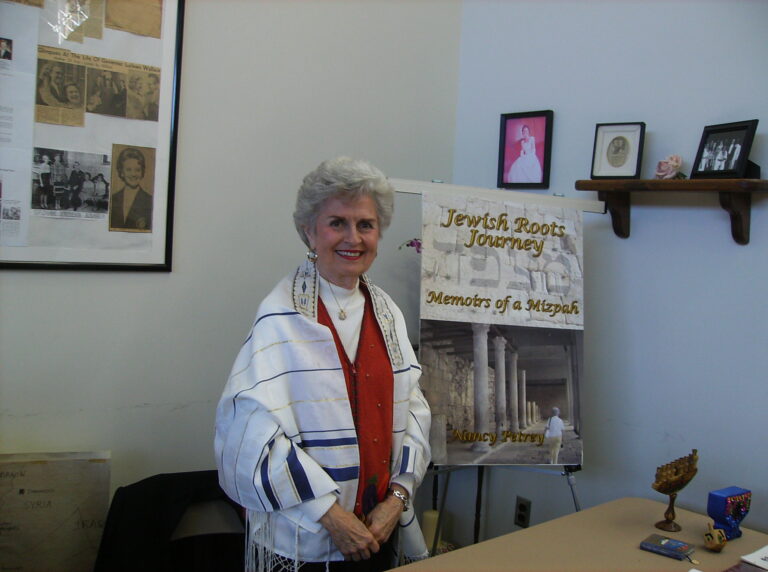
    Nancy Petrey, author of Jewish Roots Journey
    Nancy Petrey
    Nancy Petrey is the author of Energion title Jewish Roots Journey. You can learn more about her via her author page. Her book is on sale via Energion Direct for just $15.00 (free shipping in the U. S.), or $2.99 off the regular price.
    God loves unity!  “And the two shall become one flesh” (Gen. 2:24).  God modeled  unity in the Garden of Eden with the marriage of the first man and woman.  The Apostle Paul quoted this verse to teach that Jesus and the Church were like husband and wife, united in one flesh (Eph. 5:22-32).  The greatest demonstration of love the world has ever known was when the Bridegroom laid down His life for the Bride.  And the greatest love the Bride can show for the Bridegroom is to submit her life totally to Him.  Unity is all about love.
    Unity is the essence of the God we believe in.  “Hear O Israel: The Lord our God, the Lord is one” (Deut. 6:4)!  God proclaims the unity of the Godhead, so, of course, He expects unity in His covenant people.  That word, “one,” is echad in Hebrew.  It is a compound word.  Christians can see the Trinity in that word.  Jesus made the bold claim, “I and My Father are one” (John 10:30).  Paul ends his second letter to the Corinthians with this benediction, affirming the Trinity, “The grace of the Lord Jesus Christ, and the love of God, and the communion of the Holy Spirit be with you all. Amen” (II Cor. 13:14).  Yes, amen!
    Jesus wants His followers to be in unity.  He prayed to the Father right before His arrest and crucifixion that those who believe in Him would be one just as He and His Father are one.  He prayed that His followers would be included in the divine oneness.  That marvelous witness of unity would be what the world longs to see! (John 17: 20-23).  Who could resist the allure of a Church who truly loves its own enough to die for them?  That is the divine strategy for winning the lost – unity!
    The Church today needs to understand just who Jesus was referring to in His high priestly prayer for unity.  The average Christian who reads John 17 most likely thinks of divisions he is familiar with, such as racial, ethnic, parent-child, husband-wife, employer-employee, political, religious, educational, or economic divisions.  Those types of division are real and touch everyone on the planet.  No doubt Jesus grieves over these divisions, but the division he most longs to see healed is that of Jew and Gentile.  The original Church was totally Jewish for ten years, with Jewish bishops in Jerusalem.  The first church split happened in the second century between Jewish and Gentile believers, and it resulted in a paganized kind of Christianity that forgot its Jewish origins.  This led to anti-Semitism and persecution of Jews during the Inquisition, the pogroms, the Crusades, and right up to the Holocaust, all at the hands of the Church!  This is documented history and very tragic.  Most Christians don’t know a thing about it!  And many in the Church do not even realize the Jewishness of the Head of the Church, Yeshua HaMashiach (Jesus Christ).
    Jesus made it clear at His first coming that His mission was primarily to His own people, the Jews, not the Gentiles.  Jesus sent out His twelve disciples, saying: “Do not go into the way of the Gentiles, and do not enter a city of the Samaritans.  But go rather to the lost sheep of the house of Israel.”  After His death and resurrection that line of division was eliminated when He gave the “Great Commission” to His Jewish disciples – “Go, therefore, and make disciples of all the nations, baptizing them in the name of the Father and of the Son and of the Holy Spirit” (Matt. 28:19).  It is significant that He named the Trinity in His command to bring all nations into His kingdom.  The big heart of God is longing to bring everyone into His kingdom.  He is not willing that anyone should perish!  He invites all to be one with the Godhead!  Incredible!
    God does not show partiality, but He does have order in the way He operates, and the Jews come first.  On the Day of Pentecost the Holy Spirit first came to 120 Jews and baptized them with “tongues of fire” on their heads and in their mouths!  In Jerusalem the visiting Jews “from every nation under heaven” heard the gospel in their own language, and 3,000 believed! (Acts 2).  No doubt they went back home and began discipling others, just as Jesus had commanded.
    Paul kept the order Jesus initiated, saying that the gospel was for the Jew first, then the Greek or Gentile (Rom. 1:16).  He always first visited the synagogue in every place he went, even after he said on two occasions that he was finished with the Jews and would go to the Gentiles (Acts 13:46; 18:6).
    The Church gained more and more Gentiles as Paul went on his missionary journeys.  He taught them their Jewish roots, saying to the Ephesians that as Gentiles they “were without Christ, being aliens from the commonwealth of Israel and strangers from the covenants of promise, having no hope and without God in the world.  But now in Christ Jesus you who once were far off have been brought near by the blood of Christ.  For He Himself is our peace, who has made both one and has broken down the middle wall of separation, … so as to create in Himself one new man from the two, thus making peace, and that He might reconcile them both to God in one body through the cross, thereby putting to death the enmity” (Eph. 2: 11-16).
    In those days it was a curious thing that Gentiles could join the Jews as part of God’s covenant people.  The Jews were in.  The Gentiles were out.  Paul called it a “mystery” that God had revealed to him, previously hidden in other ages, “that the Gentiles should be fellow heirs, of the same body, and partakers of His promise in Christ through the gospel” (Eph. 3:3-6).
    May Gentile Christians rejoice that we, as “wild branches,” have been “grafted into” the Jewish “olive tree.”  We should not be conceited and “boast against the natural branches.”  We, like the Ephesians, must respect the Jewish roots of the Church and remember “we do not support the root, but the root supports us” (Rom. 11:17-18).
    Having this understanding of our Jewish roots, Christians should prayerfully and practically support the nation of Israel, love the Jewish people, and seek to bring them to a knowledge of their own Jewish Messiah.  Jesus is longing to see One New Man in His Church!!

    By Nancy Petrey, March 1, 2013


Energion Direct
Privacy Overview

This website uses cookies so that we can provide you with the best user experience possible. Cookie information is stored in your browser and performs functions such as recognising you when you return to our website and helping our team to understand which sections of the website you find most interesting and useful.