Tag: ecumenism

  • Can the Many Christian Churches Ever Be United?

    by William Powell Tuck
    www.friarsfragment.com

    Unity banner
    One of the most powerful movements sweeping across the Christian world is the quest for Church unity. Since the Second Vatican Council and the establishment of the World Council of Churches, many Christian bodies have labored diligently to see if the broken body of Christ, the Church, could be united. Many Christians have seen the fragmentation of the Church as a scandal and a factor that harms its witness to the world. Many believe that the wide variety of denominational expressions of the faith hurts the cause of Christ. The fighting within the Church between Christians about correct doctrines and Church practices is an affront to our Lord. As we gather at the Communion Table, we join other Christians around the world who worship on this day with a prayer for Christian unity.
    Those of us in the Western World need to be aware that we have increasingly become a minority in the Church. Since the middle of the last century, the majority of Christians in the world are now colored. The white skinned Christian is no longer the dominant race in the Christian Church. People of color will likely continue to grow in their numbers in the Christian community.[ene_ptp] Jesus prayed for the unity of the future Church (John 17: 20-26). He prayed that the future growth of the Church would not inhibit its unity. What then is the debate about whether or not the Church should be united? The last will and testament of our Lord was a prayer for the unity of the Church. All the debate about whether or not the Church should be united is superfluous, if we really want to follow the intention of our Lord. The unity of the Church was our Lord’s basic desire.
    The efforts to bring about the reunion of the Church have never been easy. Anyone who has labored within ecumenical circles to bring about the unity of the Church knows the difficulties and obstacles for such unity. But we have to start someplace to reunite separated Christian churches. Any small step is at least a step in the right direction.
    In a CBS special several years ago, Bill Moyers told about a man in New York City who decided he would try to do something to help the hungry. As he went to work each day in New York City, he distributed a hundred sandwiches to the street people. The street people soon learned about his kindness, and they lined the sidewalks waiting for him to hand them a sandwich. After a TV segment which showed the man handing out sandwiches to the people, Moyers observed: “New York City’s population now runs in excess of eleven million people. A hundred sandwiches will hardly scratch the surface in the need. But while Sam may never move his world very far, at least the direction he is moving it is forward.”
    Every effort we make to move the Church forward to be united is at least a step in the right direction. Every step we take to bring fragmentation in the Church, we move away from our Lord’s intention.
    Jesus prayed for a unique kind of unity for his Church. He prayed that the future disciples in the Church would be united as he and the Father are united. “May they all be one, as you Father, are in me, and I in You” (17: 20). Jesus’ unity with his Father was based on a unique personal communion of the Son with the Father. The Church’s unity is a reflection of the unity within the Triune God.
    The unity for his Church for which Jesus prays extends beyond organizational or ecclesiastical uniformity. This unity is not simply under some giant administrative group that brings various factions together, but rests on an openness to the Spirit of God who works in our lives as God worked in the life of his Son, Jesus Christ, our Lord.
    The basis of the Church’s unity, as it is modeled after our Lord’s unity with his Father, is rooted in the nature of God and Jesus’ obedient love. The Father was “in” Jesus, and Jesus was “in” the Father. As the Father has “sent” the Son, so Jesus “sends” his disciples into the world (17: 21). Jesus mediated the presence of God through the temple of his body (John 2:17-19), and the flock was united under Jesus, the one “Shepherd” of his Church (John 10:16). The unity of the Church in the contemporary ecumenical movement needs not to be a unity void of all diversity of theology or administrative form. Instead, it is a unity based on the Triune nature of God, characterized by the diversity within the unity of the Father, Son, and Holy Spirit.
    It is sometimes sad to listen to the various theological discussions about the reunion of the church and to see how inflexible many persons are in their stance in various denominational traditions. Dick Shepherd, a leading Anglican churchman of several generations back, gathered a group of church leaders together to discuss the question of the reunion of the Church. He thought the meeting had been very successful until he heard the two clergymen who were the speakers for the night make a comment to their own followers. One of them remarked to his minister friends. “I don’t think I gave anything away, did I?” The other minister observed to his friends: “I rather fancy I held my place all right. Didn’t I?”
    How unlike our Lord who laid down his life for the Church. Too often we are more concerned with. “Can I get my way?” or “Is my position well established?” If unity is going to be achieved, each side must seek to see what each give and not what can they hold on to. To recover unity, sacrifices will have to be made.
    Our model for the unity in the Church comes from our Lord. Jesus Christ extends God’s grace to all persons.  Jesus called all persons to experience the Father’s love. Instead of exhibiting Christ-like love, we often draw circles and exclude persons from the Church. We often want to include only those who think like we do or act like we do. Only those who fit in certain theological boxes or believe along our rigid patterns can be included in the fold. Jesus encountered this attitude in the Pharisees who built their religion on exclusiveness. Their religion erected walls and fences to keep people out. But this was not the kind of religion Jesus proclaimed. Rather than excluding persons, Jesus reached out to include them. Rather than pushing people down, Jesus reached out to lift them up. Rather than crushing people with heavy burdens, Jesus sought to liberate them. Rather than hating people, Jesus sought to love them. Rather than trying to destroy people, Jesus wanted to redeem them. The Christ who reaches out to all of us with his love is the same One who instructs us to reach out to our brothers and sisters across all racial barriers. He does not want to build walls that separate but doors that open to include others.
    [slideshow_deploy id=’2745′]

    Click on any picture for more information or to order

  • Why All Christians Should Care about the New Pope

    Why All Christians Should Care about the New Pope

    REFLECTIONS ON THE ELECTION OF A NEW POPE

    Rev. Dr. Robert R. LaRochelle


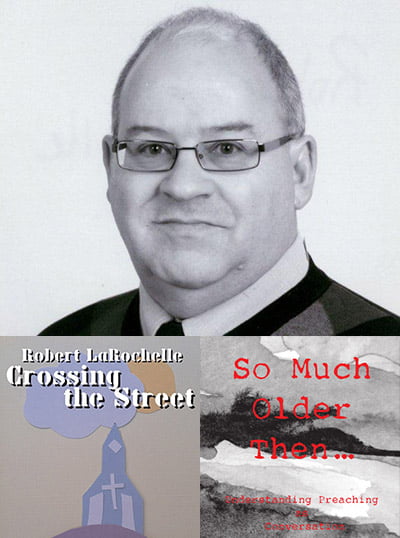
    Rev. Dr. Robert R. LaRochelle and his booksBob LaRochelle is the pastor of 2nd Congregational Church (UCC) in Manchester, CT and is author of Part-Time Pastor, Full-Time Church (Pilgrim Press, 2010), Crossing the Street (Energion Publications, 2012) and So Much Older Then … (Energion Publications, 2013). He was an ordained deacon in the Catholic Church before becoming a United Church of Christ pastor. He is passionate about ecumenical dialogue.


    The recent election of Francis I as the Roman Catholic Church’s new Pope has attracted great worldwide interest and justifiably so. First and most obvious is the fact that the election of a new Pope is a significant time of transition for Catholics. In light of many unfortunate occurrences, including well known scandals, within the Catholic community, this particular election carries with it a hope for a new beginning and some substantial changes.
    Of course, depending upon where individual Catholics might rest on the theological spectrum, there are significant differences over precisely which specific changes should occur. There is diversity of thought within Catholicism regarding such policy changes as allowing priests to marry and ordaining women priests, just to name but two examples among many. One’s position on policy changes is connected to something far deeper. Policy flows from theology and theological differences have and continue to exist within the Catholic Church. They flare up in discussions on the topics mentioned above, as well as homosexuality, contraception, the relationship of church doctrine and public law, and many others.

    Any Papal election is significant because the Pope is a world leader and has the potential to serve as a bridge builder between and among cultures, religious perspectives and nations.

    Any Papal election is significant because the Pope is a world leader and has the potential to serve as a bridge builder between and among cultures, religious perspectives and nations. What is quite interesting is that etymologically the term Pontifex associated with the ministry of the Pope literally means ‘bridge builder’. In addition to the capacity a Pope has to influence world events, he can be a great source for the unification of all Christians, be they Catholic, Protestant or Orthodox. In my view John XXIII and his successor Paul VI were significant catalysts in the way Vatican II expressed the Church’s understanding of ecumenical relationships.
    In my book Crossing the Street (Energion Publications, 2012), I contend that Catholics and Protestants, two Christian groupings that have had a checkered relational history, have much to gain in learning from and engaging in dialogue with one another. Despite some different interpretations, oftentimes flowing from different understandings of church authority, there is a true ecumenical center binding Roman Catholics and Protestants together. In his role as the most recognized Christian religious leader in the world, the Pope can do what others have done before him. He can be an influential leader in the necessary cause of Christian unity.
    All of which brings us to the election of this man who will go by the title Pope Francis I. As I note in my book, Roman Catholicism is not monolithic. It is comprised of a pluralism and diversity of spiritualities, theological perspectives, starting points and devotional practices. With this in mind, it is thus important to look at the shape of this new Pope’s particular practice of Catholicism with an eye as to how that might influence his leadership.  In this vein, I find the following facts about his life to be quite telling and illuminative:

    1. Pope Francis I is a Jesuit. As a member of the Society of Jesus, founded by Ignatius of Loyola, he is part of a religious community that takes the notion of religious community itself most seriously. The Jesuit tradition has made major contributions to the Catholic Church and the Christian world in these significant ways:
      1. The church’s intellectual tradition. No community of priests as a whole receives a broader and deeper education than those who belong to the Jesuit community. This integration of faith and reason has had a profound impact on the world. We Americans can readily identify many truly outstanding universities (Georgetown,  Holy Cross, Boston College, to name but a few) that are run to this day by the Society of Jesus. On a personal note, I am so grateful that I have received degrees from two of these simply wonderful educational institutions.
      2. The church’s spiritual tradition. Pope Francis is grounded in the Spiritual Exercises of Ignatius of Loyola, one of the most profound prayer experiences constructed by a mere mortal! Those who enter the Jesuit priesthood have undergone a period of training in which a 230 day retreat centered on these exercises is a necessary component.
      3. Jesuit spirituality is intrinsically linked to its relationship to social justice. The Jesuit community has a global vision, rooted in the church’s stated preferential option for the poor. It is clear that Pope Francis’ compassion for the poor is a hallmark of his approach to pastoral leadership. Some would sound a cautionary note here, one that is worth watching as his Papacy unfolds: There is a chasm between those who embrace ‘liberation theology’[1] and others who express concerns about it. It appears that the new Pope has been among those in the latter category, especially in events that took place in Argentina over thirty years ago. It remains to be seen what this bodes for the future.
    2. He chose the name Francis, in deference and respect to Francis of Assisi. It seems clear from all indications that this Pope eschews a pompous lifestyle and favors simplicity and access to the people whom he pastors. There are those, including myself, who would contend that, regardless of specific policy changes or lack thereof, a Pope could make an incredible impact by changing the image of the Vatican. My early sense is that there is something of Pope John XXIII’s warmth and informality in Pope Francis, somewhat akin to that fictional Pope depicted in Morris West’s classic The Shoes of the Fisherman. The power of that witness could truly make for an incredible effect.
    3. Finally, there was a less than subtle theological/ecclesiological emphasis in the Pope’s opening remarks from the balcony of St. Peter’s. In referring to himself as Bishop of Rome, he issued a reminder that is often lost on many in the Christian world, including a good number of Catholics. Historically, the Petrine ministry, that which Catholics situate in the Pope, rested in the unique role Rome’s bishop played among those other bishops with whom he governed the church. It could be stated that Rome’s bishop is a ‘first among equals.’
    There are those, including myself, who would contend that, regardless of specific policy changes or lack thereof, a Pope could make an incredible impact by changing the image of the Vatican.

    I would contend that in referring himself in this way, we learn something about an approach to church governance that is most conversant with the historical growth of the Catholic Church and takes its first few centuries as highly informative, not limited its perspective to the medieval model that has wielded great influence in the church for so long. Where this Pope stands in relation to the kinds of questions that dominated Vatican I and other periods of debate over church authority cannot be easily gleaned from these remarks, but the remarks themselves might just scratch the surface of something the implications of which are most profound.
    With all of this being said, I believe that this Papacy will be a significant period in the life of the universal church, a church that thrives as the gifts of varied traditions within it are cherished and become resources for our deepened relationship with God.
    May all of God’s children thus turn to our God as we pray for Pope Francis’ health, well being and a deeply prophetic ministry to us and with us, in this, God’s most needy world!
    AD MAJOREM DEI GLORIAM![2]


    [1]  This emerged in many nations in Central and South America and was a powerful force in the tensions between governments and religious leaders within the Roman Catholic Church. If ever possible, see the film Romero as a powerful expression of this.
    [2]  ‘To the greater glory of God’. This is the motto of the Society of Jesus (The Jesuits). It is typical to find the letters A.M.D.G in the cornerstone of buildings at Jesuit colleges, retreat centers and other settings.
  • Sincere but Unfortunate

    by Dr. Robert LaRochelle
    Earlier this week, a piece of writing was brought to my attention which has caused considerable reaction out there in the blogosphere. In his Parchment and Pen blog, C. Michael Patton published an entry under the rather intriguing title of ‘Embracing Doubt’ or Why ‘Roman Catholic scholarship‘ is an Oxymoron.’ Mr. Patton’s position, developed and corroborated in numerous other entries, is that one cannot be a real theological scholar and also be truly Roman Catholic because Catholics must always yield to the authoritative teaching of the church, a teaching which can be invoked as ‘infallible.’
    To be honest, I consider this entry to be highly sincere but most unfortunate. In my view, it is important for Roman Catholics and Protestants to engage in respectful, ecumenical dialogue and to look for ways in which we can learn together, pray together and serve together, in Jesus’ name. It is also my conviction that we must search for an ‘ecumenical center’ while recognizing that individuals, in conscience, will make their own individual decisions regarding their own church affiliation. It is my preference that both Catholic and Protestant theologians, educators, and writers look for ways to focus on what we share in common, even to the point of making clear that what we have thought really must divide us, under the scrutiny of closer examination, in fact, actually need not!
    The issues Mr. Patton raises are personal ones for me. I am an ordained clergyperson and have served as a pastor for over ten years in the United Church of Christ. For the first forty five years of my life, I was a member of the Roman Catholic Church. Over the course of my professional life, I worked in Catholic parishes and a diocese in such capacities as Theology instructor, Youth Minister and Director of Religious Education. For nine years, I served as a Permanent Deacon, a member of the Roman Catholic clergy, and in that capacity baptized nearly three hundred individuals and officiated at a rather large number of weddings and funerals as well.
    My wife, with whom I will be celebrating our thirty first anniversary in just a few days, remains a member of the Roman Catholic Church, as do our three children, one of whom works at a college as a Catholic campus minister. I am the beneficiary of a wonderful education in Catholic schools which includes exposure to magnificent Catholic teaching and scholarship in two excellent Jesuit institutions, Holy Cross and Boston College.
    My eventual decision to leave the Catholic Church and my service in a Protestant denomination has really deepened my passion for that ecumenical center I have mentioned. As a matter of fact, I explore this in detail in my forthcoming book Crossing The Street, which will be released this coming Spring by Energion Publications. In my book, I explain my own decision to leave Catholicism, one that did, for me, center on the issue of authority. After much struggling with the multiplicity of issues involved, I made the decision that I am really a Protestant and thus felt deeply that it was time for me to move.
    Yet, having said this, I also realize that other people who struggle with some of the same issues I did have decided to remain within the Catholic Church. Where I differ with Mr. Patton is in my strong belief that one can harbor doubt and question authority within Catholicism and yet remain a Catholic. Some of the Catholics whom I most admire are those who either have or do!
    In his sweeping assertion that one cannot be scholarly and a faithful Catholic, Mr. Patton, in my view, misses three very important realities:

    1. Many changes in the Catholic Church were as the result of theologians questioning what was current and historic church teaching. The major changes in worship, ecumenism, Biblical understanding, the priesthood of those other than the ordained, the church’s understanding of the relationship between religion and science, among many others, teachings promulgated at Vatican II and in the workings of the church in subsequent years, came as the result of ‘cutting edge’ work by theologians within the church, individuals such as Teilhard de Chardin, Yves Congar, Karl Rahner and others whose theological positions truly ‘pushed the envelope’ of Roman Catholic convention.
    2. Even in some traditional ‘authoritative’ documents, the influence of dissenting Catholic theologians is clear. The great church authority test in the late twentieth century was the reaction of Catholic theologians and ordinary Catholics to the church’s teaching on birth control as expressed in the 1968 encyclical Humanae Vitae. It should be noted that prior to writing the encyclical, the Pope appointed a commission to study the question. One could argue that, though Pope Paul VI reiterated the traditional position in this Papal decree, the document also included a theological perspective expressed by those ‘ on the other side’ of the Pope’s conclusion. This same dichotomy is notable in the 1976 Vatican Declaration on Certain Questions Concerning Sexual Ethics. Even more telling, this ‘dissent’ on these questions and others is operative in both the behavior and attitudes of Catholics today who remain members of the church while holding positions different from the ‘magisterium’ on such issues as well as on others, including, yet not limited to, women’s ordination.
    3. Most importantly, in the personal sense, Catholic teaching has clearly held to the concept of the primacy of the INDIVIDUAL CONSCIENCE in decision making. Church documents, including those of Vatican II, speak eloquently of this reality. I think it is fair to say that there are Catholic theologians who would see their dissent on particular teachings and interpretations as an exercise of their consciences.

    So, in summary, as one whose movement into Protestantism and practice of my faith has been deeply enriched and enhanced by bold and exciting Catholic scholarship, I find Mr. Patton’s argument unconvincing. I do admire, however, his strong advocacy of the importance of theology within the Christian community of faith. It is my firm belief that true ecumenical dialogue between Protestants and Catholics really suffers when theological ‘indifferentism’ is seen as the norm. The idea that ‘it makes no difference’ and that all belief systems are ‘really the same’ is both inaccurate and does no justice to the cause of deeper understanding and shared contribution to both Christ’s church and to God’s world.
    While I applaud Mr. Patton for his passion for theology, so obviously born of a love of God and a passion for truth, I see this blog entry as both falling short and also doing unnecessary collateral harm to the necessary cause of Christian unity!


    Rev. Dr. Robert R. LaRochelle holds a Doctor of Ministry from Chicago Theological Seminary. He is pastor of the Congregational Church of Union, Connecticut, UCC, and is the author of Part-Time Pastor, Full-Time Church (Pilgrim Press, 2010) and the forthcoming book Crossing The Street (Energion, 2012). He writes a blog at http://wwwpastorbob.blogspot.com

Energion Direct
Privacy Overview

This website uses cookies so that we can provide you with the best user experience possible. Cookie information is stored in your browser and performs functions such as recognising you when you return to our website and helping our team to understand which sections of the website you find most interesting and useful.