
Tag: eschatology

  • Book Extract: The Antithesis of the Law

    Book Extract: The Antithesis of the Law

    This post is an extract from the forthcoming book Justification by Faith by Dr. Edward W. H. Vick, which should be available late spring to early summer. It is posted as part of our Discussion on the Law.

    Thus if there is a way to be found to God it will be the antithesis of law. In Jesus Christ that way has been found, โ€˜But now the righteousness of God has been manifested apart from law. Romans. 3:21. What is meant by law here is a way of approach to God via the performance of the deeds of law, without the presence of faith. This usage of the term โ€˜lawโ€™ has been defined as โ€˜divine law viewed as a purely legalistic system made up of statutes of the basis of obedience or disobedience to which it justifies or condemns.[i] There was no guarantee of freedom from sin under this way. In fact the law seemed to gain in authority every time it was broken. Manโ€™s impotence in face of it, his indwelling sin dominating him, gave to the law the power of a tyrant. As long as sin is present, the power of the law is present and law condemns. When sin is removed the sting is drawn from the law. And when the sin is removed, the law ceases to be a way of life, Romans 8:3,4.

    โ€˜For what the law could not do, in that it was weak through the flesh, God sending his own son in the likeness of sinful flesh, and for sin, condemned sin in the flesh: that the righteousness of the law might be fulfilled in us, who walk not after the flesh, but after the Spiritโ€™

    That new way of life is described by the expression โ€˜under graceโ€™. So Paul asserts, โ€˜Ye are not under law but under grace.โ€™ Romans 6:14. And as usual he meant what he said. The statement is made, interestingly enough, in connection with another, โ€˜for sin shall not have dominion over youโ€™, which precedes. This connection the legalist always misses. To be free from the dominion of sin you must repudiate law. If it is freedom from sin that we quest, โ€˜under lawโ€™ must be rejected for โ€˜under graceโ€™. The legalist says that the only way there is freedom from the dominion of sin is by putting myself โ€˜under lawโ€™. The antithesis could not have been more sharply drawn as it has been in this verse. We may take our choice. โ€˜Under graceโ€™, the way of law is over and done with once and for all. Through grace we see that adherence to law any law, divinely given or humanly framed, majestic or trite, is a blind alley if peace with God and sanctification of life is sought. The rejection of law at this essential point is our only shield against antinomianism, as it is our only shield against legalism. For the despair that ensues from the attempt to keep law may easily lead to an accommodation of its requirements and to a casuistry that is more concerned about avoiding the injunction than in following it.

    It is in the context of an experienced grace, and a continuing faith, which is to say, in the context of relationship with God that the โ€˜worksโ€™ of the Christian are done. Since they are spontaneous they do not occupy the foreground of attention. For one who really has faith, the obedience which the discipleship requires at this point is forthcoming. It is the fruit and the evidence of the discipleยญship. And the discipleship is often expressed in unpredictable ways, as new demands are made upon oneโ€™s obedience. It is the unpredictability of the demand that the legalist cannot stand. He must know all and everything now. The trust that is absolute requires no assurances for the future, except that which is given by the present relationship.

    Sanctification thus has its eschatological aspect. The believer must wage the warfare against sin, the flesh and the devil. He knows both that the victory has already been won, as well as he knows that the victory is not yet. In Christ sin has been judged, and thus vanquished. At the parousia it will be finally obliterated. While living between the times, the believer enters into the victory of the former, and anticipates the victory of the latter. Christ has conquered, and will conquer. The believer shares in one victory and anticipates the other. Between the cross and the eschaton the believer demonstrates the reality of that conquest.

    The way of faith is a way of freedom. To abandon faith for law is to abandon freedom for bondage. One cannot add law to Gospel and hope that benefit will ensue. A decided choice between the two must be made. That is the point of Paulโ€™s allegory of Sarah and Hagar, with the command he draws from it: โ€˜Cast out the slave and her son; for the son of the slave shall not inherit with the son of the free woman,โ€™ Galatians 4:30.


    [i] Burton. Commentary on Galatians, p. 457.

  • The Invincible Obedient

    The Invincible Obedient

    This book extract is posted in the series Discussing the Law in Scripture. See that page for a detailed directory of articles in this discussion. The initial article in that discussion is The Law as Gospel.

    https://www.energiondirect.info/wp-content/uploads/2021/03/Weston_invicible_obedient.pdf
  • On Words and Meanings – Link

    On Words and Meanings – Link

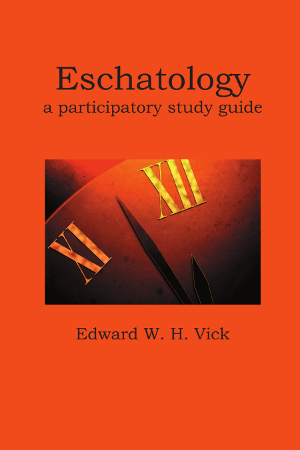
    9781938434105mBrian Fulthorp comments on a passage from Eschatology: A Participatory Study Guide.
    His conclusion:

    So the thought for the day is that we need to show respect to words and their various meanings and be sure that we always seek mutual understanding when conversing with others in regards to the Bible and how we talk as Christians.

    Amen!

  • The Nature of Hope

    by Edward W. H. Vick

    If the man of Old Testament days were asked how he had come by his understanding of the world, how it was that he had come to have a standpoint on the meaning of reality, there would be little question as to how he would answer the query, after it had been put in concrete enough terms so that he could understand it. He would refer to what God had done, to the โ€˜mighty acts,โ€™ and to the traditions by means of which such past acts had been preserved in remembrance. He would speak of the expectation which the recalling of these remembered acts had awakened in him. For his God was not simply the God of his fathers. The teaching which had been handed down was not simply a memory of what was past and done. Yahweh was not the God of the past only. He could stride across the length of the future leaving newly fulfilled promises and newly awakened anticipation in His train. Yahweh was a living God, He had made his will known in His doings. These doings had passed into history and yet were not past. They had passed into history, but they were present in being remembered. But not only that, the God who had performed them then was the God who acted now. The Hebrew lived between memory which was no mere memorial, and anticipation which was no mere wistfulness. He was the man he was because of the God in whom he believed. He had been shaped to be the man he was by his trust in the God in whom he believed. He hoped because he knew Godโ€™s promise, and because he knew that it was not exhausted even when it was being fulfilled. He knew that the fulfilment itself pointed beyond itself to what was yet to come in the activity of Godโ€™s future.

    It was this forward looking that came to distinguish the Hebrew people, and the Hebrew book, the Old Testament, from other peoples and from other books. It appears in different ways, but it is always there, โ€˜All presentation of history in the Old Testament is in one form or another inherently open to a future . . . in this connection โ€˜futureโ€™ is always a future to be released by God . . . . This forward looking is certainly not always the same. Sometimes it is more obvious, sometimes less: but it is present everywhere . . . . the prophets looked for the decisive factor in Israelโ€™s whole existence โ€” her life or her death โ€” in some future event . . . . Thus Hosea foretells a new entry into the land, Isaiah a new David and a new Zion, Jeremiah a new covenant, and Deutero-Isaiah a new Exodus.โ€™1

    We are constantly borne forward to what is to come. Faith in the God of the covenant, who is the God of promise and of fulfilment, has its natural accompaniment in the hope that can face the future, not only without fear, but with confident expectation. The greatest acts of God are not those from the past. They are yet to be. God has begun what He has not yet finished. The believer lives between the times, and thus in expectation. His faith is a hopeful faith. โ€˜Not only words of promise, but also the events themselves, in so far as they are experienced as โ€˜historicโ€™ events within the horizon of promise and hope, bear the mark of something that is still outstanding, not yet finalized, not yet realized.โ€™2 Here everything is in motion, the accounts never balance, and fulfilment unexpectedly gives rise in turn to another promise of something greater still. Here nothing has its ultimate meaning in itself, but is always an earnest of something still greater.

    The very fact that the Old Testament is a Christian book means that this distinguishing characteristic must be retained in any adequate Christian thought about God. The concreteness of the Old Testament attitude to โ€˜religionโ€™ (they, of course had no such word), and the concreteness of the Old Testament understanding of God stands guard against different kinds of attempt to forget or to minimise this intrinsic tie to what is past, and the anticipation of what is yet to be which was the distinguishing feature of biblical faith. To put it in other words, faith rests upon that which has been done. It thus has a stake in speaking about history. It anticipates what will be. Genuine faith is never unaccompanied by hope. It knows what hope is because in its history it has seen hope fulfilled.

    We are thus led to the need for clarifying an important term. It is the word eschatology. The Greek word eschatos is an adjective and means โ€˜last.โ€™ The English term โ€˜endโ€™ might serve also as a translation. But the English term โ€˜endโ€™ has an interesting ambiguity which this Greek term does not have. For as well as โ€˜lastโ€™, the English term โ€˜endโ€™ also means โ€˜purposeโ€™ or โ€˜fulfilment.โ€™ To โ€˜achieve oneโ€™s endโ€™ is to โ€˜get oneโ€™s purpose fulfilled.โ€™ Now if we take the Greek term, transliterate it into English (adding a transliterated Greek suffix) the term โ€˜eschatologyโ€™ emerges. It means the doctrine of the end. The term comes to have an interesting ambiguity however. The end can be temporal or it can be purposive (When we learned Greek and Latin, final clauses were purpose clauses). Traditional eschatology has held the two meanings of the term together, when it asserted that the purpose of God was fulfilled at the end of the world. The problem of eschatology was then to relate the final (that is, the last) fulfilment of Godโ€™s purpose to that which is here and now being fulfilled in the life of faith. For, it was rightly realised that in an essential sense of the term Godโ€™s purpose is fulfilled in the life of faith here and now. The believer has eternal life. This was balanced in the traditional view by the assertion that that was not all that needed to be said, but that it must be insisted that there was life, fulfilled life after this one.

    It is clear that a divorce can take place in two quite different directions. Eschatology can become exclusively futuristic or exclusively โ€˜presentativeโ€™! The former takes place when schemes of eschatological geography, of end-time mapping, replace the proper concern, which should (if the emphasis is going to be put on the future) be the fulfilment of life in the future which follows the events of such neatly mapped-out schemes. The latter takes place when emphasis is placed on the reality of present faith to such an extent that the content of hope is pushed out of range. All that matters is that one believe, that one decide. These are the dangers of fundamentalism and of existentialism respectively.

    There is yet another danger. It is that of holding the importance of hope (however the events of the end-time are mapped, or whether they are at all) in one compartment and the importance of faith in another. One knows that faith in Jesus Christ is essential but this faith is not brought into intrinsic theological relationship to an understanding of the last things. The doctrine of the eschaton, and those of the life of faith and of the Spirit and of the church remain as disjecta membra, never brought into essential connection (that is, integration) with that of the eschaton. As with the doctrine, so with the preaching of the church. It is then that the preaching of the Christian hope, or as it is sometimes called of the โ€˜Second Advent,โ€™ becomes something less than Christian. Christian hope is secularised even with the retention of the symbolism that points beyond such secularisation. Sometimes it may take on crass form not entirely different from the eschaton promised to the Islamic warrior, as in the case of the Tennessee preacher heard by the writer for whom fulfilment consisted in having a large boat, a magnificent house, every imaginable comfort. He simply transferred these (in the name of Christian fulfilment) to the eschaton. It requires little insight to see that this has nothing to do with Christian hope. The moral of the piece is that in preaching fulfilment, the Christian preaches Jesus Christ, no less. He is to preach Jesus Christ even when he preaches eschatology, rather one should say, especially then. Jesus Christ points to the fulfilment of our needs and provides for what is involved in being a real person. The future is thus first and foremost Godโ€™s future, and this means the future of faith and of holiness.

    Thus the subject of eschatology is God. The decisive question which talk of fulfilment raises is simply, What sort of God is it that the Christian believes in, trusts and hopes for? The kind of future and of fulfilment on expects will be determined by the kind of God who (or which) is the object of oneโ€™s ultimate concern. All questions in theology finally come back to this one โ€” namely, the question of God. If we cannot speak of God, we cannot speak of Godโ€™s future. If God is known by reference to Jesus Christ, the future of the Christian will be the future of Jesus Christ. But if Jesus Christ has not revealed the future of God, must we not say that that future is completely unknown? โ€˜Only when the present of Christ is an anticipation of the future of God, can it be understood as germ and beginning of that which is to come.โ€™3

    At this point we return to the Biblical understanding of God with which we began. We saw that for the Hebrew, the future was Godโ€™s future. The future did not simply come, it was not simply inevitable. It was shaped by the initiating activity of God, and thus quite the opposite of that which would simply happen. In the future, God was expected to come, with power, deliverance, revelation, fulfilment. What God would do, โ€” that was one side of it. What man might expect, โ€” that was the other. The future of the believer was a different future from that of the non-believer. For the believer it did not simply come, it was initiated by God. One spoke of God rather than of fate. This is signified by the Latin adventus, from which we get our English word โ€˜adventโ€™. The Greek equivalent is parousia, which quite appropriately has come to stand for the โ€˜end.โ€™ The parousia in the New Testament is the future that Jesus Christ will initiate. The advent, the parousia, is that which will come. It is the actualisation of purpose not simply the passage of time. Without the actualisation of purpose, there is no future. The Christian affirms that Jesus Christ anticipates the future of God in the present in that in Him the purpose of God has come to fulfilment. So as faith is directed toward Him, the possibility of His future is shared by the believer.

    1Gerhard von Rad, Old Testament Theology, Volume II, pp. 361, 117.

    2Jurgen Moltmann, Theology of Hope, p.107.

    3Jurgen Moltmann, Diskussion uber die Theologie der Hoffnung, pp. 212-213.
     

Energion Direct
Privacy Overview

This website uses cookies so that we can provide you with the best user experience possible. Cookie information is stored in your browser and performs functions such as recognising you when you return to our website and helping our team to understand which sections of the website you find most interesting and useful.