Tag: textual criticism

  • Preface to The Byzantine Text-Type & New Testament Textual Criticism

    Preface to The Byzantine Text-Type & New Testament Textual Criticism

    The following preface was prepared for this reprint edition by Dr. David Alan Black.

    Preface

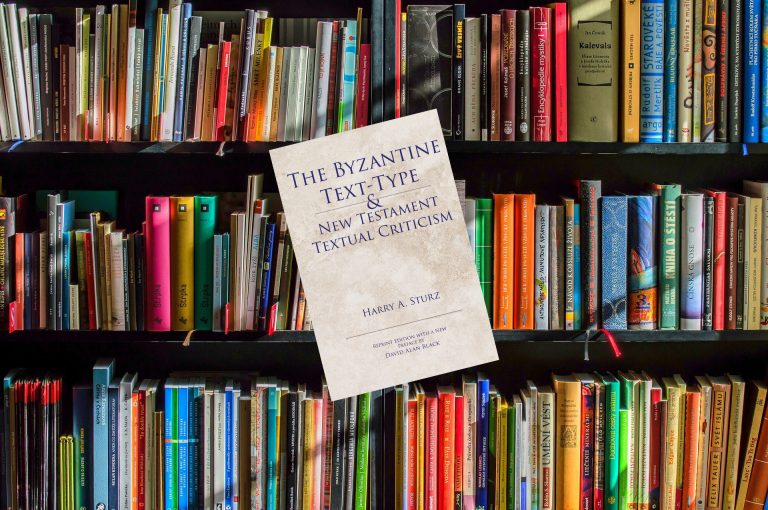
    Most people know that my views about New Testament textual criticism have been greatly influenced by my former colleague in the Greek Department at Biola University, Prof. Harry Sturz. Sturz’s 1976 dissertation (Th.D. Grace Theological Seminary) was published as The Byzantine Text-Type & New Testament Textual Criticism.

    It is masterful work. It was written by a scholar for scholars. And it’s a reminder of just how unpredictable scholarship can be at times. Just when the coaches thought they had their players set up for an off tackle thrust, someone seizes the ball and carries it on a wide sweep around end. This is precisely what happened when Harry Sturz published his book.

    In textual criticism, one enters a discipline that is as much art as it is science, so that what is all too clear to one scholar may be opaque to another. I have known some scholars who also took Harry Sturz’s textual criticism class at Biola and who, for a time, were convinced of the correctness of his views, only to leave the Sturzian fold and return to the camp of the Critical Text — much to the joy, I surmise, of the coaching staff.

    I have never changed my mind.

    Harry Sturz had no personal axe to grind. He neither hoped for nor expected any professional advantages from his work on the Byzantine text. He had been a student of E. C. Colwell when the latter was still teaching at Claremont Graduate School in Southern California. Like Colwell, Sturz always presented his views in a scholarly yet humble way. His work was not a revelation from Mount Sinai but the considered judgment of an intelligent, hardworking scholar. As one reviewer, writing in Novum Testamentum (28.3 [1986] 282-83), has put it:

    Sturz’s book is a carefully documented and painstakingly argued thesis which demonstrates that Westcott and Hort (= WH) were wrong to dismiss the validity of the Byzantine text-type as a legitimate claimant alongside the other text-types to possess the original text.

    Much to his credit, Sturz had the temerity to challenge the status quo and to take up the cudgels of the primary data in search of the truth. His views were (and still are) diametrically opposed to the conception behind the Byzantine Priority view and the Critical Text view alike. With the grim determination of a spawning salmon, he swam up the stream of scholarship. His total sincerity shows through every page of his work. His reputation at Biola was such as to compel respect and attention by all. His conclusion — that the Byzantine text is not edited or secondary in the Westcott-Hort sense — gushed forth from the fountains of his conviction.

    I consider The Byzantine Text-Type & New Testament Textual Criticism to be extremely fair with the evidence, and whenever I teach textual criticism, I always require it to be read alongside other standard works in the field. Sturz’s perspective is, I believe, essential to a correct estimation of the problem. This is all the more important in our day, which is characterized by a burgeoning ambivalence toward all things text-critical. It is the duty of every student of the New Testament to dig up the skeleton of truth, even if only a dozen people in the world care about it.

    Harry Sturz was a gentleman to his fingertips. He would never have thought of imposing his ideas upon his students, who held him in awe. He was a beaver for work despite his age. Unlike so many scholars of his day (and ours), he refused to resort to the ark of groupthink, scampering up its gang plank whenever his views were challenged.

    Harry Sturz’s The Byzantine Text-Type & New Testament Textual Criticism is a magnificent tour de force. In my opinion, it seriously weakens the arguments of both those who elevate the Byzantine text to a position of unquestioned primacy and those who seek to relegate it to the academic rubbish heap. All in all, it pulls the rug from under a great deal of what passes for scholarship today. It is a dangerous book for a young scholar to read, unless one enjoys coolheaded, impersonal logic. It is a coda to an investigative symphony, and for the symphony I am most grateful, even though it remains unfinished.

    David Alan Black
    Bradford Hall, Virginia

    NOTE: The publisher and I decided to republish Harry Sturz’s book as is, even though Sturz was painfully aware that the original edition contained numerous typos. Sturz had in fact notified the publisher of them. Unfortunately for all concerned, the book went to press before the corrections were made. I trust that our reprinting of the book as is will not prevent anyone from interacting with the subject matter.

    An important note on the release date for the book.

    Featured image by Lubos Houska from Pixabay

  • When Should You Talk about Textual Criticism?

    When Should You Talk about Textual Criticism?

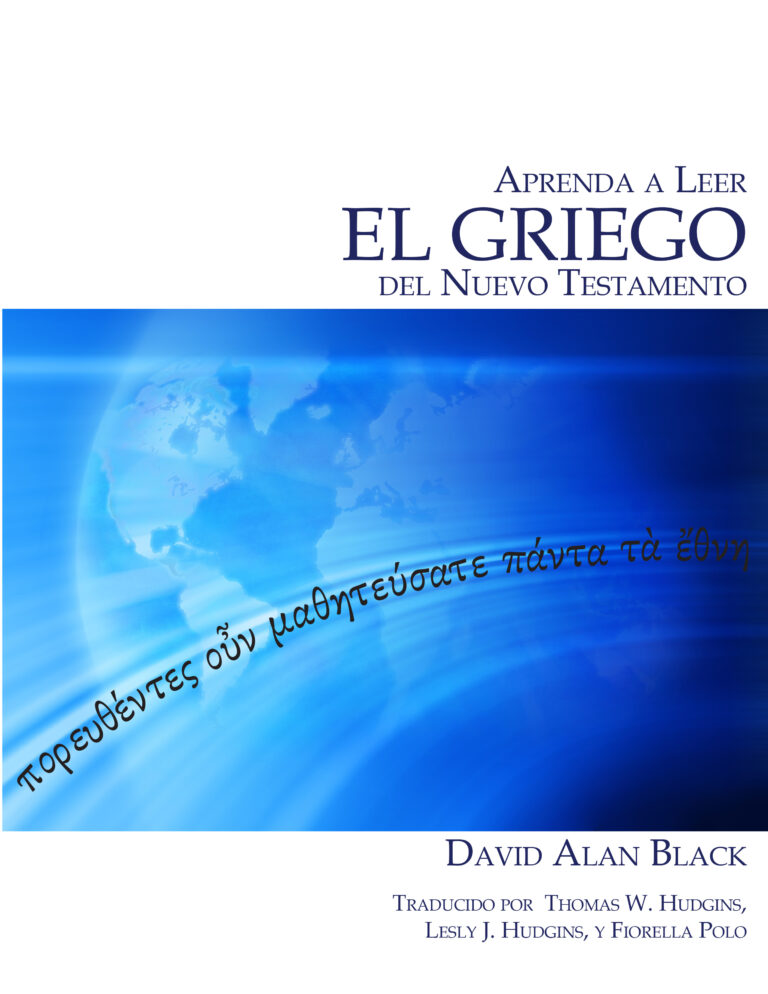
    Aprenda a Leer el Griego del Nuevo TestamentoThomas Hudgins, translator of the forthcoming book Aprenda a Leer el Griego del Nuevo Testamento by David Alan Black asks a question on his blog that I think might interest many of our authors and readers:
    When Should A Bible Teacher Talk About Text-Critical Issues? Or Should He (or She)?
    I’ve made some comments of my own at my Threads from Henry’s Web blog.

  • On the Pericope Adulterae Conference at Southeastern Baptist Theological Seminary

     
    From Dave Black Online, used by permission.
    7:45 AM Today I’m taking a much-needed break from scholarship. I’m going to spend the next few days getting the farm into shape for the haying season. My new ride mower (that was dead-on-arrival) was replaced yesterday, and I am hoping against hope that this new machine will start. The yard grass is already reaching Eden-like proportions, and I’d rather not bush-hog it if I can avoid it.
    Let me just say a word about this weekend’s Pericope of the Adulteress Conference on campus. A number of factors made it, in my opinion, a fabulous success. First, there was the high quality of scholarship represented by the five speakers.
    pa ndjriroirororThat level of expertise provided the rest of us with an enormous opportunity that is often absent when these matters are being discussed or debated. Second, the lecturers all spoke with the greatest clarity —  and charity. The buzz in the room was definitely a positive one! This is partly because the speakers all knew each other fairly well; some have collaborated on writing projects for years. Constant association with one’s colleagues cannot help but build a sense of genuine collegiality. It is partly because the speakers respected each other, and it showed. Third, it has been shown that the majority of people base their academic positions on exposure to various points of view. Hermeneutics is not so much a crisis; it is more a process. This may well be the most critical aspect of the conference: it both broadened and deepened the conversation in significant ways. Fourth, it is abundantly plain that the vast majority of people who attended left with a deep sense of satisfaction and even joy at having witnessed such cordiality and amiability. Each of our speakers is a warm, committed, unembarrassed Christian, representing different Christian traditions to be sure, but nonetheless “Christian” both in their approach to the text of the New Testament as Scripture and in their deportment.
    Without a doubt, the most interesting speaker this weekend was our own Maurice Robinson, whose status among the textual critics present has achieved, it appears, almost that of Michael the Archangel. mr fwgtwyqiuiqoioqoq
    Maurice’s perspective draws from a lifetime of experience in encountering actual manuscripts rather than from the many books on the subject. Some may find him too detailed, but this is a good fault for a textual critic! For far too many Christians, textual criticism is a meaningless ivory tower pursuit or else simply the prolegomenon to something far more important. Maurice showed us that nothing could be further from the truth. He has spent a career showing average evangelical Christians how important and relevant textual criticism is to our understanding of sacred Scripture.
    I was delighted in the extreme to see many students and “lay persons” in attendance. (The Johannine scholars seem to have stayed away in droves.) pa mbmkb,lblblb
    Just as politics is too important to leave to the politicians, so textual criticism is too important to leave to the experts. They may know more than you do, but you are the ones who will have to decide, week in and week out, whether or not you  teach or preach this disputed word or that debated passage. No, we cannot leave textual criticism to the scholars. Each church member has a job to do. And that job includes personal involvement, to some degree at least, in deciding between textual variants. I dread to think of the opportunities I constantly miss through my failure to dig deeper into the text on this level. Years ago one passage brought this home to me, and it will always stand as an example of the relevance of textual criticism for the church. In some manuscripts of Matt. 5:22 we have a Jesus who condemns all anger, while in other manuscripts we see Him forbidding only causeless (eike) anger. What a difference a little Greek adverb can make! To put it another way, our views about the legitimacy of anger for the Christian are dependent to a very great degree on our understanding of textual criticism. We have to engage in it!
    This is now the third time I’ve helped to organize a conference of this kind on campus, and I must confess to you that all along I’ve had an ulterior motive. We Christians live a good deal of our lives in splendid isolation, rarely interacting with people from differing perspectives or backgrounds. It is sort of a self-imposed monasticism. And it is dangerous. My hope for all of our conferences is that they will become bridge builders. Christians are so varied, and their starting points are so diverse, that it is always good for us to listen to each other. I’m not suggesting for a moment that it is necessary to surrender our long-cherished views or personal convictions in order to engage in dialogue. What I am saying is that none of us has a complete handle on the truth, and so we need modesty. The world is filled with harsh, pushy people who are always trying to sell us something. We are repelled by them, and rightly so. Christianity calls for much more moderation than that. At the same time, Christianity also calls for us to speak with confidence whenever we proclaim the word of God. If that is the case, it follows that we should acquire at least of modicum of facility in the art and science of New Testament textual criticism. No, we may not always know precisely what the original reading is in a place of variation. But at least we can tell our people that we have done our own homework and have made an honest effort to understand the problem for ourselves. Christianity is inescapably intellectual. Engaging in exegesis is not an optional matter for those who “like” that kind of thing. It is an integral part of what it means to be a Christian.
    Evangelical textual criticism is not the kingdom (God forbid!). But it is a tool in God’s kingdom that tries to serve and please the King. New Testament interpretation does not end with textual criticism but it begins with it. No wonder the audience over the weekend seemed so delighted and pleased to have been treated to a clear and enjoyable presentation of the major hypotheses surrounding the PA. I hope the time will come when every serous Christian will join the conversation. An excellent entrée into the discipline is Harold Greenlee’s Introduction to New Testament Criticism. My own New Testament Textual Criticism: A Concise Guide, attempts to introduce the subject in a simple and clear manner. In all this, it is important to remember that we are not trying to undermine anyone’s confidence in his or her translation of the Bible. We are simply trying to bring home to others the awesome responsibility that interpreting the Bible is. New Testament textual criticism is not an end in itself. The hope is that as we study the text of the New Testament we will go on until we find the pearl of great price as part of our search.
    My sincere thanks to all of the wonderful speakers (J. D. Punch, Jennifer Knust, Tommy Wasserman, Chris Keith, Maurice Robinson); to president Danny Akin of SEBTS for his enthusiastic support; and especially to my personal assistant, Mr. Jacob Cerone, whose tireless attention to a myriad of details — sprinkled with a massive amount of live blogging — reminds me daily of why I appreciate him so much.
    P.S. For what it’s worth, my own view is that the PA is original. The inclusion of John 7:53-8:11 is well attested externally; it is early (the Old Latin pushes the reading back into the second century); and the passage is sui generis with the rest of John’s Gospel in terms of vocabulary and style. I’m not much of a fan of internal evidence, but I would accept either the “Liturgical Omission” or the “Ecclesiastical Repression” hypothesis as an adequate explanation for the omission of the PA in some early manuscripts. So, in conclusion, I would most certainly preach/teach this passage as Scripture but let’s be honest — there is no unique “evangelical” stance one can take. The issue is a matter upon which good people (including biblical inerrantists) will continue to disagree.
    P.P.S. I agree with Dr. Robinson that the elephant in the room was the (often unexpressed) predilection for the Alexandrian text type among modern textual scholars. My friend Keith Elliott once called this the “hypnotic affect of Aleph and B.” (I honestly do not know if he continues to use that language to describe this phenomenon.) I believe it is time to lay this misconstrued concept to rest. The NA 28 is no more to be considered an authoritative text than the TR was 150 years ago. At the same time, I think Maurice’s case for Byzantine Priority is very weak. I’d love to believe it, but the evidence is just not there. I tend to lean more toward Harry Sturz’ view (The Byzantine Text Type and New Testament Textual Criticism) that the Byzantine text, because it is unedited in the Westcott and Hort sense, remains a reliable witness to the text of the New Testament but not the only one. Which is why I’ve been speaking to Henry Neufeld of Energion Publications (who is now visiting with me on the farm) about the possibility of him re-issuing Harry’s now out-of-print book.
    henry ngkgogpogpgpgpSo there you have it.
    Keep thinking, reading, discussing, and living the Gospel!
    Dave

Energion Direct
Privacy Overview

This website uses cookies so that we can provide you with the best user experience possible. Cookie information is stored in your browser and performs functions such as recognising you when you return to our website and helping our team to understand which sections of the website you find most interesting and useful.