
Author: empower

  • Living in God's Evolving Creation

    Living in God's Evolving Creation

    by Dr. Robert Cornwall

    Darwin coverSince the beginning of time human beings have been trying to explain how things came to be. Today we often turn to science for answers. The most respected answers assume some form of evolutionary development occurring over vast periods of time. Those who disagree with this assessment most often do so on the basis of religion. They deem the scientific consensus to be in conflict with their reading of the biblical story, especially that found in the first three chapters of Genesis. For a significant number of Christians Charles Darwin is the enemy. To embrace evolution is to dismiss God. There are others of us who disagree. We believe that one can hold both truths at the same time. God is Creator and science suggests that evolution is the means by which that creation unfolded.
    About a decade back I signed a public letter as a member of the clergy affirming my recognition of the scientific consensus. I have tried to have my congregations observe some form of Evolution Sunday/Weekend. In part I’ve done this because I believe that the credibility of the Christian faith requires this. That is, if we dismiss science as some kind of enemy of the faith, then we hold the gospel hostage to an earlier scientific vision.
    There’s another reason why I think it is important to try to hold in proper tension my faith in God the Creator and the scientific consensus. That concerns the way in which we live on earth. The scientific consensus tells us that the earth is experiencing significant climate change. 2015 is on target to be the warmest year on record. Each year the earth seems to be getting warmer. Polar ice caps are melting. Deserts are advancing. Weather becomes more unpredictable. It is unfortunate that many of those reject this scientific consensus are Christians. They reject it in large part because they’ve already discounted science. They’ve embraced forms of pseudo-science to explain the origins of the earth. So it’s no surprise that they are attracted to forms of pseudo-science that reject the premise that humans are contributing to climate change. Some Christians have embraced the premise that since God appears to give “Dominion” over the earth to the human creation, then we are given permission to despoil the earth. Indeed, some who embrace an apocalyptic vision of the faith believe that since we’re in the last days there’s no reason not to use up all the resources at hand. Why worry about fossil fuels? Why worry about polluting rivers and streams and the air? Why worry about changing climate or depleting ozone layer?
    That is one way of seeing things, but I’m not sure it’s faithful to science or faith. Growing numbers of people, including evangelical Christians have begun rethink our relationship to the creation. They have begun to think in terms of stewardship of resources rather than dominion over them. Science can be an important partner in this effort. It can reveal to us the way in which we misuse or overuse the creation. I’m tempted to use the word resources, but that is probably not the best way of speaking. Instead, let us think of the Creation as a gift of God. As icons/images of God we’ve been given responsibility to tend the garden. To do this we need to listen for God’s voice, which can be revealed in Scripture but also through science.
    Charles Darwin found himself at odds with God, or so he thought. He considered himself something of an agnostic and even an atheist. Yet, it is said that he went to church with his wife who was a devout Anglican. So in the spirit of that expression of solidarity, perhaps we too can worship God in the presence of Charles Darwin. We do so by taking both science and faith seriously. We express this solidarity in the way we treat God’s Creation.


  • To Whom Do We Give Allegiance?

    by Dr. Robert Cornwall

    Allwgiance coverAs a child I had a classmate who remained seated as the rest of us stood to say the “Pledge of Allegiance.” While we pledged our allegiance to the nation symbolized by the flag, thinking nothing of the religious implications of our act, my classmate, who happened to be a Jehovah’s Witness, had been taught that to stand and recite the pledge would break one of the Ten Commandments—the one about having no graven images. At the time I didn’t understand why he refused to stand and say this innocuous statement, but when I think about it now it does give me pause. While his religious community refuses to acknowledge any government besides God’s kingdom (they don’t vote or serve in the military either), most of us live with a Constantinian vision.
    Most Christians don’t see anything wrong with pledging allegiance to the symbol of our national identity. In fact, many American Christians have equated their Christianity with their national loyalty. After all, isn’t the United States a “Christian Nation”? Yes, God and Country go together! The Scouts even have a badge you can earn that celebrates this. Of course, other nations have felt the same way. In fact, they have assumed that God was on their side during serious conflicts. The German Christian movement even reconfigured the Christian faith to fit its ideology. I wonder if we do the same? Do we discount the teachings of Jesus when they come into conflict with our national aspirations?
    Symbols are important. So, if you go into many churches, including my own, you will find an American flag placed somewhere in the sanctuary. I must confess my own unease with the presence of the flag, but thus far I’ve not made an issue of it. Fortunately, our flag sits at the back of the sanctuary and not in the chancel. What I find more puzzling are the churches that choose to fly large American flags out in front of their buildings. More often than not the American flag stands above the “Christian” flag (I’ve always wondered who decided this flag, with its red cross on a blue field in the corner of an otherwise white flag, should represent Christians, or at least Protestants). It seems to me that when we make the flag such a prominent symbol, we give pride of place to nation over the realm of God. I know that my Jehovah’s Witness classmate all those years ago would find all of this befuddling.
    When we say the pledge of allegiance we are expressing our loyalty to the nation in which we hold citizenship. I really don’t have a major problem with this. I’m quite happy with my American citizenship, at least to a point. I think we can have a variety of allegiances. I am, for instance, a life-long San Francisco Giants fan. When it comes to baseball, they have my allegiance. My family has my allegiance as well. I made a covenant with Cheryl some thirty plus years ago to be her husband. But, having said that, none of these allegiances is ultimate.
    For those of us who continue to recite the Lord’s Prayer on a regular basis (my congregation continues to say this prayer each week), I believe this prayer which we believe Jesus gave us is our pledge of ultimate allegiance. With this prayer offered up to God whose name is hallowed, we ask that God’s kingdom would come and God’s will would be done “on earth as it is in heaven.” There is an expectation present in this prayer that God would be engaged in something transformative, and that we’re agreeing to be part of God’s work. Yes, when we offer this prayer, we are making a statement of loyalty to God’s vision and offering ourselves as agents of that vision. It isn’t that we will bring the realm of God into existence, but we make ourselves available to God’s realm.
    I realize that some might find this affirmation of God’s realm a bit disconcerting. They might think that I’m recommending some kind of theocracy. In a way, I am, but not in the usual way of thinking. This isn’t a divine government imposed by an earthly realm. This is instead a recognition that our ultimate loyalty belongs to God, and when loyalties conflict, and they will, we must choose the realm of God. The church is called to be an expression of that realm on earth as a reflection of God’s realm in heaven. So, no I’m not advocating making the United States a Christian nation. I’m advocating that we recognize that God’s realm is present on earth as in heaven!


  • The Unsettling Voice of Public Faith

    by Bob Cornwall

    Cover1The day that Pope Francis addressed a joint session of Congress, and through them the American people, I’m sure that some felt this was an unwelcome mixture of church and state. It is true that the Pope is a head of state (Vatican City is a recognized nation), but he wasn’t speaking as head of state. He was speaking as a religious leader who has become for many a voice of conscience in a world being torn asunder by political and religious turmoil. Critics, many of them Catholics, faulted him for taking up an issue such as climate change. He should stick to religion they said, though many of those same critics would welcome his support for their own causes. Those who lauded him for his strong stand on climate change and immigration may fault him for not going all the way the other direction.
    So, here’s my take on things. It is difficult to separate faith and public life. Faith is personal, but it is not private. That is, if faith has any bearing on our lives it will influence the way we live our lives public. It should cause us to stop and consider the way we vote, spend our money, engage in human conversation. Christianity and Judaism both affirm two great commands – love of God and love of neighbor. Jesus brings the two together, but both appear in the Hebrew Bible. The Golden Rule emerges out of this call to love one’s neighbor.
    I believe that faith has a place in the public square. I have engaged in community organizing for quite a number of years. I’ve lobbied politicians and government officials, seeking to encourage them to pursue the common good, a good that I believe is rooted in my faith. The temptation, of course, is for me to so align my social justice work with political affiliation that little daylight exists between faith and politics. What that happens, I put myself in service to political ends that might not in the end serve the common good.
    When I listened to the Pope speak and read his message to Congress, I found him to be appealing to our better angels. He spoke of his concern for the least of these – women, children, the poor, the immigrant, the refugee. He called on us as a nation to remember our own immigrant roots. He embraced his role as bridge builder and called on the nations to pursue policies that would bring peace and justice. The problem for many in America (and elsewhere) is that we want to label people. We want to impose a sense of order on them. Therefore, pundits try to cast the Pope in political terms, and therefore on a left/right axis. The problem is that he doesn’t fit. He may seem to stand with the left on many economic issues, but his support for family might resonate more with conservatives. His championing of attempts to ameliorate the challenges of climate change put him in line with the left, but he remains theologically conservative. Those who understand his demeanour will say that he places the emphasis on mercy rather than on toeing the line. That’s not liberalism; that’s simply being gracious.
    As a good preacher, Pope Francis is able to bring into the conversation sources of wisdom that lie beyond religion. In his speech he simply attempted to bring to our attention what should be our national vocation, and that is to pursue the common good. Thus, he pushed Congress to do just that:
    Each son or daughter of a given country has a mission, a personal and social responsibility. Your own responsibility as members of Congress is to enable this country, by your legislative activity, to grow as a nation. You are the face of its people, their representatives. You are called to defend and preserve the dignity of your fellow citizens in the tireless and demanding pursuit of the common good, for this is the chief aim of all politics. A political society endures when it seeks, as a vocation, to satisfy common needs by stimulating the growth of all its members, especially those in situations of greater vulnerability or risk. Legislative activity is always based on care for the people. To this you have been invited, called and convened by those who elected you.
    Most Americans want to see this nation being one of greatness. It may be aspirational or maybe it’s self-delusion. The question is, what is greatness? The Pope challenged us with these words:
    A nation can be considered great when it defends liberty as Lincoln did, when it fosters a culture which enables people to “dream” of full rights for all their brothers and sisters, as Martin Luther King sought to do; when it strives for justice and the cause of the oppressed, as Dorothy Day did by her tireless work, the fruit of a faith which becomes dialogue and sows peace in the contemplative style of Thomas Merton.
    There are some in our nation who believe that there should be no wall between church and state, and by that they usually mean that they want their version of “church” to define the “state.” In an increasingly pluralistic nation where the Protestant hegemony no longer exists and even Christianity lacks the dominance it once had, that is probably not going to happen (without imposing religion on an unwilling populace). Others would see religion completely banned from public life. Put it in the home and the religious building, but don’t bring it out in to the light. Others of us, believe that faith and public life not only can coexist, but the public square needs these voices (I put the emphasis here on voices, for there are many different faith voices). The question is, can these voices speak in a way that lifts up the common good without compromising one’s deepest values?
    Perhaps the best sign that such is possible is seen in the decision of Pope Francis to skip lunch with the nation’s power brokers (leaders of Congress) so he could have lunch with the homeless. Some commented that he seemed a lot happier in the company of the latter than the former! That may be truly unsettling!


  • Hospitality and Our Global Context

    by Chris Freet

    Hospitality coverThe following is an excerpt from the book A New Look at Hospitality as a Key to Missions      p. 3-4.
    ——————————————————
    A key issue concerning the American church and the role of hospitality involves the role of migration, immigration and refugees. Today, most nations face issues related to globalization. The world is becoming smaller and smaller. A person can be anywhere on the globe via plane in about a day. Technology enables people to communicate across the world with the click of a button. This has greatly impacted the movement of people groups. For example, M. Daniel Carroll R., in his book dealing with immigration in the West from a Christian perspective, observes, “The greater part of Christians now live outside North America and Western Europe. Some characterize this movement of Christianity’s center of gravity as the…‘globalizing’ of the faith’” (Christians at the Border, p. 60). Similarly, Andrew Walls also notes, “By 1980, the balance [of Christianity] had shifted again, southwards; Africa is now the continent most notable for those that profess and call themselves Christians.” (The Missionary Movement in Christian History, p. 6) This shift brings with it contemporary issues which the Western Church will have to work through. Not least of these issues involves the role of hospitality and the American church’s place in welcoming others from around the globe.
    Awareness of this southward shift is present and still growing in the West. The landscape has changed but continues to evolve. What role will the West take in this as a result? One point is clear: The American church can either embrace the shift or deny it. If the latter is chosen then the American church could potentially miss out on a great spiritual opportunity—perhaps even spiritual renewal. If “pride-of-place” is maintained by the American church, thus fighting against or ignoring the global shift within Christianity and all the potential benefits and opportunities for growth, then stagnation or even further decline among some segments of American Christianity seems possible. As Ogletree warns, “Ethnocentricity is egoism in cultural mode” (Hospitality to the Stranger, p. 49). Further, Carroll reminds us that a surprising number of immigrants, migrants and refugees are Christians (Christians at the Border, pp. 60–61). This information is potentially vital for the American church which currently finds itself in the midst of figuring out where to land in issues related to immigration. Indeed, many scholars, including Soong-Chan Rah, hold strongly to the conviction that “immigrants and ethnic minorities are saving American Christianity” (The Next Evangelicalism, p. 74). To fail to pay any attention to this reality in America could possibly mean to miss out on the work of God in this nation.”
    Have you seen or heard of any local churches welcoming and ministering to diaspora people groups? How has your local church welcomed the stranger or foreigner? How might God want to use diaspora people groups to breathe new life in the Western church?


  • Hospitality and the Western Culture

    by Chris Freet

    Hospitality coverOver the last five to ten years or so there appears to be an upsurge in the focus upon hospitality within the Western church culture. Whether it is in the form of books (of which there seem to be many), lectures, or seminary/college courses, hospitality is experiencing a renewed interest for which I am personally grateful. In my last post I mentioned that in the pages of scripture, especially the New Testament, hospitality seems to be a defining characteristic of the church. While this renewed focus on hospitality is very welcome, I think any blind application of it could meet with frustration unless we first examine briefly our Western culture.
    Throughout the Majority World hospitality seems to be more natural or at more ingrained and a regular part of the lifestyles and cultures. Within our Western culture there are certain mindsets, world views, or manners of thought which need to be at least noticed if the Western church desires to embrace the Christ-like characteristic of hospitality. Our Western emphasis upon individualism is one that is usually referenced in many sources as something that works against hospitality. But what other mindsets might we hold onto without realizing it that may work against the practice of hospitality? In my book A New Look at Hospitality as a Key to Missions I mention individualism along with other possibilities. Here are just a few:
    Time and Hospitality
    While on a visit to Kenya in 2012, our hosts jokingly commented that most Westerners are captive to “the power of the watch.” We can see this in such phrases as “Time is money.” We like things to be neat and orderly. If we can’t schedule it then it most likely stirs up feelings of chaos, disorder and even confusion. The practice of hospitality may involve messiness and unpredictability. After all, we are talking about an encounter with a stranger who bears the image of Christ.
    Order, Control and Hospitality
    Similarly related to the issue of time is order and control. Hospitality, according to biblical record, appears to have an element of surprise. Whether it is the example of Abraham or Lot (Genesis 18, 19) welcoming the strangers in a moment of surprise, or New Testament believers welcoming missionaries and seeing them on their way (3 John 8; Hebrews 13:2), surprise seems to be the norm. However, within our Western culture we value control and order. We plan everything and as a result, we don’t seem to do well with surprise. We need to clean the house first, after all.
    Can you think of any other Western mindsets or thoughts that could work against the practice of hospitality? How have you shown hospitality to a stranger?


  • Hospitality as a Hallmark of Christianity

    by Chris Freet

    Hospitality coverIs hospitality something that has, in a sense, been co-opted in the West? Perhaps a quick Google search could shed some light on this for us. The result of this search brings up websites pertaining to restaurant and hotel management topics and issues. It would indeed seem that hospitality in the West has become an industry focused upon making a profit. When compared with the teachings of Christian scripture it would seem that there is a divide between biblical hospitality and what is passed off as hospitality within our Western culture today.
    Defining Hospitality
    A simple definition of hospitality is “welcoming the stranger/other.” Our cultural understanding of hospitality seems to thrive on welcoming the stranger, but for a small (or not so small) fee. The Western business model of hospitality appears to view the stranger/other as a commodity or a “consumer” rather than a blessing or an opportunity to build bridges with someone who may be different in some way. I understand that our culture is not equated with the Church, so I want to be careful not to equate the two. However, has the Church in the West been effected by this business approach to hospitality? I think if we take an honest look at ourselves we could say “yes, we have.”
    God as Host
    I think (and I argue in my book) that hospitality is rooted in the very nature of God himself. Within the creation account according to Genesis chapters 1 and 2, we witness what I call God’s “great invitation” to humanity. The Garden belongs to God; it is his “home” into which he invites humanity. In this great invitation, humanity finds identity, purpose and life. These elements reside at the core of the practice of hospitality. Whenever a stranger is welcomed in, a space is created in which these elements begin to work, thus changing both guest and host in profound ways. In light of this, the fall of humanity recorded in Genesis 3 can be viewed as humanity rebelling against God’s hospitality. The result of this is a closed door, a significant picture within the realm of hospitality.
    Hospitality and the Church
    In the pages of the New Testament we see that hospitality is mentioned numerous times (cf. Acts 28:7; Romans 12:13; 1 Timothy 3:2; 5:10; Titus 1:8; Hebrews 13:2; 1 Peter 4:9; 3 John 8). Within each context the focus is on the practice of hospitality within the life of the Church. Hospitality is to be a hallmark of the Christian faith. In part, it is tied to the reality and it is a reminder that we, too, are strangers in this place so the church needs to welcome the stranger/other. The church is to show hospitality to (1) other believers and (2) those outside the Church. As followers of the God who has shown hospitality to us, especially in Jesus Christ, we are to be a people that imitate God by showing hospitality to those around us.
    In what ways have you, your family, or your Church family experienced or practiced hospitality?


  • REFLECTING ON THE VISIT OF POPE FRANCIS

    REFLECTING ON THE VISIT OF POPE FRANCIS

    by Rev. Dr. Robert R. LaRochelle

    X:/Energion Publications/Bob LaRochelle/9781938434013-cov.slaNow that a few weeks have passed since the whirlwind visit of Pope Francis to the United States, I think it would be worthwhile to pause and explore some of its significance. However, I have to begin with a disclaimer. For the first forty five years of my life, I was a Roman Catholic. I was active in the Catholic Church and spent nine years as an ordained clergyman within it. The heart of the struggles that led me to leave Catholicism had to do with the issue of authority in the church. When you talk authority in the Catholic Church, the Pope is a pretty significant figure. If you want to look at this struggle in more detail and examine some of these ‘authority’ matters in more depth, you may want to check out my book entitled Crossing the Street (Energion, 2012). In this book, I look at the issue of authority in the church by including my own personal journey as a way of explaining it.
    So, the bottom line regarding the Papal visit for me is that it was most certainly of high interest! It seems to me that this interest was shared by many in this country for a variety of reasons. I am optimistic enough to believe that deep within the human person there lies a longing for that which we would call spiritual, and Francis, because of the way he comports himself, strikes people as one who has some depth and whose priorities are in the right place. I am not the first to say that the timing of his visit in the heart of a nasty political campaign was quite the stark contrast. I want to believe that most Americans know that there is a qualitative problem with our political discourse and that Francis was here to talk about those things in life that REALLY matter.
    Upon further reflection, I also considered a few things I think important enough to share with you:

    1. The Pope is uniquely positioned to make an impact as a well known religious leader. No other religious group has a leader who commands the attention the Pope receives. I say this objectively. I am not contending this is good or bad theology. It simply IS a fact!
    2. With the long standing dissent and the real pain that has been experienced within the Catholic community, how this particular Pope presents himself represents a certain degree of hopefulness within the Catholic Church, something that has been missing for a while. Even if church doctrines are not going to change, there is a different tone ( dubbed the ‘ Francis effect’) which has already made a difference in local Catholic churches.

    The great political leader, former House Speaker Tip O’ Neill, said something once that has become rather famous. O’Neill noted about politics that ‘all politics is local.’ I would contend that, in a very real sense, such is the case with the church: Catholic, Protestant or Orthodox alike. The local parish or congregation is the body which most people associate as ‘church’. A highly charismatic Pope may increase peoples’ interest in things spiritual, but, ultimately, it is in smaller groups, i.e. local churches, where people have concrete opportunities to learn, worship and serve. Sadly, it is the church on the local level, and the leaders of the church, who have let too many people down, people searching for meaning and depth from their religious faith.
    No large scale visit will render the necessary effects unless that visit has somehow inspired people to build communities of faith that are inspirational to others. These are communities where worship really strikes an internal chord, where preaching speaks to both our minds and hearts, and where people are clearly DOING FOR OTHERS!
    Thus, for me, the bottom line is this: It was a great visit. It really was. Now where does the Christian church, and I don’t just mean Roman Catholic, go from here?
    I would invite your comments…


  • Grace Beyond Belief: A Meditation on Galatians

    Grace Beyond Belief: A Meditation on Galatians

    by Bruce Epperly

    Galatians coverAs a child growing up in a Baptist church in the Salinas Valley, California, I remember altar calls in which the congregation sang:

    Just as I am – without one plea,
    But that Thy blood was shed for me,
    And that Thou bidst me come to Thee,
    -O Lamb of God, I come!

    Child and adult alike were challenged to place their lives in God’s hands. Regardless of the past, they could become a new creation. Sin, guilt, shame, fear, no longer had power. We no longer saw ourselves through human eyes or self-judgment or the judgment of others, but through God’s eyes, saved by grace, welcomed home, forgiven, and restored.
    Galatians has been called the magna carta of Christian freedom. In Paul’s Letter to the Galatians, the “radical Paul,” as Marcus Borg and John Dominic Crossan assert, lets loose in a hymn to grace that overcomes all alienation between God and humankind and humans and each other. In Galatians, Paul describes a grace that accepts sinners like himself and gives them a new identity and purpose in life. We can’t earn this grace, claim this grace, or assume this grace. We can’t build walls around it or exclude anyone from it. It is God’s to give and in Christ, Jew and Gentile, slave and free, male and female are one.
    Following Jesus is not about rules, even the well-intended traditions of Judaism or any other religious tradition; it is about a relationship with a living God, who loved us into life and receives us in love at the end of our days. Grace is audacious and contagious. It shows up where we least expect it and makes a way where there is no way. It is the mercy and healing touch of a power greater than ourselves that liberates us to love and frees us from the shackles of shame, guilt, and self-justification.
    Many have tried to make grace another rule or work. They connect receiving grace with making a public proclamation or confession of faith. They assume that apart from an altar call, sacrament, or testimony, grace eludes us. But, making a particular emotion or belief a requirement makes grace just one more human effort, another bar we must jump over to be loved by God or others. Grace is simply not grace if there are conditions. God is not like the spouse or partner who says “I will love you if…” Nor does God love us “in spite of ourselves.” I certainly don’t love my grandchild in spite of themselves, but because of who they are, bone of my bone and flesh of my flesh.
    For several weeks, a group of congregants and I studied Galatians at our midweek Bible Study at South Congregational Church in Centerville, Massachusetts. The fruit of that study was Galatians: A Participatory Study Guide. We wrestled with grace and with Paul’s affirmation that regardless of ethnicity and prior religious commitments every follower of Jesus has a place at the table. There are no second-class Christians, nor absolute rules that dictate entrance into the faith. Broken yet accepted, there is room at God’s table for Rowan County, Kentucky clerk, Kim Davis and gay and lesbian persons seeking marriage licenses. In God’s realm, there is neither gay or straight, citizen or immigrant, faithful or seeker. Even doubters are welcome at God’s banquet table. We all belong as God’s beloved. We just don’t know it yet! As one of my teachers, Ernie Campbell asserted, “There are only two kinds of people in the world: those who are in God’s hands and know it and those who are in God’s hands and don’t.”
    I invite you to take time reading Galatians, and discover that you can become a new creation. Perhaps you are already and just don’t know it. Let me close with words that have sustained me over the years. In his sermon “You are Accepted,” Paul Tillich describes moments of grace that emerge in the darkest valley when we are unsure of ourselves and the future, and discover a grace that opens the door to new life and hope. Unexpected, this grace changes everything. Let me conclude with these words of grace:

    Sometimes at that moment a wave of light breaks into our darkness, and it is as though a voice were saying: “You are accepted. You are accepted, accepted by that which is greater than you, and the name of which you do not know. Do not ask for the name now; perhaps you will find it later. Do not try to do anything now; perhaps later you will do much. Do not seek for anything; do not perform anything; do not intend anything. Simply accept the fact that you are accepted!” If that happens to us, we experience grace. After such an experience we may not be better than before, and we may not believe more than before. But everything is transformed. In that moment, grace conquers sin, and reconciliation bridges the gulf of estrangement. And nothing is demanded of this experience, no religious or moral or intellectual presupposition, nothing but acceptance.


    Order Galatians: A Participatory Study Guide here: https://energiondirect.info/study-guides/galatians
  • Process Theology: Theology for Progressive Christians

    by Bruce Epperly

    When you mention process theology, often peoples’ eyes glaze over. As one person noted in a Facebook comment, “I’ve read a little Whitehead, and couldn’t really grasp the language.” A pastor I know preaches a yearly process theology sermon. The congregants comment to the pastor as they shake hands at the end of the service, “That was really a heavy sermon, pastor. You really gave us something to think about.” But, out in the parking lot, I’ve been told, they shake their heads and note, “I really didn’t understand a word he said….What was his point?”
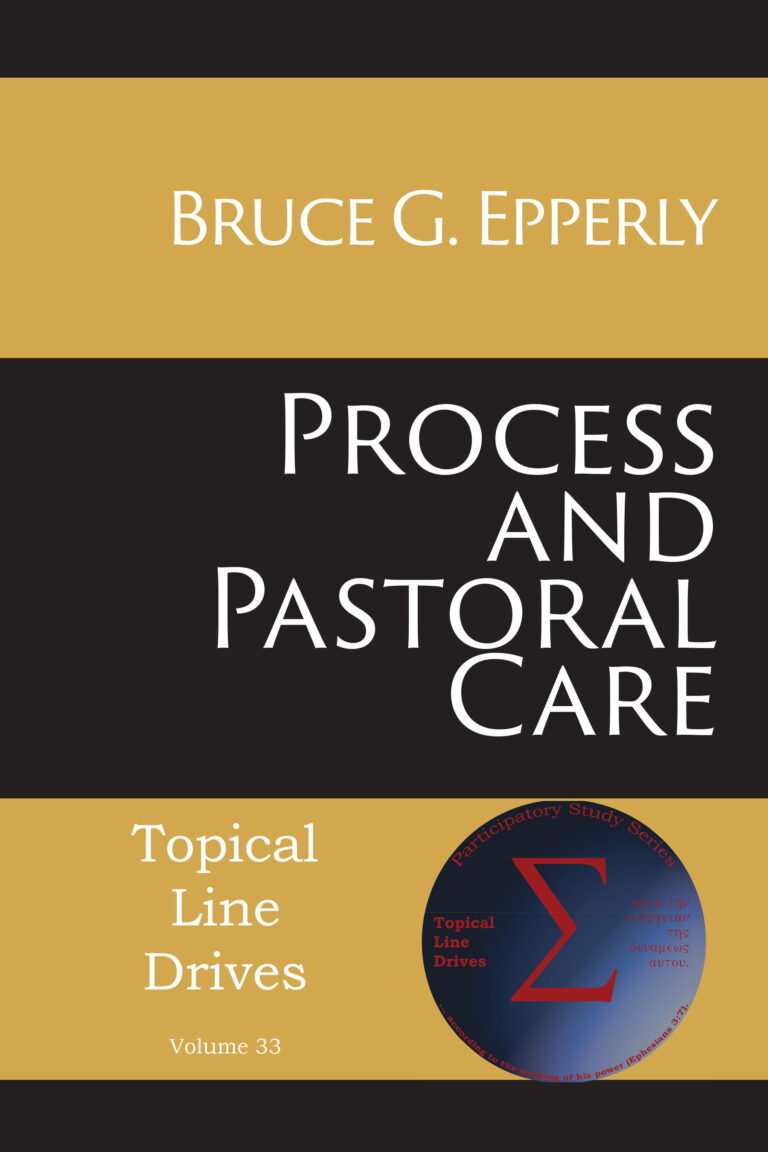
    The language of process theology and philosophy is unique and often difficult, and off-putting to the layperson and educated pastor. That’s one of the reasons I took up the challenge of writing a 40 page introduction, Process Theology: Embracing Adventure with God, as part of Energion’s “Topical Line Drives” Series. I had written a longer introduction, Process Theology: A Guide for the Perplexed, but I wanted something that a layperson could pick up, read for a couple hours, and get the heart of process theology.
    I believe that process theology is too important to be left to the academics. I believe that progressive and mainstream Christians need accessible theologies that illuminate what it means to be a Christian in today’s pluralistic, postmodern, and rapidly change time. We need theologies that can inspire world loyalty, care for the earth, hospitality, and congregational vitality.
    I have been living and breathing process theology for over forty years, first as an undergraduate and graduate student, and then as a professor and working pastor and university chaplain. I believe that process thought can be translated in ways that inspire personal and congregational transformation and address the questions of those for whom paternalistic, rule-oriented, and hell-fire and brimstone images of God no longer work. Process theology can speak to church people, providing new horizons for understanding God, and also to the growing “spiritual but not religious” community.
    Progressive in spirit, process theology can be described by a number of life-changing affirmations:

    • The world is a dynamic, forward moving process.
    • Reality is relational. All things are interdependent.
    • Experience is universal, though variable, and extends beyond humankind.
    • The universality of experience leads to the recognition that every creature is inherently valuable and deserves moral consideration.
    • Freedom and creativity are essential to reality.
    • God is the primary example of the dynamic, process-relational nature of reality.  
    • The future is open-ended and we have a role in shaping the future, for good or ill. God is not aloof from history, but is acting within history, shaping and being shaped by history.

    The concept of God is the most challenging of process theology’s contributions to Christian theology. Here again, let me share some affirmations about God’s relationship with the world:

    • God’s power is relational, not domineering or unilateral. God works within the world, shaping the world, and God acts in relationship to the freedom of God’s creatures.
    • God aims at a world with maximal freedom and creativity, congruent with the well-being of both individuals and communities.
    • God is truly changed by what happens in the world. While God influences us, we also influence God. God truly hears our prayers and responds to them with possibilities and energies.
    • God is adventurous, constantly doing new things, and urging us to be creative. Following God means honoring innovation as much as tradition. God is still speaking and God’s inspiration is at work in ethical advances involving persons of color, gay and lesbian persons, economic justice, and the care for the earth.
    • God’s inspiration and love embraces all creation. Revelation is found in scripture and also in the world’s many faith traditions. Faithfulness to God involves embracing God’s wisdom and healing wherever it is found.

    Process theology gives us the vision of a faithful, intimate, lively, adventurous, and loving God, for whom this world truly matters. It pushes us beyond old orthodoxies and unbending rules to live adventurously, exploring new ways of life, and prizing relationship over rule.


  • Liberty vs Law

    Liberty vs Law

    by Elgin Hushbeck

    Democracy coverA recent Global Christian Perspectives focused on the subject of rights and during the discussion the claim was made that liberty is not a biblical concept (@ 35:45). Personally I found this to be surprising. I believe liberty, and the nearly synonymous freedom, goes to the very heart of the Bible’s message. God created us with the ability, not just to react, but to make choices, the most important of which is whether or not we choose to love and serve him.
    Then there is the verse that on the Liberty Bell: Leviticus 25:10 “Set aside and consecrate the fiftieth year to declare liberty throughout the land for all of its inhabitants. It is to be a jubilee for you.” Why bother declaring liberty throughout the land if liberty was not important?
    In the New Testament Paul writes in Galatians 5:23 “For you, brothers, were called to freedom. Only do not turn your freedom into an opportunity to gratify your flesh, but through love make it your habit to serve one another.” 2 Cor 3:17 says “Now the Lord is the Spirit, and where the Lord’s Spirit is, there is freedom.”
    The defining event of the Old Testament is the Exodus, where God brought his people out of slavery, and in fact a state of slavery is pretty much the opposite of liberty. The defining event of the New Testament is the death, burial and resurrection of Jesus by which we are set free from the bondage of sin (Romans 6:7), and brought into the liberty spoken of in the verses above.
    Now perhaps some will counter with Roman 6:18 “And since you have been freed from sin, you have become slaves of righteousness.” This is true. The freedom we have in Christ is not a freedom to do whatever we want. As Paul says “Should we go on sinning because we are not under Law but under grace? Of course not!” (Romans 6:15).
    But it would seem that many are uncomfortable with liberty. If people are free to make choices, they might make choices that we disagree with. They might choose to do something other than what we think they should.
    The history of both Judaism and the Church is full of those who have sought to create a whole range of new rules to limit people’s freedoms. Thus, over the years Judaism, surrounded the 613 laws of the OT with thousands of additional laws. Christians down through the ages have also had a tendency to add new rules that Christians should follow such as prohibitions on drinking, smoking and dancing.
    This problem of seeking to limit freedom has afflicted both the right and the left. But in recent years those on the left have begun to push a new form of legalism. Not only do they seek to add a series of religious rules and regulations that we should follow as Christians, now they want to put the power of the government behind their rules and force everyone to follow their new legalism under threat of violence. If any should object to the phrase “threat of violence” here, they are neglecting that this is what government does. If you do not believe this, just say no to the government and see what happens should you resist.
    For me, this is a real problem. Galatians 5:1 says “The Messiah has set us free so that we may enjoy the benefits of freedom.” Liberalism seeks to put us again under a yoke of a law of their making. They justify this claiming that they are only seeking to legislate biblical principles, such as helping the poor, or that the Bible demands 100% of our money and that justifies a high rate of taxation.
    Yet I would argue that there is a significant difference between voluntarily choosing to give to the poor because you seek to follow the teaching of our Lord on the one hand and having the state automatically take money out of my paycheck that I do not see, so they can spend it on programs I am unaware of to help people I do not know.
    The studies on giving and happiness are clear. There is a reason conservative tend to give more of their time and money to charity than liberals. In addition they are as a general rule happier. As Christians do we have an obligation to help the poor? Of course we do. But the fact that we, as followers of Jesus, have an obligation does not mean that we should make this a function of the state, funded by taxes, which at least in the United States are paid by an ever decreasing number of the people. In the United States, for example, for the bottom 40% of those filing income tax returns, the income “tax” is actually a source of income rather than something they pay, as they get more money back in refunds and credits than they actually paid in.
    Then there is the problem that the government makes what would have been a gift of charity and an expression of the love of Christ working through us, into an entitlement that is demanded. These entitlements often build a dependence that is itself a new form of bondage.
    As such I do not believe that our obligations as Christians should be transformed into mandates from the state. To do so makes a mockery of the liberty that God has given us and is often detrimental to all involved.


Energion Direct
Privacy Overview

This website uses cookies so that we can provide you with the best user experience possible. Cookie information is stored in your browser and performs functions such as recognising you when you return to our website and helping our team to understand which sections of the website you find most interesting and useful.