Blog

  • Video Interview: Dr. Thomas Hudgins on Who Was Paul?

    Henry Neufeld, Energion Owner/Editor
    Last night I had the privilege of interviewing Dr. Thomas Hudgins on the question, “Who was Paul?” Thomas has a different perspective from the previous authors I interviewed, which you’ll discover in the interview. I’d particularly call your attention to the answer starting at 29:03 regarding what Paul might say to the church in America today, and 33:30 regarding the use of Hebrews as a source for Paul.
    This is the fourth interview, and all four done so far can be found on my Resources for Studying Paul page. I have also been referencing these interviews in my Thursday night series regarding perspectives on Paul. Previous interviews were with Dr. Bruce Epperly, Dr. Herold Weiss, and Dr. Bob Cornwall.
    Here’s the interview with Thomas. You can read a written form of the responses (not a transcript) here.

    I’d also like to add here a link to The Authorship of Hebrews: The Case for Paul, by Dr. David Alan Black, which is referenced in the interview.


    (Featured image credit: Openclipart.org.)

  • Gathering of the Eternal Five: A Pious Woman Named Bernice

    Gathering of the Eternal Five: A Pious Woman Named Bernice

    Chapter 4: A Pious Woman Named Bernice

    Spellbound with so much history and local facts Onofrio listened intently to his private mentors. Searching for something intelligent to contribute and knowing his offerings would be miniscule, he settled back to continue his journey into knowledge. But, not before he asked his learned companions, “What more has been said about the woman Bernice? Serou was recipient to many news items in his capacity; the story of Bernice had reached his attention. “Son, you should know this first. The Greeks have been translating the history of our world since the conquest of Alexander the great. Of the three languages in constant use Bernice will most likely be given a Latin name in the future. It’s reasonable to guess it may even be Veronica. Since the Greeks are known to favor the truth regarding what they write. Vera is their word for “truth” and “icona” means image. My guess is they will call her “Veronica of the veil”. Even though Bernice is a respectable Jewish woman, historians will not give her a Hebrew name. Think back to the inscription on a rude plaque over the head of Jesus at the cross. It read “Jesus of Nazareth, king of the Jews.” It was written in Aramaic, Latin and Greek. Based on that, I believe history will call Bernice by her Greek name, Veronica. “The bearer of the truth.”

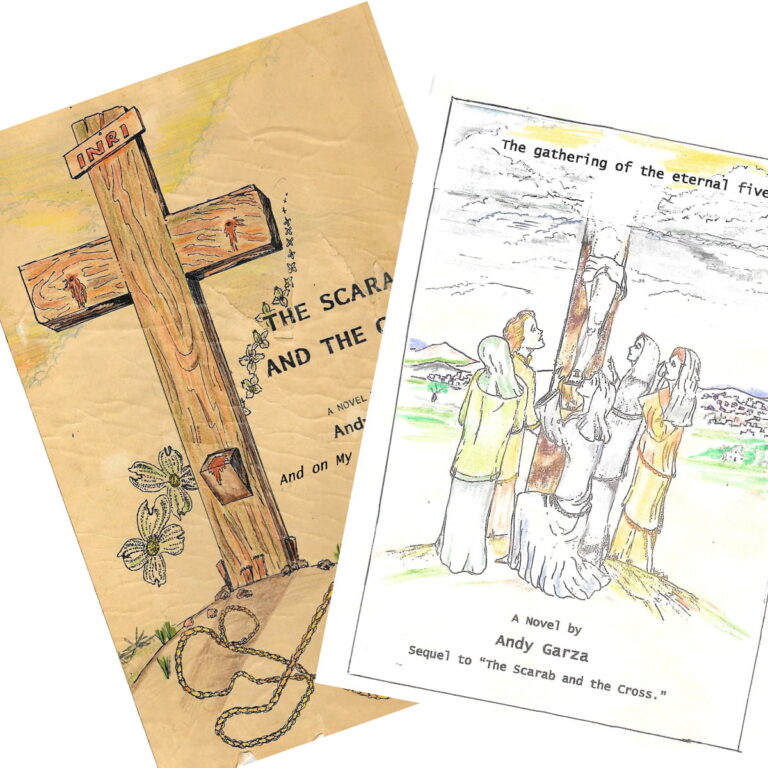
    Don’t forget The Scarab and the Cross, also by Andy Garza, on sale through March 31 for just $13.99. Follow the link for information on purchasing, including links to ebooks.

    Bernice (Veronica) suffered from an unexplained blood issue for twelve years and went to consult Jesus. According to the story she was healed of her malady the very same day. That made her an instant believer with no qualms. She repeated her story to all that would listen. It was rumored that she was at the beheading of John, the Baptizer. How she fit into those high ranking guests, I do not know. That story would make her a witness to the sorrows that plague young Salome. The horror of seeing the head of John on a platter then passed around for all to see put a tamper on the evening’s festivities. Friend, foe or critic of John’s accusations found reason to be elsewhere. Bernice may have been a front row witness to all that. Her pious ways would urge her to be home instead of such a place. After seeing all that and knowing that Jesus and John were related, her reverence for Jesus may have amplified. Should that be the case, imagine her agony to see Jesus in torment on his way to Golgotha. The weight of the cross and the crude surfaces adding grief to His painful journey.” Serou stopped his story to look at his adopted son. “Onofrio, may I go on. Can you stand to hear of that ordeal once more?”  Glassy eyed Onofrio looked at him and crimped his lips. “Yes, it’s become easier over time. And I want to hear how Bernice fits into His final journey. I was there but cannot remember ever knowing who she was.”

    Many of the Jews read the sign, for the
    Place where Jesus was crucified was near
    The city, and the sign was written in
    Aramaic, Latin and Greek.

    John 19:20 NIV

    “Bernice is the woman that struggled past the guards and used the mantle from her head to wipe His face of sweat and blood. She is a kind and gentle local woman with no malice in her heart. She was severely torn to see this kind and gentle man so brutally penalized. So deep was her torment that she felt the pains Iesus suffered herself. Once His face was cleansed to a reasonable degree she was forced from His side but not before Iesus thanked her.


    Just then a woman who had been subject to bleeding for 12 years came up behind him and touched the edge of His cloak. 21. She said to herself, “If I only touch his cloak, I will be healed!” 22. Jesus turned and saw her. “Take heart daughter,” He said “Your faith has healed you.” And the woman was healed at that moment.

    Matthew 9: 20-22

    Then Serou placed a gentle hand on his adopted son’s shoulder and added with cautious wording. “Son, what I tell you next is to help console your heart. I know you still suffer from your day at Golgotha. This is for you to carry in your heart. Salome the dancer is said to have become intrigued with all the talk of stone castles in the sky, eternal life and the healing power of Jesus. She knew Jesus and John the Baptizer were cousins and she risked going to Golgotha. She feared hell fire and damnation from the heavenly father of Jesus. In disguise she was at His crucifixion. She was still hounded by the eyes of John looking at her in eternal condemnation. She wanted to sleep in peace and could not do so. In the depths of her grief and close to witnessing a second murder, she begged Jesus to forgive her for her part in His cousin’s beheading. The furious rains came down and Salome with her companions were forced from the scene. Only Salome went untouched by the downpour and saw the blood stains on her forearms and chest disappear in the midst of that hellacious storm. She was forgiven for her actions with the same words that forgave you, for building the cross.

    “Forgive them father, for they know not what they do.”

    Only a stone heart would not want to be held in loving arms at that moment. Onofrio was not a stone heart. No words were exchanged in that loving and peaceful embrace. None were necessary. Onofrio had learned to accept his pardon and grew ever more curious about Jesus and the things that happened around him. It was Onofrio’s turn to pour the wine and asked for what happened to Bernice after the crucifixion?

    “Bernice went home in arduous lament with the mantle over her head as her only protection in that awful storm. Finally safe, she took it off and almost suffered a heart attack to see a portrait of her healer’s face emblazoned on her mantle. She fell to the floor in awe as well as fear. How could it be? The portrait of Jesus complete with blood trickling down his face and thorn wounds dug into his flesh.

    But, there it was. A miracle appearance by the healer from Nazareth. A man of destiny, a man on a mission not yet fulfilled.

    The cloth she used was common among housewives and often called a sudarium in Latin. It means a “sweat cloth.” The humble cloth with the face of Jesus vividly imprinted will no doubt become an object of envy and plots to obtain. The Hebrew council will go far to discredit the image as a hoax. They have yet to accept the workings of their God. If I were God, I would quit trying so hard. Some knowledgeable people examined the cloth and have not come up with a conclusive answer. Other than to say that the image is definitely not a painting and the image shows up in the color red. More mystifying is the fact that the image seems to disappear into the fabric under various positions. Some seem to think that it is affected by light. Held to the light, the image comes forth and fades when in darkness. Jesus may be relaying a message through that mysterious veil. “Come unto me in the light for I am the way and away from me remain in the dark.” I cannot say for sure, but it’s possible. Close associates of Bernice felt healing power from the cloth and now people are calling it a veil. A sweat rag is hardly a veil. However, the imprint of Jesus’ face makes it the finest piece of fabric in the known world.” The Egyptian had listened well to his paid messenger. Having seen the works of various Gods in his youth as well as his mature years, Serou was an open door to the magic of his most recent Godly guest. Iesus, son of IamthatIam. Yehovah. Thinking deeper, Serou reached another point of vital interest. Isis had been totally helpless against the works of Yehovah in Egypt. The plagues, the death of Egypt’s first born, the insect infestations and the parting of the Red Sea were marveled even by the powerful Goddess Isis and held the works in reverence with head bowed. Perhaps it was time for Serou, the Egyptian to reinvest his faith.

    A few days passed and the hunger to hear his learned scholars speak urged Onofrio to seek them out and re-gather their knowledge in Tremiyo’s back yard. Pleasant warmth rode on the desert breeze causing overhead branches to gently sigh and sway. No clouds sashayed across the sky. Only a mantle of pale blue announced the makings of a flawless day. The usual birds flew, fluttered and flitted around the patio while baby Horacio played with a wooden horse Onofrio carved. It was the Sabbath and most people were spared the task of going to work. A day of rest and meditation.  A day to praise individual Gods for the generosity of their gifts. Onofrio was no exception.

    Although Serou’s wife, the lady Clavenia had called on the young man for various errands and minor tasks she remained reserved not to ask too much of her adopted son. She had developed into a refined lady with impeccable manners and a beauty rare among women. Her skin was a flawless sheath of glowing mellow tan. She had eyes the color of muted chocolate with flashes of light when she made sudden turns. Posture and stride were reflections of unpretentious grace. She liked being in the company of Onofrio but would delay their time together as much as possible. She would never betray her husband but she had an inherited right to fantasize. It’s possible she harbored a secret jealousy of Senobia and her time with Onofrio. She nonetheless felt obligated to contribute to Onofrio’s ongoing education conducted by her husband and Tremiyo. Serou was at a distant location and would be gone a few days. Tremiyo gathered his wife, Camia, Senobia and the children then went into the city for a prayer meeting and some needed items in Tremiyo’s vast kitchens. The lady Clavenia summoned Onofrio to her presence by way of a faithful servant. A sumptuous array of edibles and wine rested on a large low level table along with finger bowls and fresh linen towels. Serou’s two young daughters were in a music class in the distant corner of the vast banquet hall. Special people roamed around cleaning, sweeping, wiping and generally just going through the motions of working. Re-arranging the furniture was ignored today. Their interest was divided between the handsome young man dressed in white with touches of gold and the girls plunking off key notes on their string instruments. One of the girls was practicing her vocal notes that sounded more like crickets chirping in the night.

    Clavenia was first to speak, “My husband tells me how interested you were in our local history and I thought I could contribute to your store of knowledge. It is often said that women understand the plight of their fellow women far better than the most learned man. You were at the crucifixion and suffered much for your part in that. In your state of mind, you may have missed some vital instances. I have all the respect in the world for your ordeal. I could not endure what you went through. But, your quest for knowledge must fill in all the gaps, that you may have a fuller picture. My husband said you called Yerushalayim (Jerusalem in Hebrew) a cradle of miracles. Son, that is only partially true. The miracles we see are the workings of Gods that we mere humans cannot understand. Take heed and beware where you place your faith and dedication. Jupiter, the God of Rome is considered a heavenly father by name. Numerous Gods have found earth women attractive and have sired children through them. Our history is filled with such stories. Therefore the Romans are making a serious effort to achieve two goals. Unite all people in Judea under their God or Gods  and second bring peace and prosperity to the region without bloodshed. Son, the Greeks are advancing to the same goal from an opposite direction. The Greek God Zeus is closer to being connected to our local son of god, Iesus. Listen carefully when they’re saying “hail Zeus”. It sounds close to saying hay-sus, the birth name of the Nazarene. The people hunger for a god to bring an answer to all their problems free of charge. Iesus came close to answering that wish with his miracle cures. His being conceived by the Holy Spirit and Mary is much talked about. But the young girl within Mary is cast aside by people anxious to pass out unpleasant labels. My heavens son, she was only fourteen years old. Brought up in the bowels of sanctity and devotion to the God the Hebrews worship. The child was pushed into obedience to the temple rules at the age of three. She never had the opportunity to take the knowledge she gained, sort it out and decide what she wanted to believe and what to reject. The child never had a will or her own.  That an angel named Gabriel came to her is well known. Such an apparition can scare a grown person into docile submission. Moses is said to have groveled on the ground in the presence of his God. Can you not see how intimidated the child Mary could be? She was scared out of her wits. Hardened Romans were rendered like dead men in the presence of the angel that came to collect the corpse of Iesus. The Gods have much business to conduct in Judea. Add a miracle to the list of the obvious. The Gods have chosen Judea for their battle ground. Mary the virgin is a key in the ongoing struggle for supremacy. Mortals may condemn and call her unfavorable names. Stone hearts make mockery of the Immaculate Conception but the Gods will give her an honorable place in their domain. The Holy spirits visit to her was like a sun beam passing through a drop of clear water. Seemingly disturbing nothing, yet leaving a seed of life to develop in warmth and protection. Only a God could leave young Mary’s virginity intact. And, don’t forget that while on earth she was a child bride with no say in her own destiny. I am proud and happy to see you frolic with your son, Horacio. Can you fathom the depth of your grief, if he was claimed by death? Can you not accept that your grief would be equal to Mary’s as her only son was spiked to a cross and waited in deathly agony for him to die and pray and wish that a miracle would occur? You had your day with Iesus, now think of Mary. Iesus is gone to be with his heavenly father. Mary is still alive living and reliving her son’s ordeal every day of her life. Her day at Golgotha will last a lifetime. Nobody pays heed to her daily ordeal. Nobody reflects on her as a child, programmed and guided to her present position. She is treated as though she was born a mature adult in full command of her decisions. I feel safe to say that people accept the stories of Gabriel’s visit with a degree of uncertainty. Furthermore she is not poor. Her parents left two homes and some gold for her support. She was entrusted to the disciple John by Iesus while on the cross. The gossip heads have a new question: What does Mary and John do after the candles are snuffed?

    When Jesus saw his mother, and the
    disciple whom he loved standing near
    He said to his mother, “Woman, behold
    your son!” Then he said to the disciple,
    “Behold, your mother!” And from that
    hour the disciple took her to his home.

    John 19: 26-27  NIV

    Onofrio remained speechless before the insight of his step mother.  Momentarily amazed at what she knew from her secluded domain. She seemed to always be home. She was surrounded by people that served her every need. Rightfully Onofrio surmised they were the lady Clavenia’s fountain of knowledge. An obvious source of information would be a lady music and voice teacher that came every day to instruct Clavenia and her two daughters, Banafrit (beautiful soul) and Irisi (fashioned by Isis). The girls had a mature woman tutor them every day on all matters of life. Clavenia’s quest to learn was constantly nourished by three sources. Serou was generous in sharing many things he gathered from his sources of information. She was always a good listener being a perpetual student of the world. Onofrio realized that her concept of events around her, were well based. It led him to wonder if men gave serious thought to the tribulations of women.

    He left the company of the lady Clavenia after extended good buys from his step sisters who adored him. Banafrit and Irisi clung and begged for his attention at every opportunity.

    His wife Senobia had been raised with the liberty of her thoughts. Her father and step mother, Camia were careful daily instructors in all matters of life. She was invited and spent much time in the same tutorship as the lady Clavenia. In that ambience of learning Senobia gathered much knowledge about music, voice and other feminine interests. She grew into the graceful manners of lady Clavenia by association. Senobia by standards was a free mind like few other females. She read and wrote fluently like an experienced scholar. She  wrote an entire story about the humble beginnings of Iesus and recorded all his sermons and lessons on numbered scrolls. They were in fact books on the life of the Nazarene for future reference. And though her father allowed her the privilege of indulging in such work, he had ulterior motives. The activity kept her from dwelling too much on her growing biological needs. He was staunchly devoted to preserving her virginity for her wedding night. Senobia was too innocent to understand his motives and obeyed as any child would.

    It was not uncommon for Onofrio to encounter a phrase or word he did not understand and call on his wife for help. It grated him at first to ask but soon learned how much she liked being a help to him and so he accepted her assistance. It nourished a special time together.

    In a far away dream Onofrio often remembered his introduction to Senobia’s butterfly kisses. She fluttered her eyelashes on his cheek to cause a miniature thrill on his masculine senses. To this day and on special occasions Senobia would come to his side and flutter her eye lashes on his cheek. It was in fact an invitation to some private time. It pleased him infinitely that she would take his hand and lead them to their private chambers, as if he needed help finding the way.  These were times when she was a miniature dictator. Love was a wondrous thing that lived comfortably in his home. Lady Clavenia’s oratory opened a new door to Onofrio’s life. He compared how Tremiyo and Camia had carefully tutored their child to obey the same things taught to the Virgin Mary at the temple. An undeniable correlation to both young girls’ lives opened brightly in his mind. A deeper appreciation of Mary’s ordeal and her daily torments found reverence in his heart. While Iesus recuperated comfortably in the house of his heavenly father.

    Out in the streets dissention, political unrest and religious upheaval were having a game day for all parties. There remained no doubt that the Hebrew authorities used every possible means to eradicate the followers of the Nazarene. Supposedly righteous men committed heinous crimes removing human obstacles to regain control of their eroding congregations. Many members of the Hebrew council resolved never to be penniless slaves again. There was power in gold and they used it as a weapon. A practice in use since the birth of greed.

    [Previous episode] [Next episode]


  • Allan R. Bevere: God's Will – A Roadmap or a Canvas?

    by Dr. Allan R. Bevere, pastor, professor and author of Colossians and Philemon: A Participatory Study Guide, The Politics of Witness: The Character of the Church in the World, and The Character of our Discontent.
    Too many Christians often compare God’s will to a road map with very specific directions from the Almighty they need to discover– God wants you to turn left here and go right there– God only has one spouse in mind for you and only one profession you must enter. And while I do believe that at times God may call certain persons to specific things because the Bible itself contains such callings, God’s call is often more open and elastic.
    I believe that most of the time, God’s calling is more like a canvas on which we are allowed to paint wherever we desire. We may not move off the canvas onto the walls, but anywhere on the canvas we express ourselves in daily living is acceptable and pleasing to God. God may call me to ministry, but that may be validly expressed in being a pastor, a missionary, or a professor. God will work God’s will through me regardless of the vocation I choose.
    (Read more)
     
    [slideshow_deploy id=’2564′]  

  • William Powell Tuck: The Art of Preaching (Video Interview)

    You’ll get some good ideas about preaching from Dr. William Powell Tuck, author of Energion titles Overcoming Sermon Block, The Forgotten Beatitude, and A Positive Word for Christian Lamenting. Also check out the Energion Direct category Preaching.

    [slideshow_deploy id=’2745′]

  • Doris H. Murdoch: God's Promise Fulfilled

    by Doris H. Murdoch, teacher and author of Testify: By the Blood of the Lamb and the Word of our Testimony and Constructing Your Testimony.

    Bethlehem
    In God’s fulfilled promise of the Messiah, let us look at the Promise’s Names, the annunciation of the Promise, the Holy Spirit’s indwelling, and how all of this should affect us in our roles as followers of the Promise.
    God’s promise was fulfilled through the Virgin Mary in the birth of His One and Only Son, Jesus Christ. Jesus (Luke 1:31 “the Lord saves”) is described as the Promised Messiah, the Son of the Most High (Luke 1:32), Emmanuel (Isaiah 7:14-16), and the Son of God (Luke 1:35). In Micah 5:2-5, the Promise was described as the Ruler in Israel, Peace, Great, Shepherd, Eternal and This One. His name continues in Isaiah 9:6-7 with Wonderful Counselor, Mighty God, Eternal Father and Prince of Peace.
    We know that the Virgin Mary lived in the town of Nazareth (Luke 1:26) when the angel Gabriel spoke to her and the Holy Spirit came upon her. Today the Church of the Annunciation marks this part of Nazareth. This event came about fourteen generations from David to deportation to Babylon and fourteen generations from the deportation to Babylon to the Messiah (Matthew 1:17). God really has the details down in His plans, doesn’t He?
    The indwelling of the Holy Spirit did not overlook other individuals involved in this story. We know the Holy Spirit moved in Elizabeth and her unborn son, John the Baptist, when the baby leaped with joy within Elizabeth’s womb (Luke 1:41, 44). With this indwelling of the Holy Spirit, Elizabeth cried out with a loud voice, “Blessed are you, Mary, and blessed is the fruit of your womb!” In Luke 1:68-79, we read how the Holy Spirit filled Zechariah (Zacharias) and revealed that John would “prepare the way” for the Promise of salvation and forgiveness of sins. Zechariah praises God in verses 68-75 and then gives a blessing on his newborn son in verses 76-79.
    God’s favor or blessings don’t always bring immediate pleasure. Mary and Joseph had to be patient and forgiving for surely the two had to tolerate a certain amount of gossip and ridicule. Mary traveled to Bethlehem in the latter part of her pregnancy. Here she was, a young and probably petite girl about 13 years old when she gave birth to her first child in a stable or cave in extremely humble circumstances. After the birth of Jesus, Mary and Joseph had to face the struggles of relocation in Egypt as they fled from King Herod. Mary had to face the death of her son Jesus as He was crucified on the cross in His adult years. Mary may not have felt blessed until after the resurrection of Jesus or possibly not until she sat at the feet of Jesus in heaven. We will face struggles also; belief in Jesus Christ does not free us from the struggles of life. We, too, may have to face death of family, persecution, relocation, discomforts, and so forth. We may not see blessings until we sit at the feet of Jesus! It may even be our children or grandchildren that receive the blessings of our faith while on earth.
    Cherish the Promise and our role as a follower of Jesus Christ. Let’s offer ourselves wholly, joyfully and obediently to God, just as Mary did…”Here I am, Lord. Use me according to Your will or plan.”
     
     
    [slideshow_deploy id=’2440′]
  • William P. Tuck: Defining Our Neighbor in Today's World

    William P. Tuck: Defining Our Neighbor in Today's World

    by Dr. William Powell Tuck, friarsfragment.com, retired pastor, professor and author of The Forgotten Beatitude: Worshiping Through Stewardship, A Positive Word for Christian Lamenting: Funeral Homilies, The Church Under the Cross, and more!
    Jesus told his followers to love one’s neighbor as one’s self. (Mark 12: 28-34). Who is your neighbor? Jesus defined neighbor in his parable about the good Samaritan. Can you imagine Jesus telling a Pharisee, who even thought fellow Jews were unclean, that a Samaritan was his neighbor? Who did Jesus make a hero? A half-breed Samaritan! No, the Pharisees and other Jews would not have been too thrilled with that hero. In fact, when Jesus asked the Pharisee which of the three he thought had been neighbor to the man who fell among the thieves, he would not even say “Samaritan.” He replied simply: “The one who showed him kindness” (Luke 10:37). This parable focuses on those who talk a lot about religion but in time of need only walked by. The priest and the Levite walked by on the other side of the road and left the man in his pain after he had been robbed. The good Samaritan saw the need of his neighbor and came to his aid.

    Who then is a neighbor? My neighbor is anybody who needs help. A real neighbor reaches out with spontaneous love and extravagant graciousness to help someone in need. There is a need, and we reach out to meet it. Can we turn our back on the refuges in the world or shut our borders to them and still claim we are following the teachings of Jesus?

    The original meaning of our English word neighbor comes from an Anglo-Saxon word which meant “nigh boor” the person who lived “nigh”–near you. The person nigh you might live in the next hollow, on the hill nearby, in the valley below you–anyone nearby. But Jesus doesn’t want us to see our neighbor simply as somebody who happens to live next door, or on the next hill, or over in the next hollow, or in the valley, or on the next mountain peak. Any person who has a need is your neighbor and mine. Persons fleeing persecution around the world are indeed our neighbors.

    The test of real love is not in talk but in action. Love is not limited to feelings but is most visibly realized in service. The real neighbor in the parable of the good Samaritan was the one who reached out and ministered to another person in need. It is one thing to talk about love and another thing to practice it. Who is your neighbor? Any person who has any kind of need at all is your neighbor and mine. When you and I listen to the television news or read the paper and learn about hurting persons around the world, these persons are neighbors too. If we shut our eyes to the immediate needs at hand or around the world, we refuse to be neighbors as God wants us to be. Wherever there is hurt, pain, sorrow, hunger, prejudice, or disease, there is an opportunity to be a neighbor.

    But the tough question then arises: How can I really be a neighbor to others, even if I know there is a need? How can we love our neighbor as we do ourselves? That seems a tall command. Let me make several suggestions on how we can love our neighbor. First, to love my neighbor does not mean that I have to like him or her. If you and I are honest, there are a lot of folks who are hard to like! When we see some of the ugly things they do or say, they are not easy to like. But Jesus didn’t say that we had to like our neighbors, but we were to love them. This might sound like we are playing with words, but, I believe, there is a real difference.

    Now let’s be honest! We all do a whole lot of things from time to time that we don’t like about ourselves, but we keep on loving ourselves. And that is the same way we need to act toward our neighbors. The reason we can do this is because the love which Jesus is talking about here is not an emotion. This love is not based on goose bumps or our feelings. Agape is love that directs the will to actions. Agape is an effort of the will. This is the kind of love that Jesus is calling us to have here. You may not like what somebody does, but you can love them and try to overcome the bad behavior and respond to a higher way.

    Secondly, we can love another person as our neighbor if we treat him or her like we want to be treated ourselves. This teaching is summarized in the golden rule where Jesus taught: “Do unto others as you would have them do even also unto you.” If you and I would act toward other people as we want them to act toward us, then we could love them. This attitude means that you will not do anything to belittle another person, hurt them, or harass them. Your goal is to help them. You act kindly toward them because you know that is the kind of response you would like in return from them. When you and I treat other people as we want them to treat us, it gives us a different perspective toward them. If we see another person merely as someone we can manipulate, abuse, hurt, or criticize, then we do not see them as we want to be seen ourselves. We know that is not the way we act toward ourselves or want others to respond to us. We want to act toward them as we would want them to act toward us.

    Thirdly, you can love your neighbor when you recognize that you cannot be indifferent to another person’s needs since you are not indifferent to your own. You cannot ignore needs in your own self. If you never responded to any of your own needs, you could not really exist. You have to meet those needs in your own life, whether they be food, water, sleep, or friendship. Our awareness of our own needs should make us more sensitive to our neighbor’s needs. This awareness should keep us from shutting our eyes and folding our hands and ignoring our neighbor. He or she is a person who wants love and care.

    Fourthly, we can love our neighbors if we recognize that they are persons of worth and are loved by God, just as we ourselves have sensed that we are persons of worth and we too are loved by God. Even at times when we may feel the most unworthy and unacceptable to God, the good news is that God still loves us. Jesus expressed this in the way he reached out to persons in every walk of life. Tax collectors were among those who were often rejected by their fellow Jews in the time of Jesus. Nevertheless, Jesus reached out to Zacchaeus and called Matthew to be one of his disciples. Mary Magdalene, who was most likely a prostitute, was also forgiven of her sins by Jesus. Jesus called his disciples from every walk of life to follow him. He communicated to all of them that they were persons of worth and were loved by him. He reached out to the hurting people of humanity–the blind, the lame, and the deaf. He reached out to people who were rejected and told them that God loved them.

    Jesus didn’t say that this commandment was going to be easy. Loving God with your total being is certainly not easy. Loving your neighbor as yourself is likewise not easy. But think of the radical difference there would be in our world if we could really love God with all our personality and love our neighbors as we love ourselves. In the early church what often made the real difference in how society responded to the first Christians was not their theology but their love for each other. Others observing the early Christians would often remark: “Behold, how they loved one another.” Do they say that today? How can the world see that kind of love in the constant fights in our denominations, the quarrels in our churches, and especially in how we treat our needy neighbors around the world in their time of need. I for one want to welcome the stranger, the refugee, and the immigrant as my neighbor. “Behold how they loved one another” needs to be a refrain in the life of the church once again.

    We cannot build real communities on hate. They must be built on love. Helmut Thielicke has suggested that we need to turn the lawyer’s question around. We do not need to ask, “Who is my neighbor,” as the Pharisee asked. Our question should be, “To whom am I a neighbor?”i Needs are all around us in our world today. Jesus has told us that the commandment to love our neighbor as ourselves is like the one about loving God. “Love your neighbor as yourself,” Jesus has instructed us. Let us as Christians get up and be about our Lord’s business as we confront the needs near us and around the world.

    i Helmut Thielicke, The Waiting Father (New York: Harper & Row, 1959), p. 168.


    [slideshow_deploy id=’2745′]

  • The Tribulation of Mary – Continued

    The Tribulation of Mary – Continued

    With his right hand on a low overhead limb Onofrio bowed to pray in his own style. The God he praised was a close friend and the need for a formal address was cast aside. Onofrio knew the power of resurrection in his own young life. His father, valiant warrior and protector of his domain passed over dense forest, vale and mountain high and even crossed a mighty sea to find his son and spend precious time with him. On a previous visit Horacio brought news of his wife’s location. Onofrio finally remembered his father calling his wife by her full maiden name, Maria Elena De Las Montanas. (Mary Ellen from the mountains.) She was in eternal rest now, on a picturesque hillside. A site boasting grand views of fertile valleys in multiple shades of green, snow capped mountains and fresh breezes to soothe the soul. A huge white stone marked the location and a clear stream meandered slowly by. One could clearly hear the musical gush of water roiling over stones. The green of peace was her everlasting blanket and a sky of heavenly blue was her veil. Mother earth held Maria Elena in her bosom and enfolded her gently into herself. Maria Elena was the foster child of Mother Earth. She had been on loan to a just and rightful man. Born in two worlds united in one by God. Between the sun and the moon was the realm of his mother, Maria Elena de las montanas. (Mary Ellen of the mountains.)

    A collection of birds found reason to reside at this location. They were a daily symphony directed by angels for the lovely Maria Elena. She lived in the heart of Onofrio as a gentle beautiful image of unfathomed love. He was too young to know about marital devotion, but he knew it existed in the loving scenes he often saw his parents in. Horacio was granted passage from beyond his grave to this strange land. As an alien being without map or compass he instilled lessons in his son as was his paternal duty. “The storms of men will be countless. The peace of heaven will always be one. Be a righteous man and all righteous things will come to you.”Senobia was a living model of righteousness as Maria Elena had been in life. There was not a fleck is malice in their hearts. They knew love and devotion only in full gear. No in betweens existed. Onofrio’s prayer was one of immense gratitude to the father of Jesus, who was said to reside in heaven. Without heavenly guidance, he would have died on a long forgotten desert trail. To that Devine guidance Onofrio owed allegiance.

    Relieved of a soulful call Onofrio resumed his place among his personal scholars, Tremiyo and Serou. Senobia and Camia came to check on their men and refresh their snack tray and wine. Senobia asked her father, “Papa, when you go into the city, I would like to have some fish. I’ve been craving baked fish for days with a tart sauce overlay.” Camia and the men all looked at Senobia in wonder if perhaps a fourth arrival into Senobia’s family was being announced? The ladies self discharged into their other obligations as if they were not wanted at this conference of learned men.

    Serou commented how happy young Senobia appeared. Then praised his adopted son for being a good father. It was apparent Senobia was devoted to her husband and that brought about another round of resurrection stories. “Egypt is a land with an awesome past. There is no greater love story and portrait of devotion in all of Egypt than the love of the goddess Isis and the God Osiris. The statement sparked immense curiosity in the mind of Onofrio. What possible connection could there be to the ancient God and goddess Isis and Osiris to the current events with Jesus. But, the young man had learned to always listen to the wisdom of Serou. Quietly he rested easy waiting for his foster father to relate his story.
    “They were brother and sister and as was the royal habit they fell in love and had a son named, Horus. Many royal lines were kept intact by these family love affairs. To a degree the practice preserved royal lines. Family fortunes remained intact and often multiplied.
    Jealousy gave life to the wickedness of the brother of Osiris, named Seth. Legends will unfold for millennia regarding his plots to destroy Osiris and take over the kingdom. He hated his own sister Isis with a deadly passion. Legend has it that the envy of Seth was so enormous that he urged his Gods to grant him guidance and remove the obstacle of his glory. Helped by 72 constituents, he secretly secured his brother’s exact physical measurements. From only the most costly materials he had an ornate box built in human form to only fit his brother Osiris. At a great feast with only the followers of Seth present, they each tried to fit into the box as a game to win the expensive prize for themselves. His guests toyed, and jested about fitting in the box. Some were too tall, others too fat and some too short to make a proper fit. Music, wine, food, laughter and good cheer rang throughout as each contestant failed to win the prize. With no malice in his heart and trusting his conniving brother Osiris tried the box. It was a perfect fit and when he went into it, Seth and his cohorts closed the lid and sealed it with molten lead. The box was the coffin of Osiris and it was caste into the Nile to float out to sea and dissolve into nothing. Isis suffered greatly from the loss of her brother/lover and searched the entire world for his remains. Driven by powerful devotion she tirelessly searched the immensity of the Nile river swamps in all directions. At last, she found a Tamarisk tree where the coffin had lodged. The tree was admired by the king and queen of Byblos and had it cut down then fashioned into a column for their palatial home. Isis became a slave at their palace just to be close to the coffin that held her lover/brother.

    Finally she was discovered to be the goddess Isis and was given the contents of the coffin in return for services rendered. She had used her magic to heal the sick and bring solace to the bereaved. Isis used all her magical powers to restore life to her brother. Painfully, methodically she slowly fused life and blood flow back to Osiris. In joyful splendor they had a honeymoon that cheered the angels in heaven. Music rang from the motion of their love and the world heard it all. When Seth learned of the success of Isis he kidnapped Osiris while he still struggled to fully recover. This time he cut the remains into fourteen pieces and spread them out into the vast marshlands of the Nile as a feast for the crocodiles. Devotion, my young friend. Pure and undiluted devotion moved Isis to search the immensity of the wild swamps again for the pieces and used her magic to re-construct her brother. She found all the pieces except his manhood. That part had been eaten by fish that no human will ever taste. Twice Osiris was brought to life by the magic and the love of his devoted sister, Isis. After that Osiris resigned to be ruler of the dead. And Isis was left to suffer her life without her brother/lover. It was believed that the mighty Nile River flooded every year with the depth of her tears. That deep love and devotion was given an eternal monument in the skies. The star of Isis and the star Osiris will reside in heaven forever.” “I see a reflection of that devotion in our current hero lady Mary of Magdala towards Jesus of Nazareth. You, of course know that Jesus started calling her “Magdalene” to distinguish her from so many other women named Mary including his mother. She is the daughter of Syrus along with her brother Lazarus and sister Martha. The family is descended from the royal line of David and was extremely well off. The castle of Magdala on the shores of the Sea of Galilee was Mary’s part of her inheritance. The fortress Magdala as it is called by some people. Magdalene suffered from a malady that affects many people of wealth. For a woman she was overly curious about all the workings of the world. The world was an open book she delved into it with voracious hunger. It is not wrong to want to grow mentally. It is an obligation we inherit to serve humanity. It is ordained by every known god since time immemorial. She explored the teachings of Isis at the temple of the goddess and effectively became a devoted slave to that doctrine. That doctrine placed her in many objectionable circumstances, but she made a commitment and like it or not she lived up to it. Her devotion to Isis has gained her some ugly names but that is close to normal. People find more pleasure in finding fault with others than they find by looking into themselves. She also suffered from gluttony, she loved food. Other personal maladies plagued her. Her beauty inflated her ego and fanned her vanity into a constant display of her feminine attributes. Which, I must say were admirable. I saw her a few times in the streets of Jerusalem. She was quick to anger and that is a human fault. As Isis was a goddess of good so appears to be the teachings of Jesus. Benevolence and empathy appear to be their scepter of power. Magdalene’s thirst for knowledge propelled her to search the teachings of Jesus as a comparison to what she learned as a devotee of Isis. It is not for me to say conclusively, since I know not the innermost workings of the lady’s mind. But, I feel safe to say that in Jesus she finally found a man worthy of a devotion she denied any other man she may have known. Jesus did not plot to gain her wealth. He instilled love and peace in her heart and soul. He won her dedication when he set her free of her human faults and more so when He rose her brother from his would have been eternal grave. Those are two powerful incentives for devotion and even love. The fortunes of her family are in careful management by their sister Martha. She is prudent and infinitely trustworthy. As a way to play the guiding mother of her family, Martha persuaded Magdalene to get close to Jesus and hopefully it would cure her of her humanly demons. She was said to suffer from seven of them and Jesus cast them all out. Her devotion to Jesus has been called a love affair by some of the same people that dare not look into themselves. Jesus would not profane his father’s mandate with such a base human behavior. The work Jesus knew to lay ahead of his journey through earth was of far greater importance. As a student of the world, the knowledge gained by Magdalene served her well in understanding what Jesus spoke of better than his faithful disciples. She was not a mind reader but a mind quicker to grasp the in depth meanings of his teachings. She believed in greatness such as Isis, Osiris and the father of Jesus. I feel safe to say that she sensed a far more meaningful destiny developing for the humble carpenter from Nazareth. More so now that she knew Jesus was taken from his grave by a greater power and escorted to heaven by angels before a multitude of witnesses. It was said the Hebrew council made an effort to logically explain the apparition as a flock of migratory birds. Some even said it was somebody’s laundry rambling wild on the desert wind.

    It was spell binding to Onofrio to hear such a comparison of an ancient love affair from far away Egypt to the current day Jesus and Magdalene. But Jesus was not a God like Osiris, he was the earthly son of a humble carpenter and it was said he was miraculously conceived by the Holy Spirit. That phase in the life of Jesus still gnawed at Onofrio’s biological knowledge.\

    Beyond the intricacies of politics, religious convictions and Roman law and order, down in the heart of the outrageous crowd was the mother of Jesus being shoved and pushed aside as she struggled to see her son being spiked to hardwood timbers. There to suffer painfully until slowly the last breath was forced from his tormented body by his own weight. The rude crowd all too focused on achieving the best views showed no concern or mercy for the grieving mother. Finally a strong armed somewhat friendly face pushed people aside to let Mary and her companions pass. An angry individual shoved aside had to ask, “Who in the hell are they and what are they doing in this madness.” “Shut up, idiot. That’s the mother of the one on the center cross”, came the stern reply. Cheers mixed with catcalls to blush the air followed in profusion. Obnoxious name calling with hoots and hollers rang throughout as melee and disorder reigned supreme. Along with Mary Magdalene and other women, his mother came to witness her son’s death.

    Enormous trauma wrapped in deep seated grief must have gripped her heart. The child she carried in her womb was now the subject of scorn and ridicule. A frightful helplessness governed her heart forbidden by law to help her child. With human strength drained from her, she accepted helping arms from her companions. Magdalene and His mother both wore the mask of painful grief. She too was helpless to intervene or subdue her own pains. She waited painfully at the summit for the end to come and prayed it would not. Rest assured, son. She prayed that He be spared by a God sent miracle. She took her heart in hand and prayed to her only God that like Abraham was stopped by an angel and ordered not to sacrifice his only son Isaac. Jesus was the only son of her God. And though Mary may have wished to stop the killing of her only son, she knew better than any other human on earth that this was not the final destiny of her beloved son. There were far greater plans yet to unfold. “But Onofrio, you must grasp the reality of the moment that was here and now. The future was a promise made by an unseen God with no name.” The ordeal of Mary was equal to dying without a God’s hand to hold. She had a right to wonder if perhaps she had placed her faith in the wrong hands. As a human female, with little or no voice in a world dominated by men, that reality had to be a terrible penalty to pay for giving away her faith. I wish her grief never befall on any woman I know or have known. It pains me terribly just to think of my wife, Clavenia suffering such an ordeal. That you may see deeper into the strength of the human soul, Mary, mother of the son of God regained her faith with a single story of her son Jesus rising to heaven escorted by angels. Taken to where none of his enemies would ever go. Mary and Joseph from the obscure village of Nazareth have struggled much to bring Jesus to this end.” Pensively Serou brought his oratory to an end looking to Tremiyo for confirmation and received a broad smile and a positive nod.

    “Mary of Magdala, now known as Magdalene is a portrait of faith unhampered by devious minds. She dedicated her faith to Isis until she was called to cleanse her life. She abandoned her post as a temple priestess, which carries notable respect. Casting away the mandates that came with that membership to serve a greater purpose. Magdalene has considerable means of income, managed by Martha. They pooled their resources to provide for the disciples without showing their hand. The family has considerable social contacts which they maintain honorably. There are still splinters of Magdalene’s weaknesses. She over eats and most likely drinks a bit too much. But, nobody has ever said that she over takes her dose of wine. Even though she may trip a bit in her new role, she has made remarkable progress. She is now called the disciple of the disciples. An honorable position with no pay, except for paying a debt to Jesus for resurrecting her brother. That obligation will go to the grave with her. She sees to some of the needs of the poor. She sends the disciples to render assistance where it is needed. She constantly reminds them that these are the things Jesus would do. It’s been said that she clarifies what Jesus said to his disciples assisted by her learning’s at the temple of Isis.

    Do not seek straight paths in
    The darkness possessed by fear.
    But gather force and support each
    other. He who supports his
    neighbor strengthens himself.

    The woman has my utmost respect for rising head and shoulders above her foul mouthed critics and doing a service to people that need it. She is not doing this for fame or glory. She became the favorite disciple people choose to call beloved, because she understood the depth of his teachings. Jesus took a long educational expedition to other cradles of knowledge to the east. He was sixteen or seventeen when he left Judea and returned as a mature individual. The things he learned on his epic twelve or fourteen year journey eclipsed the understanding of his followers. She has no aspirations of becoming immortal. My dear son, She’s a portrait of devotion. Pure and simple. Her presence at the crucifixion fed the gossip mongers a lesson they may not understand. Gossipers chose to call her appearance a physical love for Jesus and could not think deep enough to attribute her presence as a pilgrimage of faith, a show of devotion. She made an open declaration when she stood firm alongside His mother and the son of God before man and the tempest that followed. She was not shaken by the earthquake nor did she fear the noon day night. She was there with stout heart and unquestioned dedication. It took volumes of love to stand her ground. She is like Isis waiting for her Osiris to rise again. I have no doubt that Jesus and Magdalene will meet somewhere in the promised afterlife. They will walk hand in hand before a greater glory. Like Isis and Osiris did before his second abduction by Seth. All God men have a female counterpart who resurrects them from death. Osiris by Isis- Attis by Cylele – Tammuz by Ishtar. This part is as old as humanity. It is in God’s plan to always have a male and a female to set the pattern for mankind. It is a part of the myth of the goddess and speaks of the true worth of the female and her part in the dance of reality. We are seeing that dance of reality pass before our eyes. I predict that Jesus and Magdalene will become icons of faith in the distant future.”

    “Mary Magdalene and Mary of Nazareth knew each other. It is too much to say that they were close friends, because I do not know for sure.

    But it would be impossible not to know about each other, living in the same community with daily stories of current events coming to them. They were women drawn to the same man, for different reasons but none the less true. Their torment at the cross brought them closer together. They were united in pain, in hope and in grief. I would go so far as to say that Magdalene may have wished to carry the child of the son of God in her womb. It is as you say the will of nature to seek out the most worthy for reproduction. The grandson of God would qualify. But, that was not the plan of the almighty. Jesus and Magdalene would sail in different directions to each a separate destiny. It has been said Jesus will sit on the right hand side of his father. There they will wait for Mary and Magdalene to make their journey to heaven as both have earned their passage.” Tremiyo was simply awed by the knowledge and understanding of his long time friend, Master Serou.

    While Onofrio was curious to know, “why was the supposedly virgin Mary chosen for such an arduous task?” Her suffering through all this required a far stronger person than Mary appeared to be. She sacrificed her entire life to arrive at her son’s demise. His rising into the sky accompanied by angels still leaves Mary earthbound without her son. Who praises her? Who rewards her ordeal? She is alone with the world as her critics. Not everybody believes the virgin story. There’s ugly rumors’ floating around regarding her past. It’s even been said that she was forced to know a Roman centurion named Panterra while she was so carefully guarded at the temple.” Tremiyo came to the rescue of that rumor. “What callous hearts do not know for fact, they will embellish to suit themselves. That reality is woven into the history of mankind. And true, there’s many stories floating around regarding Mary’s history and it is true that the centurion Panterra lusted for the Virgin Mary. She was very pretty and referred to as being green fruit come to ripening and the Centurion lusted much for her. In spite of the compliment, she was forbidden fruit. Most especially to a transient centurion of dubious distinction. Mary had been entrusted to the priest Zachariah and he was responsible for her in every way. Should he fail in his duty, he stood to be severely reprimanded. His priesthood was in jeopardy. He would be disgraced and other parents would withdraw their daughters and their monetary support from such disregard for their young virgins. The temple was a place of worship and we must accept the fact that it was an educational center for young eager minds also. It was the responsibility of the temple elders that the girls in their care were kept virgin. Respectable older women were often used to safe guard and chaperone these young ladies. The girls would be awarded to worthy men as wives. There should be no unhappy husbands wanting to return a disqualified wife. I was told that Zachariah approached the centurion Panterra with a declaration of vital concern to the Roman’s future. “I strongly advise you to seek a post away from these virtuous young girls. Should you disregard my advice, I will be forced to report your behavior to your commanding officer. Since your comportment can have disastrous effects, I will strongly urge your superior to transfer you to a battle front, where your true manhood can be tested. Zachariah is an old man but his physical strength is considerable. His tone of voice carries much authority worth accepting. I later heard that centurion Panterra was moved to Germania.” Such is the power of Zachariah and his regard for those young girls left in his care to serve God. God had other plans for the virgin Mary and centurion Panterra was not included. We must remember that Mary made a commitment to God and the centurion was not a God.”

    The doubtful Mary Salome

    Tremiyo was on a roll defending the integrity of Mary from Nazareth. Rumors of the unbelievable virgin birth ran wild throughout the countryside. Countless people found great humor in the story. It became barroom jokes and back yard discussions to many. “Onofrio go a bit deeper and resign to accept the facts. Mary Salome was the virgin’s aunt by marriage and when she was told of the miraculous delivery, she had to know for herself. Mary Salome confronted the virgin and asked that she show herself. Along came the midwife to verify what she previously reported and add proof to her future stories. Mary Salome tested the virgin with her finger and her hand gnarled up painfully before her eyes. She screamed in agony and proclaimed on the spot that the living God almost severed her hand. I will not say that she fell to the floor in painful lament for her previous doubt. But, it would be a good time to do so. She was made a confirmed believer of the virgin delivery and the mission of Jesus.” In later years the sons of Zebedee and Mary Salome, John and James became disciples of Jesus and  Mary Salome begged Jesus to bring her sons into His Kingdom and give them an honorable place at His side. But Jesus said it would be decided by His heavenly father and they must follow what his heavenly father ordered. She is still a devoted believer in the Nazarene and holds meetings repeating his lectures. She’s now into doing that for life“. It was time for Tremiyo to refresh his drink and then continued. “Legends and myths will be born from what we see and hear passing by. Each story will have an origin and suffer embellishments by language and geography. Some story tellers will blatantly exaggerate the facts to make an impression on their listeners. Others will be dedicated to relate the facts as close to the truth as possible. Take for instance the daughter of Herodias, Salome the young dancing girl.”
    Tremiyo looked at Serou and asked,”What have you heard about that young lady? Is she as guilty of being an accomplice to murder as the rumors say? Or is she a victim of the powers that be?”
    Serou gave the question some thought with a crimped brow and eyes in mental conference. “One of my tell tale contacts rode with me one morning wanting a bit extra for his story. It seems that young Salome was coerced by her mother Herodias to ask for the head of John. Herodias is a clever and scheming woman. When the opportunity presented itself, she put it to work. She was quite fired up to dispose of John because he criticized her marriage to Herod Antipas. Her anger flared from the fact that the Baptizer gave her no room to love. On a visit to Rome she fell hopelessly in love with her husband’s brother. With money placed in the proper hands she secured legal aid in getting a divorce to marry the man she loves. As we all know love is blind to politics and public opinion. John the Baptizer called Herod out for marrying his brother’s wife. In reality it violates Mosaic Law. But that put young Salome between two awesome forces. Public opinion of her mother’s marital misconduct and wanting to protect her from John hammering away at her relationship. Her step father is legally her uncle and she owed some allegiance to him also. Herod Antipas was kind to her. She suffered for nothing from the material world. She is no doubt a spoiled royal child. That is common among children of the highborn. The solution seemed simple. Getting rid of John would shut his mouth. Public opinion has a tendency to dissolve with time. John violated the law by what he did. Right or wrong, it was not for him to say that Herod Antipas and Herodias violated Mosaic law. It was the Hebrew council’s place not to allow the divorce or grant her license to marry her brother in law. With money in hand the authorities agreed to the divorce vocally but never in written form.

    Mother and daughter did not set out to ask for the murder of John, the baptizer. Herodias saw an opportunity present itself when she saw the lust in her husband’s eyes for her daughter, his niece. Salome had a desirable physique for a girl her age. Her dancing lessons came to her from Arabia where women use their bodies to lure men into webs of intrigue. The lusty minds of men have been baited with that routine since the birth of time. Her provocative dance was not intentional; she was exercising her lessons and entertaining her step father’s guests at his birthday celebration. The evening was filled with excellent food, drink and good cheer. Companionship and friendly conversations filled the hall. There were no premeditated plans for murder. The penalty for John’s transgression was not decapitation. A serious lashing or exile, yes. But not death. Herod Antipas was fully intoxicated. He lusted for the youthful Salome and his wife saw it. The spectators could all plainly see the desire for her gleaming in his eyes. His hands twitched to caress her sensuous flesh. In that inebriated state Herod made Salome an offer that everybody heard. He offered anything she wanted including half his kingdom if she would only dance for him. Such an offer by a king cannot be taken back. Herod was obligated to keep his word before the high ranking people in his presence. Serious apprehension ran wild among the guests. How could Herod make such an outrageous offer? It was beyond logical comprehension. It was insane.
    Rest assured my good friends, Salome was not anxious to comply with her mother’s macabre request. Salome is not insane. Only an insane person would find joy in complying with such a gruesome demand. She was a teen aged girl. Not a hardened warrior. The truth of my statement comes to light when my tell tale reporter announced that Salome had been suffering from nightmares of immense proportions. It is said that she hears John, the Baptizer calling her name. Another tale from one of her personal maids declares that they had to pacify her one night because John the Baptizer was reaching out from his grave to touch her. Salome was screaming and running around the room escaping a phantom John the Baptizer who was calling and chasing her. The blood of the Baptizer that splattered on her arms and breasts brought horror to her dreams. She had the costume and the seven veils she used burned immediately. She has been bathing two and three times a day to wash away the stains of his blood on her skin. The story goes on to say that his blood stains will not wash off. But only Salome can see them. None of her ladies or staff at the palace has found a single spot of his blood on her skin. The horror lives with her nightly. She has someone sleep in the same room with her to help if the nightmare returns. She is said to wake up screaming to horror only she can see. The gleaming silver platter with John’s head is never at her bedside table as she seems to believe.
    Herod made a terrible mistake offering Salome anything she wanted including half his kingdom, if she would only dance for him. That was the cue for Herodias to formulate a plan on the spot. Salome had to be horrified to comply and yet she was forced to obey her mother. It is horror to see a decapitation looking up at you. More so for young Salome. It’s rumored that Phillip the tetrarch of Ituraea and Trakonitis will send emissaries and ask for Salome’s hand in marriage. Herod and Herodias will most likely comply. But Phillip is too old for her. There’s reason to believe the marriage will not last long. Salome is young and being from a royal line will marry again. Who knows to whom and she may even become a queen. Herod Antipas does not openly show a lust for power. His wife, Herodias is the ambitious one. That ambition can produce catastrophic results when playing in the parlor of high politics. Time will prove that philosophy correct.” Serou concluded, nonchalantly reaching for another snack.
    Outside the pleasant surroundings of Tremiyo’s court yard the world continued its daily quest to achieve their goals.

    [Previous episode] [Next episode]
  • Edward W.H. Vick: Acquired Tastes, Required Tastes and Authority

    by Dr. Edward W.H. Vick, retired professor and author of From Inspiration to Understanding: Reading the Bible Seriously and Faithfully, Creation: The Christian Doctrine, Philosophy for Believers, and more!
     

    Delicious Grilled Octopus
    We all have acquired tastes. Our first ones are gotten within the family. An obvious area is at the dining table. From childhood we get what we are given. Better said, we accept what we are served. So we get to know cheddar cheese in England and may never have heard of provolone while at home.

    An acquired taste easily becomes a required taste. Within the context in which is has been acquired is becomes expected. That is because it is the taste of what is served here. What you get day after day you get so accustomed to that you accept it as normal.

    But it is the same with conversation and ideas. As we grow as children we get used to certain topics of conversation. Regularity, repetition, leads to acceptance and endorsement. So as time passes we get so used to certain attitudes and accept particular ideas, beliefs and outlooks that they become so much a part of us that we come to take them for granted.

    ‘This is what we do’ becomes ‘This is what we must do’ and ‘we’ means ‘you’ because you do not have to make decisions, yet! Then there is a further step. What we do in the family is what you do as part of the family, and usually in childhood you do it naturally. But the further step is that what the family does and says, what father does and says, what mother does and says, is what you are expected to do,. Should you have questions, we will tell you what you must do. So ‘this is what we do’ becomes ‘this is what you must do, this is what is expected of you’. ‘What they do’ becomes ‘This is what I do.’

    Sometimes, if not in most cases, there is authority within the family. That means the child as it grows meets with approval and disapproval. Making clear what is expected is the first step to efforts to bring it. about

    It happens in many other social units. So instead of saying ‘This is what we do’, put ‘believe’ for ‘do’ and see what happens. Now take the religious case. ‘What we believe’ becomes ‘This is what we expect you believe.’ Intolerant communities have their pressures and sanctions if they discover disagreement.

    I have been reading a book about William Tyndale, an extraordinary virtuoso in the English language and the talented translator of the Bible. He lived in England in the sixteenth century. It is not generally known that the translators of the Authorised Version , sometimes called the King James version of the Bible simply took over ninety percent

    from Tyndale’s translation. He was one of the shapers of the English language. He was also an energetic publisher of the Testament he had produced. But he was the object of intense hatred. The reason was simple. He did not fit in with the ‘family’, namely the Church of King Henry and his court, Thomas More and Wolsey in particular.

    Henry was disaffected with the papacy for his personal reasons, but not from Catholic dogma, to which he was firmly attached. The breakaway Anglican church was violently opposed to Tyndale’s resolute attempt to provide ordinary people with a translation of the bible in a language that could be understood by all. Tyndale had stated his aim to give the ploughboy the Word of God in a language he could understand. And so he did. He gave ordinary people the opportunity to have the Word of God in their own language, and in a version of that language that they could readily understand. After his betrayal he was finally burned at the stake, as Wycliffe had been before him.

    The root of this persecution had its source in the assertion of authority Tyndale had challenged this, for his translation meant that those who read the Bible for themselves resisted the demands of the church both in doctrine and in practice. .

    ‘This is what we do becomes ‘This is what we must do.’ .,That then becomes :We means you. So They can then say to me,. We are telling you what you must do and say.,

    We will tell you what we do and then you must do. Se will then find out whether you are willing to do what we do. We believed such and such and so do such and such. So then they can tell me, so they can tell you what you must not do and say and what not believe. Then they find out if you co-operate, using whatever means are needed to get you to co-operate.

    But there was a further step Tyndale’s enemies took. Indeed it was the initial one taken as an assumption. What we tell you is what God is telling you. Our authority is God’s authority and we and our system is the means by which God is now speaking. What we are telling you is what God is telling you.

    Times have changed but we can see a sad repetition of the opposition in Christian communities of the conflict between an authoritarian demand for conformity and the allowance of the protestant principle that believers must find their own understanding and experience. Ironically it frequently occurs over the issue of understanding the scriptures

    now available to all. The very communities which inherited the benefits of the Reformation now demand an authority that insists that their interpretation of that available scripture be followed. In some conservative Christian communities the shift to discussion of correct method of interpretation even taker precedence over the actual understanding of the original text of Scripture.

    [slideshow_deploy id=’2645′]

  • Interview with Fiction Author Kimberly Tanner Gordon

    If you’re interested in Christian fiction, you need to watch this!

  • 3: The Tribulation of the Virgin

    3: The Tribulation of the Virgin


    Serou continued his story with thoughtful looks upon his face, “The Virgin Mary is the second miracle in her own existence, you should know, that her mother and father were equally favored by God. Their love story is the fuel of legends young girls dream about. Iochim needed no introduction to Anna. He had a full report come to him from her handmaidens and nanny. He knew her likes and dislikes before their parents spoke about a family arranged marriage. Rightfully so, Anna held fear in her heart not knowing to whom she would be betrothed. There had been other inquiries about her. At their formal introduction, Iochim dressed like an imperial prince. He had a young man’s beard and mustache struggling for maturity. His eyes were radiant brown and his smile could melt snow. The apparition awed the young girl beyond her wildest expectations. He loved her childlike innocence. Her devotion to Yahweh as her parents was an added bonus. One could tell that within the multiple robes she wore there was a well formed young woman in her budding years. She had eyes of onyx black that sparkled like silver fire. She had a pretty face equipped with high cheek bones and her hair had a natural curl in places. Pretty pink lips with pearl white teeth adorned her oval face.  She wore braids that crossed the crown of her head to add height to her petite stature. In all, she comprised a delectable morsel of femininity. Add to all that her cooking ability and household knowledge. She was a good catch and Iochim wasted no time in putting his bid in for her hand. When her parents were presented with the ketubah (the marriage contract) Iochim included a designated home that would belong to Anna if he should meet with some misfortune. His own home was near the Probatic pool close to the temple. Along came the Mohar (payment to her parents) and a note that her folks would read to Anna. It promised to make her queen of his world. Her soul would dance with joy when he announced his arrival by having one of his companions blow the Shofar.(A wind instrument made from a Ram’s horn.) It advised her that her suitor was coming to call. Love did not take long to develop into full blossom by mutual consent.

    Fifty wondrous years filled their lives with countless blessings and cheerful memories. In spite of all their joyful efforts they remained childless. Anna became castigated on two fronts. She blamed herself for being barren. Knowing without doubt that Iochim had done his best to plant seed in her womb to bear no result. Her prayers were the kind that moved mountains and her suffering for lack of a child was worse than death.

    She knew without being told that her husband would be held accountable. She suffered agony for the pain and disgrace she caused Iochim to endure. Iochim was dishonored by his council members for not producing a child. All men of standing contributed to the population with their off spring. He was no longer allowed to contribute to the council’s coffers. Furthermore he was banned from their gatherings. He descended from the tribe of David and bore his ancestry with justified pride. Anna (Channah, in Hebrew meaning favor or grace.) was the daughter of Matthan, a priest from the tribe of Levi. Joachim and Anna made an admirable pair and their standing in the community was well noted. Respected and admired they lived well within their social circle. They owned a large comfortable house in Jerusalem with a staff to maintain the home and bring comfort to their lives. Somehow they managed to buy a second home close to Gethsemane, the garden of olives. not far from Jerusalem. Ioachim was an honorable man and his flocks provided a comfortable life. He sheared his sheep and sold the wool to the highest bidder. People from all over the region came to milk his carefully chosen stock and buy what they produced. He sold goats for their meat, sun cured skins for leather and milk for cheeses. Lambs and kid goats for sacrificial purposes were common sales from his flocks. All his endeavors paid him well and he was never without coins in his purse. He shared his good fortune with God. He gave one third of his earnings to the poor; one third went to the temple while he and Anna lived on the remaining one third. And yet they never lacked for anything except a family to call their own. In painful shame Joachim took his flocks and went into isolation in the desert. There he prayed with soul wrenching strength that God deliver him from the shame he bore and grant him a child. He lived in bitter solace away from his loving wife of a lifetime. Perhaps in the desert he cleansed his soul of unwanted debris and became worthy. He found no comfort in his increasing flocks, the food provided and the good pastures laid before him. With a small campfire burning he listened to his animals baying in the night. He knelt before the infinite sky and prayed to God once again. Within his soul, he knew God would not abandon him during this awful time of need and heart torn grief for his home life. His life with Anna had been a paradise on earth. Unmeasured love abounded in their union and yet no child came forth. A purple canopy sparkling with countless stars hosted the visiting angel, Gabriel. The messenger of God stood before the frightened shepherd, Joachim. A fearsome apparition even to a braver man. Intimidated by the awesome presence of Gabriel, Joachim bowed to the ground like a scared child. “Rise” the angel spoke. “I bring glad tidings from the Lord, our God. Round up your flocks and make haste to the gates of Jerusalem. Your wife awaits you there and you will be father to a baby girl.” Joachim had reason to question his sanity. Had he actually seen Gabriel or was it a wishful dream? He resolved to believe that God would not torture him further without just cause. Anna’s loneliness for Iochim was a penalty she suffered nightly. The sun did not shine in Iochim’s absence. During a night without sleep Anna had an equal vision and met her exhausted, bearded and dust covered husband in unfathomed joy by the gates of Jerusalem. It was a reunion that rang the bells in heaven. And in due course their child came forth as foretold by Gabriel. Joachim and Anna were devoted to the God of Abraham without recourse. Together they decided to return the child to the service of their God. She was presented to the priest Zachariah at the age of three. She grew up in the guarded company of other girls at the temple. They were all students preparing for their future. And so the Virgin Mary, Mother of Jesus would develop in total reverence and devotion to the words of her parent’s God. Her heart was full of it. After their faithful service to God and the temple it was customary to give the temple virgins to worthy men. Mary of Nazareth could not marry just anybody. It was said that she went into the Holy of Holies to ask God for guidance. When the angel Gabriel came to her and announced that she was in favor of the Lord and would bear a child she would name Jesus, she said,” How can that be? I have never known a man. I am innocent of sin.” Then she realized that who spoke to her was the Lord’s messenger. Her parents had been visited by him. And she owed her birth to the miracle Gabriel delivered. There remained no questions in her heart as she proclaimed. “Let it be done to me as you will.” At that early age, she was God’s willing servant. Close to the age of fourteen, she was betrothed to an older man named Joseph. A craftsman by trade. It was the accepted thing of the time.

    Do not be afraid, Mary, for you have found

    favor with God. And behold, you will conceive in

    your womb and bear a son, and you shall call his

    name Jesus. He will be called great, and will be

    called the son of the most high; and the Lord

    God will give him the throne of his father

    David, and he will reign over the house of Jacob

    forever; and of his kingdom there will be no end.

    Luke 1: 30-33  NIV

    Ioachim passed away at the age of 80. Anna was struck by grief beyond consoling. She felt her heart had been ripped out and could not find reason to stay alive. Nights were an agony of despair and soul tearing loneliness for her husband. She walked the darkened corridors of her home countless times and prayed she would find Joachim working at his desk as he often did. For close to six years she visited Mary at the temple and retold her life story to her daughter many times. She instructed Mary to always follow the Lord’s will.  Once knowing she had done all she could for her daughter, she gave up the will to live. There was nothing to fill her life without Joachim. She had seen to the long range care of Mary. In her heart she felt secure that Mary would develop into a fine young lady and would serve God as she and Joachim had faithfully done. She arranged for Mary to own their family home in Jerusalem and the second home near Gethsemane. What funds were raised from the sale of Joachim’s flocks had been put in safe storage. Anne was by no means poor. She had stored wealth and Mary would not want. Her dowry was far from meager, it was impressive. Anna requested her grave be next to her husband that they may be together for all eternity. She was 79.  Young Mary was about 10 years old when she became an orphan and close to the age of fourteen, she moved into her parent’s home in Jerusalem.” After that long story, serou took the time to catch his breath as well as re-gather his thoughts.

    The afternoon was an unblemished tapestry of Nature comprised of an unusually cool breeze from the desert scented by moist sand and wild flowers. It had rained somewhere in the distance. Slowly stray fleecy clouds meandered across a background of hazy pale blue. Birds that made their home in the gardens of Serou were busy with the task of providing for their young. The grounds and patio behind Tremiyo’s home were not the Garden of Eden but it had a close resemblance. The guests at this ambience of peace and well being enjoyed the day as well as each other’s company. Tremiyo prepared to verbally educate his son-in-law. While watching Senobia play with the children nearby. He had prayed for this scene a hundred or more times before and here it was, properly delivered and displayed to fill his heart with joy. From time to time Tremiyo would think of his deceased wife, Sintia. Senobia’s biological mother and silently wished she were here to see the result of their love. Sintia was killed by kidnappers and her memory visited Tremiyo’s mind often as a dream unfulfilled. A story without a loving end. A chapter in his life that never gathered dust.

    [Previous episode] [Next episode]


Energion Direct
Privacy Overview

This website uses cookies so that we can provide you with the best user experience possible. Cookie information is stored in your browser and performs functions such as recognising you when you return to our website and helping our team to understand which sections of the website you find most interesting and useful.