For many today the issue of homosexuality is easily and clearly settled in scripture. The issue, for them, is one of scriptural authority. One either obeys the command found in scripture or one does not. Yet for others, the scriptural commands are not nearly as clear as claimed, and the issue is not obedience, but rather interpretation. It is not whether one will obey God’s will, once known, but determining if, in fact, traditional interpreters have discovered God’s will. Joe Miller, Jr., a retired pastor with a deep concern from LGBT persons in his community and church, tackles this subject by examining not just the scriptures, but also the people who interpret them and the theology and science they use to do so. He believes that a scriptural case can be made for the full acceptance of LGBT, and that to truly follow Jesus and care for “the least of these” demands nothing less.
Silence is often as therapeutic as conversation. Sometimes more, when there really isn’t anything to say. Healthcare with people experiencing a life-threatening or terminal illness brings daily life into a new, sharp focus. Dr. Lee takes us along on her House Calls with Jesus where she learned the art of companionable, healing visits. Her willingness to pray with her patients in an open, non-pressured manner allows that act to be helpful and, indeed, therapeutic. Come along with Dr. Lee and meet patients and families who will teach you, encourage you and leave you considering your own life and legacies.
Human hunger for God is intense and universal. Even if suppressed or denied, it cries out silently from the depths. Such hunger is not a wish to know about God, but rather a quest to encounter Him. People want to touch, experience, and feel the divine – not just discover facets about God. — Dr. Jon L. Dybdahl
Humans have tried since the beginning of their creation to fill the hunger, or empty space, inside of themselves with all that they can find on their own. The desire for money, homes, cars and various material possessions continues to fill our credit cards without filling our longing for “something.”
Dr. Jon Dybdahl brings his passion for teaching into this second edition of his successful book, Hunger: Satisfying the Longing of your Soul. Whether you are a seminary professor, a small group leader with 3-12 students or someone who seeks to move closer in your relationship to God, your Savior and Creator, you will find entrees which are biblically grounded to study and that are savory and healthy for your spiritual body.
Are you looking for a study guide to help you, your small group, or your whole church understand and practice spiritual disciplines? If so, this is the book for you.
It is based on Dr. Jon L. Dybdahl’s book Hunger: Satisfying the Longing of Your Soul. Each chapter contains goals, a story from scripture providing background, and activities to help develop your spiritual life.
Human hunger for God is intense and universal. Even if suppressed or denied, it cries out silently from the depths. Such hunger is not a wish to know about God, but rather a quest to encounter Him. People want to touch, experience, and feel the divine – not just discover facets about God. — Dr. Jon L. Dybdahl
Humans have tried since the beginning of their creation to fill the hunger, or empty space, inside of themselves with all that they can find on their own. The desire for money, homes, cars, and various material possessions continues to fill our credit cards without filling our longing for “something.”
Dr. Jon Dybdahl brings his passion for teaching into the second edition of his successful book, Hunger: Satisfying the Longing of your Soul, and from there into this study guide. Whether you are a seminary professor, a small group leader with 3-12 students or someone who seeks to move closer in your relationship to God, your Savior and Creator, you will find entrees that are biblically grounded to study and that are savory and healthy for your spiritual body.
In a world increasingly characterized by division and hostility, Reverend Janice Jean Springer offers a profound and practical guide to fostering peace and understanding. With its eye-catching title, I Know We’re All Welcome at the Table, But Do I Have to Sit Next to You?, this book immediately resonates with anyone struggling to connect across differences. It speaks directly to the challenges of the “political divide,” rising hate crimes, and the pervasive “us versus them” mentality.
Drawing on over 35 years of experience as an ordained Minister in the United Church of Christ, a spiritual director, and a seasoned workshop leader, Reverend Springer presents a refreshingly personal, honest, and humble path to transformation. At the heart of her approach is the poignant and powerful mantra: “Bless them – Change me!”. This isn’t just about passive acceptance; it’s an invitation to a rewarding, though at times uneasy, journey of inner change and outward peacemaking.
This book is uniquely designed for broad appeal, moving beyond a purely Christian perspective to incorporate interfaith insights from Buddhist, Hindu, Jewish, and Islamic traditions, making it “accessible and useful to all people, regardless of the tradition in which they stand or the spirituality that they practice”. It offers six simple yet not easy tools for navigating conflict and building bridges:
Bless Them: Pray for their well-being, be willing to feel at least a little of their pain, and cherish their story.
Change Me: Be willing to be vulnerable, refuse to diminish another person, and talk from your feelings instead of your thoughts.
The effectiveness of these tools has been proven in numerous workshops and retreats, with over 350 participants expressing “enthusiasm and appreciation” for the material that originated from helping diverse church communities in “open conflict”.
For those looking to share these transformative teachings, the book includes a comprehensive Leader’s Guide (Part 3). This invaluable resource provides practical suggestions for structuring classes, workshops, or retreats in diverse settings—from faith communities and high school groups to men’s or women’s gatherings. It includes advice on creating a welcoming setting, community-building activities, sample schedules (one-day, overnight, weekend, and weekly classes), worship/reflection ideas, optional exercises, and ready-to-copy handouts.
I Know We’re All Welcome at the Table, But Do I Have to Sit Next to You? is an essential resource for interfaith peacemaking and community building, helping individuals and groups cultivate “accepting and loving relationships” and find “compassion over judgment.” It empowers readers to become the change they wish to see by providing the courage, community, prayer, patience, and humor needed for this vital work of inner and outer transformation.
A conversation hosted by Rev. Steve Kindle with Rev. Janice Springer and Dr. Bruce Epperly
You want to pray but you have no idea what to do? What is prayer? Is there any value in it?
This book provides the basics of Christian prayer for the non-specialist. Perry Dalton, retired pastor, and Henry Neufeld, Bible teacher and biblical languages student combine their knowledge and practical experience to create this guide. Each chapter includes questions for thought and discussion and exercises to help you get personally involved in prayer.
Topics covered include praying in the pattern of the Lord’s Prayer, praying for others, healing, praying the scriptures, fasting and prayer, and much more, all presented in a simple, direct style.
Ideal for group study and church-based classes, clear and practical.
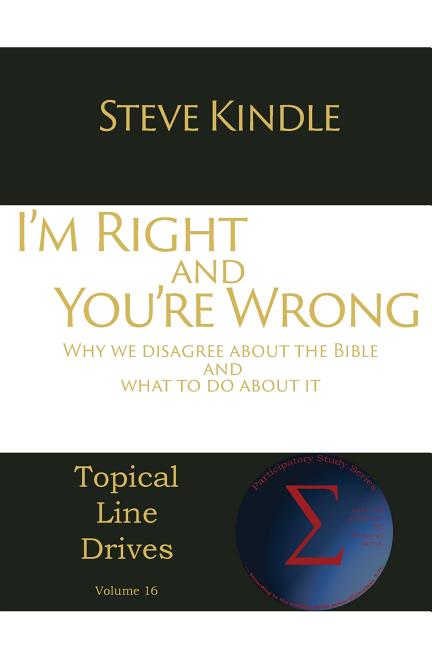
Why do well-meaning, intelligent people disagree about the Bible? What should I do when people disagree? How can I use disagreement to help me understand the Bible more clearly? If I can’t agree with someone on how to read the Bible, does it mean the end of fellowship?
How many times have you had a conversation with someone that involved a disagreement over the Bible? And how many times have these conversations led to interruptions of friendships or even extended family disputes? Some of these disputes have split congregations. Even the more mild disagreements can leave us perplexed. Why is it that something so plain to one is so obviously unconvincing to others?
This often leads us to search for ways to convince others through honing our interpretive skills, doing elaborate word studies, consulting scholarly commentaries and the like. In the end, however, people don’t easily change their minds, and we are left to wonder why. This book differs from most in that rather than looking at how to interpret the Bible properly, we’ll examine the sources of disagreement among interpreters.
We all have our own ways of trying to understand the Bible and they are close to our hearts. Many of us think our way is superior to most, if not all. But we will not venture into who is right and who is wrong in our interpretations. What concerns us here is why we interpret the way we do and what our attitude should be toward those with whom we disagree.
Zoom Bible Study
Many people are looking for a safe place to gather with others to share in the quest for a relevant faith in the 21st century. We are either Christians or seekers who find our received faith wanting and look to the Bible and each other for fresh insights. We start with two fundamental givens; the results of critical biblical research must be respected (but not always approved), and the Bible’s worldview(s) need to be reconstructed for our time (they do not naturally explain who we are or our world). We meet on Zoom. For more details go to our website: https://faithontheedge.org/zoom-bible-study/ ALL are welcome.
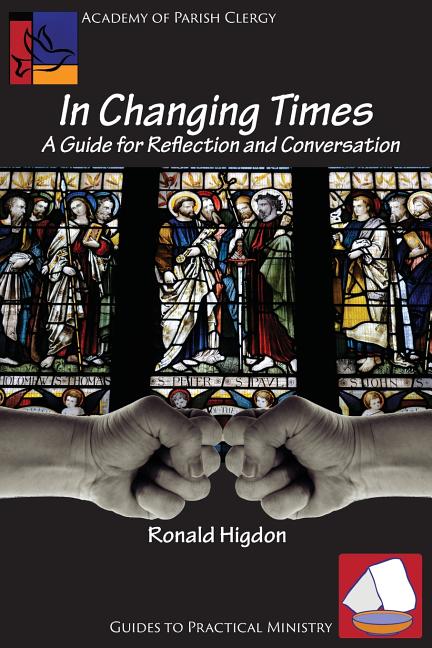
Being in ministry means dealing with change. In fact, living itself means dealing with change.
Church leadership, however organized, will have to deal with change. This book looks at the types of change that might occur in ministry and the difficulties involved and presents practical approaches to dealing with conflict and change in a postive, affirming, edifying way. Chapter titles such as “The Big Picture Provides Perspective,” “The Dangers of Listening for the Applause,” and “Major on Conversation, Candor, and Compassion” tell a story of practical experience applied to real-world situations.
Each chapter includes suggestions for activities and items for reflection. Dr Ronald Higdon, author of Surviving A Son’s Suicide, brings his five decades in ministry, including ten years of intentional interim ministry and ten years as an adjunct seminary professor, to extend his hands of encouragement and experience to other pastors. His is practical encouragement because he has lived what he teaches.
This book is suitable for individual study, small group study, and particularly colleague fellowship groups.
(This is volume 2 in the Guides to Practical Ministry series edited by a team from the Academy of Parish Clergy and published by Energion Publications.)
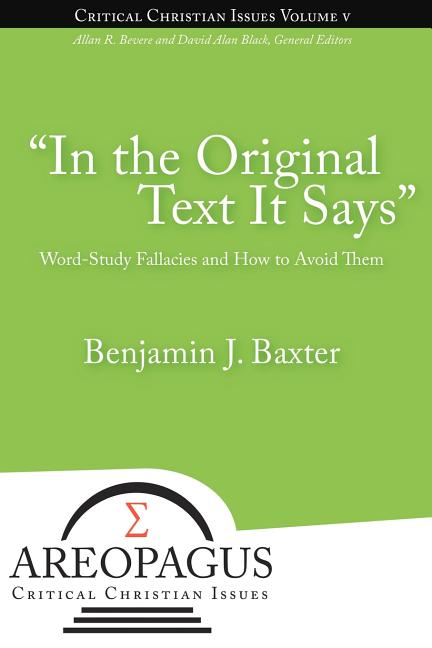
When you hear the words “in the original text it says” or “in the original text this means,” it’s time to be wary. Those words often provide the introduction to misleading information.
But how can the hearer discern just what is correct and what is misleading? How can pastors avoid giving their congregations misleading information?
“In the Original Text It Says” takes a look at word-study fallacies and how you can avoid them. Author Ben Baxter gives an introduction to word meaning and how word meaning differs between languages. He then examines a series of fallacies, errors that people make in assigning meaning to words in the original languages of the Bible.
But he doesn’t leave it with that theoretical examination. After providing the basis for how to understand Biblical words, he examines the discussion of specific words and phrases from passages in both the Old Testament and the New. He takes these examples from commentaries commonly used by pastors and teachers in sermon and lesson preparation. With each example, he shows how one might misunderstand the linguistic evidence provided, and also how one can properly apply this information.
This book is designed for readers who have had some contact with Greek or Hebrew, but will also be useful to those who have more language skill, but may not have studied linguistics or looked carefully at how to apply their knowledge in teaching.
If we look too closely at the Bible might we find things that will destroy our faith?
Should I be afraid that some new archeological discovery will prove the Bible wrong?
How much freedom do I have to interpret the Bible?
Combining history, Scripture, and an understanding of human nature, Dr. Thompson takes on the difficult questions regarding the Bible and inspiration. He goes beyond the question of whether you can trust the Bible to ask whether you can trust yourself as you study.
This unique study of inspiration uses internal evidence from the Bible text, its history, collection, and transmission to look at the way in which God works through prophets and Bible writers. As an experiential lens, he uses the experience of the Seventh-day Adventist community, of which he is a part, and its reception and use of Ellen White as God’s messenger. This provides an example of someone who produced an incredible volume of written material in her lifetime, yet maintained a great humility and understood her own spiritual experience as one of growth.
However, Inspiration: Hard Questions: Honest Answers is not just for Seventh-day Adventists. The lessons, drawn from the experience of one community, have wide applicability as we look at a range of views on biblical interpretation, experience, tradition, and contemporary claims of a prophetic word. All communities of faith would do well to ask the hard questions addressed in this book and to learn from the history and experience of others.
Ultimately, the author is addressing a question that comes to all of us: What is God’s will and how can I know it? Can I be certain? To find the answers we need, Dr. Thompson reminds us “We cannot just know Scripture, we have to know God.”
In this Second Revised Edition, you will find a new “bridge” chapter, designed to invite readers outside of the Adventist tradition to join in the conversation, as well as a number of minor updates, and a set of beautiful photographs and drawings inspired by scripture, prepared for this edition by Wanda Thompson. It is not enough to determine how the inspiration of scripture works as a theological tenet or a doctrinal point. Ultimately, for God’s Word in scripture to accomplish its mission, we must each be inspired by it as well.
If you’ve been looking for a way to go from that surfboard to the Greek classroom, this is the book for you That’s not your goal? Then how about following God’s leading wherever it takes you? Dave Black believes it’s all about mission, and living for God means just that. Your mission may be right in your own home, or it may take you on a journey into danger. Coming back alive may not be assured. But adventure is
We carry our purses everywhere. We don’t leave home without them. They are as diverse and unique as we are. A purse can truly reflect who we are. Is it smooth, black leather or bold pink flowers? Does it hang from our arm or is slung over our back or strapped around our waist? What if we were given a purse by Jesus Himself full of whatever we would need for the day and season of life? How much would it cost? Who could afford it? It’s free because it is given to us, the Bride, by our Groom, Jesus Christ. Let’s see what Jesus has given – It’s in the Bag