Since its publication, Ultimate Allegiance: The Subversive Nature of the Lord’s Prayer by Robert D. Cornwall has been used frequently for Lenten studies. Now the author presents a short study guide, six or seven weeks in length, to help you get the most out of your study.
Imprint: Energion Publications
Our main Energion Imprint
-
Surviving a Son’s Suicide
Grief may be the most difficult “work” that we as human beings must do. When a loved one, especially a child, dies through suicide, the tasks involved in that journey require a different perspective.
Ronald Higdon shares with us his experience in Surviving A Son’s Suicide. With loving but unapologetic candor, Pastor Higdon shares the questions and thoughts that often will continuously circle in our minds. He brings notes, book resources and inspired ways of helping from people who were supportive.If you are looking for something that makes it possible to avoid the three great words in life and faith – mystery, paradox, and ambiguity – then this book is not for you. If you have lost a family member through suicide or are seeking ways to be a comfort to those who have and are searching for a painless and less confusing way to do it, you will not be disappointed in what you find in these pages.
As the author notes, “The title for this book is in the present tense: Surviving a Son’s Suicide. This continues to be a work in progress. This is not a book about triumph or resolution or “now it’s okay.” It’s not okay; it never will be okay. Our pain and our questions remain but Pat and I are surviving in the sense that we are attempting to go forward with our lives without Mark’s presence. On occasion, there is some degree of tension as we seek to understand how the other is making the extremely personal grief journey.” – Ronald Higdon, father
While your grief is personal, this book includes 15 helpful things others did for Ron and his family, and their written responses to what we received along with a summary list of 31 items of what we found to be helpful survival strategies.
This book is suitable for individual reading, but will also make an excellent book for a study or support group.
-

Tales from Jevlir
Simple Risk: Marita is a teenager, or at least she thinks she is. Nobody knows, not even her noble adoptive parents. But she has been arrested near a bank with gold bars bearing the bank s stamp. Now she’ll go on trial for armed robbery, and the penalty is death.
The Call: Hedder doesn’t have any gifts other than following a plow or silencing a squalling child until the king’s knight comes along with a call.
A State of Mind: Laaraalindarinaaz, more commonly known as Lara or even just La needs a weapon to drive the pirates from her village. But can a weapon be more dangerous than the pirates?
In this collection of ten fantasy short stories, eight collected from The Jevlir Caravansary story blog, and two written especially for this collection, the author portrays parts of an alternate universe he created originally for adventure gaming, but which now forms a background for story writing. Each major character illustrates some aspect of the background world. Together they begin to form a tapestry. These stories are written for fun, not education. They offer the opportunity to play with some different rules and different consequences, and to look at the people such a world might produce.
-
Tending the Tree of Life
There is nothing quite so valuable as a book that is rooted in difficult and real personal experience, constructed with sound theological thinking, and applied in a practical manner. That combination is rare, but Richard Voelz manages it in this book.
Often those who are in ministry, in positions of leadership in the church, fail to respond to needs, or seem insensitive to them, simply because they have no idea what to say and what to do. We have celebrations and commemorations in the church for traditional holy days and for major transitions of life, and we ought to do this. But what takes the theology celebrated, taught, and lived on days like Christmas, Good Friday, or Easter and applies them to daily hardships experienced by members of the community?
If we are to be an effective community, serving as an extended family for one another, we cannot limit ourselves to talking about, celebrating, or even mourning just the expected things. We need to be able to connect with people who are mourning for any sort of loss.
In this book, you will learn how to reach out to people who are dealing with issues of reproductive loss in a way that can bring healing to individuals and to the community. It will speak strongly to pastors, but should also be helpful to church leaders, especially those in small groups. It will help build understanding and lay the groundwork for making these events of life a part of our continuing concern and our plan to bring wholeness and healing to our churches and to the world.
-
Tending the Tree of Life
There is nothing quite so valuable as a book that is rooted in difficult and real personal experience, constructed with sound theological thinking, and applied in a practical manner. That combination is rare, but Richard Voelz manages it in this book.
Often those who are in ministry, in positions of leadership in the church, fail to respond to needs, or seem insensitive to them, simply because they have no idea what to say and what to do. We have celebrations and commemorations in the church for traditional holy days and for major transitions of life, and we ought to do this. But what takes the theology celebrated, taught, and lived on days like Christmas, Good Friday, or Easter and applies them to daily hardships experienced by members of the community?
If we are to be an effective community, serving as an extended family for one another, we cannot limit ourselves to talking about, celebrating, or even mourning just the expected things. We need to be able to connect with people who are mourning for any sort of loss.
In this book, you will learn how to reach out to people who are dealing with issues of reproductive loss in a way that can bring healing to individuals and to the community. It will speak strongly to pastors, but should also be helpful to church leaders, especially those in small groups. It will help build understanding and lay the groundwork for making these events of life a part of our continuing concern and our plan to bring wholeness and healing to our churches and to the world.
-
The Authority of Scripture in a Postmodern Age
 Can the Bible speak to people in this postmodern age?
Are we doomed to a choice between rigid fundamentalism and complete rejection of this foundational source for Christianity? Bob Cornwall has found that he can take the Bible seriously in his ministry, and yet avoid such controversial labels as “inerrancy” or “infallibility.” Taking his vocabulary and direction from the work of Karl Barth, he charts a course toward a serious study and use of scripture that embraces historical-critical methology, but at the same time expects God to speak through the text in ways that will change our lives and minister to this postmodern age.
This is a quick read, but has serious depth on this important topic.
-
The Authorship of Hebrews
Who wrote the book of Hebrews? Over the last few centuries, the authorship of the book of Hebrews has been a contentious topic, but lately, a strong scholarly consensus has emerged that Paul was not the author.
There is, however, no similar consensus about who did author the book; the consensus is entirely negative. Nonetheless, it takes some courage for a scholar to risk his reputation by challenging a so thoroughly assured conclusion of many scholars. Yet this is precisely what Dr. David Alan Black has done.
In this book he adapts some of his previous scholarly work for a broader audience, demonstrating both how one goes about determining the authorship of an ancient work, and also how one challenges a scholarly consensus. And that is also why we have chosen this volume as the inaugural volume of our Topical Line Drives Series. Millions of churchgoers look to the introductions to various books in their study Bibles to answer questions of date, authorship, and background. But only those who read more than one introduction will be fully aware of the disagreements among scholars about those conclusions. How is it that scholars make a determination about authorship?
This book is for those who want to dig deeper than the notes in a study Bible and who want to understand what stands behind those conclusions. Dr. Black has paid his dues in the practice of scholarship, and here he demonstrates how one challenges such a consensus. At the same time, he will guide the reader through the various factors that influence a decision about the authorship of a book. We hope this book will give new life to your Bible study and will challenge you to study further, not just about this subject, but about many others.
Supplementary Material
Some aids for those leading small groups or teaching from this book can be found here.
-
The Caregiver’s Beatitudes
Cancer. Stroke. Alzheimer’s. These are just three in the list of too many diagnoses that cause the lives of the patient and their caregivers to tilt in the unexpected storm. This put me in a role in which I don’t think I really have ever excelled at. I’m the big strong daddy, the strong and determined husband. I’m the intellectual, the rational, the factual person. I’m the one who thrives on logic and reasonable, predictable progression. Emotions need to be subject to the mind. Me? Give compassionate, loving, gentle care to someone dealing with a serious illness? Don’t make me laugh. And yet, that is where I found myself. My choice was reduced, then, not to whether I’d be a caregiver, but more what kind of caregiver I’d be. – Robert Martin The Beatitudes from Christ’s Sermon on the Mount are more than beautiful, even puzzling words. They can be your anchor when the waves roll and the winds howl.
-
The Character of Our Discontent
The Character of Our Discontent grew out of the author’s conviction that pastors do not preach enough about the Old Testament. The result is 19 chapters, each of which represents a sermon on an Old Testament character.
These sermons are lively, fast paced, and practical yet are rooted in sound scholarship and are examples of the homiletical art. Christians who would like to learn how the Old Testament can enlighten and guide their Christian walk, and pastors who would like to learn how to preach more effectively from the Old Testament will both find these sermons an invaluable aid.
While Dr. Bevere specializes in the New Testament and theology, he believes that pastors (and academics as well) can preach and teach effectively outside their areas of specialty. Indeed, they must, and this teaching can enrich their own learning and the fields of study into which they venture.
The Character of Our Discontent is an adventure in preaching and it invites us into the adventure of living in relationship with God, an adventure that has similar characteristics whether we are learning about God’s call to Abraham or how a call to mission in Africa came to a contemporary English teacher nearing retirement.
-

The Devil Is in the Details
“There are many countries today where Christians endure persecution on a massive scale. Are we as children of God called to stand and be proactive? Are we not to be involved until we are backed into a corner? Then, are we to be always reactive, never on the offensive but always on the defensive? Are we to look the other way and allow the adversary to make a foothold in the world? How do you understand the Christian life and why? These are questions that need to be considered when truly evaluating your spiritual health. Do you look forward to your time with the Lord or does it become a drudgery or obligation?”
— J. Hamilton Weston
Rev. Weston challenges himself and us to acknowledge the “detail” inertia (and others) which has left us in the Church gliding through this life instead of reporting for duty as a member of God’s Army. Let us get up and be the servants He has called us to be and fulfill our mission in God’s Kingdom!
-
The Energy of Love
Today, we need to marshal all the healing resources at our disposal.
A growing body of evidence shows that spiritual healing practices have a positive impact, both on healing and on the quality of life that people experience while under medical care. Dr. Bruce Epperly calls on Christians to embrace these varied resources. He crosses both the boundaries between formal scientific medical practice and spiritual healing, and the boundaries between healing practices that come from a variety of spiritual and religious traditions. He then incorporates these into a distinctly Christian theology of healing practice. Where healing takes place, he sees God at work.
Healing characterized the ministry of Jesus, and Epperly believes that it should characterize the life and ministry of Christians in all times and places. This is a balanced call that doesn’t pit one tradition against another and also does not place spiritual healing practices in opposition to medical science. This is about embracing what heals.
Today, we need to marshal all the healing resources at our disposal.
-
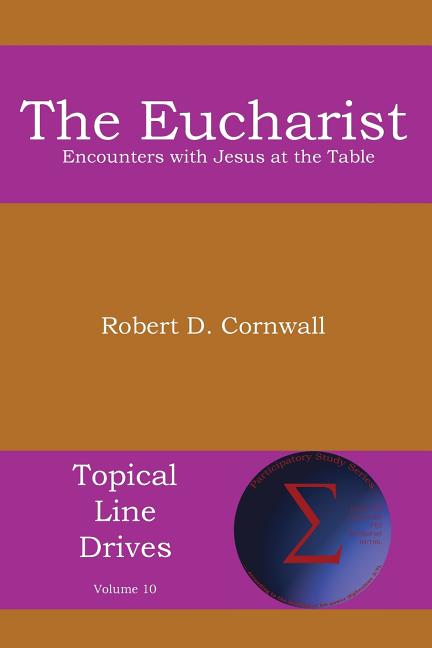
The Eucharist
Holy Communion, the Lord’s Supper, or the Eucharist are some of the names used to signify what is arguably the center of our worship as Christians. “Although the Eucharist may stand at the center of Christian worship, there are a great variety of theologies and practices present within the Christian community. For some it is a mere memorial of Jesus’ last supper with his disciples. For others it is the place where one not only encounters Jesus’ spiritual presence, but consumes his true body and true blood under the signs of bread and wine. Although rooted in the practices of the early Christians, time has witnessed considerable evolution, and with evolution comes diversity of practice and belief,” says author, Dr. Robert Cornwall. This newest addition to the Topical Line Drives series offers a rich but brief stimulus for us to converse about our differences in theology and practice. It is Dr. Cornwall’s hope that such conversations will increase our joy in the experience of this sacrament given to us by Jesus Christ.